Advantour Scheduled Uzbekistan Tours
ENG  РУС  FRA 

Hotels Ski resorts Tours Flights Visa Airport Service MICE Rent a car
Home > Silk Road > Central Asia > Kyrgyzstan About Us - Our People - Worldwide Partners - Contacts

Customs and Traditions of Kyrgyzstan


Kyrgyzstan: Customs and Traditions of Kyrgyz people

Life amongst the nomadic Kyrgyz was extremely harsh and there was a high infant mortality rate.  As a result birth and childhood were associated with many beliefs, superstitions and rituals - many with "shamanistic" overtones.  Many of these have survived to the present day.

Usually, the Kyrgyz families had many children, as the head of family was responsible to continue his lineage - and hence boys were highly regarded as they would enable this to happen.  A man, who did not have a son, was a very unhappy person as his family line had to stop with him.  The Manas epos opens with the childless Djakyp's expressing grief because he has no son to carry on his name and care for him in his old age. 

If the wife of a nomad could not have children, (or she was just gave birth to girls), then he could marry a second wife, or even a third - although this is not practiced today.

There is a phrase amongst the Kyrgyz that when a daughter is born … the family is not raising a child of their own, they are raising a child for someone else. If she is later “stolen” as a bride, the groom’s family may well call her parents with the news, “You no longer have a daughter – she is our daughter now”.  Her allegiances now switch from being to her natural family, to her husband and his.  Another interesting saying is: "The birth of a girl is an addition to the herd, the birth of a boy is an addition to the defenders".

Life was not necessarily easy for children.  They are expected to undertake tasks from an early age.  The girls would learn mainly domestic tasks, helping the older women, whilst the boys might be assigned to look after some of the livestock.  Idle, or lazy, children would be castigated and criticized ... for example, it might be said that: "hopeless Aybek's son is still a baby after ten years".

In this section we consider several aspects related to "growing up" in traditional Kyrgyz society ... from the cradle to the grave, names given to children, family life and festivals (rites of passage), respect for elders ... and so forth.

Wedding – Uilonuu Toi

As everywhere in the world, weddings tend to be big and joyous affairs. 

Much of the ceremony and traditions of the wedding has developed over the years and been succumbed to various Soviet and Western influences, and there may also be regional differences.

For example, in the south where Uzbek influences are great, a young girl makes handkerchiefs (or serviettes) by cutting out squares of brightly colored material and the trimming it with macrame edging.  These handkerchiefs are then given out to guests who come to see the bride after the wedding. Quite often the bride will be given a number of dresses and each day she will wear a different one until she has worn them all.

Once the future groom informs his relatives of his intention to marry – assuming he doesn’t intend “stealing” her - the family visit the bride’s home and discuss the arrangements with her.

Once an agreement has been reached, the groom places some golden earrings on his chosen bride and the couple are engaged. The custom of giving earrings is called “soiko saluu”.

Traditionally, there is a definite hierarchy of weddings. The eldest son has to take a bride before his younger brothers can. The youngest son has to wait for all of his elder brothers to get married before he can attend his own wedding. Although this tradition is sometimes short-circuited it is more usual for it to be honored than to be breached.

Kalim (“bride price”) – is a dowry to the girl’s family – usually in the form of livestock, (sheep, horses, cattle … and, of course, money), but other articles are also given. Some families even make their own blankets, tush kiyiz, clothes and so forth.  According to one source – the price of a bride can be as much as five horses – but a lot may depend upon the status of the relative families. He also has to pay for the wedding ceremony. (In sedentary societies - Uzbek and Uighur – it is usually the bride’s family that pay the dowry to the husband).

The groom gives his wife a dress, and she gives him a suit. These days, western style clothes may be preferred.

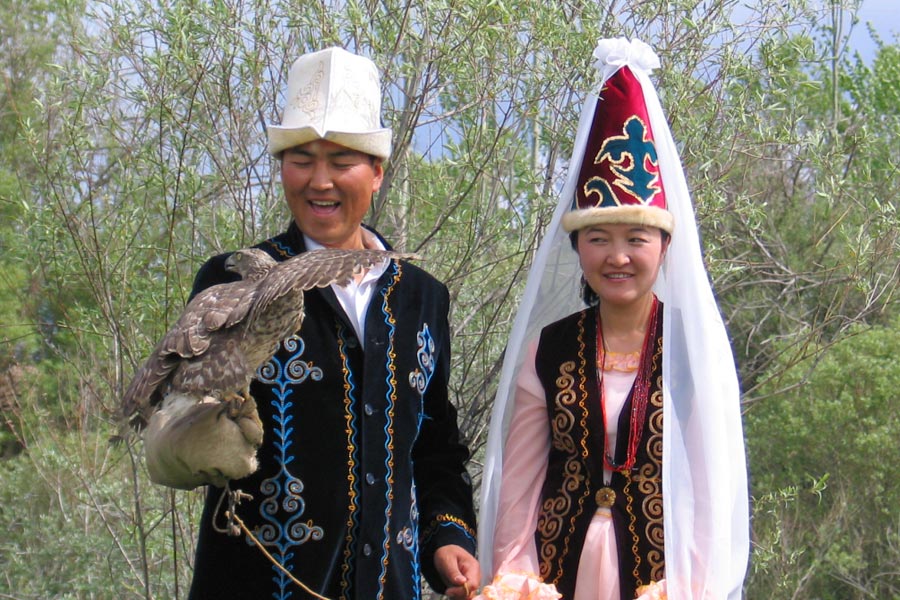
Traditionally, however, the bride’s dress was long, white with fancy embroidery in fine threads, and embellished with beads and sequins. On her head she wears a tall conical hat with a veil to cover her face.  She will also wear jewelry made from gold, jewels, pearls and coral, which may well be a family heirloom – handed down through the family for generations.   

The groom would wear clothes made from dark velvet. A long coat, fasted with a leather belt, often decorated with silver, gold and jewels. The edges of the jacket may be embroidered with traditional patters.

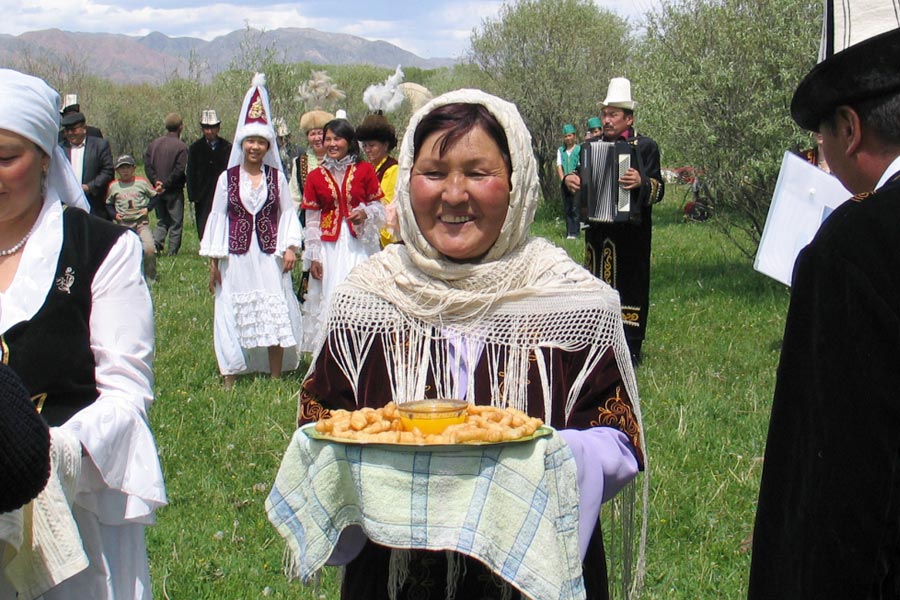
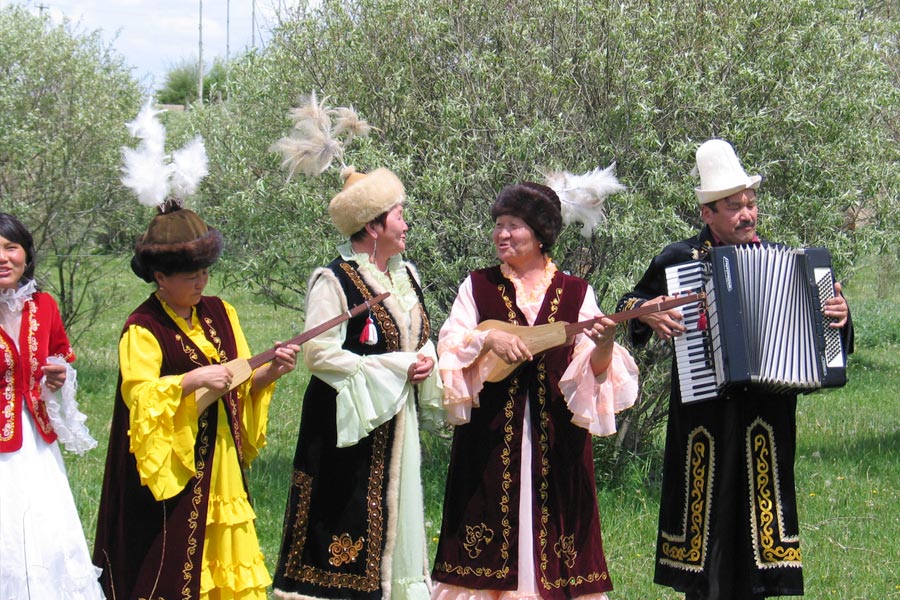
You may see costumes like these in a number of places – and many ensembles performing Kyrgyz traditional music dress in them.  At the Weddings Palace, attendants in national dress may line the approach in welcome for the couple and their guests.

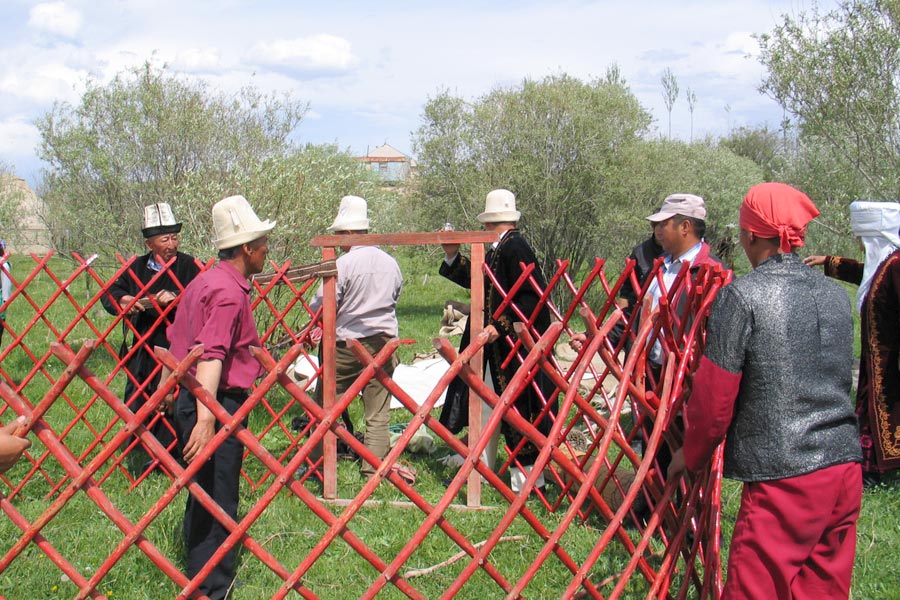
The bride’s mother, sisters in law and friends erect a white yurt – and the groom’s party come to collect her and take her away. There is a custom, called Arkan tosuu”, where a rope (“arkan”) is placed across the road and a ransom is demanded for the bride, accompanied by songs and jokes.  At this point the bride’s mother and female friends sing a “koshik”, or wail, to say “goodbye”.

The new bride spends three days in the home of her new in-laws, behind a curtain and visitors come to visit,  to see the bride. A small fee has to be paid – and compliments are showered on her. 

During the Soviet period weddings lost much of their religious significance, and although religion is now enjoying a revival, many still opt for a civil ceremony at the local registry office (ZAKS). In the larger towns there is a special “Weddings Palace” – in Bishkek it is a large, white marble building on Sovietskaya near the Circus, almost opposite the National Library. Many couples now also go to church or mosque for a blessing of the union – but this may be on a different day. Some couples invite a mullah to the wedding to issue a blessing.

Rings are placed on the ring finger – usually by both husband and wife.    

After the ceremony there is usually a promenade – a visit to a number of scenic spots (e.g. the war memorial, a park …) for photos, before attending the reception.

During the reception ceremony it is important for everyone to stand and utter their wishes for the couple – starting with the respected elders (the Aksakals) and working through all the participants.

After the ceremonies are complete the groom’s family place a scarf over the bride’s head as a symbol of blessing. (Married women tend to wear a scarf over their heads - and they also tend to wear less, and different types of jewellery.)

The couple normally live with the groom’s family until moving into a home of their own. (If the groom is the youngest son, then they will stay with his parents because, traditionally, it is his “duty” to look after his parents and he will eventually inherit their home). 

Tradition has it that the bride cannot return home to visit her parents until after there has been a ceremonial visit – otko kiruu - when she is accompanied by her new family who will offer a large present – soot akysy – to her mother as if to compensate for all the troubles and expenses she has endured in bringing up their “new daughter”.

In some ways, the role of the daughter in law is basically one of subservience and servitude – she waits on her own husband and his parents. Once she has given birth to her firstborn child, or a younger daughter-in-law is accepted into the family, then her status in the family is raised.
In his novella, “Djamila” – one of his earliest published works – Chinghiz Aitmatov explores some of the tensions of traditional family life as experienced by the heroine, Djamila, whose husband is away fighting at the front during the Second World War.

In the West, marriages tend to occur late in life – in Denmark for example, the average age for women to get married is about 30; in France it is 27. In the days of the Soviet Union, most of the brides and grooms in Kyrgyzstan were under 20. There may have been several reasons for this. It is suggested, for example, that one was that marriage brought a certain status. Apparently there now is a current trend in Kyrgyzstan for young people to put off being married until later in life.

There are also regional differences within Kyrgyzstan concerning the age at which people get married.  It is common for girls to marry younger than men.  The 1999 census data shows that whilst on 34% of women in the 20-24 age range had never been married, for men the equivalent figure was 72%.  However, it appears that there are distinct geographical atterns discernable. In some areas (such as the Ferghana valley in the South and in the lowlands) both parties marry young.  In other areas, (such as Bishkek and the Chui valley) both sexes delay marriage.  In yet others, (such as the northern, remote, mountain areas) there is a tendency for older men (say at 30) to marry younger girls (say 20). 

The birth of a child

The birth of a child was expected with great trepidation, and required the fulfillment of various traditional ceremonies and rituals - many of which carry "shamanistic" overtones - although Islam has also had an influence, (For example: When a child was born, one of the men shouted: "Azan!" (which is a call to prayer) and would read a Sura from the Koran).

A long stake would be placed in the middle of the family yurt at the start of the delivery symbolizing the "cosmic tree" which, it was believed, helped the mother in her labor.   She would kneel and hold the stake during the delivery.  The father could, if he wanted, assist with the birth.  (If he did so, then he would embrace her from behind and push on the top of her belly.) 

A midwife (Kindik-ene, "mother-navel") would also assist in the delivery: she would place the child in a better pre-natal position and cut the child's umbilical chord immediately after the birth.  As a new born child was considered "impure", only the midwife could touch it, as she was believed as an earthly reincarnation of Umai-ene (the earth goddess - Mother Umai) - the protectress of women in childbirth and of babies, (until they were three years old).   She stayed with the family for several 2-3 days to protect her from the demon albarty.  During the Toi organized to celebrate the birth, the midwife would receive gifts including a sheepskin and the most valuable part of the meat - brisket.

As an additional precaution, sometimes an eagle-owl was brought to the yurt made to cry, because there was a belief that albarty would be scared off by the noise.

One of the women helping in the childbirth, would walk around the yurt and tapping a stick on the ground, saying: "Tuishtuiby, Tuishtuiby?’, ("Was a child born? Was a child born?"), as a magic spell to cast out evil spirits.

The Dje-entek Toi – is a celebretaion of the birth of the newborn child, where people are given melted butter (“sary mal”) which has been kept especially for the occasion in the stomach of a slaughtered lamb (or calf). Guests usually bring clothes for the baby – or maybe a shyrdak. 

Premature babies were placed in a tumak, (a special "hammock" made from a fox fur), which would be hung from the top of the kerege - the wooden frame of the yurt.  This was hung to the right of the entrance and they kept moving it one cell further to the left, according to the date (nine months, nine days, nine hours and nine minutes) so that it would be next to the entrance at the end of the normal gestation period.  The child was considered to be “really born” at this point, and only then was he was taken out of the tumak, and the happy parents organized the dje-entek toi.

Because of the high infant mortality rate, special customs developed to help preserve the newborn infant.  For example, in families where children did not usually survive, they might give a newborn child to another on the understanding that the biological parents would “buy” the child back shortly afterwards - 3, 7 or 40 days later ... and sometimes even one year later.  To all intents and purposes, for this period the child was regarded as belonging to the foster family.  They informed everybody that they had a new baby and would organize the dje-entek toi.  The biological mother, upon meeting the foster-mother would ask: “How is your child?”  When the time for “buying back” the child arrived, the biological parents would pay the foster parents a "redemption" fee, comprising of nine objects - usually inexpensive things like potholders, (tutkuch), dishes (tavak), a sickle (orok), a knife (bychak) and so forth. 
 
If boys did not survive in a family, then the parents used to dress their son in girl’s clothing and braid his hair until he was 10 or 12 years old, and then his hair would be ceremonially cut, at some "sacred" place.

A talisman, or a charm, was also believed to protect a child from evil spirits.  Talismans could be in the form of a tip of a yak’s tail, or one from a newly born colt, which was stitched into the child's clothing.  Later on, when Kyrgyz tribes converted to Islam, they started using a scroll with a Sura taken from the Koran, which was given in an amulet in the shape of a triangle – called a tumar. Sometimes the parents would put a bracelet on their child’s leg, or an earring in one ear, assuming that evil spirits fear metallic things.

Bracelets made of black beads were put on a child’s wrist or a black bead in an earring was also assumed to act as a protecting amulet. Even today these amulets can be seen on children and in some places they are offered for sale to members of the public.

A celebration - Kyrkan Chygatuu – was organized held on the fourth day after the birth.

Beshik Toi

Another birthday party is called a Beshik Toi.  A Beshik is a traditional wooden cradle found throughout Central Asia, the Caucasas and India – with an arc at each end and a rod joining them which is used to rock the baby to sleep. Traditionally, it is made from archa, (juniper).  The Beshik Toi is organized for the occasion when the child is placed in the cradle for the first time – usually in the first seven days after the birth.  An old woman places the child into the cradle, as a (hopeful) sign that the child would live as long as this old woman. (Interestingly - the shroud in which the dead are laid in the grave is also called a Beshik ... it is the first and last bed). 

The “appearance” - Koroonduk - (the word comes from the Kyrgyz word “to see”) is another family festival associated with the birth of a child.  A newborn infant was kept in seclusion for forty days - it was believed that a child stepped from the animal kingdom into the human world only after forty days.  The baby is "anointed" with forty drops of salted water by specially chosen people and presented with a piece of patchwork – Kudak – which is made from forty pieces of material stitched together.  (Forty - One for each day they have lived.)  The baby's hair would be shorn by an aksakal, who would receive a chapan for his services, and then buried in a sacred spot so that it could not be used in magical rites to harm the child.

When neighbors, friends and relatives see the new born baby for the first time then they traditionally give a monetary gift to the parents.

Daily Life

The traditional Kyrgyz nomadic family was a patriarchal structure and at least three generations would live together in a small community, or ail (the equivalent to a village).

The family was organized on a strict hierarchical system.  The Head of the household was considered to be the owner of all the family property - for the nomadic Kyrgyz, that was primarily the livestock - and authority was absolute.     The eldest wife of the aksakal - the baybiche would direct the work.  She was the supreme authority in all matters relating to household management and domestic tasks - objections against her instructions were not allowed and she was subordinate only to her husband.

Perhaps the most obvious example of the hierarchy at work was at mealtimes.  The members of the family sat in a strictly established order. 

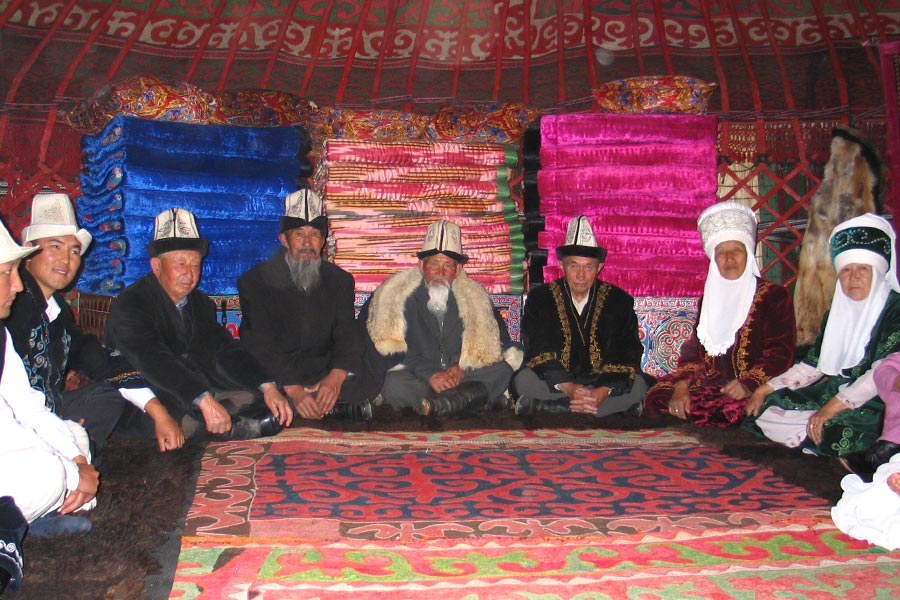
The head of the household would sit in the most honored place, opposite the entrance to the yurt - unless there were guests, in which case he would surrender it to them.

His sons, sat to his right, in accordance with their ages.  The Baybiche would sit on his left, and his daughters sat next to her, and then came daughters in law in order of precedence of their husbands. The youngest wife of aksakal sat next to the pot and guided the food distribution and the wife of the youngest son had to serve the contents of the cooking pot onto a wooden dish (chara). This dish was given to the youngest wife of aksakal, so that she could cut the meat into smaller pieces and then put it into small dishes (tabak): one was for aksakal, baybiche, the eldest son and daughters of the head of the family and another dish was given to the rest of the sons and their wives.

The nomadic Kyrgyz lived in small, isolated communities, producing almost everything they needed for their everyday life in their own households, and Members of a the family joined together to complete domestic tasks and the number of people involved in any activity would sometimes include as many as 50 people. 

Tribes and clans played an important role.  They provided a system of support and protection for the Kyrgyz.   For example, the richer relatives were expected to provide their poorer relatives with livestock so that they could pay kalym for a wedding; to adopt children from his clan who had orphaned; to lend poorer relatives livestock in times of famine.

Much of daily life revolved around the care of livestock.  During the daytime the men (shepherds and horsemen) would tend the flocks and herds - but at night time the task of looking after the livestock fell to the women and young girls. 

The family group would move from jailoo to jailoo seeking fresh, lush, grassland for pasture.  When it was time to move the whole community would dress in fine clothing and dismantle the yurts, packing the load onto the backs of their pack animals (camels and horses), covered with carpets, and the whole group would then proceed en-mass to their new camp.  Before they left a particular site, however, certain rituals would be performed (such as pouring airan, khoumis or melted butter into the holes left by the tent pegs) as an offering to the local spirits of the place in preparation for their return the following year.

The birth of a calf, foal or lamb would be a moment of great importance for the family group - and welcomed with almost as much ceremony as the birth of a child. 

Not all of the Kyrgyz were nomads.  Some, especially in the Issyk Kul region and the Ferghana valley, were also involved in settled agriculture.

Hunting

One activity which was highly prized was hunting.  The practice of hunting with eagles is well documented - but the Kyrgyz would also go hunting in other form, and hunting form a part of many Kyrgyz legends and folk tales.  One in particular, Joldosh, tells of a hunter whose skill was such that he was able to feed his whole clan.  They might use special devices made from horses hooves and iron grips attached to their shoes to help walk over the tricky rocky terrain - and special snow shows made from twigs to cross snowfields.  The Kyrgyz bred a special breed of hunting dog - the taigan.

In the past, hunting expeditions were a communal affair, and the carcass of any prey would be divided strictly according to tradition.  The hunter responsible for the fill would be allocated the head, neck, brisket, ribs and pelt - with the rest being divided equally amongst the rest of the hunting party.  On their return to the ail, the hunters would give meat to anyone they met en-route who issued a traditional request: "shyralga".  This was partly a sign of respect and help for a fellow traveler, and partly a religious duty - to share with other god's bountiful gift.  As a result, a hunting party could return home empty handed, even after a successful hunt - and so hunters might try to avoid any chance encounter on their way home.  (They could also avoid giving away the meat by replying "bolsun" - that is promising to that "next time ...").

silk road : central asia : uzbekistan : kyrgyzstan : kazakhstan : tajikistan : turkmenistan
russia : azerbaijan : georgia: armenia
Copyright © 2001-2013 Advantour. All rights reserved, Privacy Policy
Advantour Kyrgyzstan
Tel.: +996 312 900 592

All Contacts