


Georgian food offers a friendly introduction to Georgia. It reflects a country shaped by mountain pastures, fertile valleys, the Black Sea, ancient winemaking and a strong culture of hospitality.
This traditional Georgian food guide explores the dishes, drinks and dining customs that define the country’s culinary scene. Travellers will know what to order, what to expect, and how food connects to Georgia’s regions, history and everyday life.
What Makes Georgian Food So Special?

Traditional Georgian food stands out for its balance of richness, freshness and variety. Baked and dairy products, along with ingredients such as walnuts, herbs, garlic, sour plum, and pomegranate, feature prominently in Georgian cooking. Grilled meat and wine are also central to the country’s food culture, and they are endlessly reinvented.
Georgia lies in the South Caucasus. It is bordered by Turkey to the southwest, Russia to the north, Azerbaijan to the east, and Armenia to the south. Its proximity to the Black Sea coast and position on historic trade routes, including the Silk Road, brought culinary influences from Europe, the Middle East and Central Asia.
Each Georgian region has its own techniques and preferred ingredients, shaped by local produce, climate and cooking traditions: from the cheese-rich cooking of western Georgia to the wine and meat traditions of Kakheti. Regional specialities also include distinctive foods from Svaneti, Samegrelo, Guria, Imereti and Kartli, reflecting local produce and cooking methods.
Supra – Georgia’s Traditional Feast and Toasting Ritual

The "supra” is a cornerstone of Georgian food culture. It’s a communal feast centred on shared dishes, generous wine and a sequence of formal toasts led by the tamada, the appointed toastmaster. The food is served in waves, and the table remains full from start to finish. Toasts honour family, guests, ancestors, friendship, peace and the nation itself.
For visitors, taking part in a “supra” is the quintessential way to experience Georgian hospitality. Approach it with patience and respect, keeping in mind that the ritual is just as important as the food.
Classic Georgian Dishes

Khachapuri and khinkali may be the first foods travellers associate with Georgia, but they are only the beginning. Georgian cooking ranges from crisp, cheese-filled breads and juicy dumplings to grilled meat, fragrant stews and hearty soups. From everyday favourites to dishes prepared for particular occasions, traditional Georgian dishes offer a wide selection.
The variety comes through in dishes found on many restaurant menus. Mtsvadi is skewered meat grilled over coals, while ojakhuri is a comforting mix of roasted meat, potatoes and onions. Shkmeruli pairs roasted chicken with a garlic sauce. Among the stews, chakapuli is bright with tarragon and sour plum, while chakhokhbili is a chicken dish. Both develop their flavours through slow cooking. The soups are just as varied: chikhirtma is a light chicken soup enriched with egg, while kharcho is a heartier, tangy soup, often made with meat, rice and walnuts..
With so much to choose from, first-time visitors have a great opportunity to sample both well-known favourites and dishes that are less familiar outside Georgia. Our guide to what to eat in Georgia on a first trip will help you decide what to try.
Georgian Bread, Cheese, Sauces and Spices

Georgian cuisine is built not only around finished dishes but also around essential table elements: bread, cheese, sauces, herbs and spices. These appear with almost every meal and define the rhythm of Georgian dining as much as the main courses.
Georgian Bread

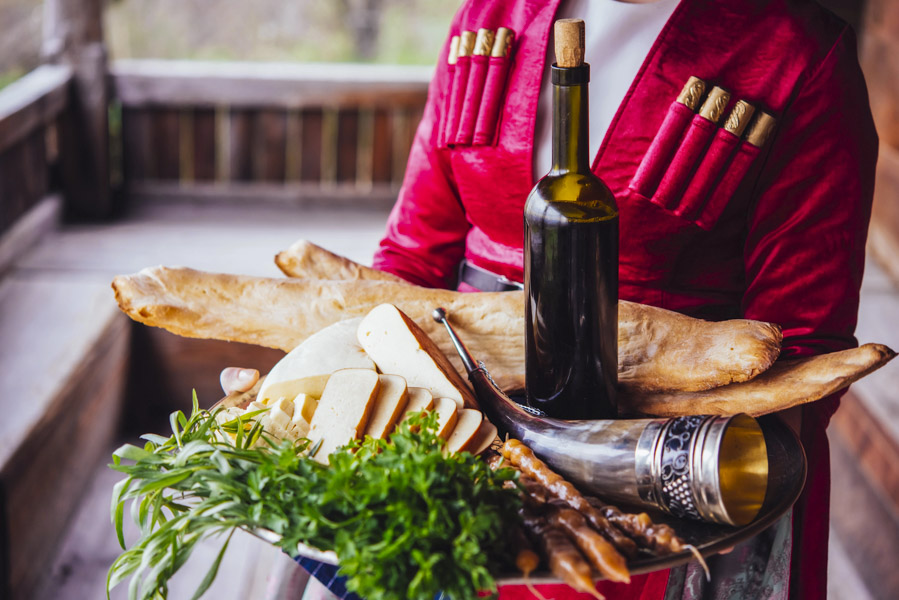
Bread holds a central place on the Georgian table. The everyday loaf is often baked in a tone, a traditional clay oven similar in principle to a tandoor. Long, canoe-shaped shoti bread is slapped against the hot inner wall of the oven and served warm, with a crisp crust and soft crumb.
In Tbilisi and other towns, small bakeries sell tonis puri throughout the day. It is commonly paired with cheese, mtsvadi, stews and sauces.
Georgian Cheese

Georgian cheese varies widely by region, texture and use. Imeretian cheese is mild and commonly used in khachapuri. Sulguni is elastic, layered and slightly salty; it can be served fresh, smoked or melted into dishes. Guda cheese was historically matured in a sheepskin sack and had a stronger flavour. Today, it is also produced using modern methods. Other distinctive varieties include tenili, a string cheese from Samtskhe-Javakheti, and dambalkhacho, a matured cheese linked with mountain households.
Cheese is eaten at breakfast, paired with bread, in baked dishes and served at traditional feasts. Sampling regional cheeses offers a glimpse of Georgian cuisine’s simple, satisfying combinations of bread, dairy and herbs.
Georgian Sauces and Spices

Sauces are essential to the Georgian table. Tkemali, a tangy Georgian plum sauce, and satsebeli, a savoury tomato-based sauce, are served with meat, potatoes and fried foods. Bazhe, a walnut sauce, usually accompanies poultry or fish. Adjika, a chilli, garlic and spice paste, comes from the Western Georgian, Abkhaz and Megrelian food traditions and can go well with something as simple as bread.
Spice blends matter too: Khmeli suneli, which may include coriander, fenugreek, marigold and other dried herbs, gives many Georgian traditional dishes their recognisable aroma. Svan salt, a seasoning blend from Svaneti, combines salt with garlic, coriander, fenugreek, chilli and other spices and is used to add depth to meat, potatoes, vegetables and stews. Coriander, tarragon, parsley, dill and purple basil are used generously, keeping food in Georgia fragrant and fresh.
Georgian Food for Vegetarians, Vegans, and Pescetarians

Georgian cuisine can be very rewarding for vegetarians because many traditional dishes feature plant-based ingredients. Lobio, pkhali, badrijani nigvzit, ajapsandali, mchadi, mushroom khinkali, and salads are widely available on menus. Many restaurants can adapt dishes to accommodate dietary requirements on request.request.
Vegans should ask more carefully. Cheese, butter, honey, eggs and other dairy products appear frequently, particularly in breads and sauces and restaurant versions of otherwise plant-based dishes. Recipes differ between households and restaurants. In Tbilisi and larger cities, menus are increasingly easier to navigate, while in rural areas, it helps to explain dietary needs clearly.
Pescetarian travellers can also find local fish dishes, notably trout in mountain and freshwater regions and Black Sea fish in western Georgia.
Georgian Drinks
Georgian Wine, Chacha and Beer
Wine is inseparable from Georgian food culture. One of its most distinctive methods is Qvevri winemaking. A Qvevri is a large clay vessel used for fermenting, ageing and storing wine, traditionally buried underground. In 2013, UNESCO inscribed the ancient Georgian qvevri winemaking method on the Representative List of the Intangible Cultural Heritage of Humanity.
For travellers, Georgian wine can be explored in several ways. Kakheti is the country’s main wine-producing region, ideal for family cellar visits and private wine tastings, while Tbilisi has many wine bars offering both conventional and qvevri wines. Amber wine, made from white grapes with extended skin contact, is notably linked with customary Georgian methods. Saperavi, a deep red grape, and Rkatsiteli, a widely planted white grape, are among the highly important varieties.
Chacha is Georgia’s strong grape pomace spirit, distilled from the skins, seeds and stems left after winemaking. Commercial bottles are usually a controlled strength, while homemade chacha can vary considerably. It is served in shot glasses and should be approached with caution, especially at family meals or supras, where refills may be offered generously.
Beer is also common in casual restaurants and mountain areas, but it does not carry the same cultural importance as wine or chacha. Notable brands include Natakhtari (lagers and flavoured beers), Kazbegi, Argo and Zedazeni. The craft beer scene is thriving too, with breweries in Tbilisi and regions such as Kvareli and Batumi producing pale ales, IPAs, and seasonal brews. Many bars and restaurants serve local draught beer alongside imports.
Non-Alcoholic Georgian Beverages

Georgia offers a range of non-alcoholic drinks, from traditional fruit beverages to locally made mineral waters. Georgian lemonade is quite popular, with flavours such as tarragon, pear, lemon and grape. Tarragon lemonade, bright green and herbal, may be surprising to first-time guests but is a familiar part of the local soft-drink culture.
Mineral waters are valued for their high mineral contents. Restaurants serve Borjomi, Nabeghlavi and other Georgian mineral waters, which are also sold in shops. People sometimes drink them to aid digestion after large meals. For a more authentic experience, you can even visit the source towns to gain deeper insight into their reputed curative properties. Compot (or kompot), made by simmering fruit with water and sugar, is commonly served in guesthouses and restaurants.
Tea has a history of more than 170 years in western Georgia, though it is less internationally recognised than Georgian wine. Tea lovers will appreciate its purity, as it is grown without pesticides.
Coffee is widely available in cities and cafes, but in family-style settings and rural restaurants, meals often finish with fruit, sweets or mineral water rather than with a formal post-meal coffee service.
Regional Georgian Cuisine: A Short Overview

Regional cuisine is a major reason to travel beyond the capital city. Imereti is known for lighter dishes, pkhali, delicate Imeretian cheese and its soft, folded Imeruli khachapuri. Samegrelo is famous for bold, spicy flavours, sulguni, elarji and Megrelian khachapuri. In the highlands, Svaneti offers hearty mountain food, including kubdari, a spiced meat-filled bread, and tashmijabi, a potato and cheese dish.
Along the Black Sea, Adjara blends coastal and mountain influences; expect Adjarian khachapuri, borano and flavourful dairy dishes.
Kakheti is Georgia’s wine heartland. During the harvest season, the tables brim with mtsvadi, khashlama (boiled meat), and Tushetian Guda cheese. Racha-Lechkhumi brings mountain comfort with lobiani, Rachuli ham, and shkmeruli. Central Kvemo Kartli’s table reflects fertile agricultural plains with soups, such as Puris Kharcho and Shechamandi, fruit, bread and vegetable dishes shaped by local farms.
The coastal and lowland cuisines of Guria favour fish, cornbread, poultry-based dishes and festive pastries, notably Guruli gvezeli, while Samtskhe-Javakheti reveals dishes prepared with goose, such as batis shechamandi soup and meskhuri khinkali. Snails are common here, as well as chiri (dried fruits). Mtskheta-Mtianeti produces rustic alpine stews, Guda goat-sheep cheese, dried salted meat, Qaghi, beer, and Zhipitauri, a local vodka.
These distinctions are not rigid, and many dishes travel across regions, but they help visitors understand Georgian cuisine more deeply than simply ordering the same familiar dishes everywhere.
Where to Experience Georgian Food

The best food experiences are often informal meals where the season, region and table come together naturally. In these settings, travellers can see how Georgian food culture works in daily life.
Tbilisi Restaurants, Food Walks and Curated Dinners
Tbilisi’s traditional restaurants, khinkali houses, bakeries, wine bars and modern Georgian kitchens make the capital a practical introduction for travellers with limited time. A guided food walk or curated dinner can explain how dishes are ordered, shared and paired, giving travellers more context than a standard restaurant meal.
For well-known restaurants, reservations are useful for the evening or for groups. At a supra or family-style meal, guests can follow the toasts at a comfortable pace.
Regional Meals and Food Festivals

Outside the capital, vineyard meals, family cellars, countryside lunches, cooking classes and regional festivals give food a more local setting.
Food festivals, such as Gemo Fest, add another way to explore local cuisine by bringing cooks, producers and regional dishes into one setting. Because the festival moves between different parts of Georgia, it can introduce travellers to specialities that are beyond the standard restaurant selection.
Markets and Seasonal Food
Markets are a useful place to understand how Georgian cooking changes through the year, but seasonality is not only about produce. It also shapes the mood of the meal. Spring food feels greener and sharper; summer meals become lighter and brighter; autumn brings the grape harvest and walnut-based sweets, while winter tables turn toward preserved ingredients, sauces and festive dishes.
Family and religious traditions add another layer to this rhythm. Orthodox fasting periods have helped preserve a strong range of plant-based dishes, while New Year and Christmas menus often include satsivi, poultry served with walnut sauce, gozinaki, a honey-and-walnut sweet, and other seasonal dishes. For travellers, this variety means Georgian cuisine can offer very different experiences, depending on the season and where they eat.