

Tashkent in the 19th century
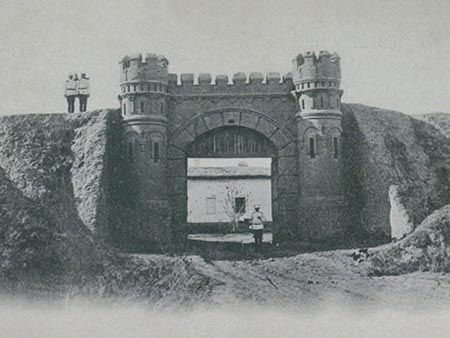 The premise of Officer’s garrison of the fortress was built by military engineer colonel Shleyfer Georgiy Ivanovich in the 80s of 19th century on the fortress esplanade. He also built gate on the esplanade, which were heavy by proportion, but monumental and expressive in military way. This new town was settled only by military men. The military engineer of the Chernyaev detachment Kolesnikov (topographer) made up the plan of the city for civilian population.
The Tashkent fortress was erected by hired workers. The hiring of workers was organized by merchants. That time the great event happened, which had the great social and political importance. It was the abolition of slavery. Since that period the market of slaves was closed. The Tsarist Government agreed to do it not because of tenderhearted feelings to the local people but for the purpose to gain its international authority. Since that time Tashkent merchants and local entrepreneurs began to root into the new life and new world, which was developed by bourgeois model.
The history of the city, beginning from that period, found its reflection in literature:
“On the border of new and old cities the fortification walls are towered. Although the fortress lost its defensive importance, the reserve of projectiles, gunpowder and weapon were kept therein. On one of berbets of fortress wall there was the gun, which shot the single blank everyday at 12 pm as in St. Petersburg. People set the watches to the correct time according to this gunshot".
Units of first Turkestan line regiment, crews of artillery storage and workshops were placed in barracks inside the fortress. Near fortress gate there was the two-storey brick premise – barracks of first Tashkent reserve battalion. The garden with small house of the General Chernyaev in the center of it adjoined to the premise.
First street of new city originated from that site. In summer of 1870 Tashkent obtained the nominal self-government. The population had increased up to 25 thousand people. The Municipal council was established in 1877. The city was built by military engineers who did not have special skills as common. Succeeding in planning works, they were inexperienced architects at the same time. Barracks, warehouses, walls, fortresses and gates were first buildings under military competence. The public premises of early period of Tashkent development (1865-1877) were one-storey buildings with very thick walls.
In the first place following streets were built:
• Chernyaev street,
• Peterburg street (today Matbuotchilar street) – on right bank of the Anchor channel.
• Romanovskiy street (today Buyuk Turon street),
• Samarkand street (today Sh.Rashidov street)
• Moscow street (today A.Temur street)
• Beginning of Chimkent high road (road, equipped with post stations for trips from Tashkent to Russia).
During first years the walls of former Kokand Urda were destructed. On the site of backfilled moat there was the boulevard, and then the Vorontsov street (it is not existed today). The spacious park spread out the banks of the anchor channel, which was available only for walks of military and civil official aristocracy. Also country gardens – Ming-Urik and the Poplar alley (today Afrosiab street) – became the recreation centre. The Sunday Bazaar (today Theatre Square) appeared just outside of the city.
The city was rapidly growing; trade of manufacture products was improved. Trade houses of Filatov, Zaho, Pervushin, Davydov, Ivanov, Tezikov became well-known. Houses of burnt brick came in stead of buildings of clay and mud brick. The production of local burnt brick was arranged.
The rapid development of the city made the city to think about further planning of the city. And the project of planning of second part of the city was composed in 1871. It was new period of building of the city (1877-1900).