

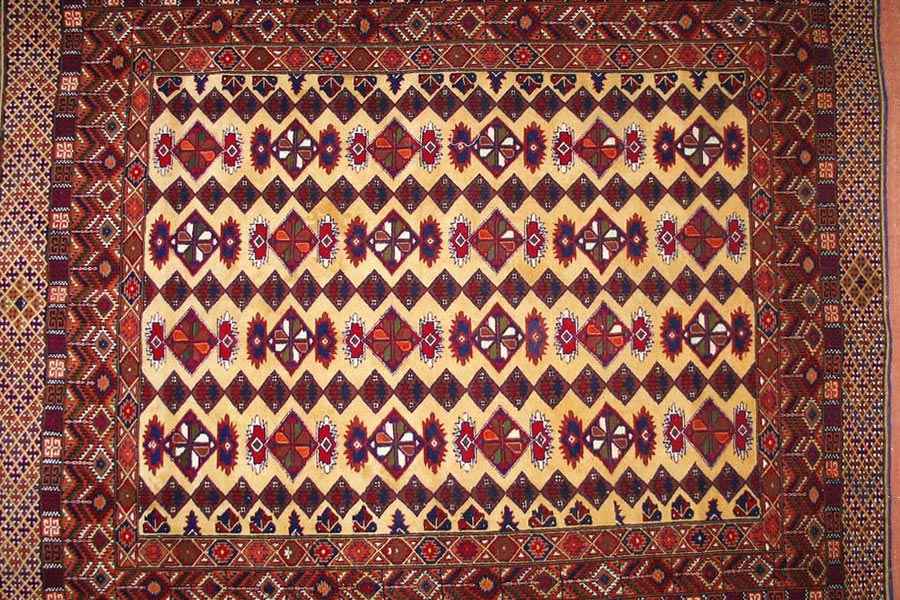
Carpet weaving in Uzbekistan is one of the country’s most distinctive traditional crafts. Ancient symbols, time-honored techniques, and the use of natural materials and dyes have made it an important and uniquely enduring element of Uzbek culture.
History of the Craft
The origins of this tradition stretch deep into antiquity: according to scholars relying on indirect evidence, weaving was practiced on the territory of modern Uzbekistan as early as the 2nd millennium BC.
One of the oldest surviving examples is the piece known as the “Sampul tapestry.” Dating to the end of the first millennium BC, it was discovered in the early 1980s during archaeological excavations near the small Chinese town of Sampul (Shanpula, 山普鲁镇).
On the remaining sections of this Bactrian textile, one can discern the structure of the weave, a range of colors, and images of people and mythical creatures, all pointing to a remarkably high level of craftsmanship. The fragment is now held in the Xinjiang Regional Museum in Urumqi (乌鲁木齐), China.
Until the 15th century AD, carpets from the region were traded along the Silk Road. The famous Bukhara carpets, known from China to Europe, became a hallmark of Central Asia. Despite this established “brand,” however, many pieces sold in Bukhara were woven elsewhere. The main production centers included Surkhandarya, Kashkadarya, and Karakalpakstan.
Later, during the period of the three khanates with capitals in Bukhara, Kokand, and Khiva, luxurious handmade textiles played a major role in furnishing wealthy homes and official residences. Some were sourced from other regions, while others were acquired abroad through long-standing Silk Road trade connections. Today, numerous pieces from this period are displayed at the Museum of Applied Arts in Tashkent.
Carpet Weaving Methods and Styles
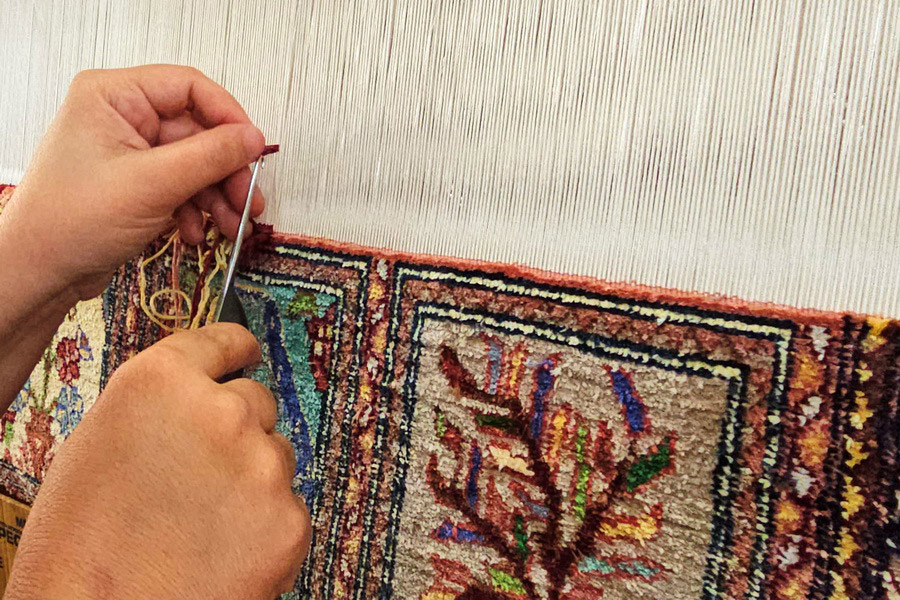
Carpets in Uzbekistan are traditionally made using either woven or non-woven methods. While woven carpets are more common today, non-woven felted wool carpets – often decorated with embroidery or appliqué – were widespread in the past.
Felt carpets were produced without a loom by felting wool, softening and compressing it into a dense fabric. Today, this technique is rare in Uzbekistan, though it remains common in neighboring countries like Kazakhstan and Kyrgyzstan.
Most modern Uzbek carpets are woven on looms using various techniques. When only longitudinal and transverse threads are used, the result is a smooth, flat-woven surface known as a kilim – a characteristic form in Uzbekistan. Kilims are classified by the way the patterns are created. For example, in gajari and terme types, designs are formed using vertical threads, while in the traditional takir technique, horizontal threads are used instead.
Adding knots to the warp and weft creates a pile carpet. These knots produce a raised surface on one side and a pattern on the reverse. The quality, durability, and value of such carpets are directly linked to knot density, typically measured per square centimeter (or inch). Silk threads are often used for the finest pieces–requiring the craftswoman to tie up to 100 knots per square centimeter.
This level of precision results in a carpet that transcends craft and becomes a true work of art. With its durability, intricate patterns, and rich textures, a finely knotted carpet resembles a high-resolution image and may last for decades – gaining both value and rarity over time.
Uzbek pile carpets come in two main types: gilyam (short-pile) and julkhirs (long-pile). Gilyams, woven from silk or wool, are more widespread. Silk is prized for its softness and luster, while wool is valued for insulation and durability. Woolen carpets are also considered to better preserve the traditional character of Uzbek weaving.
Carpet shape has also evolved. Historically, rugs were narrow, with wider ones created by stitching several panels together. The production of full-width carpets began only in the 20th century and has since become the standard approach.
The most prized pieces are distinguished by their vibrant, plant-based colors. Red dyes are derived from pomegranate rind or madder root, yellow from onion skins, and blue from indigo. Other natural sources – such as walnut, apricot, and pistachio – are also traditionally used. These materials produce rich, lasting hues that define the Uzbek carpet-making tradition.
Patterns and Meanings in Uzbek Carpets

The composition of a traditional Uzbek carpet typically includes a central element framed by a border, although some feature evenly spaced motifs throughout. Another variation incorporates alternating bands that may be plain or patterned and either woven or embroidered. These distinctive textiles, known as enli (literally “striped”), are now rarely produced. One of the few places where this tradition survives is Baysun, whose cultural heritage has been recognized by UNESCO as intangible.
The ancient motifs woven into these carpets are largely symbolic and associated with protection and good fortune. Common designs include stylized animal horns and, more rarely, circular forms that symbolize planets. This motif appears far more often in Uzbek suzani embroidery than in carpet art.
Black-and-white stripes are believed to ward off the evil eye, while geometric shapes, especially triangles, serve as protective talismans. Floral imagery is uncommon in authentic Uzbek carpets and is generally limited to motifs of bodom (almond) and pepper.
Everyday and Ritual Use of Uzbek Carpets
Uzbek carpets serve both decorative and practical roles in the interior. They are most commonly placed on the floor and less frequently hung on walls. In the past, however, carpets had a wider range of functions. They were used as curtains, and some were even fashioned into highly durable bags.
Carpets also hold religious significance. One of the most widely used types is the small prayer rug known as a joinamaz – literally “place for prayer”.
Contemporary Carpet Weaving in Uzbekistan

Today, in a market dominated by mass production and inexpensive materials, authentic handmade Uzbek carpets have become prized by those who appreciate quality and traditional Eastern design.
These carpets are most often found in remote regions of the country. For example, the oldest weaving tradition is preserved in the Baysun district of Surkhandarya. One of the region’s most recognized craftswomen, Khadicha Rakhmonkulova, presents her work at exhibitions and fairs, and took part in the International Carpet Festival in Baku (2025). Distinctive carpets are also woven in Nurata, where the local style shows clear influence from the Turkmen school.
In Uzbekistan’s major cities, carpets are produced that blend national and broader Eastern motifs. One notable example is the Hudjum Silk Carpet Factory in Samarkand, where over 400 craftswomen create handmade pieces known for their exceptional craftsmanship and beauty.
A rich collection is also found in Bukhara, in the workshop of Sabina Burhanova, a prominent Uzbek artisan featured in the prestigious Homo Faber Guide by the Michelangelo Foundation.
Additionally, a carpet workshop has been established in Khiva with support from UNESCO. The patterns and ornamentation of these pieces, inspired by the city’s historic ceramics and majolica, reflect a fusion of Uzbekistan’s traditional crafts.