

Where the Stage Wall Never Fell
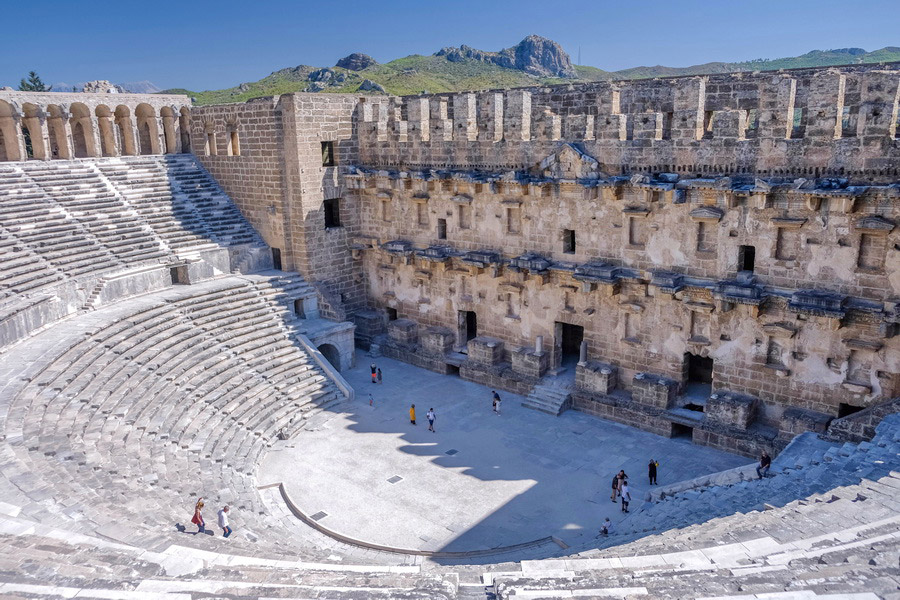
Aspendos Ancient Theatre stands 45 kilometres east of Antalya, set into a hillside above the flat Pamphylian plain. Walk through the vaulted entrance passage, and the stage wall rises in front of you – at its full original height, exactly as Zenon left it. The seating sweeps around on both sides to meet it, the orchestra floor below, the geometry of the space immediately legible. Nearly nineteen hundred years old, and the building is essentially intact.
Every September, singers perform on that stage without microphones. The sound reaches The sound reaches the back row.
History of Aspendos Ancient Theatre
Greek tradition held that Aspendos was founded by settlers from Argos around the 10th century BC. By the 5th century BC, it was the wealthiest city in Pamphylia, positioned on a river then navigable from the Mediterranean sixteen kilometres inland. The trade in salt, wine, oil, and the horses for which Aspendos was particularly known paid for everything that followed.
The theatre was built between roughly 160 and 180 AD, during the reign of Emperor Marcus Aurelius. The bilingual inscriptions above the stage-building entrances name the architect: Zenon, son of Theodorus, born in the city itself. Of the handful of Roman theatres whose architects are known by name, this is the only one where the architect was also a son of the city that commissioned his work.
Local legend offers a more vivid account. The king of Aspendos promised his daughter's hand to whichever architect produced the greatest public work for the city. One built the aqueducts that brought water from the mountains. The other – Zenon – built the theatre. When the king stood at the very top of the seating area – cavea – at its opening, he heard a clear voice in his ear: "Your daughter must be mine." Zenon was standing on the stage, nearly a hundred metres away.
What preserved the building was continuous use. In the 13th century, the Seljuks repaired the theatre rather than abandoning it, converting the stage complex into a caravanserai and later a palace for Sultan Alaeddin Keykubad I. Fragments of blue tile and geometric patterns from that period are still visible inside the stage building.
The theatre was largely unknown to European scholars until the 19th century. In the 1930s, Atatürk visited the site, declared that such a structure must not be left to decay, and ordered its restoration. It has been in active use ever since. In 2015, it was added to UNESCO's World Heritage Tentative List, together with the Aspendos aqueducts.
Inside Aspendos Ancient Theatre
The Cavea
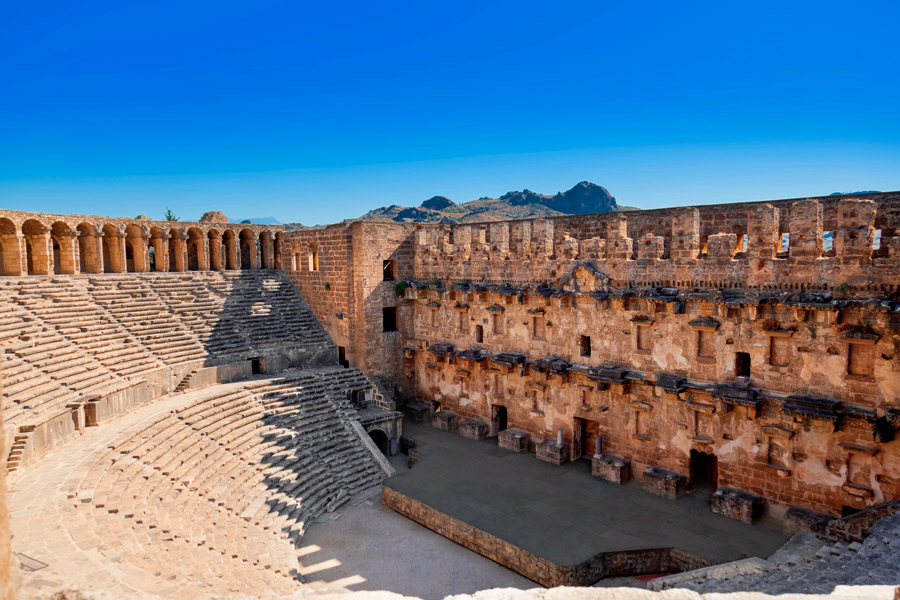
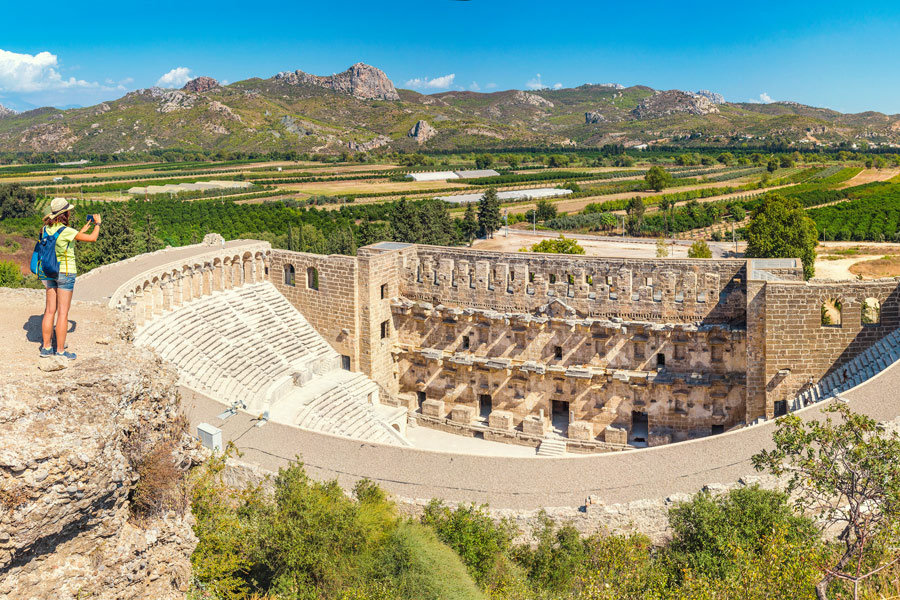
The cavea is carved partly into the hillside and partly raised on vaulted arcades where the slope runs out. Forty-one rows of benches, divided by a horizontal walkway called the diazoma, curve around the orchestra below. Archaeological estimates place the practical capacity at around 7,300-7,600 spectators.
Climb to the top row, and the geometry perfectly makes sense. The stage wall opposite stands almost level with the highest tier, and every sightline draws towards the orchestra floor below. From up here, the stage looks surprisingly close.
The Stage Wall
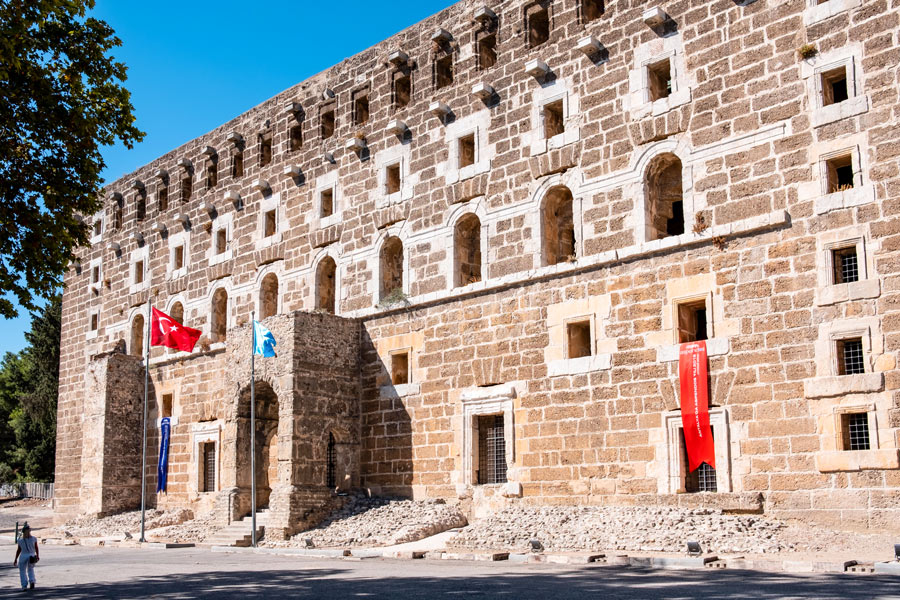
The stage wall – scaenae frons – is what makes Aspendos singular. In most Roman theatres, it is the first element to fall; here it stands almost unruined. The façade is a hundred metres wide and twenty-two metres high.
The lower level is cut by five doorways. Originally, the façade carried forty columns on two storeys, with niches holding statues of gods and members of the imperial family. The marble cladding and the columns are gone. But even so, the frame that held them is standing.
Look up towards the centre of the upper storey. The pediment above the central doorway features its original relief – a figure of Dionysus rising from an acanthus bush. Weathered, but legible. It is the one surviving piece of figurative sculpture on the façade, and it marks plainly what this building was built for.
Below the very top of the wall, a line of regularly spaced recesses shows where the timbers of a sloping wooden ceiling once rested. That ceiling projected sound out into the cavea has not survived.
The Acoustics
Stand on the stage and speak in an ordinary voice; someone on the top row will hear every word. Drop a coin, and the ringing carries. There is no amplification of any kind – only the geometry of a semicircular cavea, the reflective stage wall, and the porous limestone that absorbs stray noise rather than bouncing it into echo.
The Velarium
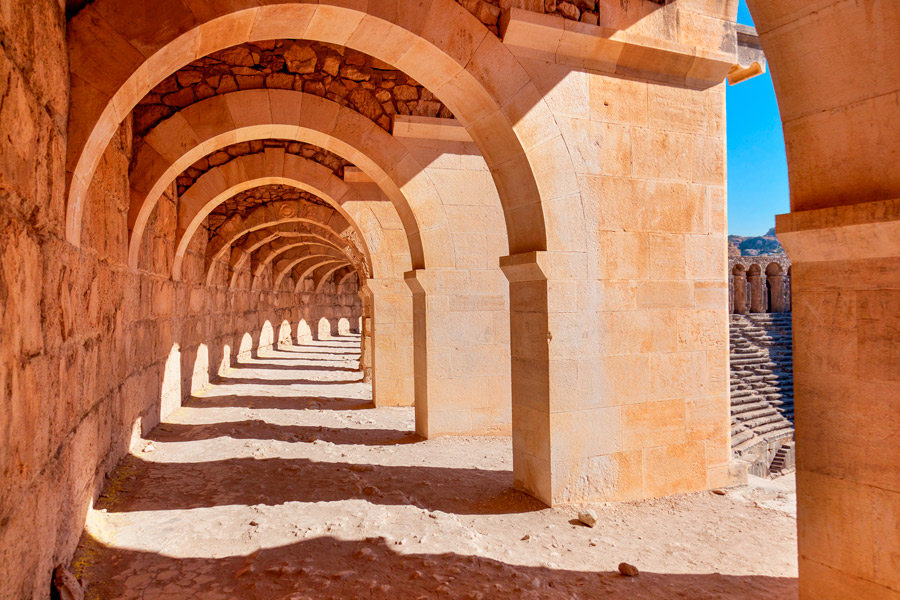
Running along the very top of the cavea is a covered walkway. Fifty-eight small holes are cut into the stonework above it at regular intervals – these held the masts of the velarium, a vast awning of linen or leather drawn across the audience to shade them from the afternoon sun. The awning is long gone. The holes cut for its masts remain where they were.
The Upper City
A rough track leads from the car park up the hill behind the theatre to the acropolis, sitting about sixty metres above the plain. Most visitors do not make this climb, which is part of its appeal. The ruins up here are less curated – weathered stone, uneven ground, overgrown edges – and almost empty of people.
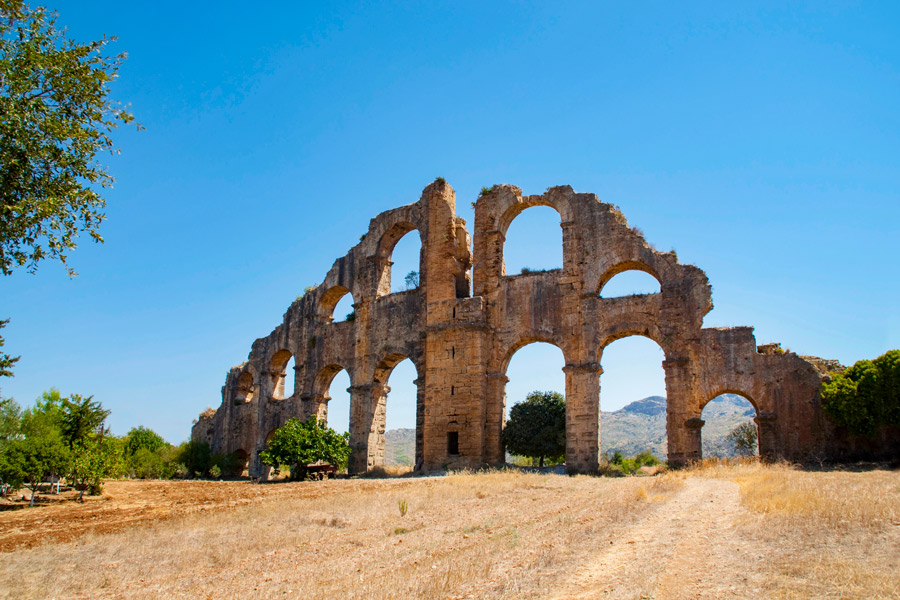
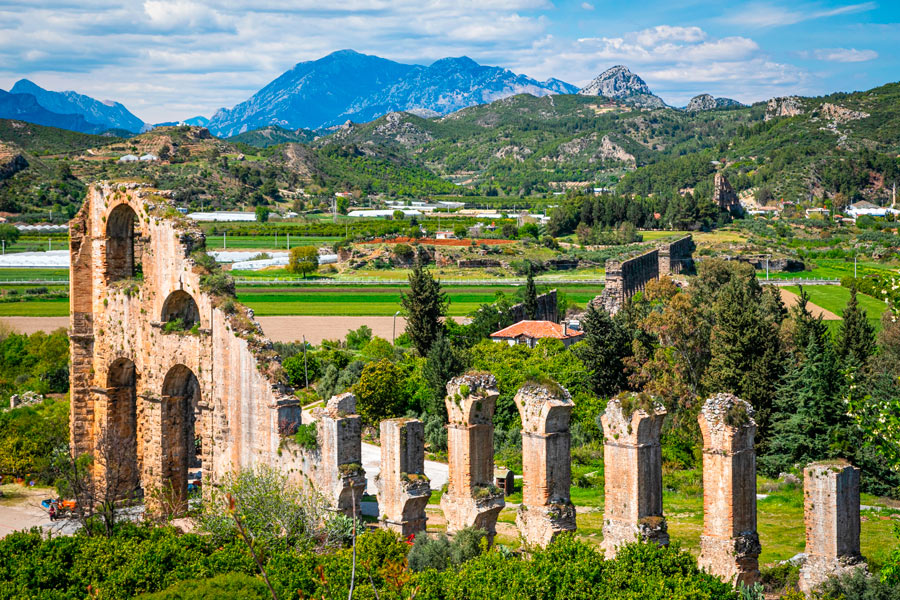
What remains includes the agora, a basilica, a monumental fountain, a small stadium, and the bouleuterion where the city council once met. From the acropolis, the line of the Roman aqueduct is visible in the distance, running in from the mountains. The last two kilometres incorporate a rare, well-preserved inverted siphon – one of the few surviving examples of Roman hydraulic engineering in the Mediterranean.
The theatre is only part of what Aspendos was. The scale of the city only becomes clear from the hill above.
Aspendos International Opera and Ballet Festival
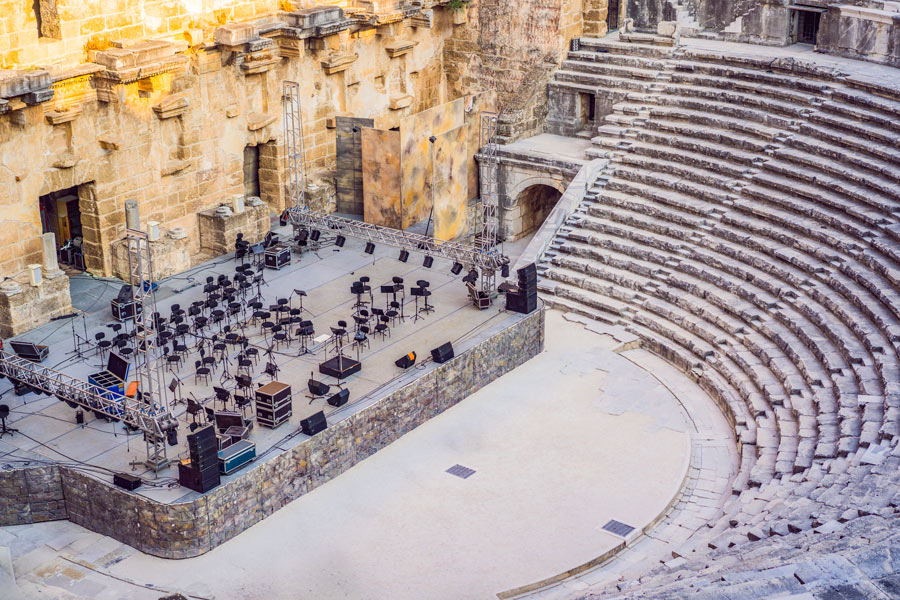
Once a year, in September, the theatre is used precisely as Zenon intended. The Aspendos International Opera and Ballet Festival has been held here since 1994, organised by the Turkish State Opera and Ballet under the Ministry of Culture and Tourism. It gained international status in 1998 and is now a member of the European Festivals Association – one of the few festivals in the world to hold a Quality Management Certificate. Companies arrive from across Europe and beyond. The stage receives them without modification.
The programme changes each year and typically runs across several evenings – opera and ballet in alternation, with international soloists alongside Turkish State companies. Recent seasons have included Aida, Tosca, Swan Lake, and Don Quixote. Performances begin at 21:00. By that hour, the sun has gone, and the warmth of the afternoon still sits in the air. The cavea fills. What audiences heard here in Zenon’s time – a voice, a space, and nothing between them.
If a festival performance is the reason for the visit, booking well in advance is strongly recommended. Bring a cushion – the benches are Roman marble – and a light layer for after midnight.
Best Time to Visit Aspendos Ancient Theatre
The theatre sits on open ground with almost no shade, and summers in this part of Turkey are unforgiving.
Spring (April–May) is the most comfortable window. Temperatures sit between 18–25°C (64–77°F), the wildflowers on the slope are in bloom, and the seats are cool enough to sit on for as long as a visit requires. Arriving before the first tour buses from Antalya is worth the early start.
Autumn (September–October) is equally good and coincides with the Opera and Ballet Festival. Crowds thin from mid-September, and the afternoon light catches the upper tiers in a way the summer months rarely allow. September is the month to aim for if a festival evening is on the itinerary
Summer (June–August) means heat – 35–38°C (95–100°F) is routine, sometimes higher. A start before 09:30 or a late afternoon arrival makes a real difference.
Winter (November–March) is quiet and mild. Visitor numbers drop away almost entirely, and the theatre on a bright January morning has a quality none of the busier seasons can match.
What are the Opening Hours?
The site is open daily, year-round.
Summer (April–October): 08:00–19:00
Winter (November–March): 08:30–17:30
Practical Information
Tickets and Entry
The ticket booth is at the main car park. Entrance is approximately ₺500 (approx. €15) for foreign visitors (April 2026), payable in Turkish lira or by card.
The Mediterranean Museum Pass (MuseumPass Akdeniz) covers entry and also includes Perge, Side Museum, and several other regional sites – worth considering for anyone planning more than one ancient-city visit. For current prices, check at the ticket office or through the website.
How to Get to Aspendos
By car: From Antalya, take the D400 east towards Serik for approximately 45 kilometres, then follow the signs inland at the Aspendos turn-off. The final stretch passes the Roman bridge over the Köprüçay. Allow 45 minutes to an hour from central Antalya. Parking at the site is free.
By public transport: Buses and minibuses run regularly from Antalya's main bus terminal to Serik town centre. From Serik, a taxi to the theatre takes around 15 minutes. Arrange the return journey with the driver before setting off – there are few taxis waiting at the site itself.
By guided tour: Day tours from Antalya, Side, Belek, and Alanya typically combine Aspendos with Perge and the Kurşunlu or Düden Waterfalls, with lunch included. For visitors without a car, this is the most practical option; a guide adds real value at the upper city, where signage is limited.
Address and Contact
Address: Belkıs Köyü, 07500 Serik, Antalya
For visitor enquiries: Antalya Provincial Directorate of Culture and Tourism
Tel: +90 (242) 238 11 11 | Email: antalya@ktb.gov.tr
Tips for an Optimal Visit
Recommended duration: Two hours covers the theatre comfortably. Add another hour for the upper city and a stop at the aqueduct viewpoint. Half a day in total is enough for everything.
Footwear: Flat, sturdy shoes throughout. The steps inside the theatre are uneven and worn smooth in places; the path up to the acropolis is rough underfoot.
What to bring: Water, a sun hat, and sun cream between May and October. The upper city has no shade at all. A small torch is useful for the darker passages behind the stage wall.
Combine with: Perge, about 35 kilometres west towards Antalya, is the natural companion visit – a Roman city with an intact colonnaded street, baths, and its own stadium. Side, thirty kilometres east on the coast, has a smaller Roman theatre and the seaside Temple of Apollo.
Several Roman theatres around the Mediterranean survive in good condition – Orange in southern France, Sabratha in Libya, Bosra in Syria, Mérida in Spain. Aspendos belongs in that company and is frequently placed at its head. The reason is the stage wall and the acoustics, which function just as designed.
Most ancient monuments are viewed. This one can be experienced the way it was built to be experienced – from the top row, during a performance, without a microphone between the voice and the stone.