

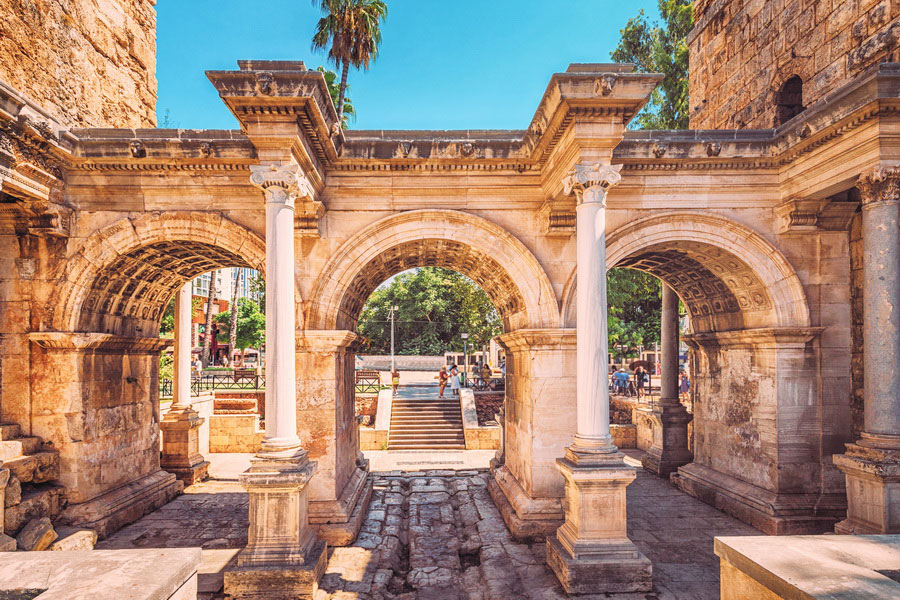
Hadrian’s Gate has stood at the entrance to Kaleiçi since 130 CE – a triple-arched Roman monument built in white marble to honour the Emperor Hadrian’s visit to Attaleia, as Antalya was then known. It is the only gate remaining of those that once cut through the city walls. Walk through it today and the city changes register. The boulevard traffic, the palm trees, the café awnings – all of it falls away the moment you step under the first arch. The marble overhead is carved into a grid of rosettes, each one as precise as the day it was finished. Underfoot, through a panel of glass, the original Roman pavement is still visible – grooved deep by centuries of wheels, worn into something that looks almost soft.
Most people pass through quickly, on their way into the old town. Hadrian's Gate is worth more than that. Stand in the archway for a moment: the modern city is framed behind you, and the cobbled lanes of Kaleiçi begin just on the other side.
Best Time to Visit Hadrian's Gate
The time of day matters more here than the season. An early start and an evening return reveal two quite different sides of the gate.
Spring (April–May) is the finest time to come. The air is mild – temperatures sit around 18–25°C – and before 09:00 the boulevard is nearly empty. In the early morning the stonework looks its best – the low sun picks out every variation in the marble, and the frieze reads as something carved by hand rather than cast from a mould.
Autumn (September–October) runs it close. The crowds have thinned, the air has cooled into the mid-twenties, and the low afternoon sun throws the relief carvings into sharp contrast – both façades repay a slow circuit at this hour. In October, the gate is seen at its best.
Summer (June–August) is busy and hot – temperatures regularly reach 35–38°C, and the gate sits fully exposed on the boulevard with little shade. An early start before 10:00 changes the experience considerably. So does an evening return: after 19:00, when the heat has lifted and the marble is illuminated, the gate is at its most atmospheric, and the old town behind it is only just beginning its evening.
Winter (November–March) belongs to those who prefer a place to themselves. Some days are grey and cool; others are bright and mild, the kind of Mediterranean morning when white stone looks its sharpest. In winter, the gate is much the same; it is the quiet around it that deepens.
Practical Information
Hadrian's Gate is open at all hours and free to enter.
Address: Barbaros, Hadrian Kale Kapısı, 07100 Muratpaşa, Antalya
Access: Stone staircases on each side lead down to the arches; the site is not suitable for wheelchairs.
Language: No English-language interpretation panels on site. A guided walking tour of Kaleiçi adds useful context for those who want it.
For visitor enquiries: Antalya Provincial Directorate of Culture and Tourism
Tel: +90 (242) 238 11 11 | Email: antalya@ktb.gov.tr
How to Get to Hadrian's Gate
The gate stands directly on Atatürk Caddesi in the city centre, visible from some distance in both directions.
By nostalgic tram (T2): The heritage tram line has a dedicated stop – Üç Kapılar – named directly for the gate. Trams run every 30 minutes from 07:00 to 23:00. Use the Antalyakart Mobil app or Moovit for live schedules, both available on iOS and Android.
On foot from the city centre: From Cumhuriyet Meydanı (Republic Square), the gate is a 5–10-minute walk east along Atatürk Caddesi.
By taxi: Drivers recognise both Üç Kapılar and Hadrian Kapısı. All licensed yellow taxis in Antalya run on meters; from the city centre the journey takes under 10 minutes.
History of Hadrian's Gate
Hadrian was one of the most widely travelled emperors Rome ever had. His journeys through the eastern provinces between 128 and 132 CE took him across dozens of cities. Each visit was a political act as much as a personal one – a way of making the empire feel present in its furthest reaches. Attaleia was among them: a prosperous Mediterranean port founded by King Attalus II of Pergamon around 150 BCE. By Hadrian's time the city was wealthy enough to mark the occasion in white marble. The gate raised in 130 CE was not a defensive structure. It was a monument, built during the long peace of the Pax Romana by a city that could afford ceremony.
It was later absorbed into the walls that grew up around it, and that enclosure is precisely what preserved it. Enclosed within later masonry for centuries, the gate was protected and largely hidden from view. The Irish hydrographer Francis Beaufort documented it in 1817, noting a second storey still partially standing above the arches. By the time the Polish explorer Karol Lanckoroński arrived at the end of the 19th century, that upper level had gone entirely – removed or fallen in the decades between – and the gate itself was buried several feet deep, its inner façade barely visible from outside.
The later masonry surrounding it was cleared in the 1950s, and what it had concealed for centuries came suddenly into the light. Restoration followed in 1959: the earth was cleared, the Roman pavement excavated, and at the base of the gate a set of gilded bronze letters was found – fragments of the dedicatory inscription that had once honoured the emperor. Those letters are now held in collections abroad. The words are gone from the stone. The gate they once decorated is still here.
Highlights
The Triple Arch
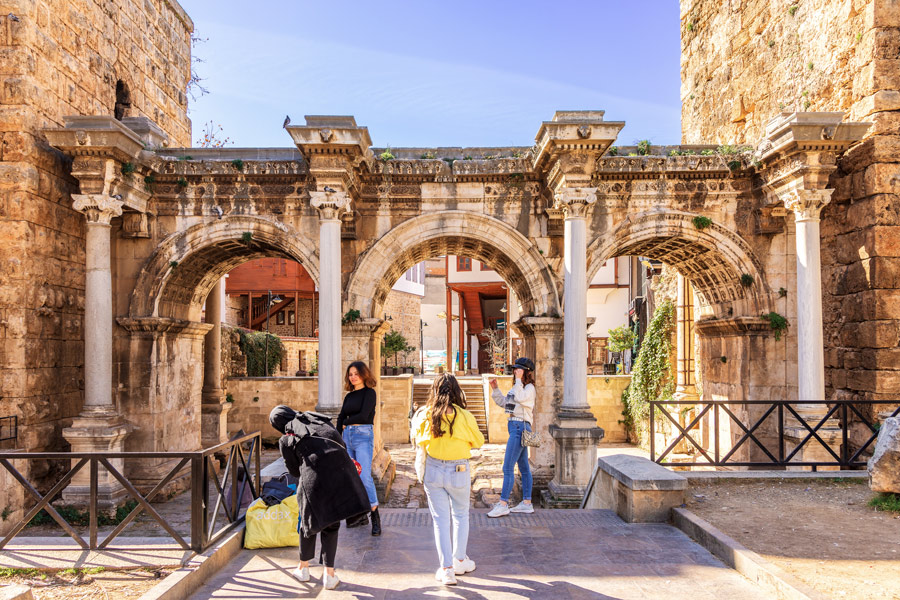
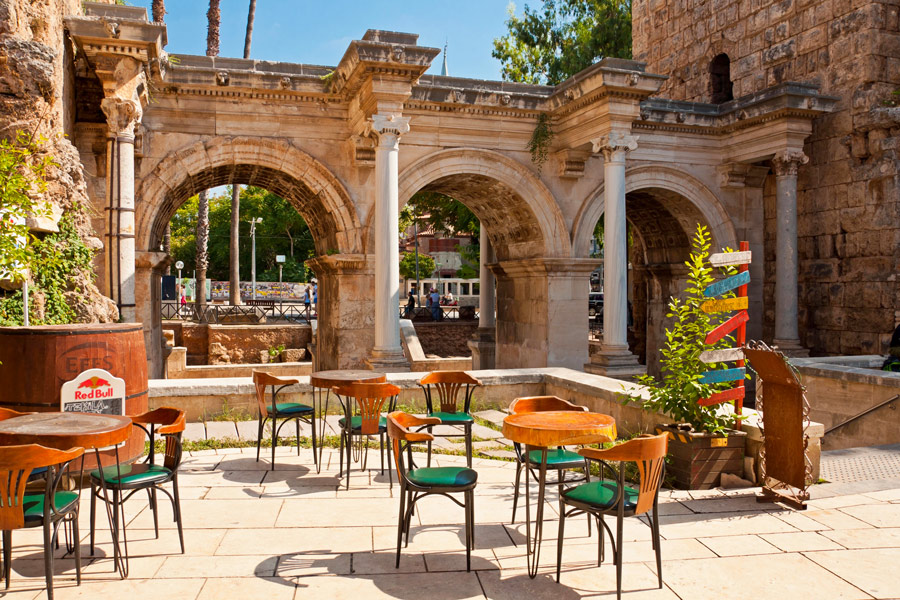
From the boulevard, before the steps down, the proportions arrive first. Three identical arches side by side, framed by columns on each face, the whole structure carrying the composure of something built to last for centuries. The material becomes clear as the distance closes: white marble throughout, except for the granite column shafts, smooth and grey against the carved stone around them. The capitals are composite – Ionic volutes combined with Corinthian acanthus leaves – and a frieze of floral motifs runs the full width of each façade, the projecting cornice carrying lion heads at intervals.
Both faces are near-mirror images of each other. The gate was built to be approached from either direction without losing dignity, and it still reads that way. The arches are modest in their actual dimensions – something in the proportions, or the whiteness of the stone against the sky, makes the whole structure appear considerably grander than it is.
The Coffered Ceiling
Most people walk through looking straight ahead, which means the ceiling goes unnoticed. Each barrel vault above the three passages is divided into a grid of shallow square recesses – and inside each one sits a carved rosette or floral ornament, held within egg-and-dart moulding. The carving is precise and still largely intact. The reason is straightforward: sealed from weather and hands for centuries, it escaped the gradual softening that open-air exposure produces. The result, looking up, is Roman decorative work as it actually left the mason's tools – unhurried, detailed, and very much alive.
The Chariot Wheel Grooves
The original Roman pavement was uncovered during the restoration and is now visible beneath the central arch through a transparent floor panel. The grooves cut into it are the most tangible thing in the whole gate – deep parallel channels worn into the stone by wheels passing in and out of the city over centuries. They run perpendicular to the arches, the stone gradually yielding to the same repeated motion. They were worn deep enough to require the glass panel. Standing above them, looking down through the glass, something about the ordinariness of it – carts, errands, the daily traffic of a working city – makes the whole monument suddenly closer.
The Flanking Towers
Stand beside either tower and the difference in age becomes immediately readable – rougher Roman stonework below, a cleaner Seljuk hand above on the northern side. The southern tower – known as the Tower of Julia Sancta, from a Roman stone inscription set into its wall – dates from the imperial period, though it was built independently of the gate rather than as an original component. Its scale and character are distinct from the arches beside it. The inscription records a dedication connected to Domitia Paulina, Hadrian's sister, adding a personal note to a monument that was already a public act of tribute.
The northern tower has a different history entirely. Its lower courses are Roman, but the upper section was rebuilt in the early 13th century by the Seljuk Sultan Alaeddin Keykubad I – the same ruler whose fluted minaret defines the Kaleiçi skyline nearby. An Arabic-script inscription marks the Seljuk work clearly. The two towers read as entirely different buildings – and yet they stand side by side, each one a record of whoever held this ground.
The Inscriptions
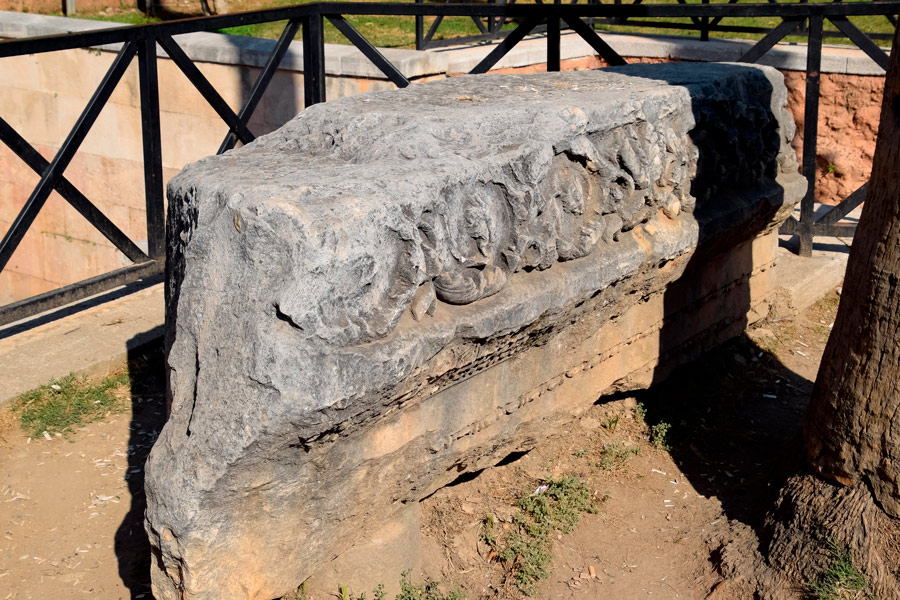
The gate carried two dedicatory inscriptions in its original form – one in gilded bronze letters mounted on the lower architrave, a second believed to have been placed on the lost upper storey. When restoration workers cleared the base of the gate in 1959, they found roughly a dozen bronze letters lying in the accumulated earth: fragments of words that had once announced to every arriving traveller whose city this was, and who had visited it. Those letters are now distributed across institutions in Vienna, Berlin, London, and Oxford. The stone carries no inscription today. There is something worth pausing over in that absence – a dedication to an emperor, now scattered across the museums of the countries that once studied his empire.
The Gate at Night
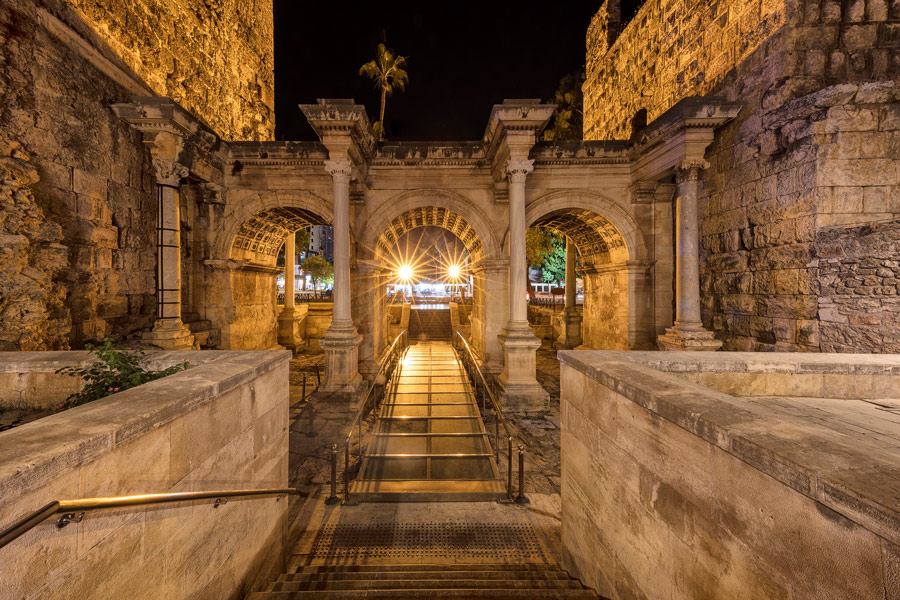
After dark, the gate is illuminated, and the marble shifts entirely. White by day, it turns warm and faintly golden under evening light, the carved details throwing shadows that flat daytime illumination never reveals. The lion heads on the cornice become more pronounced. The column shafts catch light differently from either side. The square on the boulevard face is a gathering place at this hour – a tea seller circulates in warmer months, the benches filling with people who have nowhere particular to be. The lit arches open into the darker, quieter lanes of Kaleiçi, with the sound of the old town rising from somewhere beyond the first turning.
Tips for an Optimal Visit
Recommended duration: The gate takes five minutes to walk through and considerably longer to understand. A thorough visit – both façades, the ceiling, the floor panel, the tower inscriptions – takes 20 to 30 minutes.
Where to eat nearby: The cafés along Atatürk Caddesi are good for a coffee before or after. Seraser Fine Dining for a considered evening meal – book ahead. Ayar Meyhanesi is the place for fresh seafood, local in feel and five minutes from the gate. For something simpler, Can Can Pide Salonu a couple of minutes from the gate serves honest Turkish pide at modest prices.
Footwear: Flat-soled shoes throughout. The stone steps are uneven and the surrounding paving gives no quarter to heels.
Combine with Kaleiçi: The gate is the natural starting point for the old town. The walk to the harbour takes about 15 minutes at a relaxed pace, passing the Yivli Minaret square and the Kesik Minaret along the way.
Most monuments are viewed from a distance. Hadrian’s Gate is understood by passing through it. On one side, the boulevard and the city going about its day. On the other, the old town – its lanes, its noise, its own separate rhythm. The gate is the point where those two worlds meet – and most people pause here, if only for a moment, before choosing a direction.