

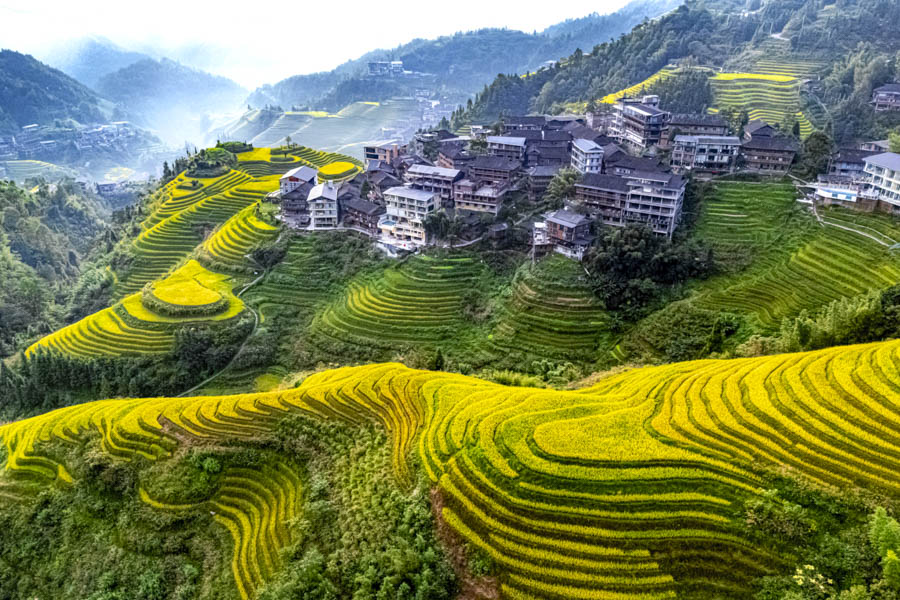
At first glance, the Longsheng Rice Terraces, also known as the Longji Rice Terraces, may seem quiet and almost ornamental. Yet behind their flowing contours lies a highly structured system shaped by centuries of observation, labour, and adaptation to the mountains. Every line of the slope reflects a deliberate decision: how to hold water, how to preserve soil, and how to make cultivation possible where the terrain resists it.
This is not only a story of agriculture, but also of engineering embedded in everyday life. The terraces operate as a connected system, in which water, earth, and seasonal rhythms are carefully balanced. Their form is inseparable from their function, and even small details reveal a practical logic refined over generations.
To understand this landscape, it helps to look beyond its outward harmony and trace the methods that sustain it: how the terraces were built, how water is guided across the slopes, and how fields are prepared, maintained, and harvested in line with the climate.
Building Techniques
Each field of the Longji Rice Terraces was formed by hand, following the natural contours of the hillside. Work began with slash-and-burn clearing: trees were felled, the timber was burnt, and the ash was worked into the soil as both fertiliser and a loosening agent. Once cleared, the surfaces were reinforced with layers of clay and compacted earth.
Narrow horizontal ledges were then cut into the slope, creating steps that could hold both fertile soil and water. Walls of compacted earth and stone stabilised each level and prevented erosion. Over time, even the smallest patches of mountainside were brought into cultivation, gradually turning whole slopes into tiered fields.
Irrigation and Farming Practices
Driven by gravity, water from mountain streams enters the upper paddies through main channels, then flows down through a network of smaller channels and spillways linking each level, keeping the fields filled throughout the growing season. This ensures an even distribution across the entire slope. In winter, when irrigation is no longer needed, the connecting channels are blocked to prevent the soil from drying out and cracking.
Maintenance of Longji Terraces
Upkeep is an annual task. Before planting – typically between March and April – weeds are removed from the ridges, and the surface is scraped level with a bamboo knife until hard-packed soil is exposed. Wet clay is then applied by hand to the embankments and tamped down with bare feet, sealing the terrace edges to retain water.
Seedling Cultivation, Ploughing and Fertilising
A defining feature of Longji agriculture is that farmers reserve the best grains from each harvest for the following year’s seed. Before planting, the seeds are sun-dried, then soaked and germinated in a warm, damp environment – typically in bamboo baskets or wooden containers. Once shoots appear, the seedlings are moved to nursery plots on well-lit slopes with loose, fertile soil and controllable water.
Sowing typically begins on the first day of the second lunar month, during the Jingzhe season (“Awakening of Insects”), when temperatures begin to rise. Preparation involves deep ploughing, repeated harrowing, and the building of earth ridges. Cleared weeds are often recycled as organic fertiliser. Ploughs, rakes, and draught animals remain the primary tools.
The terraces are fertilised with organic matter: manure, plant ash, oilseed cake, lime, and green manure crops such as legumes and astragalus. After the autumn harvest, livestock and poultry are turned loose onto the fields. Rice straw left on the terraces decomposes slowly over winter, returning nutrients to the soil.
Harvesting
Ripe ears are cut with sickles, tied into sheaves, and sun-dried in the fields for one to two days. Harvesting is a collective effort: whole families and neighbours work the slopes together, moving from terrace to terrace as the grain ripens. Due to the mountainous climate, the terraces yield a single harvest each year, typically in September and October.
Once dried, the grain is threshed by hand, traditionally by striking the sheaves against a wooden frame to separate the kernels. The rice is then winnowed to remove the husks and stored in wooden granaries, where it keeps through the winter. Maize and chilli peppers are often spread on bamboo mats alongside the rice, adding touches of red and yellow to the terraced slopes.