

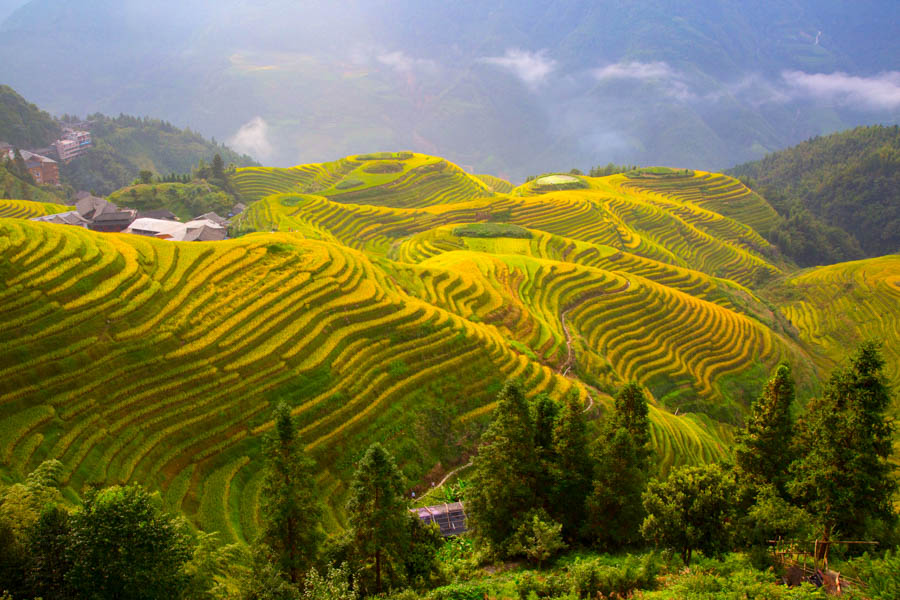
Nestled at the foot of the karst hills of Guangxi, eighty kilometres north of Guilin in China, the Longsheng rice terraces (龙胜梯田) offer visitors the chance to discover a landscape shaped by centuries of human ingenuity and cultural continuity. Often called the Longji rice terraces or the Dragon Bone Rice Terraces (龙脊梯田), they take their name from their multi-layered terraced fields resembling the scales of a resting dragon.
In Chinese culture, the dragon is a powerful and auspicious symbol, embodying strength, good fortune, harmony with nature and vital energy (qi). Imperial symbolism lends the dragon an even more sacred dimension: historically, it was the emblem of the emperor, representing supreme authority, cosmic order and the power to govern. This association gives the terraces a distinctive cultural meaning, linking them to the harmony between heaven, earth and human society. The collective and meticulous engineering work that characterises each contour reflects the balance between human effort and the natural rhythms represented by the dragon, and, by extension, the emperor’s role as mediator of the cosmic order. For now, the dragon is asleep, and you are free to wander at your leisure across its back, admiring these fields stretching as far as the eye can see.
Longsheng Rice Terraces Tours
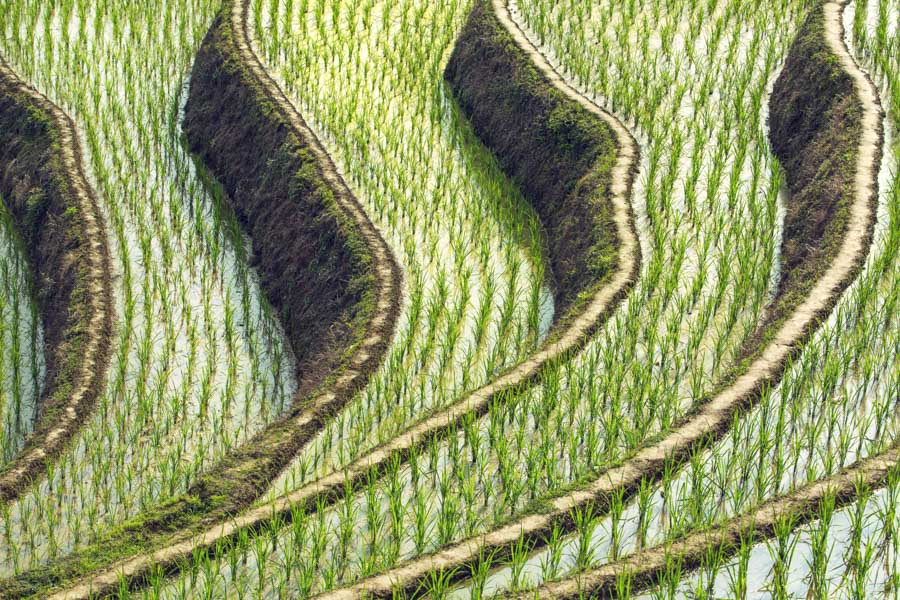
Most travellers include Longsheng within a broader China itinerary. Guangxi’s mountains and the rice terraces provide a calm contrast to China’s megacities and imperial capitals.
Our compact 4-Day Guilin Highlights Tour concentrates on the area’s karst landscape, caves and a scenic Li River cruise, with time set aside to visit Longsheng terraces. This option is available year-round and suits travellers who want to explore Guilin and Longsheng without adding long overland journeys or extra regions.
Several longer itineraries departing from Beijing combine the capital’s historic sights with scenery from the southwest. They typically include the Badaling section of the Great Wall of China and Xi’an’s old city before heading south to Guilin and the Longsheng terraces for a change of pace and scenery.
Some variants add Zhangjiajie or continue to Shanghai and its nearby water town, Zhujiajiao, bringing together major cultural sites and the region’s distinctive natural scenery.
A specialist option on this route is a food-focused programme that also visits Chengdu with its Panda Base and the Longji (Longsheng) rice terraces, pairing regional cuisine and market visits with the usual historical and scenic highlights.
Group tours beginning in Hong Kong concentrate on natural attractions across several provinces: Guilin’s karst hills, the terraced fields around Longsheng and more distant sandstone formations. A number of group departures also include a Yangtze River cruise to link cities and scenic regions into a single continuous journey.
Best Time to Visit
The region lies within a subtropical monsoon area. Each season reshapes the terraces. The colour of the slopes shifts, the pace of farm work changes, and the mountain villages take on a different character. Plan your visit with seasonal weather in mind.
The rainy season usually lasts from May to July, bringing less favourable conditions for outdoor activities.
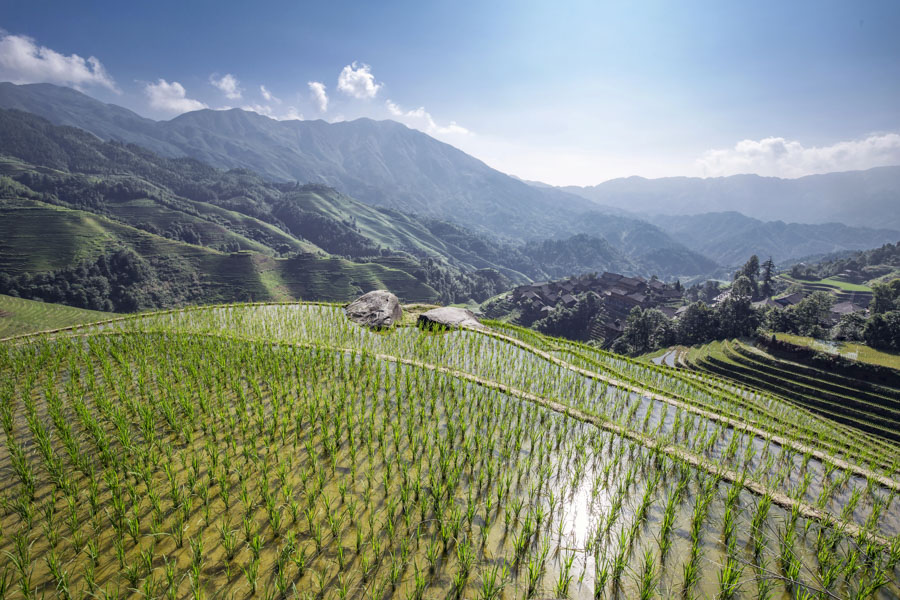
Spring (April and May) boasts average temperatures from 10 to 24°C (50 to 75°F). Rainfall increases toward late spring with intermittent showers that help fill the paddies. Expect light to moderate precipitation, becoming more frequent in May. This is one of the most photogenic times of year, as the terraces fill with water and reflect the sky.
June and July are typically the rainiest months, with heavy, often short-lived downpours and high humidity that can make paths slippery; overall precipitation is high. In summer (June to August) temperatures averaging from 18 to 30°C (64 to 86°F).
From October to February, the weather is often windy, but this is also the best time for clear, unobstructed views and one of the most comfortable seasons to visit the terraces.
In early autumn, mainly in September and October, rainfall decreases significantly, when the ripening rice turns the slopes golden. Average temperatures usually range from 12 to 26°C (54 to 79°F).
Winter is generally the driest season, with occasional cold snaps and frost at higher elevations reaching -6°C in January, offering striking, sharply defined mountain scenery. Average highs are 10 to 16°C (50 to 61°F), and lows are 0 to 6°C (32 to 43°F).
Timing a visit around local Yao and Zhuang festivals can add add another layer of interest to a visit.
History of the Longsheng Rice Terraces
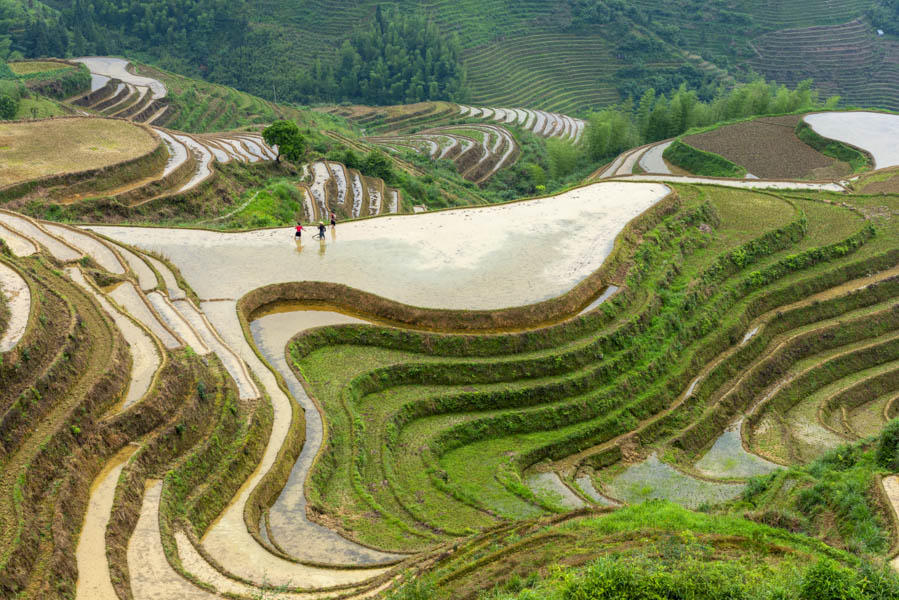
Longsheng’s story spans more than two millennia of terraced farming and, more recently, the changes that modern life has brought to its villages.
Early History: Origins and Dynastic Development
Terraced farming in the Longsheng area has ancient roots. The earliest forms began to emerge during the Qin Dynasty (221–206 BCE) and Han Dynasty (206 BCE–220 AD), when communities in southern China first carved narrow ledges into steep ridges for the artificial cultivation of early japonica rice varieties.
A major expansion occurred during the Tang Dynasty (618–907) and Song Dynasty (960–1279), when population growth and agricultural policy drove more ambitious land reclamation. Over the centuries that followed, the system kept expanding. By the Ming Dynasty (1368–1644) and the Qing Dynasty (1644–1912), the broad landscape visible today had largely taken shape.
Modern Influences: Economic Development and Tourism
In 1964, Dazhai Village (大寨 ) became a national model for agricultural production, following Mao Zedong’s directive “Learn from Dazhai in agriculture”.
The traditional rural economy shifted markedly during the 20th century. In the latter half, many villagers left the terraces to seek work elsewhere, and some fields gradually fell into disuse. Tourism changed the equation: travellers began arriving to see the terraced slopes, and local communities recognised the landscape’s value as both cultural heritage and an economic resource.
Since the early 2000s, infrastructure has developed steadily: viewing platforms, walking trails, guesthouses and cultural programmes have all appeared. Tourism now provides a significant income source for local residents and, crucially, gives economic purpose to maintaining the terraces and the traditional practices that sustain them. The Longsheng Rice Terraces are listed by the Food and Agriculture Organisation (FAO) of the United Nations under its Globally Important Agricultural Heritage Systems (GIAHS).
Construction and Agriculture of Longsheng Rice Terraces
The Longsheng Rice Terraces reflect centuries of careful engineering shaped by the demands of mountainous terrain. Each level was carved by hand along the natural contours of the slope, then reinforced with compacted earth and stone to retain soil and water. Over time, even the steepest hillsides were transformed into a continuous system of stepped fields.
At the heart of this landscape is a gravity-fed irrigation network. Water from mountain streams enters the upper terraces and flows downward through a network of narrow channels, ensuring an even distribution across the fields. Seasonal adjustments help protect the soil during drier periods.
Farming practices remain closely tied to traditional methods. The terraces are maintained each year, their edges sealed with clay to prevent water loss, while natural fertilisers help sustain soil fertility. Each stage of cultivation reflects a careful balance between local conditions and generations of farming knowledge.
To see how this system works in practice, explore the dedicated guide to the construction and agricultural practices of the Longsheng Rice Terraces, where the structure of the terraces, irrigation methods, and seasonal farming processes are explained in greater detail.
Things to Do in Longsheng Rice Terraces
The terraced rice paddies of Longsheng lie between 380 and 1,180 metres (about 1,250 and 3,870 feet) above sea level. They offer wide views across the slopes and a quieter rhythm shaped by village life. To appreciate the scale of the landscape, it is worth slowing down and taking in the surroundings quietly.
Explore the Scenic Areas of Longsheng
The Longsheng Rice Terraces offer distinctly different ways to experience the landscape. Some areas are quieter, with broader views and a slower pace; others are more built up, with guesthouses, cafés and a steadier flow of visitors. Most travellers focus on one section and explore it on foot, moving between villages and viewpoints at an unhurried pace. Distances are not insignificant, and each area feels complete enough to visit on its own.
The Longji Ancient Zhuang Terraced Fields suit those in search of quieter surroundings and more open views. Narrow paths wind through the slopes, and in the early morning mist the lines of the terraces stand out with particular clarity. It is a place that lends itself to a slower rhythm and longer pauses.
Ping’an Rice Terraces have a livelier feel, with more activity, more facilities and more places to stop along the way. Wooden houses climb the hillside in tiers, while narrow lanes link guesthouses, cafés and viewpoints. This is the busiest part of the scenic area, but also the easiest place to combine walking with food, local life and short breaks between viewpoints.
Jinkeng (Dazhai) Rice Terraces feel broader and more spacious. The slopes rise higher, the views open out, and the villages sit more quietly within the folds of the mountains. Climb higher here, and the scale of the terraces becomes more apparent, with each turn in the path revealing a slightly different perspective.
Panorama Viewpoints
The viewing platforms around Ping’an and Dazhai (Jinkeng) give sweeping, postcard-perfect panoramas of the terraces cascading down the slopes. From these high points you can read the contours of centuries-old engineering. The concentric bands of paddies, narrow water channels and paths that trace the dragon-like ridgeline are the most visible from here. Consult our dedicated guide to have a front-row seat.
Sunrise and Sunset Viewing
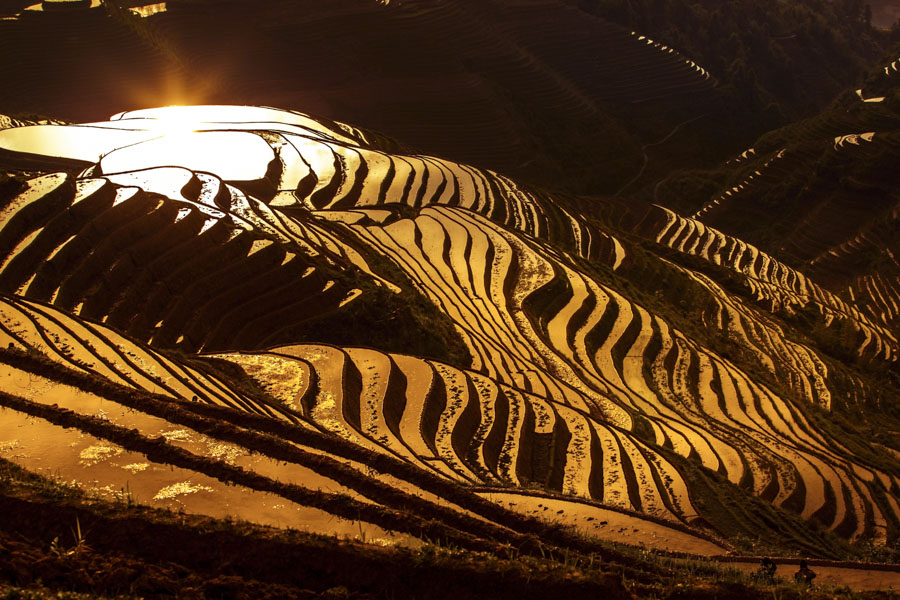
In spring, the early morning and late afternoon offer the most magical moments. At sunrise, mist drifts over the valleys and the rice paddies turn into mirrors, reflecting the sky and the clouds; at sunset, the low-angled light carves out every terrace and casts warm hues across the slopes. These two moments create striking contrasts and a unique atmosphere, much to the delight of photographers and walkers alike.
By late May and through August, the terraces are dense with young rice, reflecting a vivid, layered green. From September to early October, the paddies turn from green to gold and amber as the rice ripens. From late November through February, the terraces are mostly empty or planted with winter crops; some fields may hold residual water or show frost. Mornings can be very cold, with low-lying fog or light frost that highlights the terraces’ geometric lines.
Landscape Photography and Videography
The landscape transforms through the year, and each seasonal shift offers unique photographic compositions. This is a favourite subject for photographers specialising in landscape photography, but also for amateurs.
Hike the Longsheng Dragon’s Backbone
Several popular hiking trails in Longsheng suit different interests and fitness levels.
The easiest route for all skill levels is the Tiántouzhài loop, which covers 3.33 kilometres (2.07 miles) and takes about an hour; it is ideal for families and casual walkers.
For travellers wishing to spend more time on the trail, the Longsheng (Dazhai) loop requires a good level of fitness to complete its 7.92 kilometres (4.92 miles).
Another option is the Tiántouzhài–Dazhai loop, which demands greater stamina over 8.66 kilometres (5.38 miles). Expect steep stone staircases, narrow ridgelines and expansive viewpoints.
Nature Walks for Flora and Birdwatching
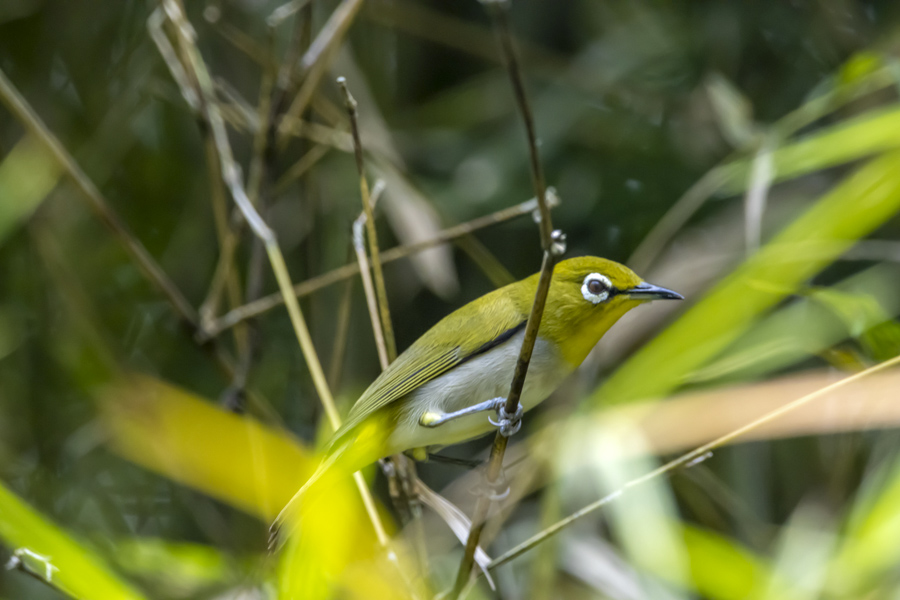
An extensive network of trails branches off the main viewing routes and passes through bamboo groves, terraced woodland and hedged fields. These quieter paths offer a closer look at local birdlife. Eastern Red-rumped Swallow, Swinhoe’s White-eye and Red-billed Leiothrix are among the 78 species recorded here by eBird. Birdsong accompanies the seasonal flowering of wild plants along the trails. Rapeseed flowers bloom from late March to April, adding vivid yellow to the landscape. Guided nature walks and early-morning birdwatching sessions reveal details that are easy to miss from the main overlooks.
Beyond the views, the Longsheng terraces also reward closer attention to village life, local craftsmanship and the daily routines of mountain farming communities.
Ecotourism: Discover the Zhuang and Yao Ethnic Minority Villages
Life in the Yao and Zhuang villages revolves around terrace farming, craft traditions and communal rhythms: mornings begin with water flowing into the paddies and neighbours meeting on stone paths, women weaving and embroidering in shaded doorways, elders sharing stories on wooden balconies, and seasonal festivals punctuating the year. Together, these create an intimate, living landscape where culture and agriculture remain inseparable. Many guesthouses and hotels with fine views over the terraces provide a peaceful and comfortable atmosphere. They are ideal if you want to spend more time there and rest.
Several villages, each with its own character, are worth a dedicated visit for those interested in observing local customs.
Meet the Zhuang people.
- Longji Ancient Zhuang Village (龙脊古壮寨) is the oldest settlement in the area, with a history of more than 430 years. A large complex of traditional wooden stilt houses lines the slopes, with their carved balconies and tiled roofs remarkably well preserved. The ancient covered bridge here features a rare stone carving – the symbol of ‘Three Fish with One Head’ (三鱼共首), which is regarded as a symbol of unity among the local communities. Zhuang architecture is based on Feng Shui principles, and many Taoist symbols are carved into the stones.
- Ping’an Zhuang Village (平安壮寨) is one of the principal settlements in the terraced area. It has a museum that tells the story of the origins of the local rice fields and the culture of the community. Two viewing platforms are accessible by trail from the village: No. 1 – ‘Nine Dragons and Five Tigers’ (九龙五虎观景点) and No. 2 – ‘Seven Stars with the Moon’ (七星伴月).
Get to know the Yao people.
- Huangluo Yao Village (黄洛瑶寨), which sits along the Jinjiang River, is home to the Red Yao ethnic minority and is renowned for the Yao women’s tradition of growing their hair to extraordinary lengths, sometimes up to 1.90 metres (more than 6 feet). They care for it by rinsing it with rice water, and even the oldest women keep their hair dark. The custom has become one of Longsheng’s most recognisable cultural markers.
- Dazhai Village (大寨) is a substantial Red Yao settlement, formerly designated by Mao as China’s model agricultural village, and the starting point for walks to the viewing platforms: No. 1 – ‘West Hill Music’ (西山韶乐), No. 2 – ‘Thousand-layer Terraces’ (千层天梯), and No. 3 – ‘Golden Buddha Peak’ (金佛顶).
Entertainment and Shopping
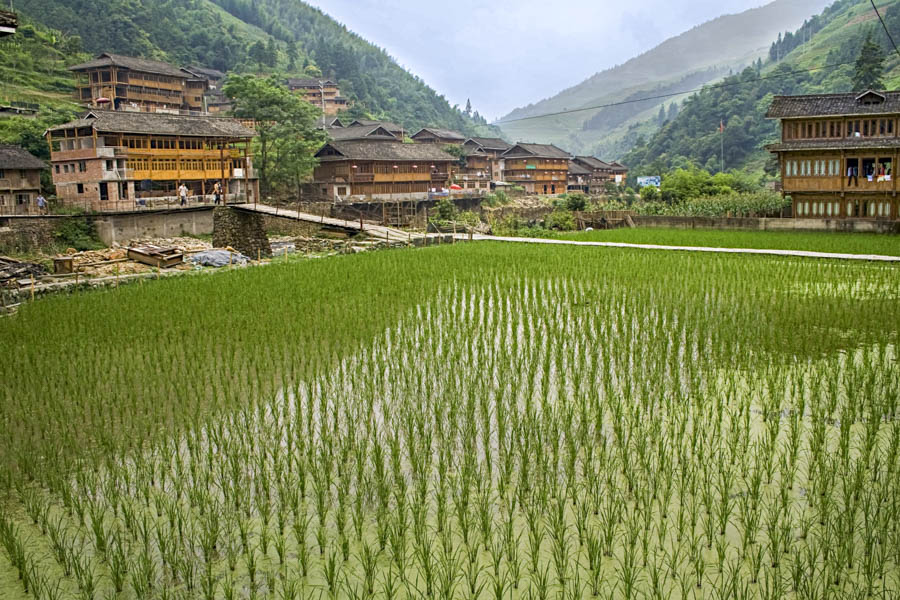
The villagers are proud of their traditions, which they keep alive and love to share with visiting travellers. If your visit coincides with a festival, it may become one of the most memorable parts of your time in China.
Entertainment in the Longsheng Scenic Area
Yao and Zhuang Cultural Festivals
Festivals in the mountain villages follow the lunar calendar and the rhythms of agriculture. In spring, the Ganniao Festival (赶鸟节, Bird-Chasing Festival) is a festival held on the first day of the second lunar month. It holds a significant place in regional cultural life. Villagers wear traditional blue-and-white costumes, perform folk songs and prepare sticky rice cakes.
On the third day of the third lunar month, Huangluo Red Yao Village hosts the annual ‘March 3rd Long Hair Festival’.
Longji Long Hair Festival, in April, is worth the visit, specifically in Huangluo Yao Village, where Red Yao women celebrate by washing and combing their traditional long hair, performing dances, and singing.
On the 8th day of the 4th lunar month, the Ox Festival marks the opening of the farming year and honours the ox as a symbol of labour. In late spring or early summer, on the 29th day of the 5th lunar month, you may encounter celebrations for the Danu Festival, which brings folk songs, dances and communal feasting.
A particularly rewarding time to visit is mid-October, during the harvest, when traditional farming is on full display alongside the colourful Yao Clothes-Drying Festival.
In autumn, on the 16th day of the 10th lunar month, Yao communities hold the Panwang Festival, honouring the mythological ancestor Pan Hu (King Pan). This is the main Yao celebration: a grand carnival with colourful performances and an enormous spread of local dishes. The day features ceremonial rites in traditional costumes, musical performances, drum dances and sacred ceremonies.
Regular Activities, Shows and Workshops You Can Attend
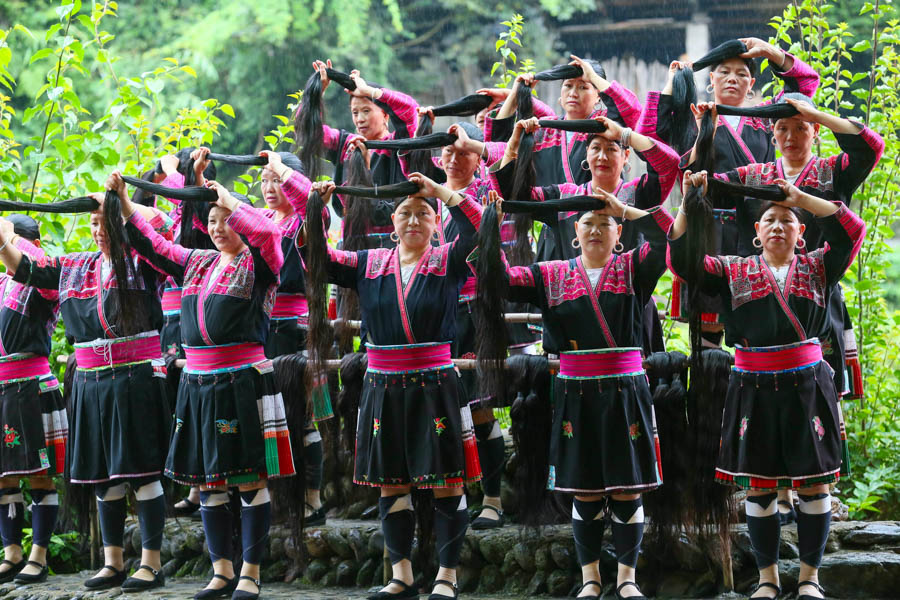
Watch the Long Hair Show, in which Yao women unbraid, wash and comb their remarkably long hair using traditional rice-water treatments. You can also see how colourful garments from local communities are made, with intricate embroidered patterns taking shape on brightly dyed cloth.
Visit Huangluo Yaozhai Song & Dance Place (黄洛瑶寨歌舞场) for folk performances featuring traditional songs and dances. Overnight guests at village guesthouses can often join masterclasses on preparing local dishes.
A number of local shops hire out traditional Yao and Zhuang costumes so visitors can pose for photographs against the terrace backdrop.
Embrace Sustainable Shopping
The villages are dotted with small shops selling handicrafts. Shops sell embroidered bags, silver jewellery and bamboo items, alongside Longji Yunwu tea, Longji chilli, sweet rice wine and fragrant glutinous rice, collectively known as the Four Treasures of Longji. Buying here supports local families and the traditional crafts they practise. Fresh produce is also worth seeking out: bamboo shoots, wild mushrooms and brake ferns – all valued locally for flavour and their reputed health properties.
At the China Long Hair Science and Technology Museum (中国长发科技馆) in Huangluo Village, visitors can learn about local hair-care traditions and purchase rice-water-based shampoo produced using ancestral recipes and modern techniques. Admission and the guided tour are free of charge.
Food in Longsheng Scenic Area
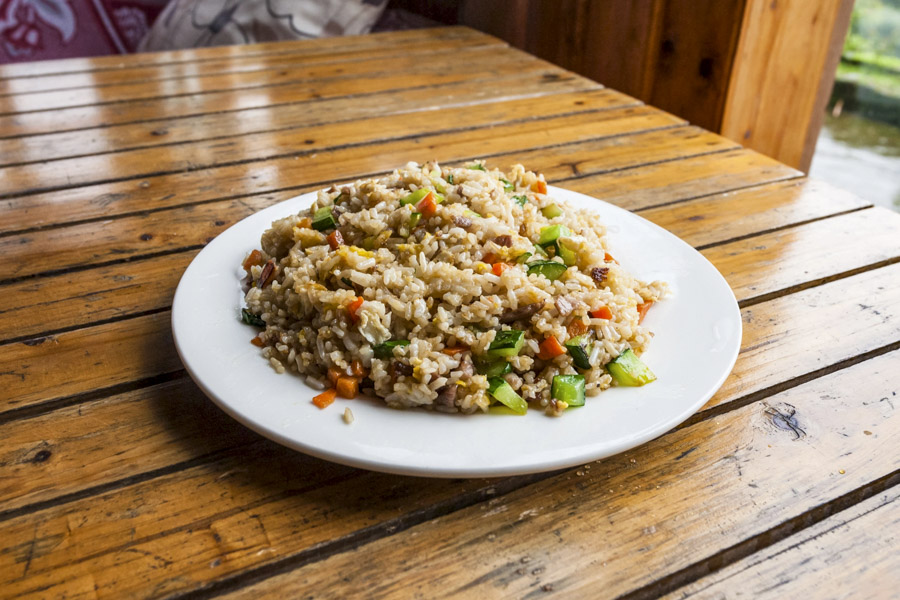
Cooking in Longsheng’s mountain villages is simple, hearty and closely tied to local produce. Rice, fresh vegetables and produce from the surrounding slopes form the base. Meals are served in small family-run restaurants and guesthouses, prepared from recipes passed between generations. However, there are ample opportunities to observe how the food is prepared, as many villagers open their doors to curious visitors keen to learn about their traditional cooking techniques.
Chinese Cuisine
The area’s best-known dish is bamboo rice: sticky rice packed with meat, vegetables and mushrooms, then cooked inside a bamboo tube over an open flame. The rice takes on a subtle smoky fragrance from the bamboo. It usually takes about half an hour to cook.
Among the savoury dishes, local favourites include free-range chicken, either prepared with bamboo shoots or braised in spring water, and chilli with smoked pork, which combines local chillies with aromatic smoked meat. Longji sour fish, made with freshwater fish marinated in fermented sauce and fried until crisp, appears on most menus. All are served with rice grown on the terraces.
Glutinous rice wine, a homemade sweet rice wine, commonly accompanies meals. Also worth trying is oil tea – a traditional drink of southern China’s ethnic communities. A strong base infusion is enriched with roasted rice, peanuts, ginger and aromatic herbs. It is typically served before a meal or alongside light snacks.
Best Restaurants in Longsheng Scenic Area
Set above the terraces, a number of restaurants serve local food with wide views over the slopes. The teahouses and dining rooms here are often busy, with villagers and travellers sharing the same tables and stopping places.
In Dazhai, Longji Yijing Meishe Terraced Field Restaurant (龙脊逸景美舍·梯田餐厅) is a good place to pause after walking the trails. The cooking is simple and filling: rice noodles with a satisfying bite, freshly cooked river fish, snails in a rich spicy sauce, and a vegetable stew with light herbal notes. After a long climb, this kind of food feels especially welcome.
Also in Dazhai, Longji Terrace Jingyuan Mountain Villa Restaurant (景园山庄) has a quieter, more traditional atmosphere. The menu includes clear chicken soup with a warming broth, bamboo-tube chicken with rice and a faint smoky aroma, cured pork, and dumplings filled with wild chives, which add a gentle sharpness. The cooking here is straightforward, with an emphasis on clean flavours.
In Jinkeng, Yue Longji Restaurant (悦·龙脊餐厅) offers a slightly richer style of cooking. Stuffed tofu comes with a soft, juicy filling and a lightly crisp outer layer, while pork braised with herbs and bamboo shoots is cooked until tender. A glass of warm rice wine works well alongside it. The flavours are fuller here, but still balanced.
Longsheng Rice Terraces Transport
By Foot
Getting around the Longsheng area is largely on foot. For those with mobility issues, sedan chairs with porters are available. Hire a local guide for waymarked trails or a porter to help with luggage on steep climbs.
From the village car parks, footpaths lead upward to the terraces and viewing platforms.
Shuttle Buses
Tourist shuttles link the scenic area entrance with the village car parks, carrying visitors to the trailheads.
Cable Car
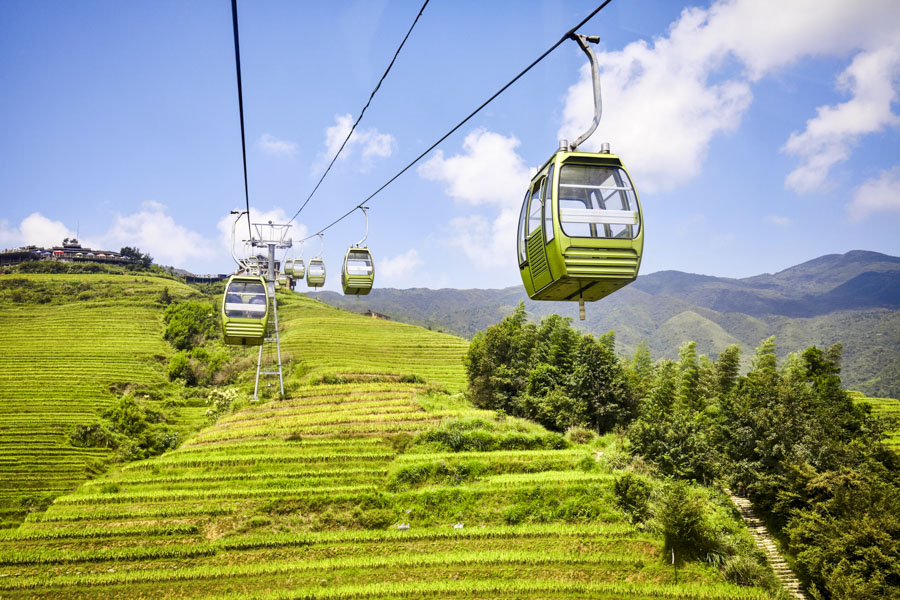
Within the Jinkeng (Dazhai) Rice Terraces area, the Longji Cableway (龙脊索道) runs, linking the car park at Dazhai Village with the Golden Buddha Peak viewing platform. The ride takes roughly 20 minutes, offering a direct route to one of the highest vantage points.
The system has 113 gondolas, each carrying four passengers, over a 1,380-metre route with an elevation gain of 310 metres.
Operating hours for the cable car:
- High season (April to November): 08:00 to 18:00
- Low season (December to March): 09:00 to 17:00
Longsheng Rice Terraces Tickets
Access requires a single ticket for the Longsheng Terraced Fields Scenic Area, which covers all three terrace zones. Tickets are sold at the entrance gate or online through WeChat mini-programmes.
Current prices:
- CNY/RMB 80 (approximately $11.60 / €10 / £8.80) per adult.
- CNY/RMB 40 (approximately $5.80 / €5 / £4.40) per child aged 6 to 18.
- Free – children under 1.20 metres (3.9 feet).
Shuttle buses cost CNY/RMB 50 (approximately $7.30 / €6.30 / £5.50) (paid separately).
Cable car fares are CNY/RMB 70 (approximately $10.15 / €8.80 / £7.70) one way and CNY/RMB 110 (approximately $16 / €14 / £12) return (paid separately).
Please note: prices are subject to change. The figures above are indicative.
How to Get to the Longsheng Rice Terraces?
Several transport options connect Guilin with the terraces.
By Bus
Travelling by public bus is a practical way to reach the Longji Rice Terraces if you are comfortable navigating the connections yourself. It is the most budget-friendly option and offers a clearer sense of everyday travel in the region.
Here is what you need to know:
Option 1: Transfer in Longsheng (most common)
Step 1: Take a bus from Guilin North Bus Station (桂林汽车客运北站) or Qintan Bus Station (桂林琴潭客运站) to Longsheng Bus Station. The journey takes about 1.5–2 hours.
Step 2: From Longsheng Bus Station, change to a local bus to Ping’an or Dazhai. The onward journey takes about 1 hour.
Option 2: Transfer at the Scenic Area entrance (less frequent)
Step 1: Take a direct bus from Qintan Bus Station (桂林琴潭客运站) to the entrance of the Longji Rice Terraces Scenic Area. The journey takes about 2–2.5 hours.
Step 2: From the entrance, continue by shuttle bus to Ping’an or Dazhai.
Option 3: Direct to Dazhai (no transfer needed)
There is also a direct route from Guilin to Dazhai Village: buses depart from Guilin Hong Kong Hotel (桂林香江饭店) three times a day – at 08:30, 10:00 and 13:00 – and arrive at Jinkeng Dazhai Parking Lot. The journey takes approximately 2–2.5 hours.
The entrance to the Longji Rice Terraces Scenic Area, where tickets are purchased, lies about 22 km from Longsheng County, or around 30 minutes by road, and approximately 76 km from central Guilin. From there, the distances to the main terrace areas vary: around 9 km to the Longji Ancient Zhuang Terraced Fields, about 17 km to Ping’an, and roughly 23 km to the Jinkeng (Dazhai) Rice Terraces.
By Taxi
Didi – China’s equivalent of Uber – operates in Guilin and offers a door-to-door option. Cars are booked through the mobile app; you can specify a particular village as the destination.
The journey typically takes 1.5 hours, depending on traffic.
Expect to pay considerably more than public transport – around CNY/RMB 250 (approximately $37 / €32 / £27.50) for the car, plus an optional CNY/RMB 53 (approximately $7.70 / €6.70 / £5.90) toll fee. It is worth arranging the return journey in advance.
Please note that prices are indicative and may vary significantly. It is recommended to agree on the fare with the driver before your ride.
Ride-Sharing Services
Shared minivans and cars offer another practical option, with transfers typically organised among travellers heading to the terraces on the same day.
Bookings are commonly made through mini-programmes on WeChat or arranged via hotels, hostels and local tour operators. Vehicles generally collect passengers from hotels in Guilin and drop them at the scenic area entrance or directly at the villages.
Fares typically run to CNY/RMB 60 to 100 (approximately $8.70 to $14.50 / €7.60 to €12.60 / £6.60 and £11) per person. This avoids the transfers required on public buses and is often faster.
Private Car with Chauffeur and Guide
The best option is to book a one-day private tour with a guide who will accompany you and make the most of your experience at Longsheng.
Languages Spoken at the Longsheng Rice Terraces
The linguistic landscape around the terraces is unusually varied. Standard Chinese Mandarin (Putonghua) – China’s official language – serves as the common tongue between villages and with visitors.
Within their own communities, residents continue to speak the languages of their ethnic groups: the Zhuang language and the Yao language. A notable feature of the area is that many residents switch freely between several languages: they use their community’s mother tongue at home and shift to Mandarin when speaking with outsiders or neighbouring villages.
English is limited in the rural areas, though guesthouse and ticket-office staff generally manage basic phrases.
Security at the Longsheng Rice Terraces
The terraces are generally safe, but the mountainous terrain and limited rural infrastructure call for common-sense precautions.
Caution on the trails
Paths are mostly stone trails and steps. Surfaces can be uneven and slippery, particularly after rain. Shoes with reliable grip are essential; take particular care on narrow sections that lack railings.
Weather and terrain
Mountain weather is humid and changeable. Bring a raincoat or light jacket, drinking water and sun cream.
Navigation and routes
Some trails fork without clear signposting. Stick to the main paths, carry offline maps, or ask local residents and tourist-centre staff for guidance.
Getting around after sunset
Artificial lighting in the mountains is minimal. Plan terrace walks for daylight hours.
Respect for local communities
If you are passing through Guilin, it is worth making time for the Longsheng Rice Terraces. Their character changes noticeably from season to season, as the paddies shift in colour and light through the farming year. Seen at different times, the slopes can feel almost like a different landscape altogether. What remains constant is the sense of continuity: the work of generations, still visible in the contours of the mountain, and the close relationship between cultivation and terrain. Let us help you plan an extended stay and make this place your own little slice of paradise.