

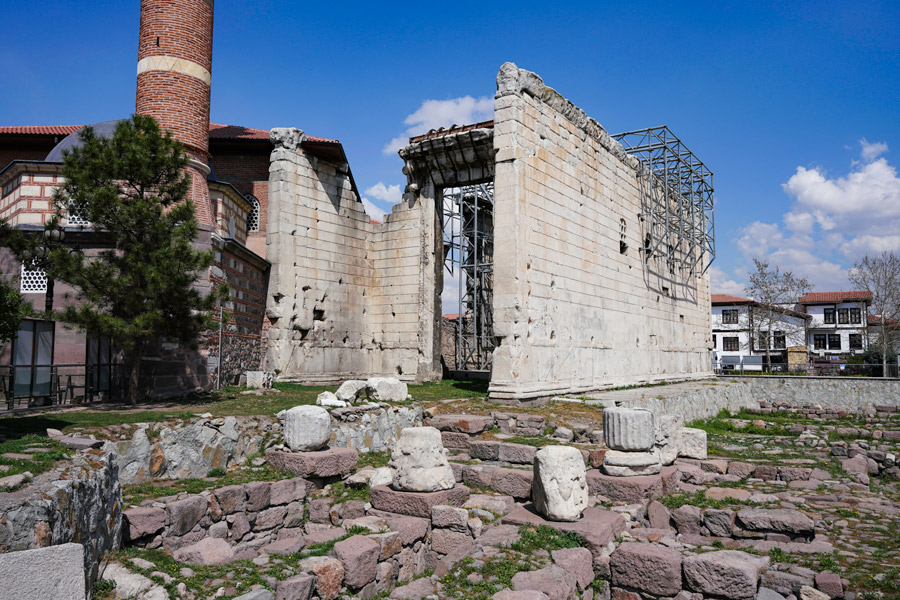
The Temple of Augustus Ankara (also known as the Temple of Augustus and Rome) (Augustus Tapınağı) is one of the most significant historical monuments in Türkiye, yet it often surprises with its quiet presence. Free from heavy tourist traffic, the temple is an ideal stop for anyone who appreciates ancient ruins and the rare luxury of calm exploration.
Located in Ankara’s Ulus quarter of Altındağ district, next to the Hacı Bayram Mosque, this Roman temple preserves the most complete surviving text of Res Gestae Divi Augusti (The Deeds of the Divine Augustus), the political testament of Rome’s first emperor, Augustus. For travellers interested in Roman history, ancient architecture, and layered urban heritage, this site is a must-see in Ankara.
Origins of the Temple of Augustus in Ankara
After the death of Rome's first emperor, Augustus (also known as Octavian), cities across the empire erected monuments, Augustea, in his honour. The Temple of Augustus in Ankara was constructed between 25 and 20 BC, shortly after Rome annexed the Central Anatolian territories and formed the province of Galatia. The installation was a deliberate political act, intended to align the city with imperial authority and to display loyalty to Rome.
Archaeological evidence suggests that the Roman temple may have been built on or near an earlier local sacred site, possibly linked to Phrygian religious traditions, although the fact cannot be proven with certainty. However, we can firmly confirm that the Late Roman or Early Byzantine period saw the temple’s adaptation for Christian use. At that time, structural modifications, such as the insertion of three windows, were made to suit church functions.
In the 15th century, the Ottomans constructed the Hacı Bayram Mosque immediately adjacent to the temple. The locals eventually constructed homes around the ruins before contemporary conservation efforts revealed the site in its current state.
Now, the temple stands within the UNESCO Tentative List–protected Hacı Bayram District, recognised as part of the “Hacı Bayram Mosque and its Surrounding Area”. The existence of a mosque and a temple so close to each other creates a rare and powerful example of architectural and cultural continuity in Turkey.
Why the Temple of Augustus in Ankara is So Important
The international significance of the Temple of Augustus in Ankara rests on the presence of the Monumentum Ancyranum. The inscription on the temple walls reproduces Augustus’s own account of his achievements, including military victories, public building projects, financial reforms, and political offices.
The Res Gestae Divi Augusti text was engraved in both Latin and Greek, allowing it to reach a wider provincial audience. The words are cut deeply into the stone, which has helped preserve them despite centuries of exposure. It serves as a fundamental resource for contemporary historians to comprehend Augustus's rule and Roman imperial ideology. For visitors, it provides a direct connection to the voice of antiquity, presented without later interpretation.
The temple is therefore not only an archaeological site but also a primary historical document carved in stone.
Temple of Augustus Architecture and Remains
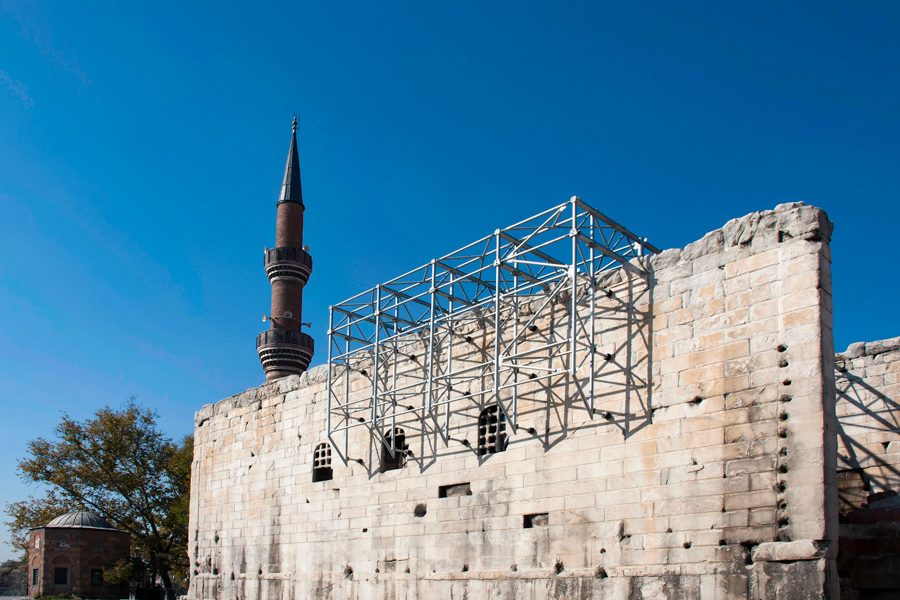
Architecturally, the temple followed a traditional Roman peripheral design. It once stood on a raised podium and was surrounded by columns, most of which have not survived. Today, the most prominent features are the outer walls and sections of the inner chamber, known as the cella.
The remaining structure allows visitors to clearly understand the size and layout of the original building, even in its partially ruined state. Unlike more ornate Roman temples, decoration here was secondary to the message. The emphasis was on permanence, authority, and text.
The Temple and Hacı Bayram Veli Mosque
One of the most distinctive aspects of the site is its integration with Hacı Bayram Veli Mosque, a 15th-century Ottoman religious complex. The mosque was built directly adjacent to the Roman temple, sharing walls in places.
This proximity is not accidental. It reflects the organic development of Ankara rather than the removal or isolation of earlier structures. Roman, Byzantine, Seljuk, and Ottoman layers coexist within the same urban fabric.
For visitors, this harmony offers a rare opportunity to see how sacred spaces were adapted and reused over time, without erasing their predecessors.
What to Expect When Visiting the Temple
The Temple is an outdoor site that does not require a ticket. Tourists can walk around the ruins freely during daylight hours. Informational panels on site explain the history and significance of the inscriptions, and QR codes provide additional context.
The Ankara Old Town area, where the temple is located, is generally calm on weekdays, while weekends can be busy due to local guests and worshippers attending the mosque. Early morning or late afternoon visits allow for a quieter and more reflective experience.
The site remains an active religious and social space; thus, respectful behaviour and modest clothing are recommended.
Best Time to Visit the Temple of Augustus
Late afternoon is widely considered the best time to visit the Temple of Augustus. The lower angle of the sun highlights the texture of the stone and makes the writing easier to read. Evening light also enhances the contrast between the Roman walls and the Ottoman mosque.
While every season has its charm, spring and autumn offer the most comfortable conditions for exploring the surrounding Old Town on foot.
Nearby Historical Attractions in Ankara Old Town
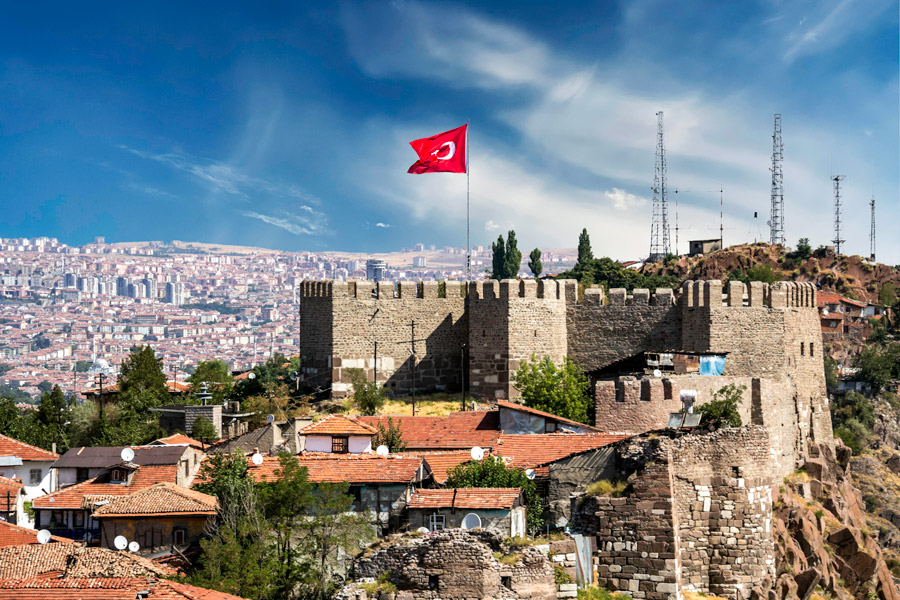
The Augusteum sits at the heart of Ankara Old Town, making it easy to explore several important sites on foot. A short stroll through the neighbourhood leads to the Museum of Anatolian Civilisations (Anadolu Medeniyetleri Müzesi), where the broader story of the region’s ancient cultures comes into focus. From there, the path continues uphill to Ankara Castle (Ankara Kalesi), whose walls offer wide views over the city. Nearby, the Roman Baths of Ankara (Ankara Roma Hamamı) provide a clear sense of the scale and everyday life of Roman Ancyra.
For more intriguing places you can visit in Ankara, you can view Advantour’s comprehensive guide about the city’s attractions.
How to Get to the Temple of Augustus in Ankara
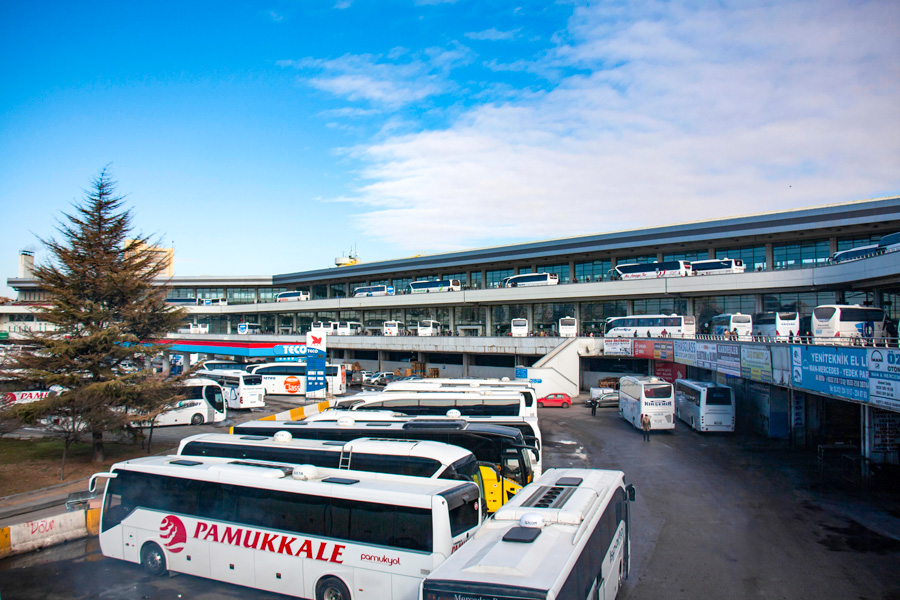
Ankara's Ulus district, a central area well-served by public transport, houses the Temple of Augustus. Ulus metro station is a short walk away, and numerous bus routes stop close to Hacı Bayram Square.
Several city buses serve the Ulus and Hacı Bayram areas directly. Buses stop within walking distance of the temple at nearby bus stops, such as the Atatürk Anadolu Lisesi, Yıldırım Beyazıt Vergi Dairesi, Asbü, and Anafartalar, all located around Ulus Square.
Taxis are widely available and offer a convenient alternative to central neighbourhoods. Driving becomes less practical here due to limited parking and heavy traffic. Using public transport or approaching the site on foot allows for a smoother visit and avoids unnecessary delays.
Practical Travel Advice for Visitors
The temple is fully outdoors, with little shade, so it is worth bringing sun protection in warmer months, especially around midday. There are no visitor facilities such as bathrooms on site, which means planning ahead is helpful. Taking a few extra minutes to walk slowly around the walls allows the inscriptions to reveal themselves gradually, particularly as the light changes.
Because the temple sits beside an active mosque, the atmosphere can shift throughout the day. Prayer times bring moments of quiet focus, while other times feel more social and livelier. Allowing yourself time to pause in the square or nearby restaurants or cafés helps the visit feel less like a checklist stop and more like a natural part of everyday life in Ulus.
The Lasting Legacy of the Temple of Augustus Ankara
The Temple of Augustus Ankara is not defined by scale or spectacle. Its importance lies in meaning, context, and survival. As the home of the Monumentum Ancyranum, it offers unmatched insight into Roman political thought and imperial self-representation.
Set within a living urban and religious environment, the temple also tells a broader story about Ankara itself. For travellers seeking depth, authenticity, and historical clarity, this shrine remains one of the city's most rewarding destinations.