

Most travellers passing through Ankara fill their onward itineraries with Ephesus, Cappadocia, and Pamukkale – undoubtedly, all worth it. But two hours east of the capital hides the Yazılıkaya Sanctuary. It doesn’t dazzle you with marble columns or thermal pools. It rather unsettles, quietly, the way a very old thing sometimes does.
Visitors walk into a narrow rock corridor, and suddenly they are surrounded. Hittite gods on every wall – more than sixty of them, carved into living stone, in frozen procession since the late 13th century. A Hittite king, life-size, embraced by the god of the underworld. And above it all, a sky carved in a stone that – if the latest science is right – was designed to track lunar months, days, and solar years.
What is Yazılıkaya?
The Yazılıkaya rock sanctuary is an important Hittite open-air temple. It is also, possibly, one of the most sophisticated astronomical monuments of the ancient world. It waits just two kilometres from Hattusa, the Hittite capital, near the modern village of Boğazkale. And it is one of the most astonishing off-the-beaten-path ancient sites in Turkey. Few people have heard of it.
History of the Yazılıkaya’s Accidental Rediscovery
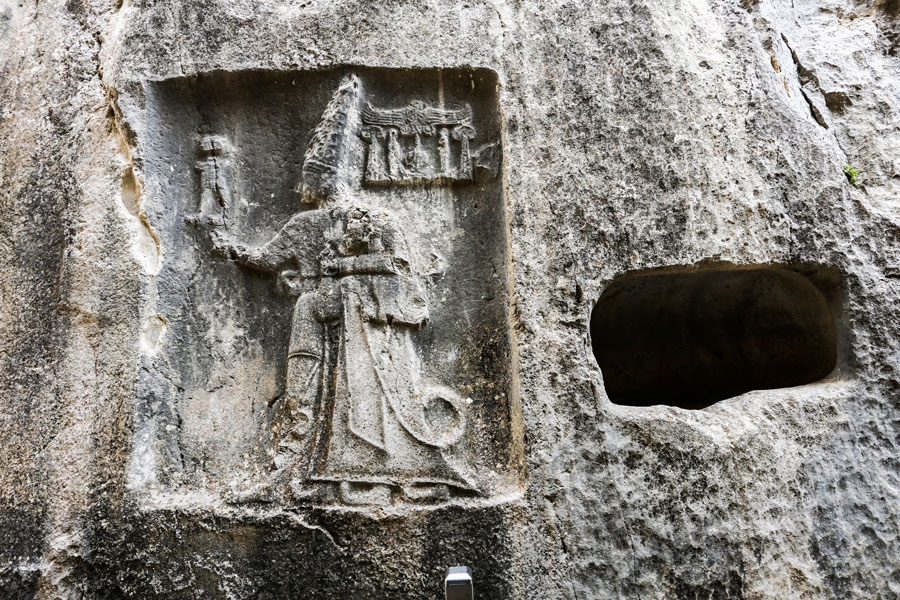
In the summer of 1834, a French archaeologist and explorer, Charles Félix Marie Texier (1802-1871), was riding through Central Anatolia in search of an ancient ruin. He never found it. What he stumbled upon instead was a vast ruined city on the plateau above the Kızılırmak river. Its walls stretched for kilometres, its gates flanked by lions and sphinxes cut from living stone. And over a mile away, engraved into a natural outcrop of rock, the locals led him to the Yazılıkaya Sanctuary.
He assumed it was Greek or Roman. It wasn't. A few dozen stone portraits in two separate chambers, arranged in long ceremonial processions, were at least a thousand years older than anything Greek. They belonged to a civilisation not yet recognised by 19th-century scholarship as the Bronze Age Hittite kingdom.
Texier was the first to identify and then publicise the ruins of Hattusa and the Yazılıkaya rock reliefs at that stage.
However, it was not until the 20th century, when archaeologists excavated Hattusa's clay tablets, that the Hittite religion and its ritual life could be properly studied. And not until the 21st century did the full significance of Yazılıkaya begin to emerge.
Who Built Yazılıkaya?
The sanctuary reached its current form under King Tudhaliya IV (reigned c. 1237–1209 BC). The same king we encounter on the Hattusa site. His builders did not create the rock reliefs from scratch. Earlier phases of carving exist, but he appears to have transformed Yazılıkaya into the form that has survived to the present day.
The site is part of the UNESCO World Heritage list that covers Hattusa and its surrounding monuments. It is located approximately two kilometres northeast of the main archaeological zone. Travellers can easily combine it with a visit to Hattusa in a single day. (Ahrens, A. (2014). Gods Carved in Stone: The Hittite Rock Sanctuary of Yazılıkaya).
What to See in the Yazılıkaya Rock Sanctuary
The Hittites did not choose this location by accident. They believed their gods dwelled among rocks and in sacred groves. This outcrop, shaded by trees and enclosed by natural stone walls, must have seemed like exactly the kind of place a god might inhabit.
The Yazılıkaya rock sanctuary has two natural rock galleries, formed by geological accident and then shaped by human hands.
Chamber A is the larger of the two, about 30 metres long and open to the sky. Its walls are lined with a procession of Hittite gods approaching from both. Chamber B is narrower and darker.
Chamber A – The Divine Council
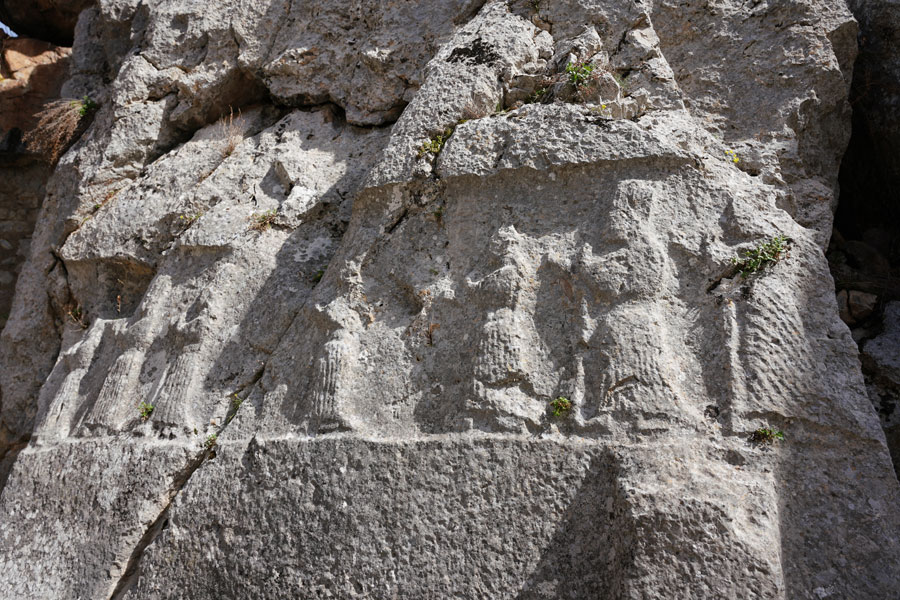
The walls inside Chamber A depict two processions of gods: male deities along the left wall and female deities along the right. They converge on a central scene in which the storm god Teshub and the sun goddess Hebat face off.
Teshub rests on the shoulders of two mountain gods. Hebat stands atop a panther. Both wear the tall, horned crown that identifies divinity in Hittite mythology. There are 42 figures on the male side, 21 on the female side. Today, only 19 female deities are clearly visible.
Chamber B – The Underworld
The Hittite rock art takes on a different atmosphere in Chamber B – tighter and more intimate.
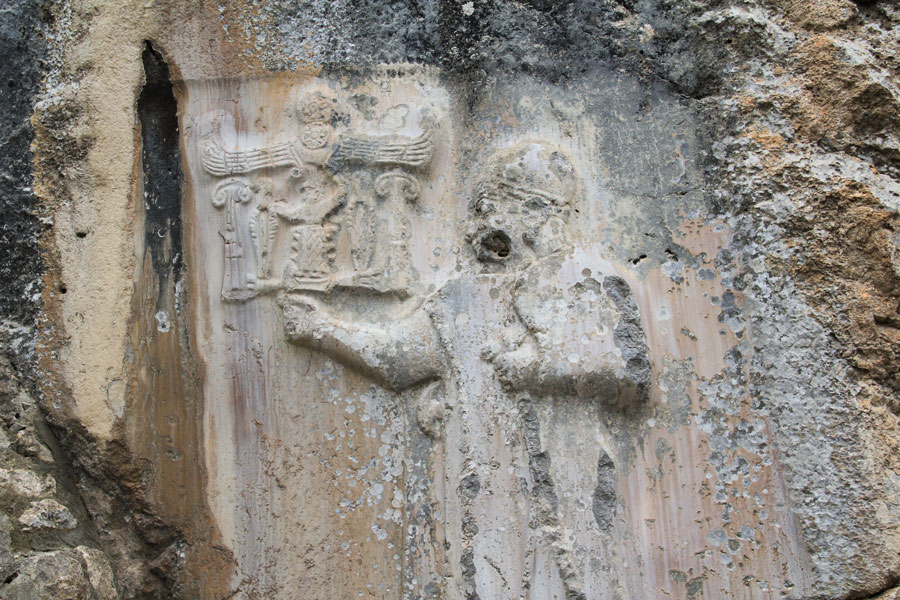
The Sword God (Nergal): On your right, a blade emerging from the rock. Look carefully at the hilt. It is formed by two lions facing each other, and above them, a human head wearing a horned divine crown. This is Nergal, the god of the underworld, often interpreted as a sword deity. The sword is not metaphorical. You are currently in the Hittite land of the dead.
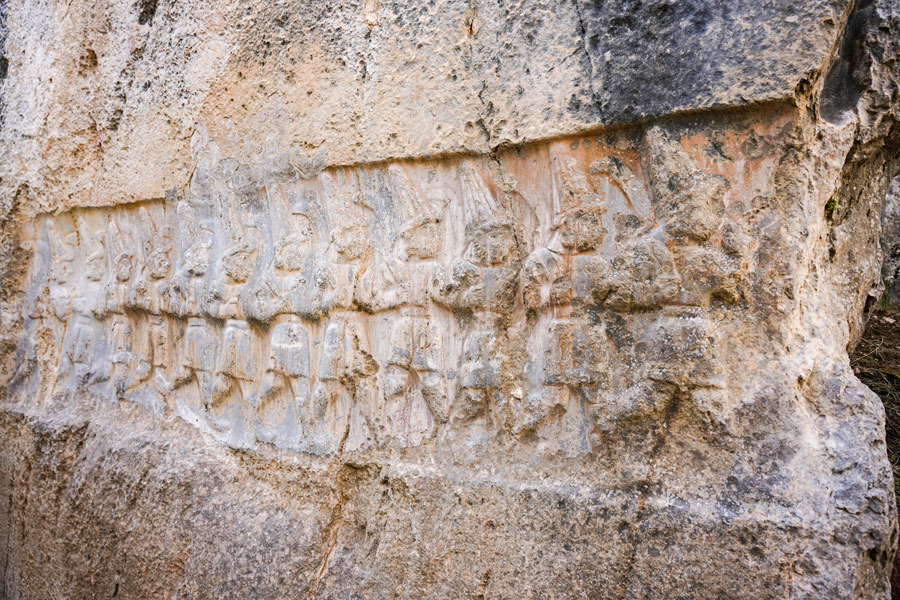
The Twelve Gods: The procession on the left wall. Twelve identical figures, carrying sickle-shaped swords.
King Tudhaliya IV: The most personal image in the entire sanctuary. The king appears in full regalia, and behind him, arms wrapped around his chest in a gesture of protection. This is the god Sharruma – a divine embrace that has survived 3,200 years.
- Take some time in Chamber B. Look up at the sword-god of the underworld and the hewn figure of the king who built this place. You can be inside one of the oldest astronomical monuments on earth. Here is why.
Yazılıkaya Calendar Theory – Was It a Lunisolar Calendar?
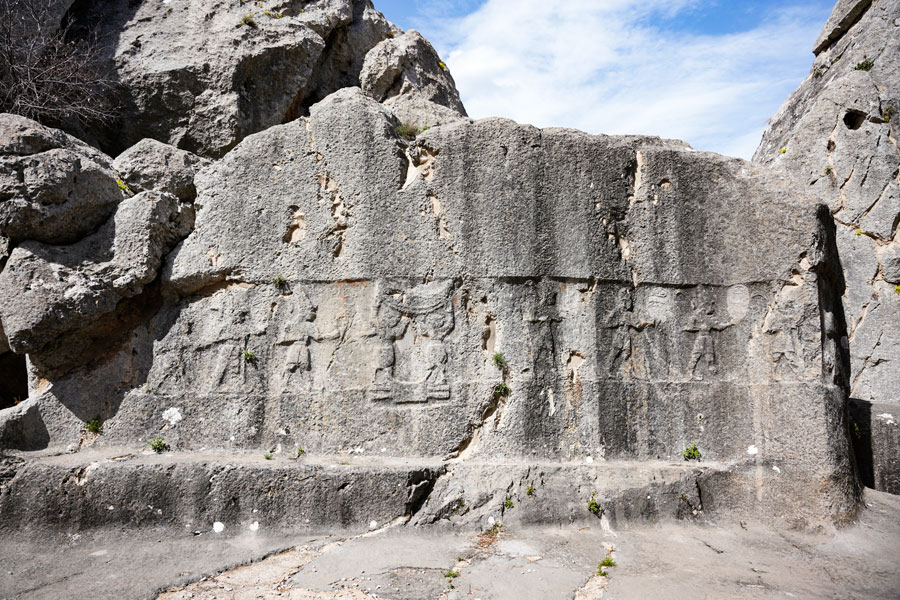
For over a century, scholars debated what the Yazılıkaya Sanctuary was actually for. A temple? A royal mausoleum? A seasonal festival site? Neither of these explanations fully accounted for the specific numbers and arrangements of the figures.
In 2019, researchers Eberhard Zangger and Rita Gautschy published a paper that tried to reframe the entire question. The key, they argued, was arithmetic. The figures at Yazılıkaya are not arranged randomly – they are arranged in groups of 12, 30, 5, and 19. These are not arbitrary numbers. Twelve lunar months. Thirty days per lunar month. Five intercalary days needed to bridge a lunar and a solar year. And 19 – the number of years in the Greek astronomy; this is the period after which the lunar and solar calendars realign, a cycle the ancient Greeks thought they had identified. And what if the Hittites had encoded an astronomical calendar in stone centuries earlier?
The female procession in Chamber A, divided by that stone column into groups of 8 and 13, maps onto the 8- and 19-year astronomical cycles that track the synchronisation of sun and moon. The sanctuary, Zangger and Gautschy concluded, was a lunisolar calendar, one that could be used to determine the correct date for religious festivals, agricultural cycles, and royal ceremonies.
It is, if the theory holds, one of the most refined scientific instruments of the ancient world. Built not from bronze or clay, but from the rock of the Anatolian plateau itself. (Zangger, E., & Gautschy, R., 2019). Celestial aspects of Hittite religion: An investigation of the rock sanctuary Yazilikaya. Journal of Skyscape Archaeology, 5(1), 5-38.)
What the 3D Scans of Yazılıkaya Revealed
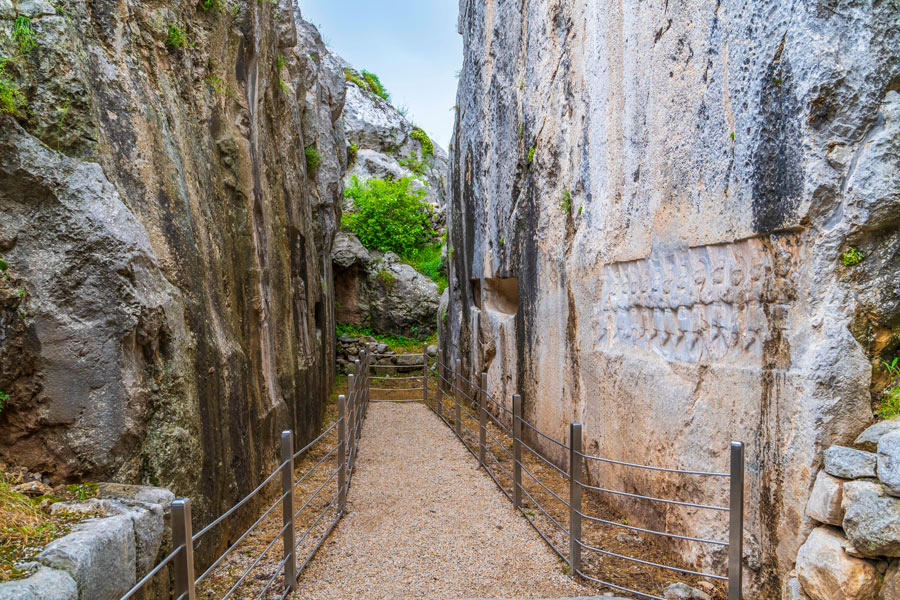
Understanding Yazılıkaya took so long partly because the reliefs are difficult to read. Centuries of weathering have softened the carved lines; some figures are partially obscured; the spatial relationships between groups are hard to judge from the ground level.
Since 2014, a collaboration between the University of Naples and the German Archaeological Institute has been using 3D laser scanning to document Yazılıkaya and large sections of Hattusa. The scans have made previously unreadable engravings and inscriptions legible. As a result, better data on the spatial relationships between figure groups and for further interpretation were obtained. (Repola, L. (2017). Constructing and Representing: a New Project for 3d Surveying of Yazilikaya-HATTUŠA. The International Archives of the Photogrammetry, Remote Sensing and Spatial Information Sciences.)
In 2024, the same zone yielded another revelation: painted hieroglyphs were found inside the Yerkapı tunnel at Hattusa – the subterranean passage that runs beneath the great southern rampart. The unearthing opened a new chapter in Hittite epigraphy and is a reminder that this site continues to surprise. (Novák, M., & Payne, A., 2024). The Monumental Turn and Hieroglyphic Writing in Hittite Empire. Bollatti Guzzo, N, 205-36.)
How to Visit Yazılıkaya Hittite Rock Reliefs
Where is Yazılıkaya located? The Yazılıkaya Sanctuary lies 2 km northeast of the main Hattusa archaeological zone, near the village of Boğazkale in Çorum Province, approximately 200 km east of Ankara.
Combining the sites: Yazılıkaya and Hattusa are almost always visited together and are the natural centrepiece of a full-day trip. A third option, Alacahöyük, is 38 km farther and can be added for a longer loop through Hittite Anatolia.
Best time to visit: Late afternoon is ideal. The low-angle light enters Chamber A from the southeast and throws long shadows across the relief carvings, making the figures far more legible than at midday. If your visit coincides with the summer solstice (around 21 June), the alignment is visible and extraordinary.
Best season: May–June and September–October. The Anatolian plateau is exposed and hot in high summer; spring and early autumn offer far more comfortable walking conditions in both Yazılıkaya and Hattusa.
Opening hours: The site is generally open daily from 08:00 to 19:00 in summer and 08:00 to 17:00 in winter, though hours may change. Check locally on arrival in Boğazkale.
Boğazköy Museum: Before or after the sanctuary, the museum in the village below is worth a stop. It holds original Hittite artefacts excavated from both Hattusa and Yazılıkaya.
Tickets: Yazılıkaya and Hattusa are included in a single combined ticket, purchased at the Hattusa entrance gate. Hold on to your ticket after visiting Hattusa, as you will need it again at Yazılıkaya.
Museum Pass Türkiye: Visitors can purchase a 15-day e-card to visit Hattusa, the Boğazköy Museum, and Yazılıkaya. It provides access to over 300 museums and archaeological sites across the country.
Lunch in Boğazkale: Boğazkale village has a handful of restaurants where you can sit down after the sites. ODAK Restaurant ve Otel is a favourite among visitors. This family-run spot serves homemade Turkish meals.
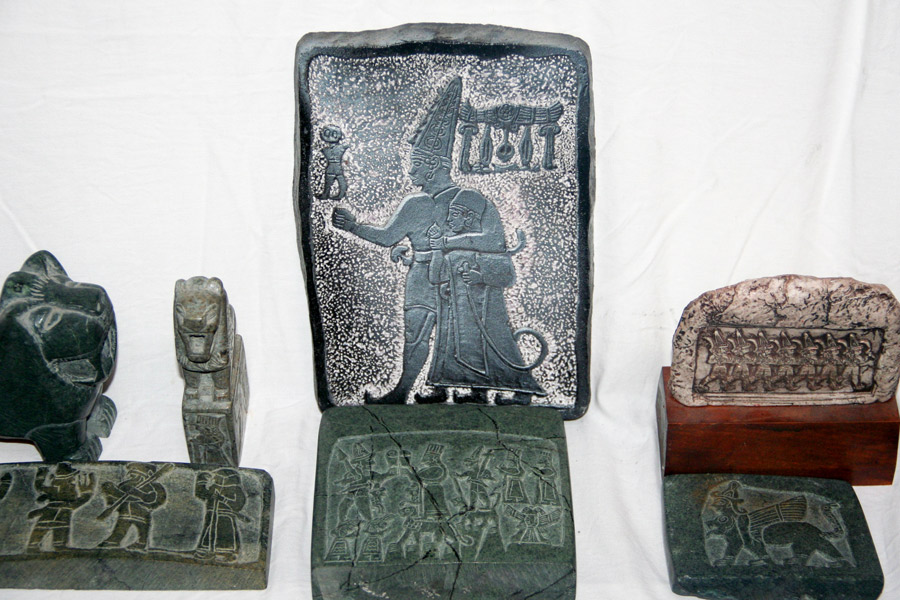
Souvenir Stalls: Outside the entrance, a handful of stalls sell souvenirs, small replicas of the Hittite reliefs, and local crafts – a good place to pick up something to remember the visit.
Getting to the Yazılıkaya Sanctuary from Ankara
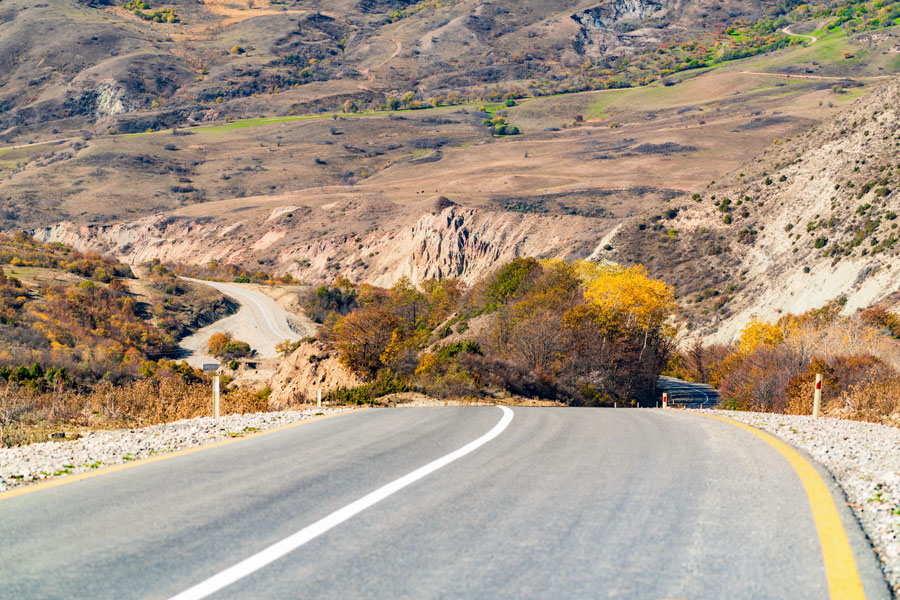
Ankara to Boğazkale (the nearest village) is approximately 2.5 hours by car or bus via Sungurlu. Most independent travellers hire a car from the capital. It gives the freedom to cover Yazılıkaya and Hattusa in a single full day without rushing.
Full transport details – from Ankara, Cappadocia, and by public bus via Sungurlu – are provided on the Hattusa page. The same road reaches Yazılıkaya and is part of the same visit.