

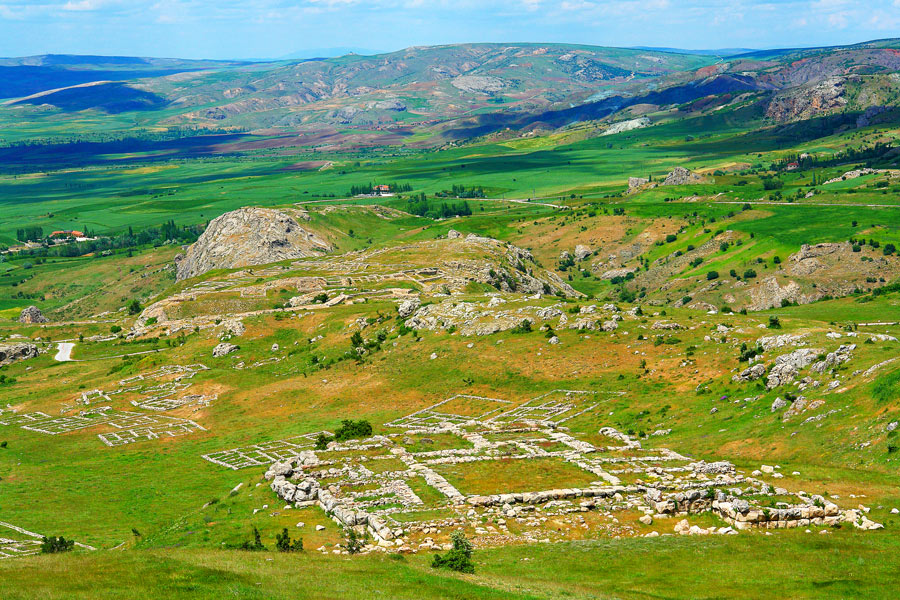
Hattusa (Hattuşaş), also known as Hattusha, is an ancient city near the modern village of Boğazkale in Türkiye, 200 kilometres east of Ankara in Central Anatolia. It was the capital of the Hittite Empire and a major centre of the Ancient Near East. During the Late Bronze Age, this mysterious state held its own against Egypt and Babylon.
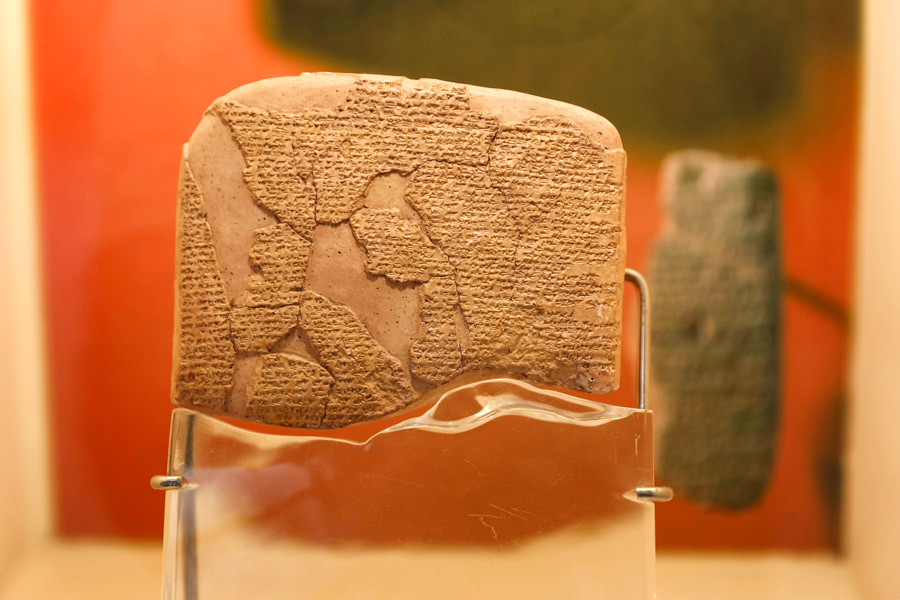
What may be the world’s oldest Peace Treaty between great powers was discovered in Hattusa. This is the famous Egyptian–Hittite treaty following the Battle of Kadesh, signed between Ramesses II and Hattusili III. A copy of it, gifted by Turkey, is displayed at the United Nations headquarters in New York. In 1986, UNESCO inscribed Hattusa on its World Heritage list.
If you are staying in Ankara, a visit to the Hattusa archaeological site makes for a perfect day trip. It is usually combined with the Yazılıkaya Sanctuary. The two sites are just two kilometres apart. A further 38 kilometres away lies another mysterious Hittite city, Alacahöyük. Hattusa may also fit into a day trip from Cappadocia – 195 kilometres, or about three hours by road.
History of Hattusa
The Hattusa Ancient City (Hattuşaş Antik Kenti) has a long history. It is thought that towards the end of the third millennium BC, the Hattians founded this Bronze Age city before the Hittites. They called it Hattush. Earlier traces of occupation, in fact, go back to the sixth millennium BC during the Chalcolithic period.
The earliest settlement was modest, concentrated in the Lower City around Büyükkale. Over the following years, the community grew into a flourishing town. By the 18th and 19th centuries BC, Hattusa had become an important Assyrian trading centre, much like other parts of Anatolia at the time.
Around 1,700 BC, the city was destroyed by King Anitta, ruler of the Anatolian kingdom of Kussara (Kuššar). He even cursed it, so that no one would ever set foot there again. The ancient tablets found at Hattusa tell us about that.
This did not stop the Hittite king Hattusili I. Years later, he rebuilt the city and, around 1,650 BC, made it the capital of the Hittite Empire. Over the next four centuries, the site grew into a great metropolis. It served as the official royal residence through the late empire, including under Tudhaliya IV and his son Suppiluliuma II. The capital comprised a royal palace and temple complexes, while ordinary people most likely resided in the surrounding areas.
Destruction by fire occurred in parts of the site, but the exact sequence and causes remain debated. The capital was abandoned around the end of the 13th century BC or early 12th century BC, during the wider Bronze Age collapse.
Then the Phrygians arrived. Small communities persisted during the Hellenistic and Roman periods. And the late Byzantine era saw periodic resettlements. Today, it is occupied by Turkish village dwellers.
The German Archaeological Institute has put considerable effort into excavating and preserving as many of the Hattusa ancient ruins as possible. (McMahon, G. (1989). The History of the Hittites. Biblical Archaeologist.)
Hattusa Excavation History
The ancient Turkish site of Hattusa was discovered in 1834 by the French archaeologist Charles Texier.
In 1906, the German scholar Hugo Winckler and his Turkish colleague Theodor Makridi uncovered the first archive of cuneiform clay tablets in the royal palace. It then became clear that this was the Hittite capital.
In 1907, the German Oriental Society and the German Archaeological Institute began the first excavations, which continued until 1912. From 1931 onwards, excavations became systematic. These efforts revealed that Hattusa is among the most significant Hittite sites in Turkey. (PJ Neve / Proceedings of the British Academy (1992). Hattusha, City of the Gods and Temples.)
Hattusa Highlights: What to See in the Hittite Capital?
Hattusa covers a large area of ancient ruins. That is why knowing the key Hittite landmarks in advance makes a real difference. The most significant archaeological finds in Hattusa are the Green Stone, the Hattusa Lion Gate, the Hieroglyph Chamber, and much more.
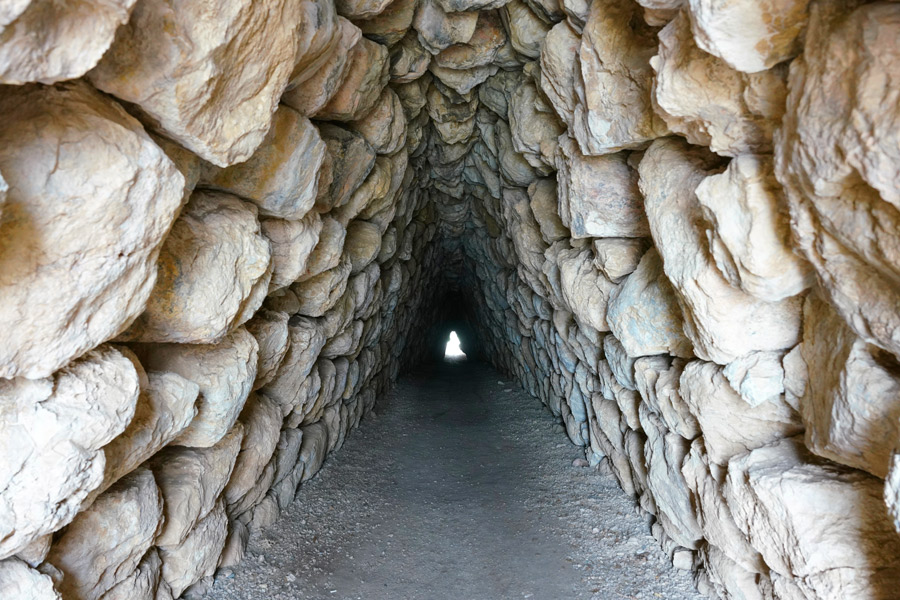
The visitor route begins at the Great Temple in the Lower City (Aşağı Şehir), sometimes called the Inner City in the north. From there, it continues along the western side towards the Upper City, reaching its highest southern point. You enter the postern tunnel as you climb the rampart. The Sphinx Gate is above it. From there, the path descends along the eastern side. Finally, you return to the starting point after passing the King’s Gate and the Royal Palace.
This route forms a loop. The total walking distance is around 6 kilometres – 3 uphill and 3 downhill. This may seem challenging for some visitors, but there is no need to worry. It is also possible to explore Hattusa attractions by car.
Here are the main highlights of Hattusa sightseeing.
Great Temple
It is no surprise that scholars describe Hattusa as a city of gods and temples. More than thirty sanctuaries once stood here. The largest is marked as Temple 1 on the Hattusa route map. It seems that wherever the Hittites built a fortress, palace, castle, or gate, they raised temples around it. As with Alacahöyük, this one was built on the ruins of an earlier Hattian level.
Excavations here have yielded a wealth of clay tablets from which we have learnt about Hittite daily life, religious practices, administration, and politics.
Their temples were akin to monasteries – entire complexes with craft workshops, storerooms, archives, and land. This is a common feature for other Bronze Age sites in Turkey.
Reconstructed Fortification Wall
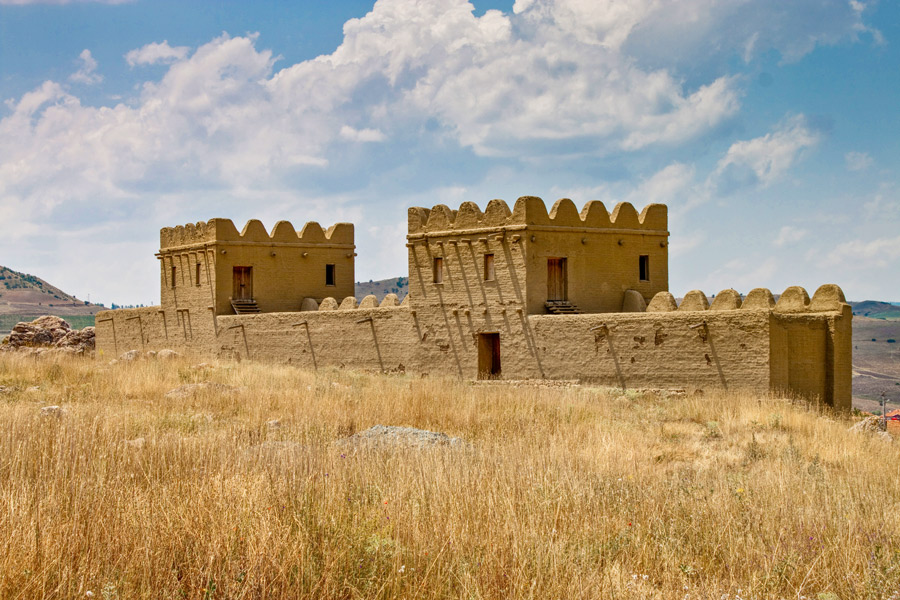
A section of the city's defensive wall is hard to miss as you move through the Lower City (Aşağı Şehir). It has been reconstructed using the same materials and methods the Hittites employed. German archaeologists carried out the work between 2003 and 2005, giving visitors a tangible sense of what the ancient fortifications once looked like.
Limestone Pool
Not far away, outside the temple ruins, a stone pool decorated with a lion's head (Aslanlı Tekne) catches the eye. Archaeologists believe it may have served ritual purposes, possibly for ceremonial washing before entering sacred spaces.
Hattusa Green Stone
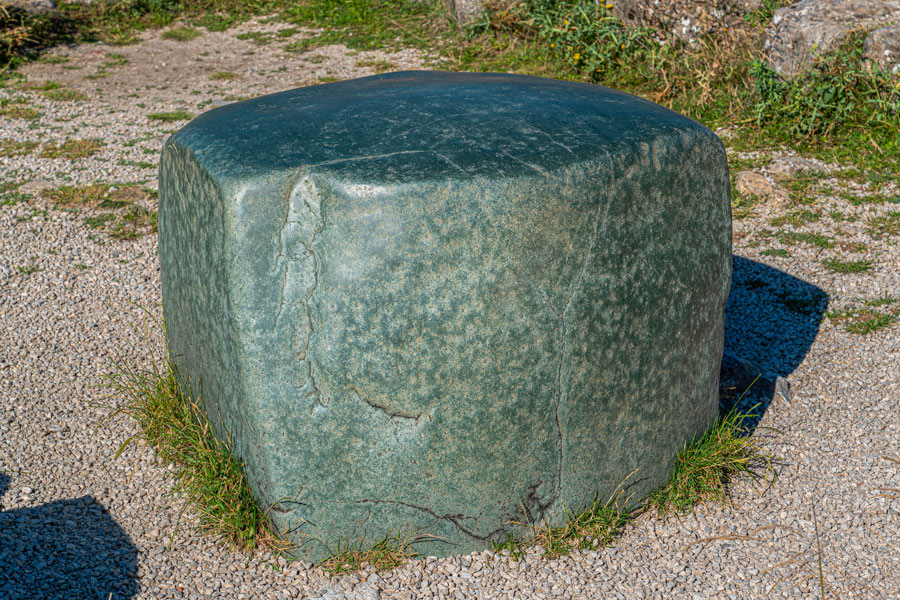
Within the Great Temple precinct sits the celebrated Hattusa Green Stone – a polished block of nephrite whose origins and purpose remain unclear. Local people have long called it the Wishing Stone. Visitors still gather around it, pressing their palms to its cool surface in the hope that a wish will be granted. Whether or not it works is, naturally, a matter of faith.
Remains of Drainage System
While Roman drainage systems are often praised, older civilisations were no strangers to such infrastructure either. In Hattusa, narrow channels directed fresh and waste water.
Residential and administrative buildings were connected to these systems. Clay pipes and basins were also linked to drainage channels.
In Büyükkale and Sarıkale, wells about two metres wide and nearly three metres deep were discovered. These stored water for emergencies, showing the advanced planning of this Bronze Age city. (Sevimli, Şükran, 2003/07/01, Water Technology and Cleanliness on the Hittite B.C. 1700–1200.)
Upper City
After exploring the temple complex, the path climbs south-west along the Lower Western Gate and Upper Western Gate, bringing you into the Upper City. Unlike the Lower City, it was built in the 13th century BC, especially during the final decades of the Hittite Empire, during the reign of Hattusili III and Great King Tudhaliya IV (1232–1216 BC).
The city was enclosed on all sides by a fortified wall and had five gates. The first two were mentioned above. The others: to the west – the Lion Gate; to the south – the Sphinx Gate; and to the east – the King's Gate. These three are the best preserved and most visited.
Sarıkale – The Yellow Fortress
The path brings tourists to Maiden's Rock and a fork in the road as they follow the tourist trail. The western branch leads to Sarıkale – the Yellow Fortress, named for the warm ochre colour of its stone.
Hittite fortifications dating to the 13th and 14th centuries BC have been found here. Yet there is much speculation about its purpose. Given the Hittite tendency to build high places for worship, it may have served a religious role or simply as a watchtower. The mystery, frankly, is part of the appeal.
Hattusa Lion Gate
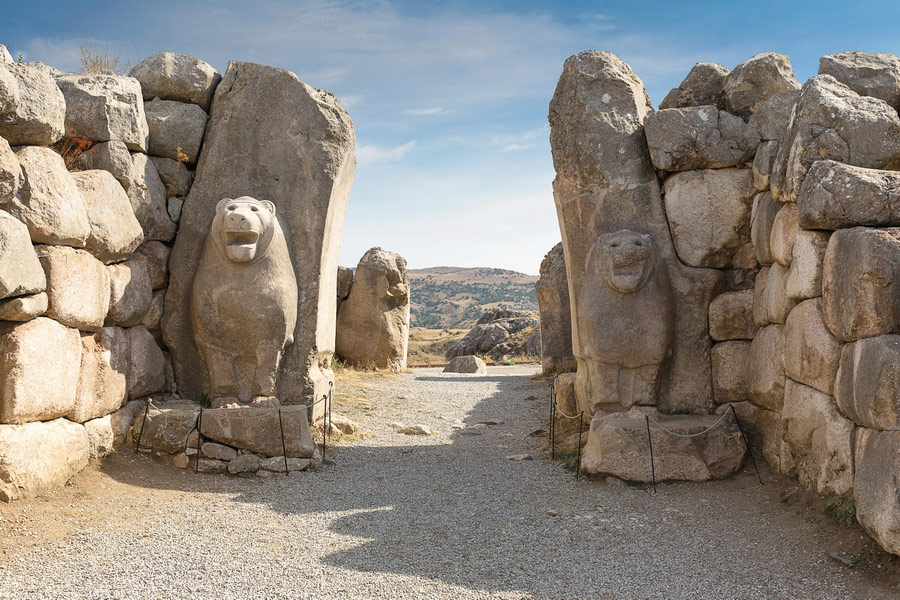
Heading back west, you arrive at the Hattusa Lion Gate (Aslanlı Kapı). Charles Texier was the first European to discover it and other ancient structures here, though at the time he did not identify them as Hittite. In 2009, the German Archaeological Institute conducted restoration and conservation work on the gate, as seen in the left-hand lion.
This gate, carved from a single monolithic stone, is impressive. It must have had an intimidating effect on any adversary. The lions look poised to spring at the first sign of danger.
Southern Pools
Continuing south, to the left of the path, take note of the so-called pools. These reservoirs played a key role in the well-being of Hattusa's inhabitants.
Sphinx Gate
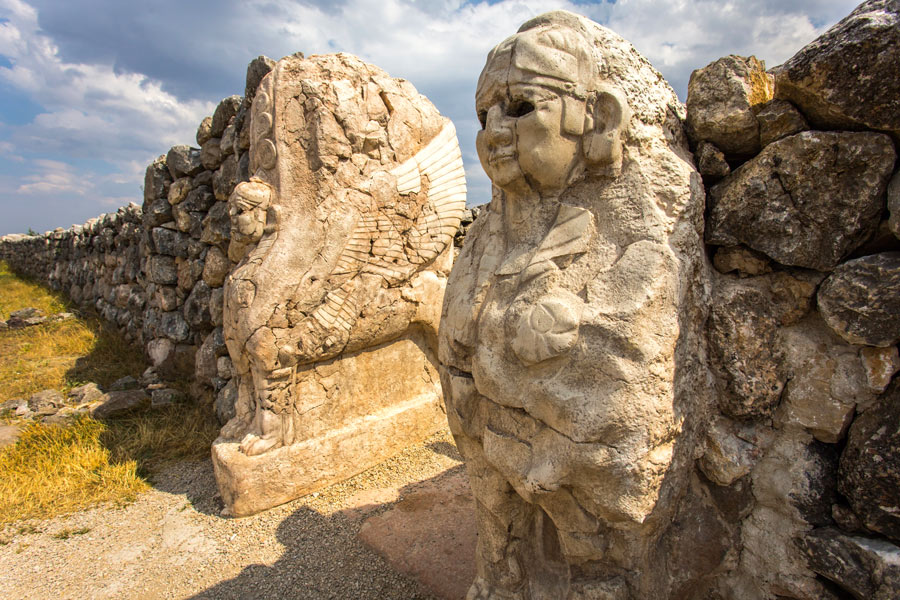
Two sphinx reliefs decorate the southern gate – hence the name. There is a tunnel over which the Sphinx Gate (Sfenksli Kapı) stands. This is not an entrance to the underworld of the dead, as one might imagine, but a secret subterranean passage, Yerkapı. In 2022, archaeologists discovered painted hieroglyphs in the tunnel. (Turkish Archaeological News).
Visitors need to climb a steep earthen ramp to the top of the hill to pass through it. And then they find themselves at the city's highest point. The views across the plains and the village of Boğazkale are breathtaking. Four sphinxes stood here originally, but only the ones facing inward have survived.
King's Gate
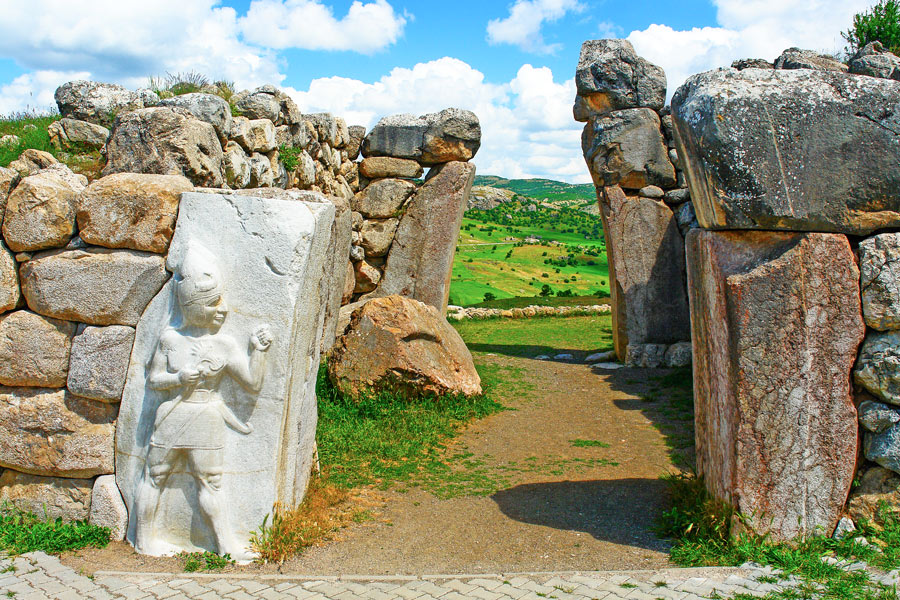
The King's Gate (Kral Kapısı) is on the eastern side of the Upper City, directly opposite the Lion Gate. The relief of a deity – slightly over two metres – guards the entrance. Many scholars interpret it as the Hurrian god Sharruma (Šarruma). The original is held at the Museum of Anatolian Civilisations in Ankara; what visitors see today is a faithful cast.
The area around the King's Gate had its own cluster of temples, designated Temple 2 and Temple 5 on the site map.
Central Temple of the Southern City
If you picture an inverted triangle, the Lion Gate and King's Gate sit on the same east-west axis, with the Sphinx Gate at the very bottom. The ruins of the Central Temple of the Southern City are roughly in the middle. Like the other Hittite temples, this one is an entire complex with numerous residential and administrative rooms.
Artefacts uncovered in the temples can be divided into three categories: ritual objects, everyday items, and cuneiform tablets. Certain votive amulets point to influence from northern Syria, which was under Hittite control, as do Hurro-Hittite tablets found here.
In the northernmost room, the remains of a Byzantine church are still visible.
Nişantepe (Nişantaş)
On the Hattusa map, to the north opposite the Central Temple, is Nişantepe. Keep to the right side of the tourist path. This sheer rock face showcases a nine-metre inscription in Luwian hieroglyphs describing a military campaign. It dates to the 13th century BC and was composed by King Suppiluliuma II.
Güney Kale – The Southern Citadel
The Southern Citadel lies between Nişantepe and the Royal Palace. It is a Phrygian citadel from the 7th century BC, most likely raised on the ruins of earlier structures. Beneath it are Hittite chambers – Chamber 1 and Hieroglyph Chamber 2. The latter is the more arresting: its walls present Luwian hieroglyphs, commissioned by Suppiluliuma II.
The outlines of two water reservoirs are to the east of the citadel, each around two metres deep.
Royal Citadel – Büyükkale
The Royal Citadel (Kral Saray) ruins today occupy the great hill of Büyükkale, where it is easy to feel a little lost. And one must admit, it takes a good deal of imagination to picture a place where the lives of kings, courtiers, military commanders, and priests once pulsed with activity. Multiple terraced courtyards were connected to gateways and staircases carved into the rock.
The evidence is there, however: 3,000 cuneiform clay tablets were found here, including the world-famous Treaty of Kadesh – the brotherhood and cooperation agreement between the Hittite king Hattusili III and the Egyptian pharaoh Ramesses II, discovered in 1906. It was drawn up in 1,259 BC.
Once you reach the Royal Palace, you have returned to the Lower City and completed the circuit of the Hattusa landmarks.
Yazılıkaya Sanctuary
A visit to Hattusa pairs naturally with the open-air rock sanctuary of Yazılıkaya, two kilometres away. Its walls, carved into a natural rock gallery, depict processions of Hittite deities, including foreign gods from conquered peoples. Indeed, it is an extraordinary piece of ancient religious art.
What Were the Hittites Known For?
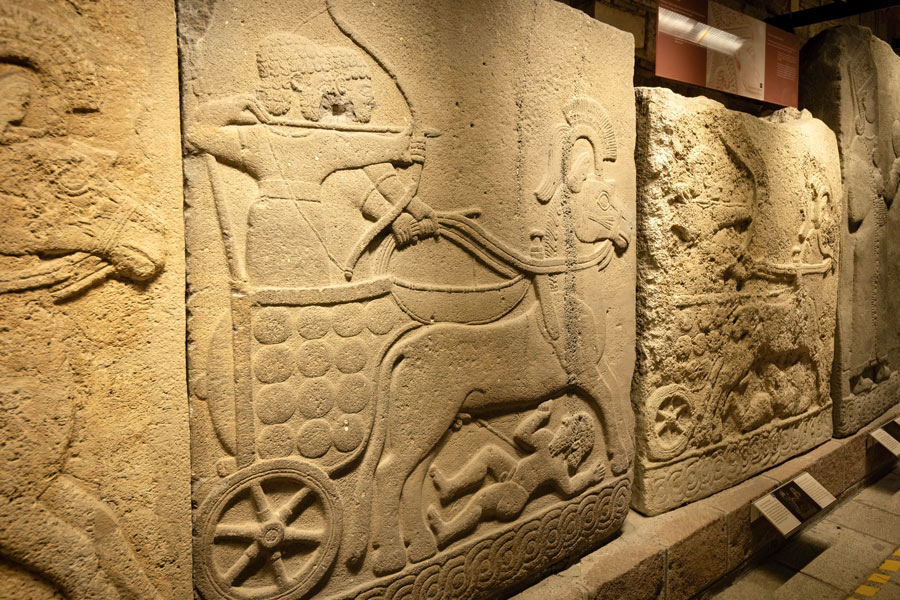
The Hittite Empire was a major power of the Late Bronze Age. From the strategic Hattusa location in modern-day Turkey, they controlled the vast territory from the Aegean coast to Syria.
The Hittites are best remembered for the Battle of Kadesh (1274 BC) against Ramesses II. And the Peace Treaty followed in 1259 BC, the oldest surviving international peace agreement. (Bryce, T. (2002). The Kingdom of the Hittites. Oxford University Press.) Therefore, they pioneered diplomatic treaties that resolved conflicts through negotiations rather than conquest alone.
They were also early iron-workers, skilled lawmakers, and prolific record-keepers. Tens of thousands of clay tablets recovered from Hattusa preserve royal decrees, diplomatic correspondence, myths, and rituals. Their legal codes were notably humane for the time, favouring compensation over punishment. (Hoffner, H.A. (1997). The Laws of the Hittites. Brill.)
What was the Hittite Language?
The Hattusha people spoke the earliest form of an Indo-European language, written in cuneiform script on clay tablets. This cuneiform script was borrowed from Mesopotamia. And the Hittite became the first Indo-European language to be deciphered, when Czech scholar Bedřich Hrozný cracked it in 1915. He demonstrated its links to Greek, Latin, and Sanskrit – pushing the history of the Indo-European language family back by centuries. (Hrozný, B. (1917). Die Sprache der Hethiter. J.C. Hinrichs.)
What is the Difference Between the Hittites of Hattusha and Biblical Hittites?
Those who have read the Bible – and the Old Testament in particular – will know that the Hittites appear in connection with Abraham. Could they be the same Hittites associated with Hattusa? The biblical ‘Hittites’ are not straightforwardly identical with the imperial Hittites of Late Bronze Age Hattusa. In scholarship, biblical references are often linked more broadly to later Anatolian/Syrian populations or literary memory of Hittite-related peoples, especially the Neo-Hittite states.” (Bryce, T. (2012). The World of the Neo-Hittite Kingdoms. Oxford University Press.)
Visiting Hattusa – Opening Hours, Tickets & Tips
The site is open daily from 08:00 to 17:00 in summer and 08:00 to 15:00 in winter. Entrance costs are very affordable, with the Yazılıkaya Sanctuary ticketed separately. Museum cards are accepted.
The full Hattusha sightseeing circuit covers six kilometres of uneven, sun-exposed terrain. Comfortable shoes, water, and sun protection are essential in summer because the Anatolian plateau is relentless under a July sky. Spring and autumn bring cooler temperatures and far fewer visitors. Those who prefer not to walk the full distance can drive the loop instead.
Set aside at least three to four hours for the site. Boğazkale village, at the entrance, has small cafés and local restaurants for a well-earned rest afterwards.
How to Get to Hattusa from Ankara
Hattusa lies 200 kilometres east of the Turkish capital – a straightforward day trip from Ankara through the open Anatolian steppe. By car, the 200-E88 highway takes about 3 hours to Hattusha. By bus, services from Ankara's AŞTİ terminal run to Sungurlu or Çorum; from there, a local minibus or taxi completes the journey to Boğazkale.
There is also a scenic alternative. The Ankara–Sivas high-speed train stops at Yozgat, with departures at 08:00, 13:00, and 18:10. The journey from Ankara to Yozgat takes around one hour. From Yozgat, the most useful option is to hire a car – Hattusa is around 75 kilometres away.
With that said, driving offers the freedom to linger – and on a site this size, that freedom matters. Several Ankara-based operators run full-day trips combining Hattusa with Yazılıkaya and Alacahöyük for those who prefer a guided experience.
How to Get to Hattusa from Cappadocia
Hattusa is around 195 kilometres away from Cappadocia, a three-hour drive across a wide area. It makes for a long day, but the kind worth planning for. Leave early, and there is time to visit both Hattusa and Yazılıkaya before the drive back.
A hire car is the most practical option because there is no direct public transport between the two regions. Day tours from Göreme and Nevşehir are available too, typically combining the Hattusa ancient city with a museum visit. Consequently, independent travel without a car would be more complicated.
Visit the Museums in Boğazkale, Ankara, and Istanbul
Two museums deserve a place in any Hattusa itinerary. The Boğazköy Archaeology Museum (Boğazköy Arkeoloji Müzesi) in Boğazkale village exhibit the original sphinxes from the Sphinx Gate, clay tablets, seals, and ritual objects unearthed during excavations at Hattusa.
The Museum of Anatolian Civilisations in Ankara goes further still. It houses the original relief of the War God Sharruma from the King's Gate.
Istanbul Archaeology Museum keeps clay tablets. One of them is the original of the Treaty of Kadesh.
Best Time to Visit Hattusa
Spring is the finest time to explore Hattusa historical site. The Anatolian plateau turns green, and the air is cool enough to walk the full six-kilometre circuit comfortably.
Summer is perfectly manageable but requires preparation. Temperatures climb sharply, shade is scarce, and the terrain is unforgiving. Autumn is a solid second choice – warm, quiet, and golden.
Winter visits are possible, but the shorter daylight hours and occasional snow limit the experience.
Hattusa: A Pleiades Place Resource
Scholars and researchers can access Hattusa through the Pleiades Gazetteer. This comprehensive digital atlas of the ancient world provides standardised geographic and temporal data for archaeological locations. It catalogues Hattusa with precise coordinates and extensive metadata, connecting it to thousands of ancient places across the Mediterranean and Near East through linked open data protocols.