

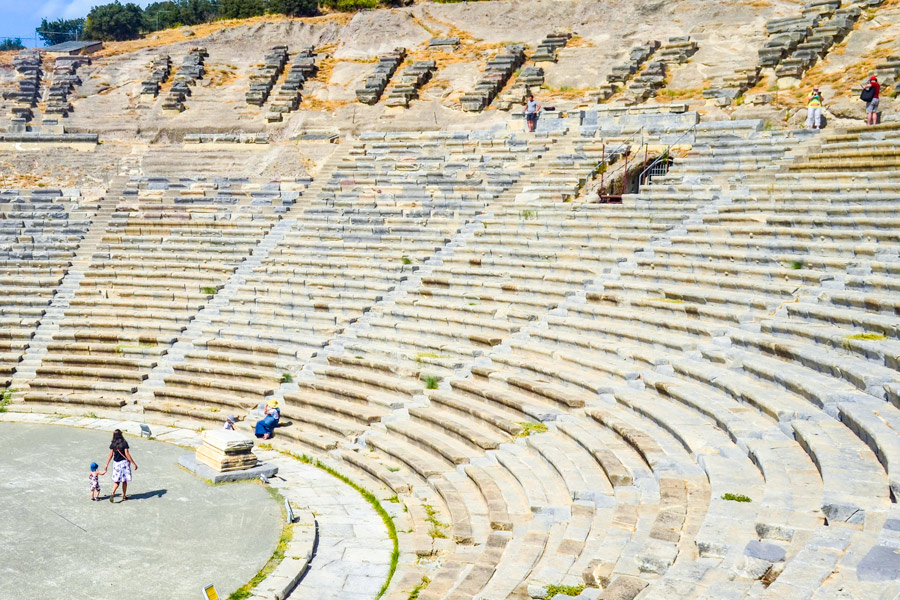
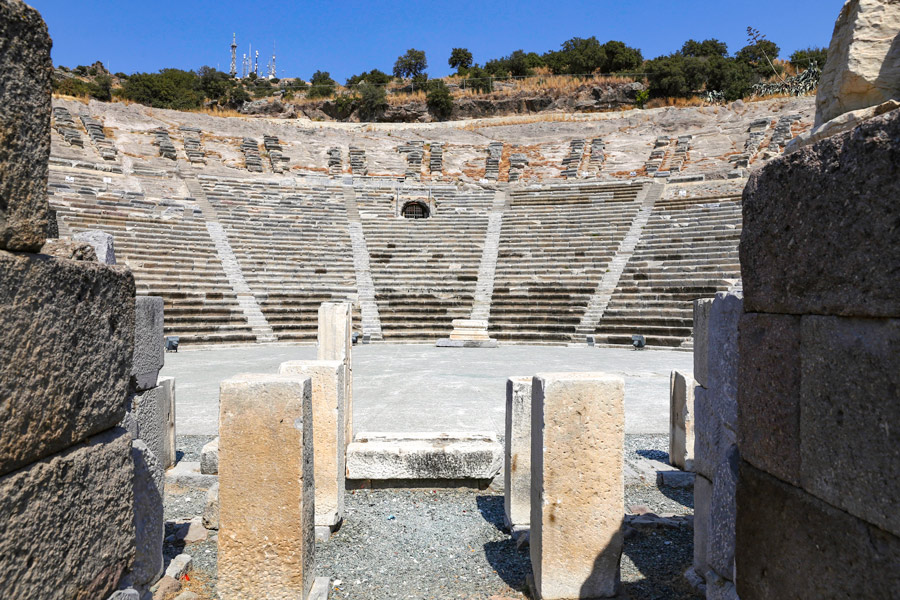
The stone rows rise from the hillside in a wide arc, pale against the dry scrub and the sky. The Bodrum Ancient Theatre – Bodrum Antik Tiyatrosu – sits on the southern slope of Göktepe hill, just above the main ring road that runs west from Bodrum centre towards Turgutreis. At the base, the orchestra is a flat circle of earth, and the stage beyond it is open on all sides. The theatre has been in use here for close to 2,500 years.
From the road, only the lowest rows show. The rest climbs out of sight up the slope, far larger than that first glimpse lets on.
History of Bodrum Ancient Theatre
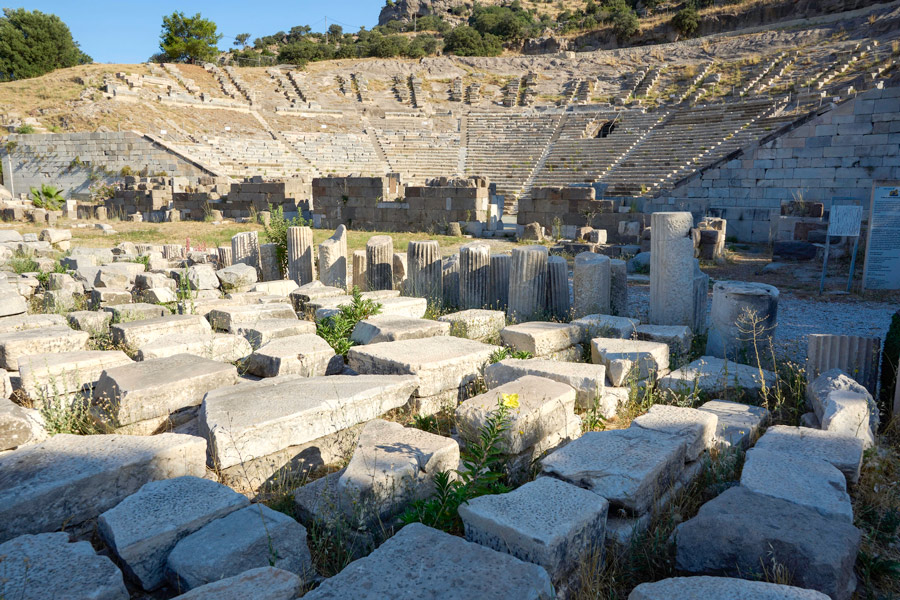
Mausolos, satrap of Caria, moved his capital to Halicarnassus from inland Mylasa in the 4th century BC. He pushed the harbour walls out into the bay and built the tomb so large it turned his own name into a common word: mausoleum. The theatre he cut straight into the southern slope of Göktepe, letting the hill do most of the shaping.
The Romans rebuilt it for a louder kind of crowd. In the 2nd century AD they raised the stage building to a second storey and dressed its front with carved masks and bull heads, filling the gaps between the older Doric columns. By the 3rd century, low barriers separated the seats from the ground below. The orchestra had become an arena, given over to gladiators and animal fights as often as to plays.
Then the city declined, and the slope reclaimed the theatre. Earth washed down over the stone until only a few rows of seating still showed above ground. That was what Professor Ümit Serdaroğlu found in 1973, when the digging began. The work carried on through the late 1970s and into the 1980s, uncovering the full sweep of the seating. A restoration finished in 2003 brought the Theatre of Halicarnassus into use, with room for roughly 3,100. Behind the rows, cut deep into the bedrock, later excavation opened tunnels and chambers no audience above had ever seen.
Highlights
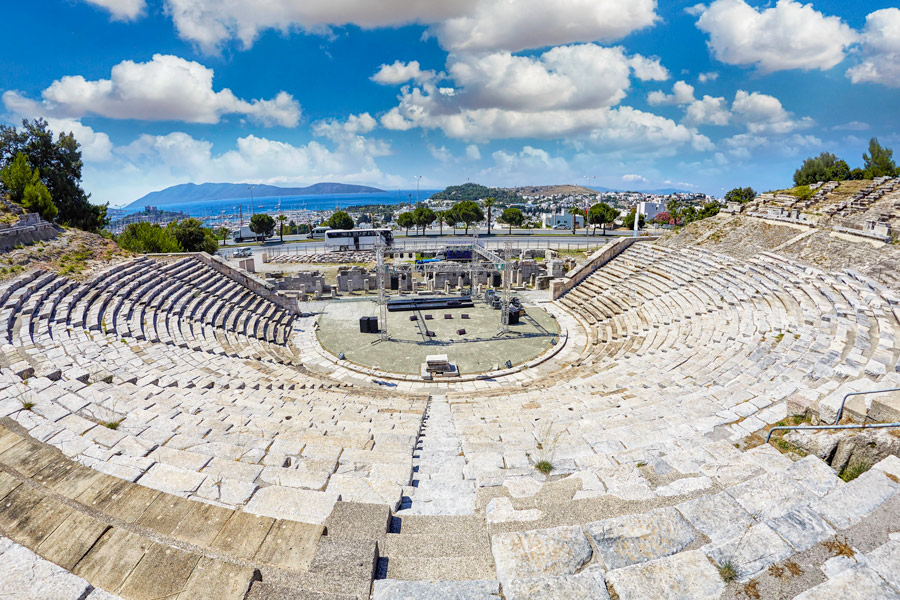
The full scale of the place declares itself slowly. At the orchestra level it reads as a theatre; from the upper tiers it becomes something closer to a hillside city.
The Cavea
The cavea is a single sweeping arc, 86 metres across at its widest – 44 rows below the central gangway, 14 more above it. The seating was divided into 3 zones by rank: the ima cavea at the front for the city's leading citizens, the media cavea in the middle tiers, the summa cavea at the top for everyone else. The divisions are still visible in the seating.
Several seats carry names cut into their upper surfaces – the patrons who paid for stretches of the building, recorded where they sat. The letters are shallow, worn soft at the edges by weather, but deep enough still to trace with a finger. The small square and round holes near some of the seats repay a second look. They most likely held the poles of awnings, fabric drawn over sections of the cavea to shade those who had paid for the privilege.
The Orchestra and Stage
The circular orchestra at the foot of the cavea is the original performance space – the flat ground where the ancient chorus moved and sang, enclosed on 3 sides by the stone tiers. The altar to Dionysus once stood at its edge. The altar is gone, but its position is recorded and the space is otherwise unchanged. The stage behind it is 26 metres across. The scene building that once rose at its back survives only at foundation level, yet that footprint alone runs to nearly 35 metres.
The View from the Upper Tiers
The highest row opens the bay out completely. The castle sits on its narrow peninsula to the south, the harbour busy with gulets and ferries below it. The white rooftops of Bodrum fill the middle ground and the Aegean reaches to the horizon. Kos appears on most clear days as a low, flat shape across the strait. Göktepe hill rises directly behind the seating – used as a necropolis in antiquity, its slopes above the cavea still hold rock-cut tombs from the Hellenistic and Roman periods. The carved symbols on several are visible on a short walk up from the site.
Festivals and Events at Bodrum Ancient Theatre
The theatre still draws performers through the summer, though the calendar is quieter than it once was. Conservation limits have cut the number of events in recent years. Even so, the stage has not gone dark – classical and crossover concerts still run through the season.
Bodrum International Ballet Festival
Turkey's only international ballet festival, organised by the State Opera and Ballet since 2003, has long been tied to this part of Bodrum. Earlier editions brought companies to the ancient stage itself; the festival now performs at Bodrum Castle's north moat, a short walk south. The programme mixes classical and contemporary work, Turkish troupes alongside international guest companies.
Practical Information
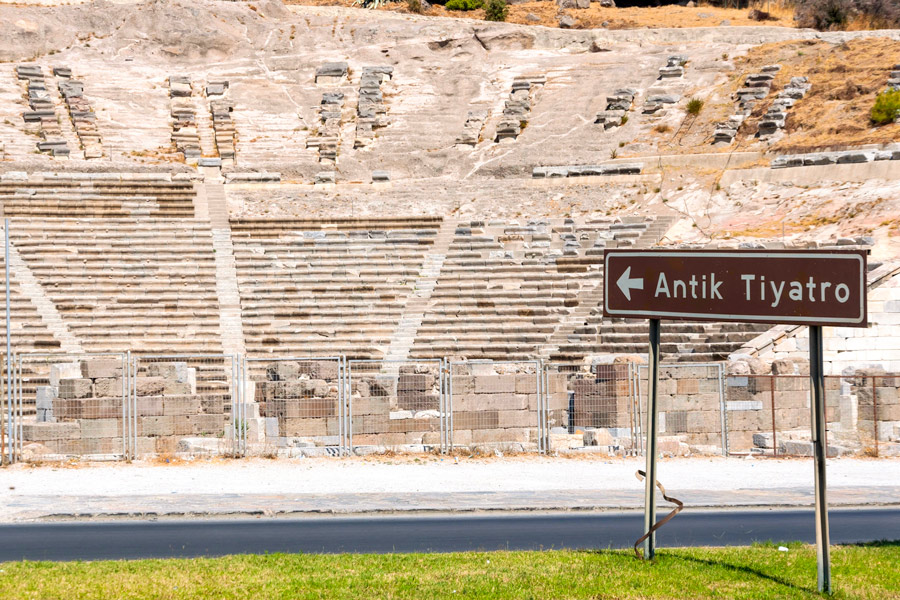
Address: Bodrum Antik Tiyatrosu, Cevat Şakir Caddesi, Yokuşbaşı Mahallesi, 48400 Bodrum, Muğla. On the main ring road towards Turgutreis, visible from the road.
Opening hours: Summer (June–September) 09:00–20:00; winter (October–May) 08:30–17:30.
Entry: Free.
Festival tickets: The summer concerts and the Bodrum International Ballet Festival are both ticketed. Concerts are sold through Passo and Biletix – search for Bodrum Antik Tiyatro. For the ballet, booking goes through the Turkish State Opera and Ballet. Programmes and dates change each season, so it is worth checking ahead, and the best summer nights sell out early.
How to Get There
By dolmuş: The dolmuş (shared minibus) route between Bodrum town centre and Turgutreis stops directly in front of the theatre. Dolmuşes depart from the main dolmuş terminal near the marina and run frequently throughout the day. The journey takes around 10 minutes. The fare is paid on board in cash.
On foot from the marina: The theatre is a 20–25 minute walk west from Bodrum marina along Cevat Şakir Caddesi. The site is visible from the road on the right-hand side before the Gümbet junction.
By taxi: Taxis are available throughout Bodrum town centre and the marina district. The journey from the marina takes around 5–10 minutes depending on traffic. Ask the driver for Bodrum Antik Tiyatrosu.
By car: The theatre sits on the main ring road (Çevre Yolu) heading west towards Turgutreis. From Bodrum town centre, follow signs for Turgutreis. The theatre is on the right before the Gümbet junction. Roadside parking is available.
Tips for an Optimal Visit
Recommended duration. The theatre itself takes 45–60 minutes at a relaxed pace – long enough to climb to the upper tiers, read the inscribed seat names, and spend time at the orchestra level. Those continuing up the Göktepe path should allow an additional 30 minutes.
Best time of day. The stone tiers are fully exposed to the sun and heat up quickly. Morning visits before 10:00 are the most comfortable in July and August. Late afternoon from around 17:00 is the best time for the view from the upper tiers – the light comes from the west across the bay.
Footwear. The steps between tiers are uneven and worn smooth in places. Closed shoes with flat soles are strongly advisable. Sandals without ankle support are uncomfortable on the upper section and can be slippery on the stone.
What to bring. There is no shade on the tiers and no water available on site. Bring water and sun protection for daytime visits. In the evening the stone cools quickly after sunset – a light layer is useful.
Combine with. The Mausoleum of Halicarnassus is a 15-minute walk into the town centre. Built by Mausolos in the same period, it is the natural companion visit. Bodrum Castle is a further 10 minutes on foot from the Mausoleum site. Together the three make an easy half-day, and sit among the main things to do in Bodrum.
Mausolos built the theatre and the Mausoleum within sight of one another, and the two have come to opposite ends. The Mausoleum was dressed stone – the kind that can be lifted out and carried off. Over the centuries, block by block, it was taken apart. The most recognisable pieces are now set into the walls of Bodrum Castle. The theatre could not be taken apart so easily. It is still here. On a summer evening, with the bay fallen dark beyond the top row, the names cut into the seats sit below an audience they could never have pictured.