

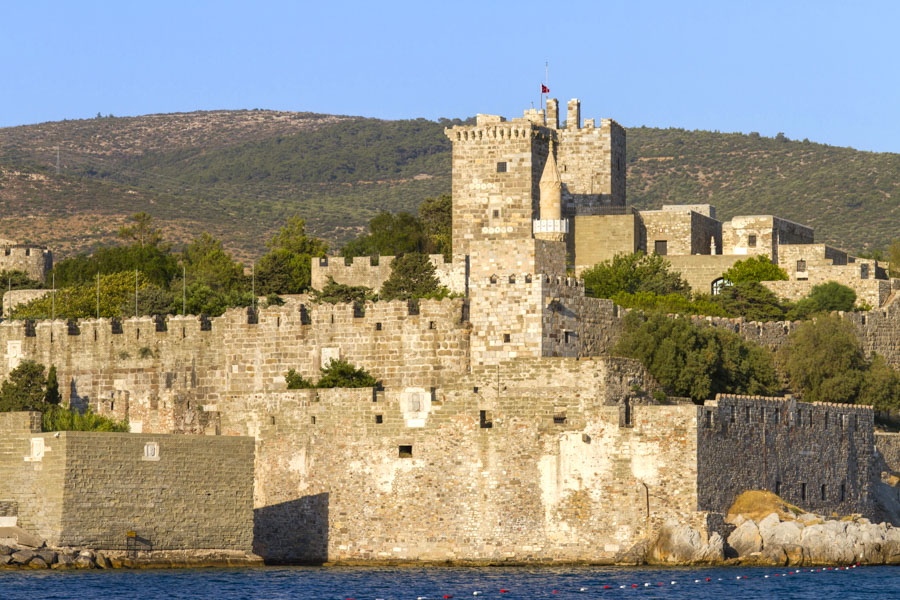
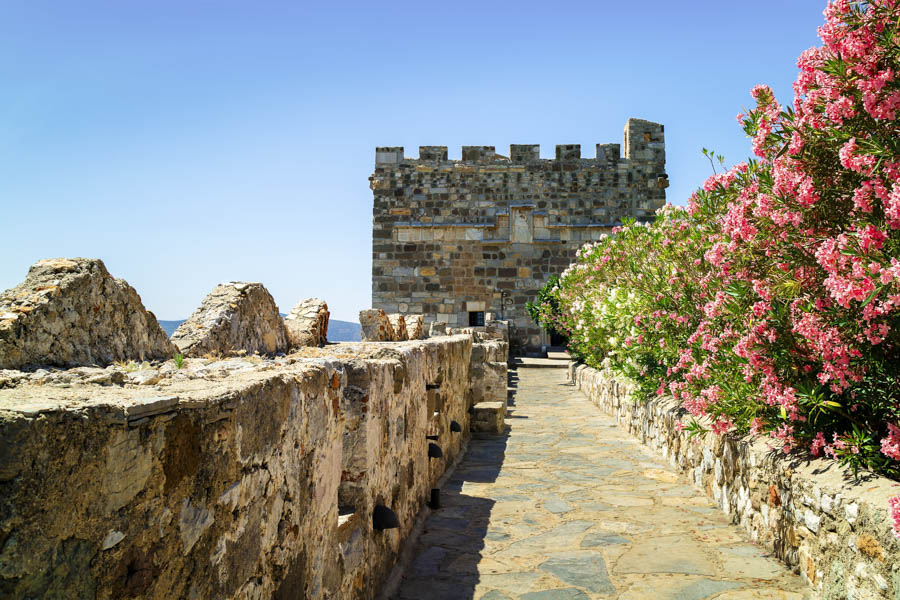
Bodrum Castle (Bodrum Kalesi) sits at the edge of the sea, its limestone walls, the colour of the light – white in the morning, gold by afternoon. Down at the waterfront, it is just a reflection, wobbling in the harbour. Step through the gate, and it becomes something else entirely: cool stone, deep shade, the smell of jasmine somewhere close. A tortoise crosses the path, and nobody hurries it along.
Higher up, the walls fall away and the view opens over Bodrum, with the harbour below and the Aegean glinting beyond it. The wind picks up. The town below looks small and very white against the water. It is the kind of view that makes the climb feel obvious in retrospect.
Inside the towers, something waits that was never meant to be on dry land. The Museum of Underwater Archaeology lives here now, built from what the sea gave back.
History of Bodrum Castle
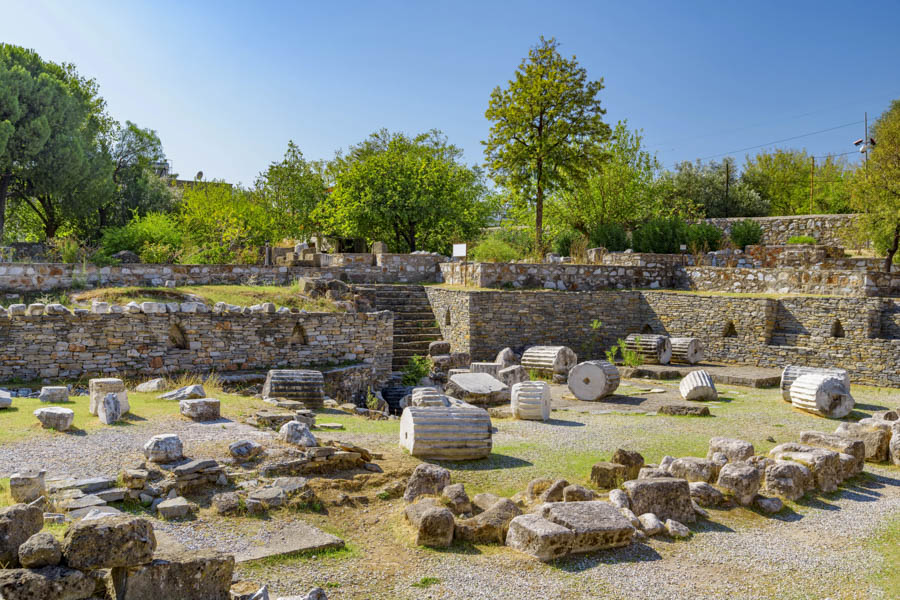
The castle began with a loss. In 1402 the Knights Hospitaller lost their stronghold at Smyrna to Timur, and needed another base on the Aegean coast. They found this promontory – and the ruins of the Mausoleum at Halicarnassus, a Wonder of the Ancient World. The mausoleum had stood on this promontory for seventeen centuries before earthquakes brought it down. The Knights began to build.
It held for over a century. Sultan Mehmed II attacked twice and failed. His own son Prince Cem sought refuge inside these same walls. The end came quietly – Suleiman the Magnificent took Rhodes in 1522 and received Bodrum as part of the surrender. The garrison sailed for Malta. The chapel became a mosque.
For four centuries it served the Ottomans as a garrison and, in the end, a prison. By the close of the First World War the walls stood empty. In 1960 an American archaeologist named George Bass led one of the earliest scientific underwater excavations off the Turkish coast. The castle became a home for found artefacts.
Highlights
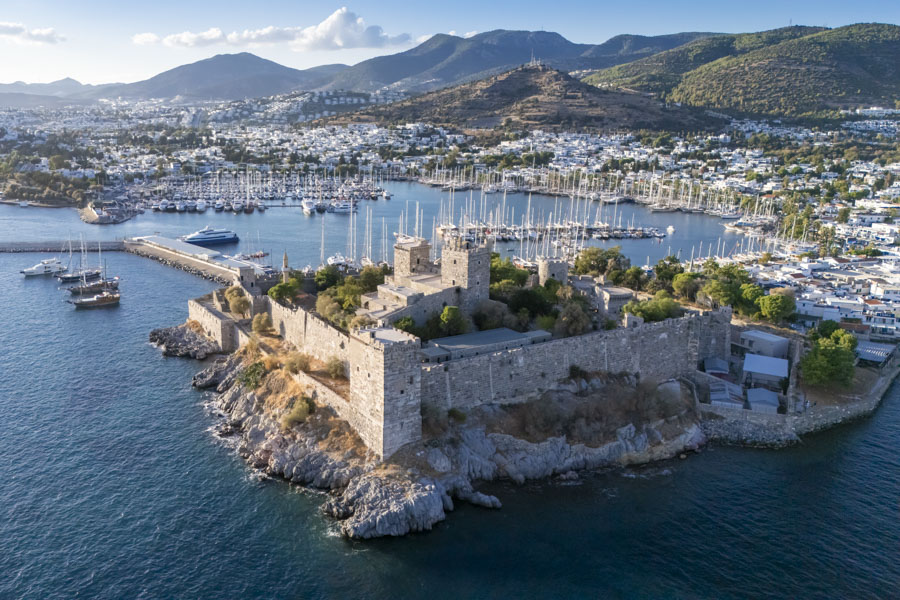
The castle rewards a slow walk. Most of what matters is in the stonework itself.
The Walls
Around 250 coats of arms are set into the walls – grand masters, commanders, individual knights, and the arms of nations. They run above the gates and passages, still sharp enough to read after six centuries. Look closely between them, and the stone shifts in age. A carved relief, a panel of polished marble – pieces of the Mausoleum itself, set into the same stretch of stonework as a knight's shield from 1410.
The English Tower
The tower rises straight from the bedrock, three storeys of pale stone finished in 1413. On the western face an antique lion sits embedded in the stone – which is why locals have always called it the Lion Tower. Above the lion, the coat of arms of King Henry IV. Beside it, running almost the full width of the building, the arms of the noble English families who paid for the work. Step inside and the walls are covered in Latin graffiti – names, dates, prayers, scratched into the stone by knights five hundred years ago and still legible today.
The Chapel and the Minaret
The vaulted nave and apse are still intact – a Gothic space that has been a place of Christian worship, then a mosque, then a museum hall. Look down at the cornerstones and two names are cut into the rock: the Spanish knights who rebuilt the chapel between 1519 and 1520, the last Christians to worship here before the surrender two years later. The mosque came next. Its minaret stood for nearly four centuries, until a French warship in the bay opened fire on 26 May 1915 and brought it down in a single morning. The broken base is still there, set into the wall beside the chapel.
The Views
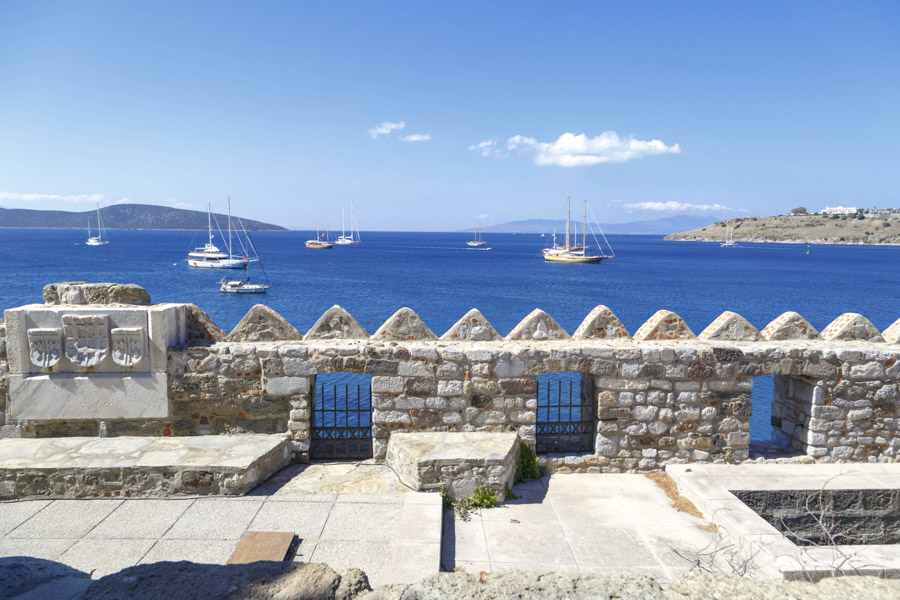
The French Tower is the highest point in the citadel, 47 metres above the sea. Grand Master Philibert de Naillac designed it himself. From its top, the two bays separate cleanly – the eastern harbour with the fishing boats and the gulets, the western bay quieter, opening towards Kos on the horizon. Look down at the town and the streets all bend the same way – towards the castle.
The Gardens
There is a photograph kept inside the castle showing the courtyard as it looked in the mid-twentieth century – bare stone, two dying trees, nothing else. The same ground today is almost unrecognisable. Myrtle, plane trees, oleander, fragrant herbs, fig and citrus press against the walls from every side; the planting so dense the towers vanish behind it in places. The Knights would have recognised the herbs – many were grown here for medieval medicine. The peacocks, turquoise and amber, picking their way across the lawns, would perhaps have surprised them.
The Museum of Underwater Archaeology
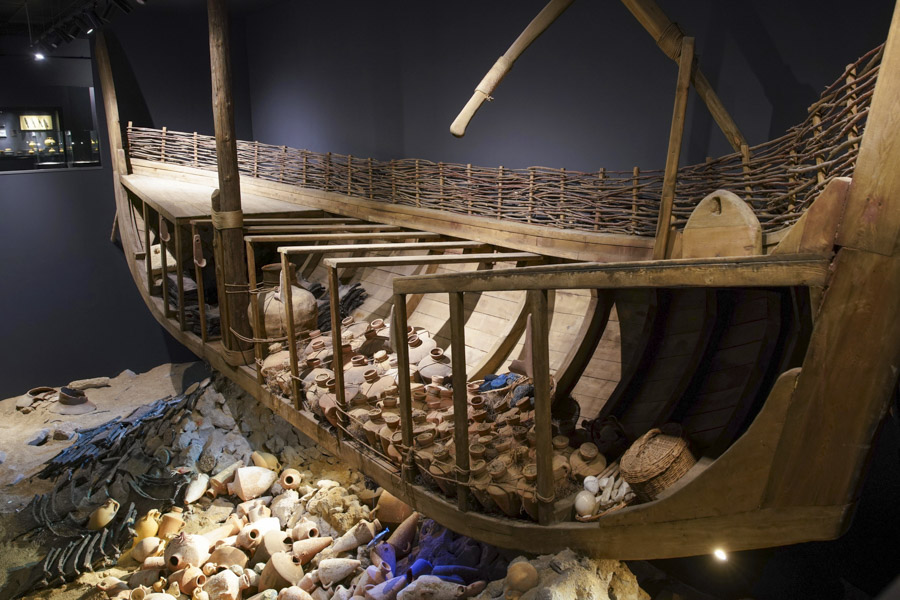
The towers were built to keep the sea out. Inside the walls, they hold Bronze Age cargoes, Byzantine glass, amphorae stacked as they were found in the holds of sunken ships. The Uluburun wreck, raised from the seabed off the southern Turkish coast, is the oldest shipwreck ever excavated. Its cargo fills a hall of its own: copper and tin ingots, ebony from Africa, ivory, gold, a scarab inscribed with the cartouche of Queen Nefertiti.
One tower contains the Glass Wreck Hall, which reconstructs an eleventh-century Byzantine ship that went down with three tonnes of broken glass in its hold. Another holds the Carian Princess, who lies in her own chamber, the gold of her diadem still bright. Most of these objects were first brought up by the sponge divers of Bodrum, who worked these waters for generations before the archaeologists arrived.
Best Time to Visit Bodrum Castle
Spring and autumn – April to May and September to October – offer the most comfortable conditions. The site is partly open-air, with long ramps, open courtyards, and exposed battlements between the towers; the heat in July and August between the stones is considerable.
Summer (June – August) brings the longest opening hours and the liveliest harbour below the walls, but the fortress is at its busiest, and the midday heat on the upper levels is unrelenting.
Winter (November – March) visits are quieter and often rewarding. Some exhibition spaces reduce their hours, and the Aegean wind on the upper levels can be sharp, but the castle itself is never closed to visitors entirely.
Opening Hours and Entry
Opening hours: Daily, 08:30–19:00 (April to October). Shorter hours in winter; ticket office closes at 17:00. Closed on Mondays during the off-season.
Entry: Entry costs €20 for foreign visitors and covers both the castle and the museum. The Müzekart national museum pass is valid. Children under 12 enter free.
Tickets: Available at the gate or in advance via the official Turkish museums e-ticket platform.
Address: Kale Caddesi, Barış Meydanı Sokak No. 36, Bodrum, Muğla.
How to Get to Bodrum Castle
On foot. The castle sits at the centre of Bodrum's waterfront and is visible from almost anywhere in town. From the marina, the walk takes around 5 minutes along the harbour promenade. From the central bus terminal on Cevat Şakir Caddesi, it is around 10 minutes on foot heading towards the water.
By public transport. The most practical option from surrounding resorts is the dolmuş – a shared minibus that runs on fixed routes and can be flagged down along the way. Services to Bodrum Merkez run frequently from Gümbet (every 10 minutes in summer), Bitez, Türkbükü, and other peninsula towns. All routes depart from and return to Bodrum Otogar, the central bus terminal. From there, the castle is a 10-minute walk. Fares are paid on board in cash.
By taxi. Yellow metered taxis are available throughout central Bodrum and at the bus terminal. The meter applies within town. For longer journeys from resorts further along the peninsula, it is worth agreeing the fare before setting off. The castle is a well-known landmark.
By car. Parking in central Bodrum in high season is limited and there is no dedicated car park at the castle. Street parking is available on the approach roads and is easier to find in the morning. Arriving by car and walking the last few minutes is the most practical option.
Tips for an Optimal Visit
Recommended duration. Plan for at least two to three hours. The castle grounds take time to cover properly, and the towers reward anyone who does not rush them.
Footwear. Wear shoes with a grip. The paths through the castle involve uneven cobblestones, long ramps, and stone stairs between levels – surfaces that become slippery after rain. Heels are not practical anywhere on site.
Best time of day. Arriving early in the morning avoids the main crowd build-up, which typically peaks between 11:00 and 14:00 in high season. The castle is also quieter on weekday mornings outside July and August.
Combine with. The Mausoleum of Halicarnassus is a 10-minute walk from the castle entrance and makes a natural companion visit.
Almost nothing here began here. The objects in the towers were drawn from the sea, the knights arrived from half of Europe, the sponge divers from a trade older than any of them. And yet the place is whole. On the lower terrace, a peacock steps between the amphorae as if it has always been there.