

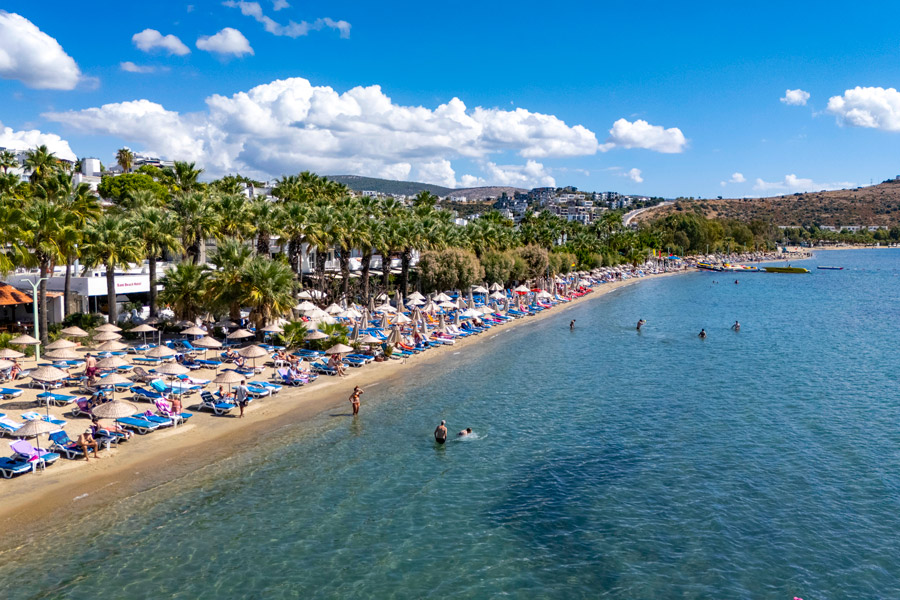
The beaches of Bodrum are lively resort bays lined with cafés and water sports. Some are quiet coves where pine-covered hills meet clear Aegean water. This contrast means the peninsula offers a stretch of coast to suit those seeking a peaceful swim just as easily as those after Bodrum's famous nightlife.
The coast road around the Bodrum peninsula never runs straight for long. It climbs over a headland, drops again, and each dip in the land opens onto another bay, cut off from its neighbour by a shoulder of pine and rock. Some hold nothing more than a scatter of villas above the waterline. Others carry a full run of sunbeds, music and restaurants down to the tideline. The same sea washes into all of them and behaves differently in each.
Nothing along this stretch is far from anything else. A car can cover the whole run in under an hour, marina to southern tip. Most of these beaches and bays were working ground before they were holiday ground, and the oldest of them still show it.
History of Bodrum's Beaches
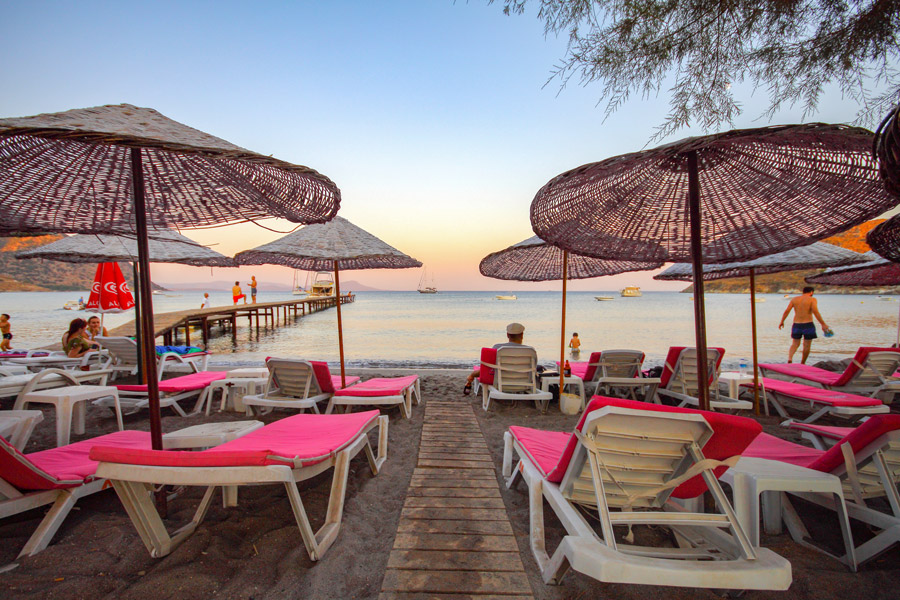
In 1925 a writer named Cevat Şakir Kabaağaçlı was sent to Bodrum in exile. He served half the sentence, finished the rest elsewhere, and then came back of his own accord. The sponge boats took him out with them. He learned the coves by their working names and wrote about the peninsula until readers in Istanbul began arriving to see it for themselves. The pen name he chose was the Fisherman of Halicarnassus. Twenty-five years later, he still had not left.
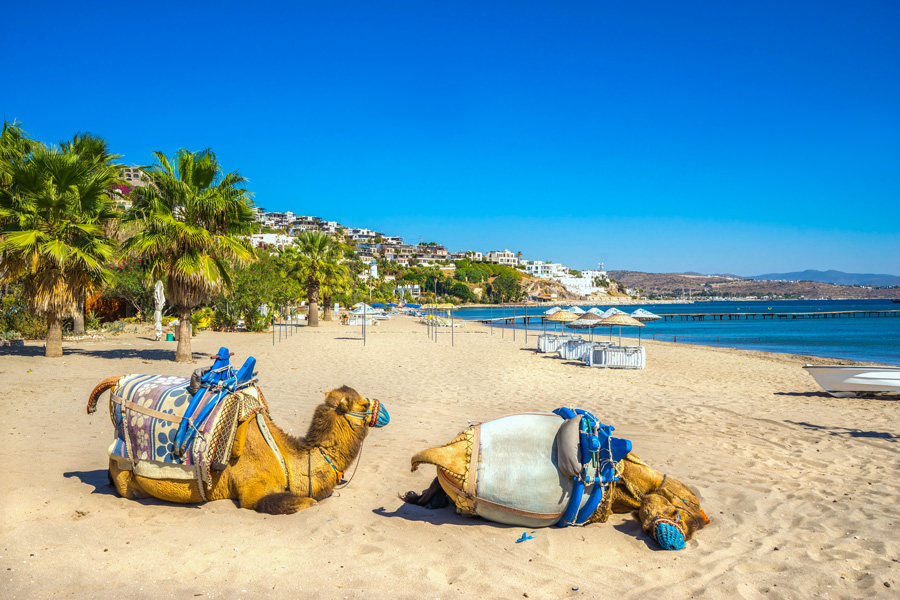
Long after he arrived, the coast was still carrying things. Sponge divers worked out of the town harbour, and the villages behind the bays lived on citrus. When the tangerine crates were ready, camels brought them down through the orchards to the sand, and boats took them on to Istanbul. On a windless afternoon the orchards can be smelled from the beach.
Tourism arrived in force in the 1980s and followed the road rather than the old paths between villages. Bodrum town filled first. The bays nearest it followed within a few seasons – Gümbet within walking distance from the marina, Bardakçı a boat ride across the same water. Beaches further out kept their slower pace a little longer, and one or two have not entirely given it up.
Best Beaches of Bodrum
Sand quality, water depth and the crowd on the shore vary from one bay to the next, and matching mood to beach matters here more than picking a single best one.
Bitez Beach
Address: Bitez, on the coast road roughly 6 km west of Bodrum centre.
By dolmuş: 15–20 minutes from the main bus station (otogar).
By car: via Cevat Şakir Caddesi and Bitez Yalısı Caddesi, about 15 minutes.
Best for families, beginner windsurfers and relaxed seaside cafés.
West of the town, Bitez curves in a long crescent bay. The shoreline shelves so gradually that a proper swim needs a fair walk out first – the same gentle gradient that lets beginners stand and steady a board before they catch the wind. The wind gets up in the afternoons. That has made this one of the peninsula’s main windsurfing bays, with schools and board hire lined along the sand. The promenade behind runs to family cafés rather than late nights.
The mandarin crop comes in at midwinter, and the village centre marks the end of the harvest with a festival. The date moves with the fruit, falling in December or January.
Karaincir Public Beach
Address: Akyarlar Mahallesi, near Turgutreis, on the southern side of the peninsula.
By dolmuş: around 40 minutes from the main bus station via Turgutreis.
Best for crystal-clear water, peaceful surroundings, and swimming.
Toward the south-western tip of the peninsula, in the old fishing village of Akyarlar, Karaincir sits inside a bay closed on three sides by pine-covered hills. The water runs colder here. It is also the clearest on this list, transparent enough that the sand shows through well beyond standing depth. Kos lies close enough offshore to pick out its hillsides. Akyarlar was Greek until the population exchange of 1923, and a few of the old houses along the shore survived it. Late in the day the light comes in low across the bay, and those who came for the swim stay on for it.
Camel Beach (Deve Plajı)
Address: Yahşi Mahallesi, Ortakent, roughly 15 km west of Bodrum centre.
By dolmuş: Ortakent-Yahşi minibuses from the main bus station, about 25 minutes.
By boat: day tours run from Bodrum and Turgutreis.
Best for shallow water and relaxed family beach days.
Further round toward Ortakent-Yahşi lies Kargı Koyu, though almost nobody calls it that. The camels that gave the beach its working name walk the sand in summer, carrying people at a slow pace along the waterline. The sea floor here is the gentlest on the peninsula. That is what lets the camels wade the shallows instead of being led along dry sand alone. Day-boat tours call in around midday. By late afternoon the bay has emptied again.
Ortakent went by the name Müsgebi until the last century. In the 1960s archaeologists opened a group of chamber tombs in the hills behind the village, and pottery, weapons and glass beads came out of them. The oldest is three and a half thousand years old. The finds sit in the French Tower of Bodrum Castle today, and they form the richest Mycenaean collection in any Turkish museum.
Bardakçı Bay
Address: Eskiçeşme Mahallesi, on the eastern side of the headland from Bodrum Marina.
By water taxi: regular crossings from the harbour, a few minutes each way.
On foot: about 15 minutes from the marina.
Best for calm water close to Bodrum town.
Bardakçı lies on the far side of the headland from the marina, a small, sheltered cove. Several hotels have built directly onto it, and their sunbeds line most of the shore. A narrow strip of public sand remains between them. The water barely moves. It feels closer to a pool than open sea. A boat crosses from the harbour often enough to make this an easy half-day out without a car.
This bay was Salmakis in antiquity. Strabo named its spring alongside the Mausoleum as one of the two things worth seeing at Halicarnassus. The nymph who lived in that spring gave her name to the myth of Hermaphroditus. In 1995 a sixty-line poem about her turned up carved into a wall on the headland above the bay. It lists Herodotus first among the writers the city produced.
Gümbet Beach
Address: Gümbet, roughly 3 km south-west of Bodrum centre.
By dolmuş: frequent minibuses from the main bus station, under 10 minutes.
On foot: 35–40 minutes along the coast road.
Best for nightlife, water sports and easy access from Bodrum town.
Gümbet, closest of all to the town, is also the loudest, its curved bay backed by a solid run of bars and hotels. The water stays shallow and calm well out from shore. Children learning to swim do well here, and so do the jet skis and parasails at the far end. Evenings move off the sand and onto Bar Street. July and August are relentless.
The name comes from the cisterns – squat domed reservoirs, roughly seven metres across, built to hold winter rain for the fields through the dry months. A handful are left in the hills behind the bay, roofless now and overgrown. Bar Street rarely stops before dawn, on ground that once measured out water by the season. For more of the peninsula’s sights beyond the shoreline, see our guide to Things to Do in Bodrum.
Tips for an Optimal Visit
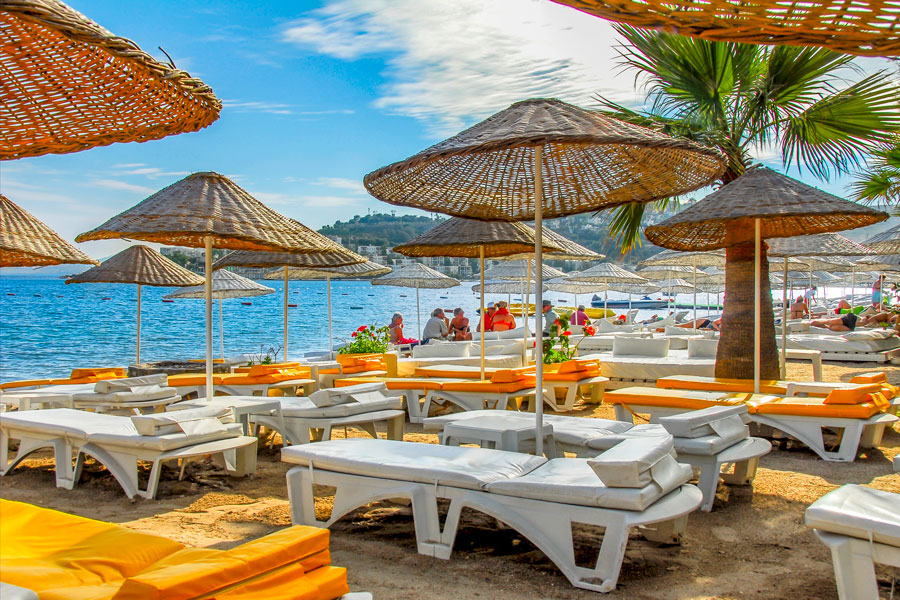
Which beach should you choose? A visitor after nightlife and easy access does best at Gümbet, while one after a quieter sea might prefer Karaincir, or Bardakçı for still water within reach of the marina.
Best time of year. Late May, June and September bring warm water without the heaviest numbers. July and August are hot and busy everywhere, though Karaincir keeps a calmer atmosphere than the beaches nearer town even at the height of summer.
What to bring. Karaincir's public stretch supplies no sunbeds, so a mat or folding chair is worth carrying. Sun protection matters at every beach on this list, since shade is limited on the open sand.
Accessibility. Bitez, Gümbet and Bardakçı are generally the easiest beaches for visitors with limited mobility thanks to their promenades, nearby cafés and relatively level access. Facilities vary by individual beach club and hotel.
Blue Flag Beaches. Several beaches around the Bodrum Peninsula have received the international Blue Flag award for water quality and environmental standards in different years. Current Blue Flag status should be checked before travelling, as certification is reviewed annually.
Getting around. A rented car or scooter makes a beach-hopping day workable, since Bitez, Camel Beach and Karaincir all sit along the same road running south and west from the centre. A return by dolmuş works nearly as well, though services thin out later in the evening.
Parking: Parking is available near all five beaches, although spaces close to the shore fill quickly during July and August. Arriving before 10:00 is recommended if travelling by car, especially at Bitez, Camel Beach and Gümbet.
The route the tour boats still follow began with Kabaağaçlı. He named it and took the first passengers along it himself, from the same quay the sponge boats had always used. They leave from there each morning. He is buried on Türbe Hill above Gümbet, facing the water, and the beach below him fills by ten.