

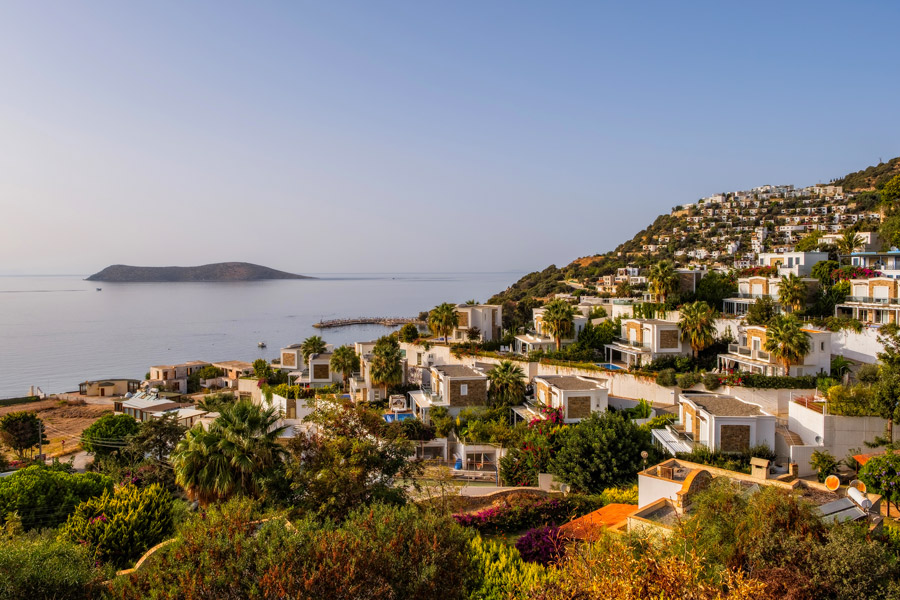
The road west across the Bodrum peninsula runs out of land at Gümüşlük. It narrows past olive groves and low hills, then drops to a shallow bay where the tarmac ends. Boats sit close to shore, their lines slack in the calm. The water is clear enough that the bottom shows through it.
Something here asks for a slower pace. The hills above the bay are protected from building, so the view holds much as it always has. There is an old stone on both sides of the shoreline, above the water and beneath it, and the village keeps still without seeming to try.
History of Gümüşlük
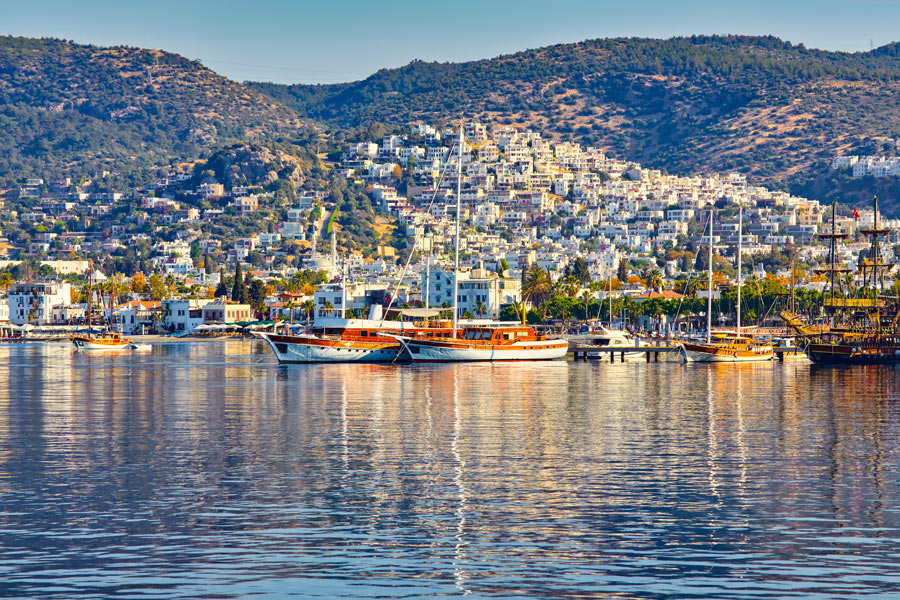
Long before the fish restaurants, this bay was the ancient town of Myndos, a working port on the western edge of the peninsula. Over the centuries the town faded, and the sea rose over its lower streets. What remained went on being useful.
In the 4th century BC, King Mausolos sent quarrymen to a cutting in the Koyunbaba hills, just south of the bay. They hauled the blocks east to Halicarnassus and raised his tomb – the Mausoleum, grand enough to lend its name to every grand tomb since, and counted among the seven wonders of the ancient world. Afterwards the quarry fell quiet for a very long time.
People kept coming back to the water. Greek families fished these waters and dived for sponges here for generations, until the population exchange of 1923 sent them across the Aegean and brought Turkish families the other way. The newcomers took up the same nets and the same boats. A village that had given away a wonder of the world settled into the slow business of catching its supper.
Highlights
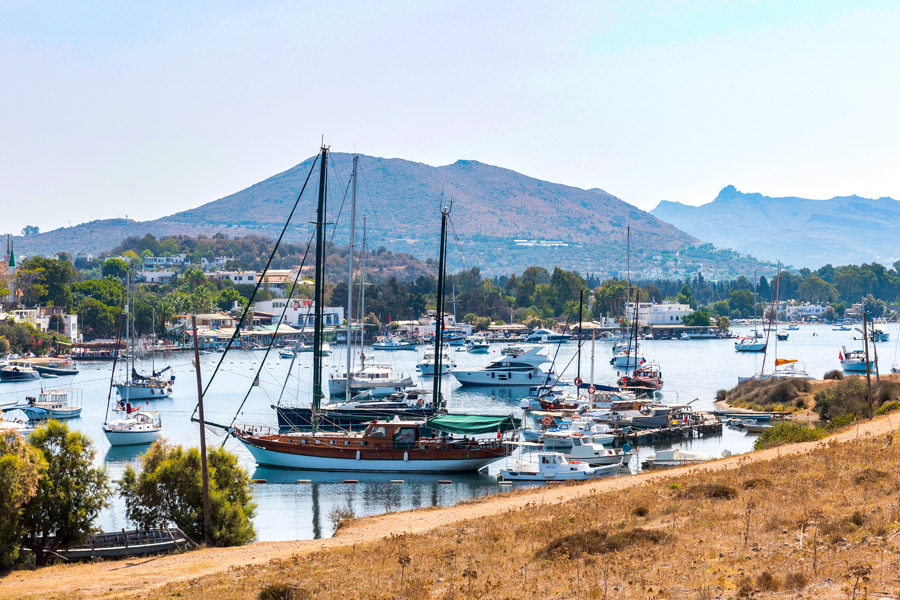
The shoreline does the organising here. Three pleasures sit a few minutes apart along it: a crossing at one end, the fish tables through the middle, and a market in the lanes just behind.
Rabbit Island and the old causeway
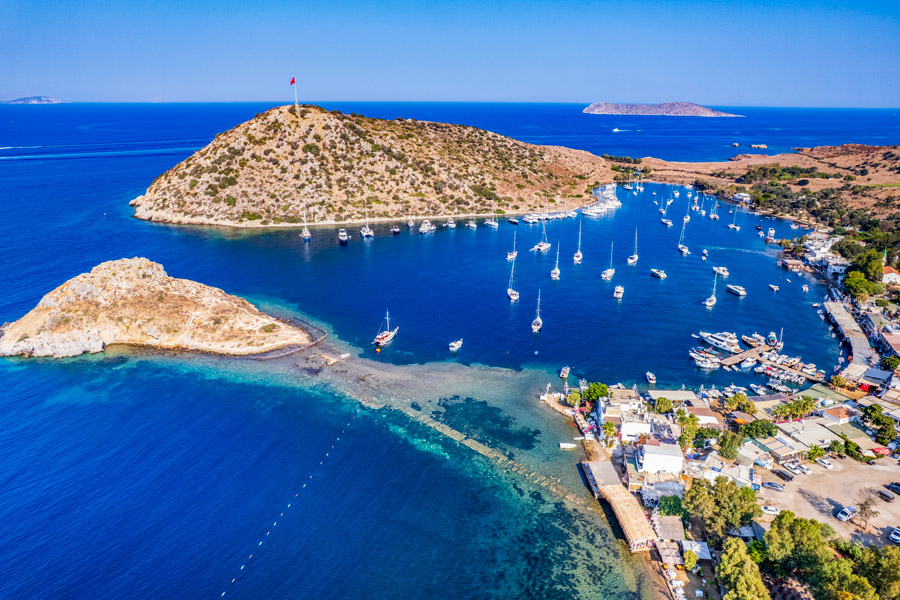
Between the two arms of the bay, a line of stone stretches out into the water towards a small green islet. This is Tavşan Adası – Rabbit Island – and the path to it is the top of a wall that once belonged to Myndos. In summer the sea sits low enough to wade across, ankle to knee deep, the old blocks pale beneath the surface. The islet itself is scrub and rock, with fragments of building scattered through it. From the top the whole cove opens out: boats, rooftops, and the long bar of the sea.
Fish suppers on the waterfront
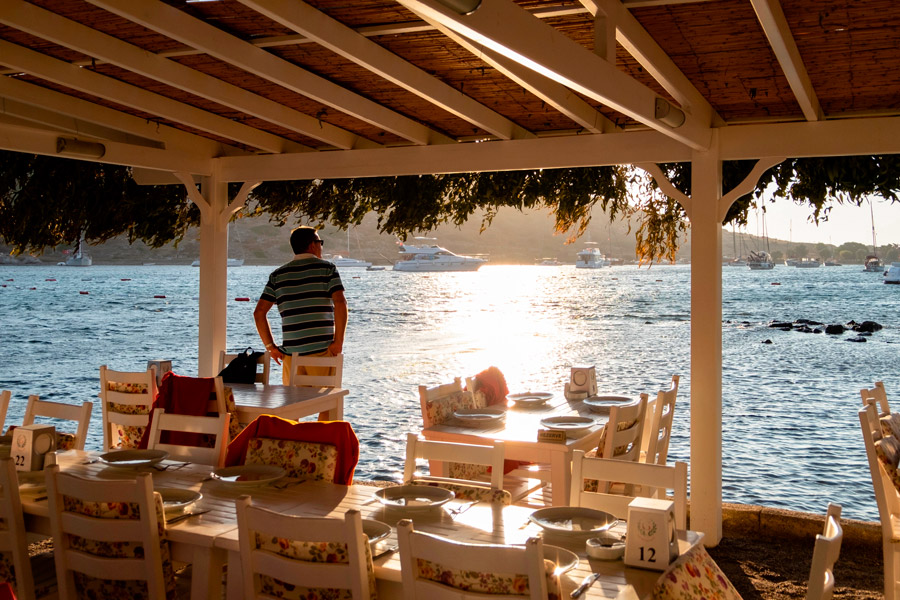
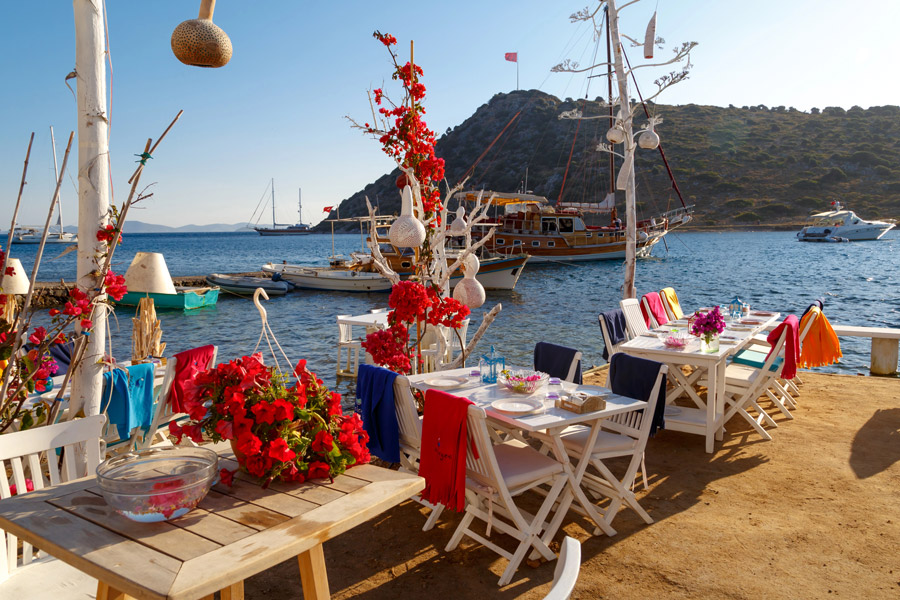
Gümüşlük is known across the peninsula for its fish, and the proof is a row of tables set right at the water's edge. White cloths sit so close to the bay that the wash almost reaches them. The day's catch comes out on ice to be chosen by eye, followed by meze and rakı in the old coastal manner. Bougainvillaea spills over the awnings. People drive out from Bodrum town, and from a good deal further, for a single long dinner timed to the sunset, when the sky over the water turns through orange and rose before the boat lights take over.
The Wednesday market
One morning a week the village turns to trade. Every Wednesday a market sets up beside Kadri Özsarı Park, halfway between the harbour and the inland houses. Stalls carry seasonal produce, village cheese and olives, cloth and plain housewares. It is a working market for local kitchens rather than a tourist row, which is exactly its appeal. An hour among the crates is the easiest way to see the everyday village behind the waterfront.
The Gümüşlük Music Festival
The Gümüşlük International Classical Music Festival has been held here since 2004, started by two pianists, Eren Levendoğlu and Gülsin Onay. It was piano only at first. The bill now takes in jazz and folk, across two months from mid-July to early September. Onay, one of Turkey's best-known pianists, still draws players from abroad.
The main stage went into the old stone cutting at Koyunbaba in 2012, with rock faces rising on both sides. Concerts are split by setting: at the quarry, at a stage by the beach, and on the sand for the youngest players. After dark the rock keeps the sound in. Nobody dresses up, and people sit on the stone to listen.
The festival has operated an academy from the start, with masterclasses where young musicians work alongside the visiting artists. Since 2012 it has also held a piano competition named for the composer Ahmed Adnan Saygun. More than a thousand players from dozens of countries have appeared, a fair number of them returning after first coming as students.
It stays small: a few hundred seats, a short walk up from the harbour, in a village that still ties up its boats at the end of the day.
Practical Information
Address: Gümüşlük, Bodrum, 48970 Muğla. At the western tip of the peninsula, where the main road ends at the bay.
Opening hours: open access. The village, the beach, and the walk to Rabbit Island are free to visit at any time. Most restaurants, cafés, and shops welcome visitors from late spring to early autumn; many close over winter.
Entry: free. The beach areas in front of the restaurants are mostly managed by them – a sunbed and umbrella come with the price of a meal or a cover charge.
Festival tickets: the Gümüşlük International Classical Music Festival runs from mid-July to early September. Programme and tickets are published each summer at gumuslukfestival.org. Seats at the quarry are limited and sell ahead of the date.
How to Get There

By dolmuş: shared minibuses depart from Bodrum's main bus station (otogar) to Gümüşlük through the day, taking around 40 minutes. They go frequently and late in summer, less often off-season. The dolmuş often sets down at the top of the village, leaving a short walk downhill to the bay.
By taxi: available across Bodrum town and the resort districts. The fastest way out and the most expensive – most useful late at night, or after a concert once the dolmuş has stopped.
By car: roughly 40 minutes west of Bodrum town. Follow the signs for Turgutreis, then Gümüşlük. The waterfront is closed to traffic, so cars use a paid lot just inland from the bay.
From the airport: Bodrum–Milas Airport (BJV) is about an hour away via the D330. There is no direct bus – car hire or a pre-booked transfer is the simplest way in.
Tips for an Optimal Visit
When to come. Late spring and early autumn are the most comfortable – warm water, mild evenings, and room to move. July and August are hot and busy, and overlap with the festival, so they suit anyone coming mainly for the music. Much of the village closes through winter.
The Rabbit Island crossing. Go in daylight and on a calm day. A stiff wind raises the water over the old causeway and hides the path. The stones underfoot are uneven, so shoes that can get wet are worth having.
A table at sunset. In July and August the waterfront fills as the light goes. A table booked ahead is the difference between a seat at the water's edge and a wait on the harbour.
What to bring. Little shade falls on the beach through the middle of the day, so bring sun protection. Evenings are cooler than the days, and the quarry is cooler than the beach – a light layer is useful for a concert.
Combine with. Yalıkavak is about 20 minutes north by road – a larger town with a marina and beaches. Turgutreis, with its own beach and a Saturday market, is a similar distance south. Either pairs well with Gümüşlük over a day on the peninsula.
The same cove gave a king the stone for his tomb and now gives a summer its music; the rest of the year it mostly just fishes. After the last concert the audience walks back down to the harbour in the dark, past the shut-up stalls and the cleared tables. The boats knock softly together in the shallows. Up in the hills the quarry stands empty again, gathering quiet until July.