

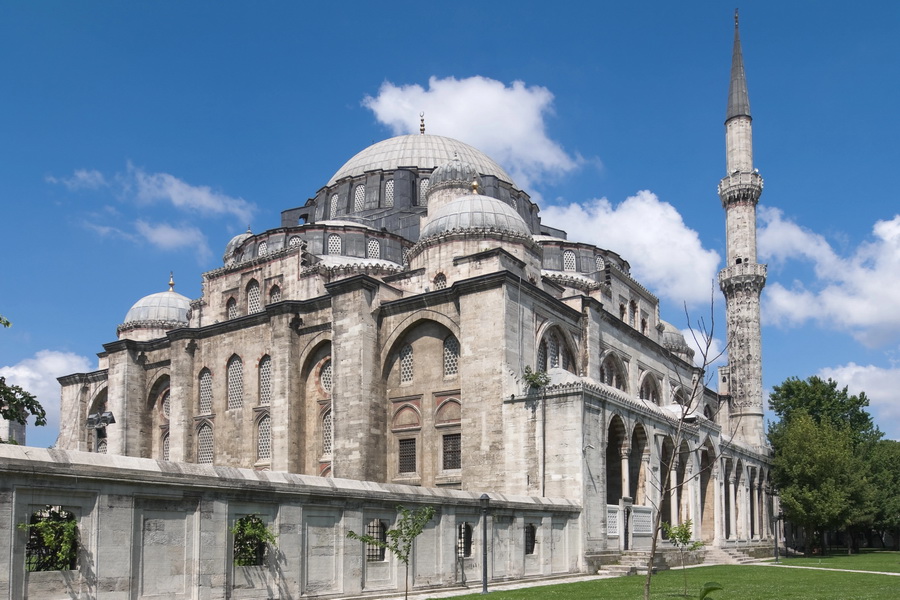
The Süleymaniye Mosque (Süleymaniye Camii) rises beautifully above the heart of Istanbul, Turkey (Türkiye). It stands on the Third Hill and boasts a sweeping view of the Golden Horn.
Many visitors call it the most peaceful landmark in Istanbul. Others come for its architecture and deep imperial history.
Whatever draws travellers here, the mosque rewards every step with a mix of grace, space, and silence that they will not forget.
What Makes the Süleymaniye Mosque Special?
The Süleymaniye Mosque is one of the popular historical places in Istanbul. It represents the height of Ottoman architecture and the vision of two influential figures: Sultan Suleyman the Magnificent and his master architect, Mimar Sinan.
Sinan designed the mosque with perfect harmony in mind. Every arch, window, dome, and courtyard follows a clear rhythm. The result feels balanced, elegant, and powerful.
The mosque is often described as quieter and more spacious than many other Istanbul religious sites.
Visitors can admire a grand monument and still find room to breathe. The view of the Golden Horn makes the experience even more striking. The blend of artistry and serenity sets the Suleymaniye Mosque apart from anything else in the city.
Visiting the Süleymaniye Mosque in Istanbul

The Süleymaniye Mosque's opening hours follow a steady daily routine. It is generally open from early morning (around 9:00) until late evening (sometimes 23:00 in summer). However, short closures take place during the five daily prayers.
You can visit the Suleymaniye Mosque without paying. As an active place of worship for Muslims, the mosque is open to everyone without an entrance fee.
Modest clothing is required, and women should bring a headscarf. Photography is welcome outside prayer times.
You can join guided tours to deepen your understanding of its history and architecture.
History in Brief
Sultan Suleyman the Magnificent ordered the construction of the mosque in the 16th century. Work began in 1550 and finished in 1557. At the time, the Ottoman Empire was at its political and cultural peak.
The Sultan wished for a place of worship that demonstrated the strength and confidence of his reign. He turned to Mimar Sinan, who later became known as the greatest architect in Ottoman history.
Sinan approached the project with fresh ideas and bold engineering, influenced by the Byzantine architecture. On the one hand, he incorporated traditional Islamic design. On the other hand, new structural techniques allowed larger domes and better acoustics.
As a result, it became the spiritual centre of the empire and the jewel among Ottoman mosques.
The mosque complex (known as a kulliye) also served a practical role. It included madrasas (schools), a library, a public kitchen, a hospital, Turkish baths, and a caravanserai. These services supported the surrounding community in accordance with the Islamic waqf principle (charitable endowment).
You can still see traces and preserved sections of several of these structures around the mosque today.
Architectural Highlights

The architecture of the Süleymaniye Mosque is truly Sinan’s genius. It is no wonder this monument is one of the famous mosques in Istanbul.
Courtyard
The courtyard (avlu) impresses with its design. The four minarets mark the borders, with an ablution fountain in the centre.
It is framed by 28 small domes resting on 24 marble and granite columns.
Look closely at the column capitals: instead of classical Corinthian or Ionic styles, Sinan used muqarnas (stalactite-like carvings), a hallmark of Islamic architecture.
The granite columns are carved from a single stone.
Gardens and Tombs

Outside, gardens surround the tombs of Sultan Suleyman, Hürrem Sultan, and Mimar Sinan himself. These burials are great cultural landmarks in Istanbul and offer a tranquil space for reflection.
The Dome and Structure
The dome was consciously designed to rival that of the Hagia Sophia (whose dome is about 55.6 meters high). The combination of Byzantine influence and Islamic architecture makes the Suleymaniye Mosque a beloved landmark among Istanbul's top attractions.
Pendentives and two semi-domes support the main dome. This edifice differs from earlier Ottoman mosques that typically used a cascade of smaller domes.
- The dome rises 53 meters (174 feet) above the floor.
- Sinan placed clay pots around the central dome for better acoustics.
Four Minarets
The mosque’s four minarets dominate Istanbul’s skyline.
- The minarets have balconies, ornamented with Ottoman geometric and vegetal motifs.
- The four minarets represent Sultan Süleyman as the fourth sultan since the conquest of Constantinople in 1453.
Things to See Inside the Süleymaniye Mosque Istanbul

When you visit religious landmarks in Turkey, it becomes clear that the Süleymaniye Mosque in Istanbul is a notable site. So, what to see inside the mosque?
Iznik Tiles
Visitors can spot İznik tiles around the mihrab and qibla wall, and in the Sultan’s prayer loge (hünkâr mahfili).
- Look for the floral and arabesque patterns in cobalt blue, turquoise, and white.
- The nearby mausoleums of Süleyman and Hürrem Sultan in the same complex showcase the most vibrant tilework.
Stained Glass Windows

Above the mihrab, the original stained-glass windows designed by the master glassmaker İbrahim Sarhoş (the Drunkard) filter light across the sanctuary.
- Many depict floral motifs or geometric forms that echo the building's overall design.
- Some pigments, particularly the deep blues, were made from lapis lazuli, a costly semi-precious stone imported from Afghanistan.
Dome Interior

Look up: the interior of the main dome evokes a cosmological space, representing the vault of the heaven.
- Intricate calligraphy and ornamentation radiate from the centre, visually reinforcing the dome as the symbol of sovereignty.
Painted Decoration

The red-and-white painted patterns you see today were added during later restorations and are not original to Sinan’s design.
Four Red Massive Granite Columns
A system of massive piers supports the central dome and semi-domes. Pay attention to the four large red granite columns that stand out near the qibla wall.
- According to architectural research, these monolithic giants were sourced from the major centres of the Ottoman Empire.
- Some commentators symbolically linked them to the “Four Rightly Guided Caliphs” of Sunni Islam.
Calligraphy

The mosque is adorned with exquisite Ottoman calligraphy.
- Verses from the Qur’an are inscribed in flowing Arabic script, particularly around the dome’s base and above the mihrab.
What is Original?
Much of what visitors see today dates from later restorations (notably after the 1766 earthquake and 20th-century works). However, these original elements remain:
- The core structure – walls, columns, dome geometry, and layout.
- The stained-glass windows above the mihrab, crafted by İbrahim Sarhoş.
- Traces of the original İznik tiles and lapis lazuli pigments in some decorative panels.
Things to Do Near the Süleymaniye Mosque Istanbul

The mosque sits in the historic district, so you can explore several Istanbul attractions within walking distance.
Golden Horn Viewpoint
Step out to the garden terraces for the finest vistas in Istanbul. Down at the Golden Horn, you can enjoy sunset walks and a short ferry ride. The skyline view of the mosque from the waterfront is breathtaking, especially at dusk.
Grand Bazaar
A short walk takes you to the Grand Bazaar, the most celebrated market in Turkey. You can wander through colourful lanes filled with textiles, ceramics, and jewellery.
Spice Bazaar
This market lies near the Eminönü waterfront. Fragrant spices, sweets, teas, and local treats fill the stalls. Spice Bazaar could be a great stop before or after your mosque visit.
Historic Neighbourhood Streets
The streets around the mosque are dotted with small shops, cafés, and traditional houses. This area reveals a quieter side of the old city.
These nearby Istanbul sights help you turn your mosque visit into a full cultural day.
Şehzade Mosque
Another mosque to visit in Istanbul is the Şehzade Mosque (Şehzade Camii), just a short walk from the Süleymaniye Mosque. Designed by Mimar Sinan, it was his first imperial architectural project.
Sultan Suleyman was extremely impressed with Sinan’s work on the Şehzade Mosque in memory of his beloved son, Prince Mehmed, who died young. Later, he commissioned him to build the Süleymaniye Mosque in his own name.
Have Tea at a Terrace Café
Behind the mosque, several charming terrace cafés and restaurants overlook the Golden Horn. Locals gather here for Turkish tea or coffee at sunset. The view of the Galata Tower framed by domes and minarets is fascinating.
Best Time to Visit & Photography Tips

The best time to visit the Süleymaniye Mosque in Istanbul is early morning or late afternoon.
Inside, look for the gentle light from stained glass windows. It casts soft shapes on the carpets and walls.
If you enjoy photography, take a moment to frame the central dome from different angles. The symmetry is impressive and easy to capture.
Avoid visiting during prayer times, especially during the midday prayer on Friday.
How to Get to Istanbul Suleymaniye Mosque
Reaching the mosque is simple. Take the T1 tram to Eminönü or Beyazıt and walk uphill for about 10–15 minutes. Several buses also stop nearby. Taxis can drop you close to the entrance. The climb is gentle and gives you lovely glimpses of the old city.
FAQs
Is the Süleymaniye Mosque free?
Yes. There is no entrance fee; the site remains completely free for all travellers.
Is the Süleymaniye Mosque worth visiting?
Absolutely. The calm atmosphere, wonderful views, and rich cultural history make it a highlight of any trip to Istanbul.
When was the mosque built?
Construction took place between 1550 and 1557 during the reign of Sultan Suleyman the Magnificent.
Why does the Süleymaniye Mosque look like Hagia Sophia?
Mimar Sinan studied the architecture of Hagia Sophia. He used some of its ideas but refined them to create a lighter, more balanced design that suited Ottoman architectural goals.