

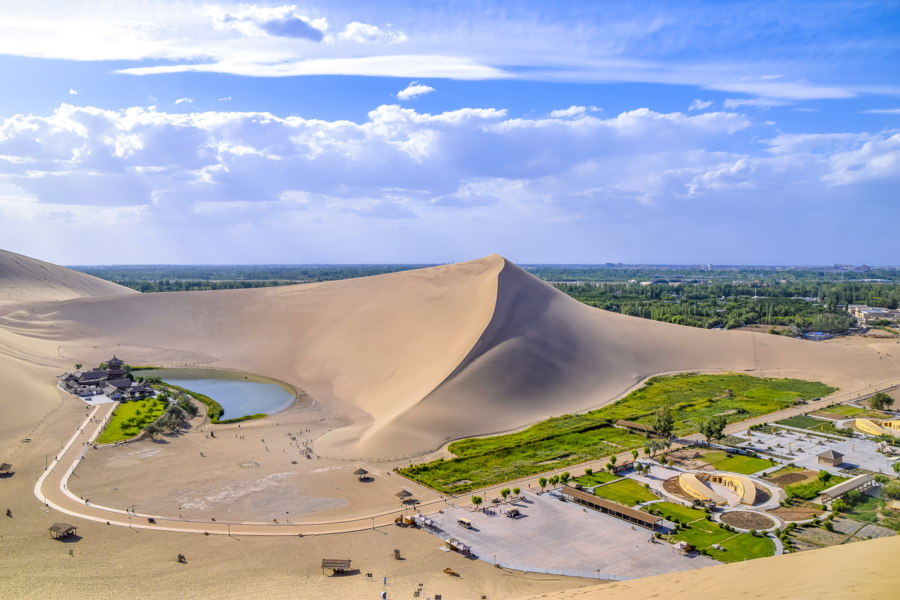
Set amid the golden sands of the Gobi Desert, the ancient city of Dunhuang (敦煌市, Dūnhuáng shì) is the only western gateway of the Chinese section of the Silk Road – the vast network of trade routes that once linked East and West. The city lies in Gansu Province, at the far end of the Hexi Corridor, a narrow passage between steppe, desert, and rocky mountains on the route from China towards Central Asia and the Indian subcontinent. Here, among dry plains and shifting dunes, a fertile oasis gave rise to a remarkable concentration of historical and religious sites, many of which continue to attract visitors today.
Beyond the modern city are ancient caves with murals that have survived for more than a thousand years, dunes that seem to sing in the wind, a crescent-shaped lake preserved among the sands, and the ruins of frontier outposts that once stood at the edge of the known world. Within Dunhuang itself, visitors will find lively streets, impressive museums, and welcoming places to try the region’s distinctive cuisine. This guide introduces one of China’s most evocative corners – a place where desert landscapes, Silk Road history, and traces of long-past eras still feel closely intertwined.
Dunhuang Tours
Dunhuang can be explored as part of a wider journey through China and the historic landscapes of the Silk Road. On a seven-day route through some of the region’s most important sites, the city and its surroundings set the tone for the whole trip. Here, you encounter local cultural traditions against a backdrop of desert valleys, wind-shaped landforms, and red sandstone canyons.
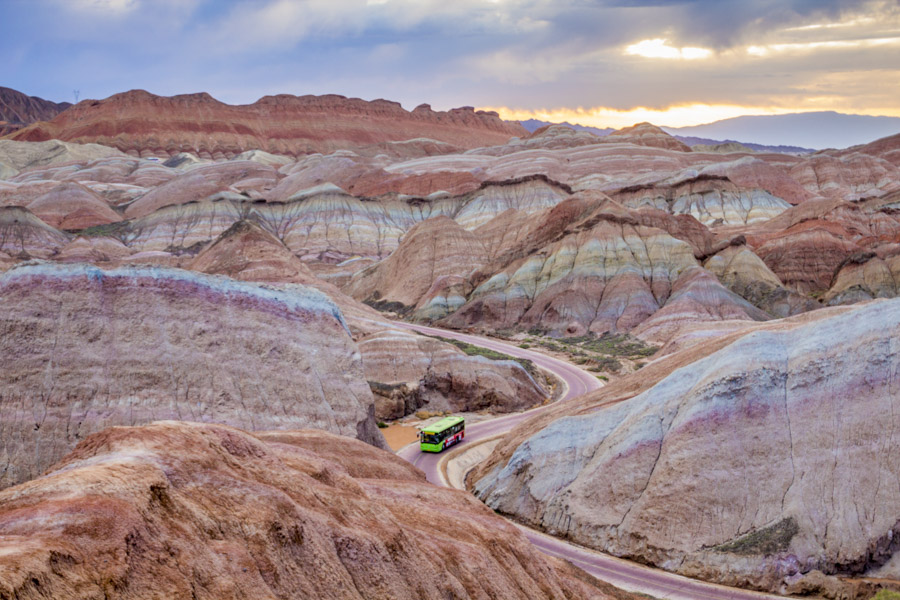
Our China tours to Dunhuang include seven- and ten-day itineraries that bring together the main highlights of this route. The shorter journey leads from Xi’an, China’s ancient capital, towards the country’s western reaches, passing the rainbow-coloured mountains of Zhangye and the Jiayuguan Fortress, set against distant snow-capped peaks, before reaching Dunhuang. The extended version continues further west to the Flaming Mountains near Turpan and the historic streets of Kashgar, incorporating Uyghur culture and the landscapes of Xinjiang.
However you choose to approach it, Dunhuang stands out for its striking contrasts: desert and oasis, Buddhist cave art and frontier ruins, quiet museum halls and open horizons.
Best Time to Visit Dunhuang
Dunhuang’s climate is cold and arid (classified Bwh in the Köppen system), marked by sharp contrasts. Summer brings intense desert heat, while winter arrives with biting winds. Spring and autumn are brief, but they offer that rare balance when the desert is most comfortable and at its best.
Spring (March to May). The sands begin to warm, a light haze settles in the air, and the days gradually lengthen. Average temperatures rise from about 16°C (61°F) in March to around 27°C (81°F) in May. April, however, can be unpredictable: sandstorms may arrive suddenly, turning the sky to ochre and blurring the horizon. For those prepared for changeable weather, spring brings quieter sites and soft light that is ideal for photography. The Buddha Bathing Festival (8th day of the 4th lunar month) falls in late spring (usually May).
Summer (June to August) is both the hottest period and the peak tourist season. Daytime temperatures in June are typically around 31°C (88°F), while in July they can exceed 34°C (93°F). The sun is strong, shade is scarce, and the dunes can become too hot to walk on barefoot. Evenings, however, bring welcome relief. After sunset, the heat eases, the sand cools, and the low light gives the dunes a gentler, more atmospheric quality.
The Desert Dragon Boat Festival (5th day of the 5th lunar month) is celebrated in early summer (usually June).
Autumn (September to November) is generally the best time to visit Dunhuang. The heat retreats, temperatures become more comfortable, often settling around 19°C (66°F) in October, and the sky takes on a deep, clear blue. Visitor numbers fall, queues at the Mogao Caves are usually shorter, and walks across the dunes are far more pleasant.
Winter (December to February) is when Dunhuang feels quietest. Temperatures can fall to between -13°C and -2°C (9°F to 28°F), and the cold feels sharper on windy days. Snow on the dunes is rare, but when it appears, it creates an unusual and quietly beautiful scene. The risk of severe sandstorms is also lower at this time of year. On overcast days, the streets grow still and visitors are few. When the sun returns, locals gather outside small restaurants to play mahjong and chess – quiet glimpses of winter life in the city. The Lantern Festival (15th day of the 1st lunar month) occurs in late winter to early spring (usually February or early March).
Whatever the season, the desert shapes the rhythm of the day. Before 10:00 and after 17:00 are usually the best times for walks, when the light is softer and temperatures more comfortable. From midday until about 16:00, the sun can be unforgiving, so it is better to spend these hours indoors, for example, in a museum. After dark, temperatures drop sharply. The difference between day and night can reach 15 to 20°C (59 to 68°F), so a jacket or a shawl is useful even in the height of summer.
History of Dunhuang
Dunhuang’s history begins in the 2nd century BC when Han forces pushed the Xiongnu out (by 121 BC) and established a fortified outpost. Its name means “blazing beacon".
By the 4th century AD, it became an important Buddhist centre after monk Le Zun (Yuezun) carved the first cave at Mogao (366), which grew into a major cave complex over the next millennium.
The city flourished as a cosmopolitan Silk Road hub under the Tang dynasty (7th–10th centuries) but declined thereafter as trade shifted and rule changed under the Tangut and Mongols and the Ming largely abandoned it.
Around 1275 the Venetian merchant Marco Polo reached Shazhou (present-day Dunhuang) with his relatives while travelling to Kublai Khan’s court.
Rediscovered by a monk in 1900, the Library Cave, which contains about 50,000 manuscripts, including the 868 Diamond Sutra, renewed global interest.
The Mogao Caves were inscribed as a UNESCO World Heritage site in 1987.
Today Dunhuang is a major cultural and tourist destination in western China.
Things To Do in Dunhuang
Dunhuang is more than an open-air museum of Silk Road history. It is also a place where the desert becomes part of the experience – a landscape to cross, observe, and experience at close range.
A trek through the Gobi Desert is one of the most memorable ways to appreciate the scale of this landscape. Multi-day routes lead across sand dunes and rocky plains, with nights spent in desert camps beneath a wide, star-filled sky. The silence, the open horizon, and the absence of city lights create a sense of space that few places in China can match.
Plan your day around sunrise and sunset. In the early morning, the dunes shift from cool grey to gold within minutes, and the landscape seems to change almost before your eyes. Sunset brings a deeper drama: orange and crimson light spreads across the sand, shadows lengthen along the ridges, and the desert takes on a quietly glowing intensity.
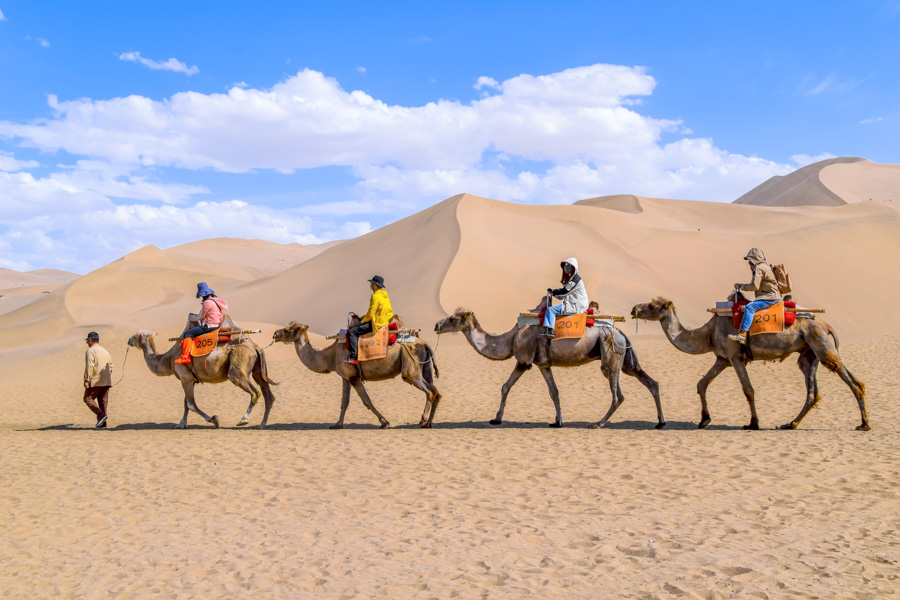
You can also spend a full day among the dunes. Climb slopes rising up to 250 metres (820 feet), try sandboarding, or cross the rolling sand by quad bike or 4x4. For a broader perspective, take a short flight in a motor glider with a pilot and view the desert from above. Camel rides offer a slower rhythm: for about an hour, you traverse the dunes to the creak of harnesses at a pace that echoes the caravans that once crossed these landscapes.
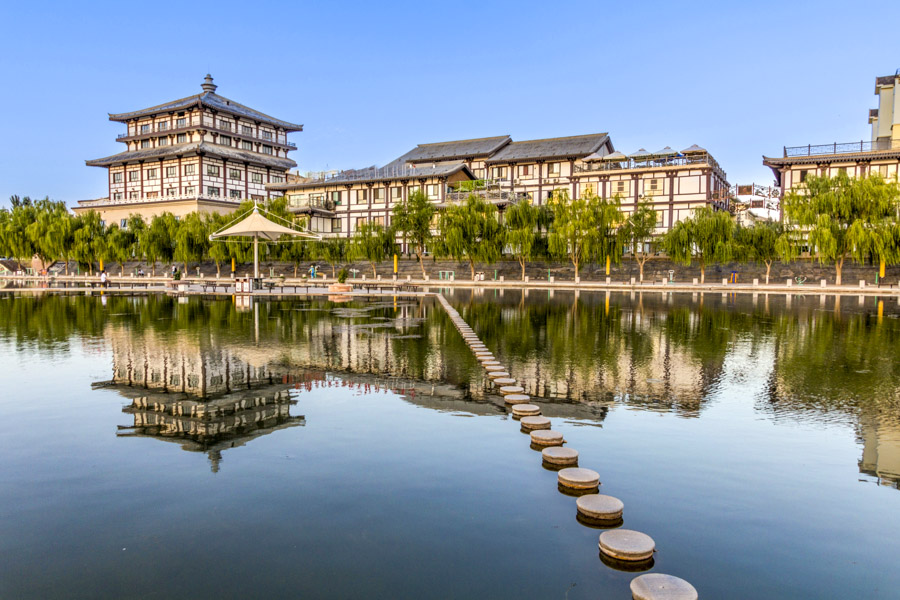
Within the city, take a walk along the Dang River. Its landscaped embankment, bridges, and viewing platforms provide a gentle contrast with the surrounding desert scenery and offer a welcome pause between busy days of sightseeing.
Places to Visit in Dunhuang and Surroundings
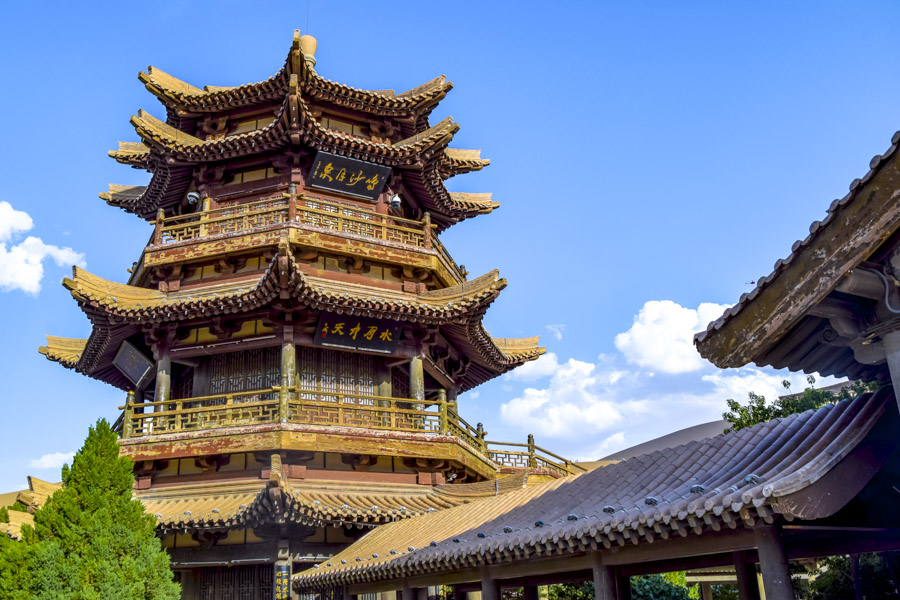
Architectural Marvels
Dunhuang’s architectural heritage spans more than a thousand years, from Buddhist pagodas and monasteries to military outposts and postal stations scattered across the desert.
In the city centre stands the White Horse Pagoda (白马塔), a 12-metre-high (39-feet) structure traditionally associated with the Buddhist monk Kumārajīva. According to legend, the nine-storied pagoda was built in memory of the faithful horse that carried him across the desert but did not survive the journey. Rebuilt and restored over successive periods, the pagoda shows traces of several dynastic styles and remains a quiet reminder of Dunhuang’s early Buddhist connections.
Four kilometres (2.5 miles) south of the pagoda, at the foot of Mingsha Mountain, lies Leiyin Temple (雷音寺), Dunhuang’s largest Buddhist monastery. Founded during the Western Jin dynasty (266–316 AD), it is entered through a monumental Shanmen Gate. Stone carvings decorate the entrances to its pavilions, while inside the halls are gilded Buddha statues, images of Guanyin, and rows of arhats.
Around 16 kilometres (9.9 miles) west of the city, Dunhuang Ancient City (敦煌古城), also known as the Dunhuang Flim and TV Base, is a replica of the mediaeval Shazhou Town of the Song Dynasty (仿宋沙洲城). Built as a large-scale film set, it is now also visited as an atmospheric cultural attraction.
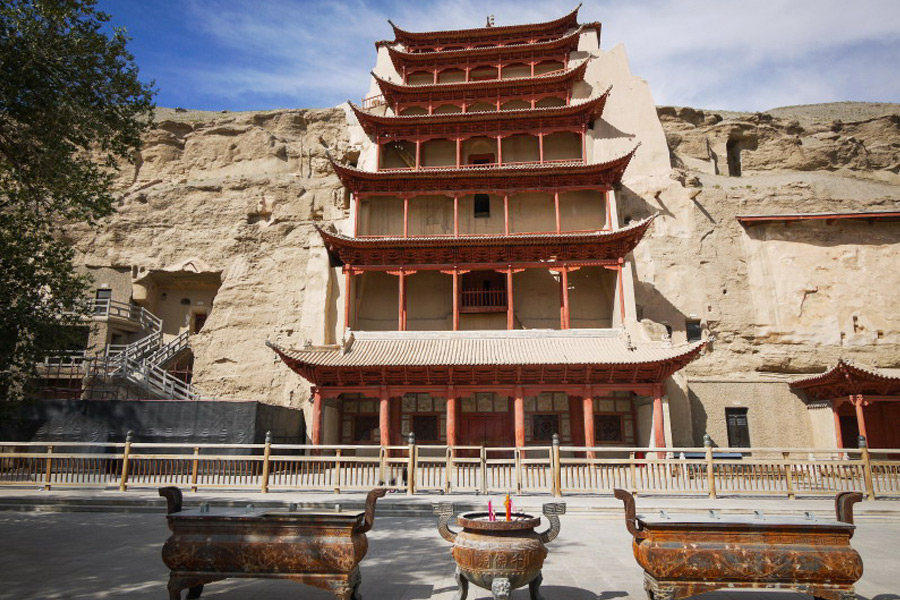
About 25 kilometres (15.5 miles) from central Dunhuang, the Mogao Caves (莫高窟), also known as the Thousand Buddha Caves, are hidden in the cliff face above a dry riverbed. They are among China’s most important Buddhist monuments. Some 492 principal caves, filled with layered murals and Buddha statues dating broadly from the 4th century (Northern Liang) to the Yuan dynasty, form a visual chronicle of religious devotion and cultural exchange along the Silk Road.
Across the gorge rises Sanwei Mountain (三危山),),peak with historical sites on its slopes, including the ruins of Laojuntang Temple, Wang Mu Palace, Guanyin Well, and a 36.6-metre-metre (120.1-foot) bronze Buddha facing the caves.-foot) bronze Buddha facing the caves.
North-west of Dunhuang, in the Gobi Desert, lie the ruins of Hecang City (河仓城), an ancient supply depot where grain, silk, and military supplies were once kept. Its wind-eroded clay walls are now all that remains of an important station on the old trade route. Around 64 kilometres (40 miles) from the city is the Site of Xuanquan Posthouse (悬泉置遗址), an excavated Han-dynasty post station where the foundations of walls, a well, and traces of stables have been preserved.
Complete the route at Yangguan Pass (阳关), around 70 kilometres (43.5 miles) from Dunhuang, and Yumenguan Pass (玉门关), about 90 kilometres (56 miles) away. These ancient outposts once marked the passage west for travellers leaving China along the Silk Road. Nearby are the ruins of the Han-dynasty Great Wall but simple ramparts of clay, reeds, and wood weathered by two thousand years of wind. Set against the harsh desert landscape, these remains feel like a faint trace of the empire that once guarded the caravan route. weathered by two thousand years of wind. Set against the harsh desert landscape, these remains feel like a faint trace of the empire that once guarded the caravan route.
Museums and Cultural Spaces in Dunhuang
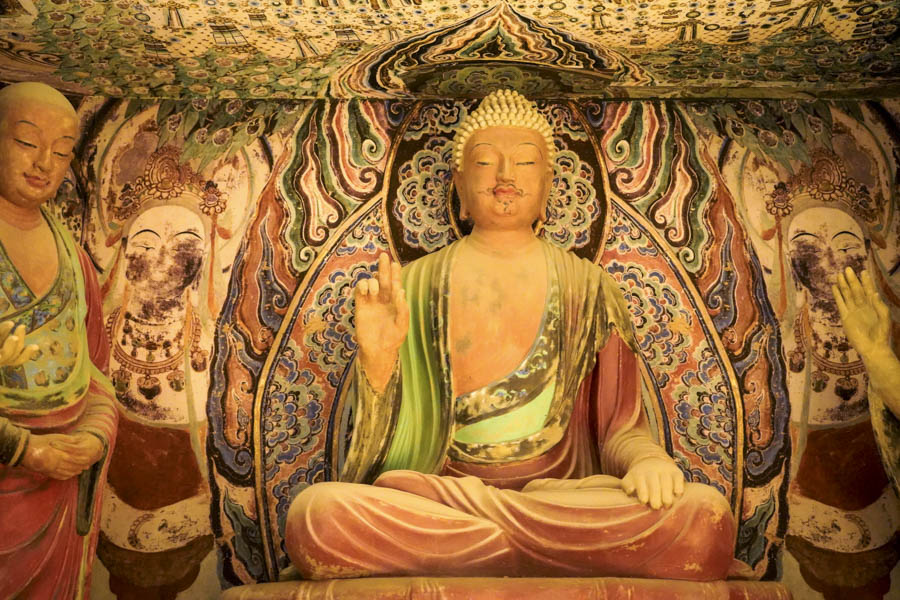
Dunhuang is not only a city of caves and desert landscapes. It is also actively reinterpreting its heritage through museums, workshops, and contemporary cultural spaces, where ancient history becomes more tangible for today’s visitors.
The Dunhuang Museum (敦煌博物馆) holds at least 13,355 exhibits, including manuscripts from the Library Cave, artefacts from Han, Jin, Sui, and Tang dynasty burials, bamboo slips, silk textiles, coins, signal torches, and other objects from the region’s past. It is one of the best places to gain a broader understanding of Dunhuang before visiting the monuments themselves.
The Dunhuang Academy (敦煌画院) offers a closer look at the artistic language of the Mogao Caves. Here, master artists reproduce the famous murals with careful documentary accuracy, using traditional techniques for copying on clay and paper. The collection includes sutra illustrations, patrons’ portraits, decorative motifs, and other works inspired by Dunhuang art. It is a rare opportunity to study these images at close range, away from the caves’ crowds.
Dunhuang Press (敦煌印局), located on the banks of the Dang River, is a modern cultural space of around 2,000 square metres (21,528 square feet) dedicated to the ancient art of seal carving. Visitors can view historical prints and join workshops to create their own designs, learning how traditional craftsmanship can be adapted for a contemporary audience.
To understand how the Mogao murals and sculptures were made, visit Mogaoli Craftsman Village (莫高里工匠村), a workshop and museum founded in 2018 by Du Yongwei, a master of painted sculpture. Visitors can try copying frescoes, sculpting, paper cutting, and working with mineral pigments, gaining a more practical sense of the techniques behind Dunhuang’s sacred art.
Dunhuang Rules is a three-storey cultural space presenting Dunhuang’s heritage through contemporary art and design. The ground floor features an installation inspired by the cave murals’ visual language. The first floor houses pottery and weaving workshops, books, and a café; the second floor contains a tea room with a quiet, meditative atmosphere.
Entertainment, Parks, and Shopping in Dunhuang
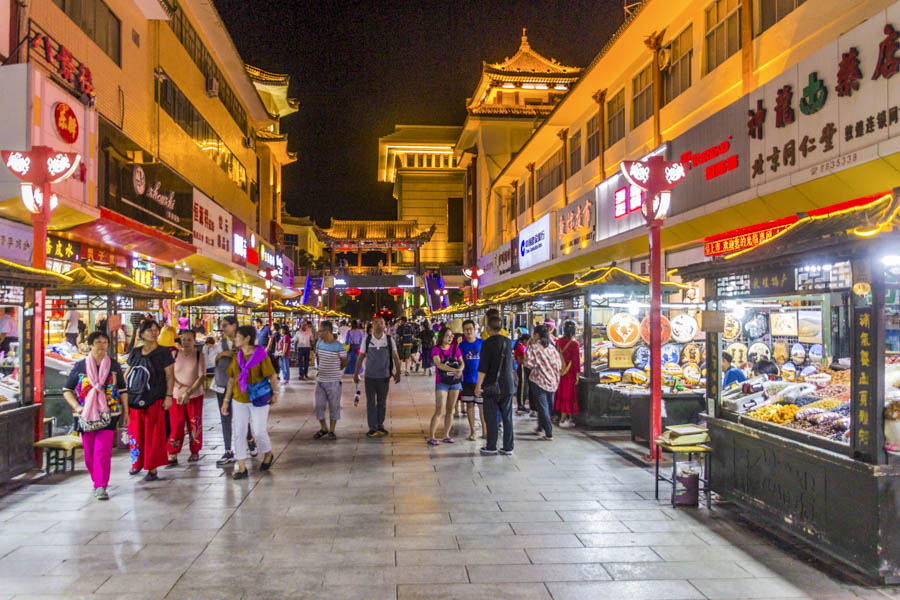
Dunhuang’s atmosphere can be experienced through large-scale theatrical performances; the vastness of Dunhuang UNESCO Global Geopark; quiet parks on the edge of the desert; and evening shopping streets lit by lanterns and shopfronts.
Entertainment
One of the region’s best-known performances is Encore Dunhuang (又见敦煌), an immersive show that draws visitors into the world of caravan trade, Buddhist pilgrimage, and Silk Road travel. The performance unfolds across several spaces rather than on a single stage, with the audience moving between scenes as the story develops. Lantern light, ancient musical motifs, and the silhouettes of travellers create a vivid sense of movement through Dunhuang’s past.
The show Ancient Sound of Dunhuang (乐动敦煌) introduces the musical and artistic heritage of the ancient city. Inspired by the murals of the Mogao Caves, it echoes the poses of celestial musicians and Buddhist figures preserved in the grottoes. Traditional instruments, dance, theatre, and multimedia projections combine to transform the stage into a living image. Scenes with Flying Apsaras (female spirits of the clouds and waters in Hindu and Buddhist mythology) are especially memorable, as the performers seem to drift through streams of light and music.
Thousand-Armed, Thousand-Eyed (千手千眼) is an audiovisual drama inspired by the image of Guanyin, the bodhisattva of compassion. The production is known for its precise choreography, in which the movements of dozens of performers merge into a single, flowing pattern. Its most striking moments come when the dancers’ hands form intricate symmetrical shapes that recall the sacred imagery of the Mogao murals.
The Dunhuang Grand Ceremony (敦煌盛典) offers a more spectacular open-air evening experience, combining music, dance, projections, and special effects. Set against the Minsha Mountain desert backdrop and stylised palace scenery, the performance presents scenes from the city’s prosperous past: caravans arriving from afar, court dances, Buddhist ceremonies, and moments from everyday life in ancient Dunhuang. The result is a vivid introduction to the city’s cultural memory.
Geoparks and Parks in Dunhuang
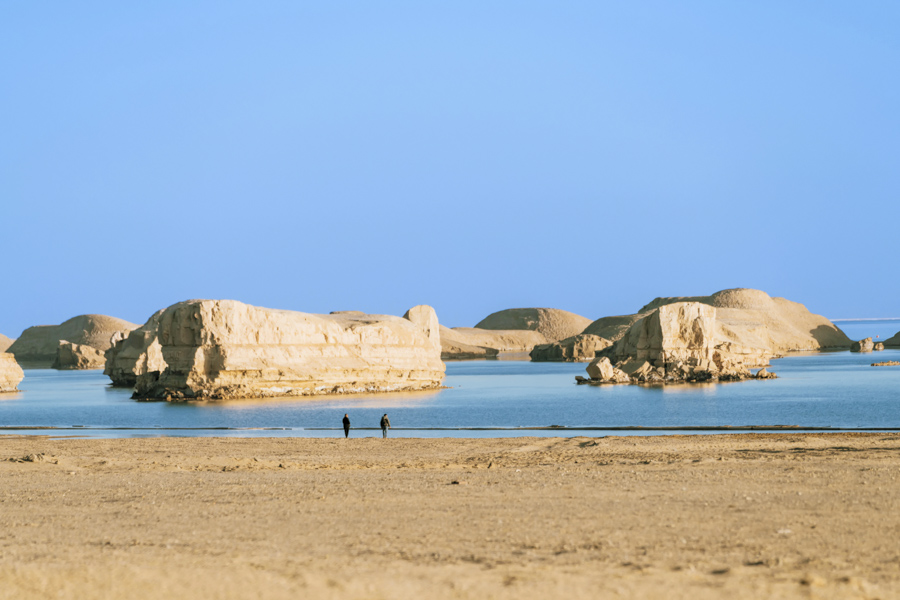
Begin with Dunhuang UNESCO Global Geopark (敦煌世界地质公园), a protected area that brings together the region’s most distinctive geological landscapes and offers a glimpse of how this land was shaped over millions of years.
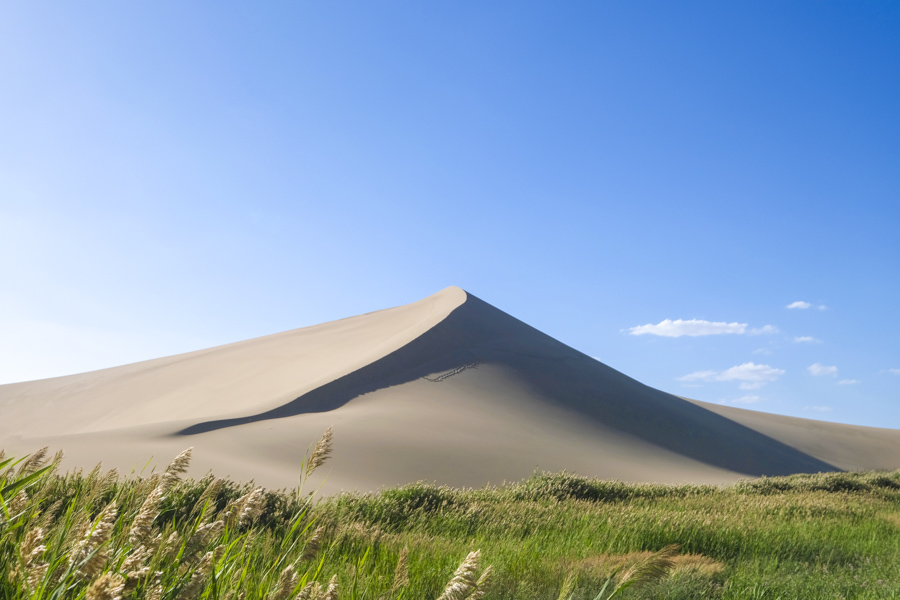
The best-known natural landmark is the Singing Sand Dunes, also called the Echoing Sand Mountains or Mingshashan (鸣沙山). When the wind moves across the slopes, the dunes produce a deep, low sound that can carry across the desert. At their foot lies Crescent Lake, or Yueyaquan (月牙泉), a crescent-shaped lake that has survived in the oasis for centuries despite the surrounding sands. The contrast between the blue of the lake and the golden dunes is startling and almost mirage-like. It is worth returning here after dark, when the lake reflects the stars and the silhouettes of the dunes rise above it in near silence.
Set aside a full day for Yardang National Geopark, around 180 kilometres (112 miles) west of Dunhuang. Here, wind and time have carved towers, arches, and maze-like formations from clay, creating a landscape that can seem almost architectural. In the late afternoon light, these strange shapes resemble the ruins of an abandoned city, making the park one of the most memorable natural sites in western China.
Among Dunhuang’s sandy streets and dry desert landscapes, the city’s green parks reveal a cooler, quieter side. Locals walk in the shade of trees, practise Tai Chi Chuan, and rest beside the water after the heat of the day. Dunhuang Park (敦煌公园), with its winding paths, pavilions, and small lakes, recalls the atmosphere of a traditional Chinese garden, especially in the evening light.
Feitian Park (飞天公园) is another pleasant place to pause for a while. In spring and summer, fruit trees come into blossom, while wooden pavilions provide welcome shade during the hottest hours of the day.
Close to the city centre, the Danghe Scenic Line (党河风情线) follows the riverside with well-kept promenades, illuminated bridges, fountains, and boat jetties. It is particularly lively in the evening, when people gather by the water and the lights lend a gentler mood to the desert city. Against Dunhuang’s arid surroundings, these green spaces offer shade, coolness, and a welcome sense of everyday calm.
Shopping in Dunhuang
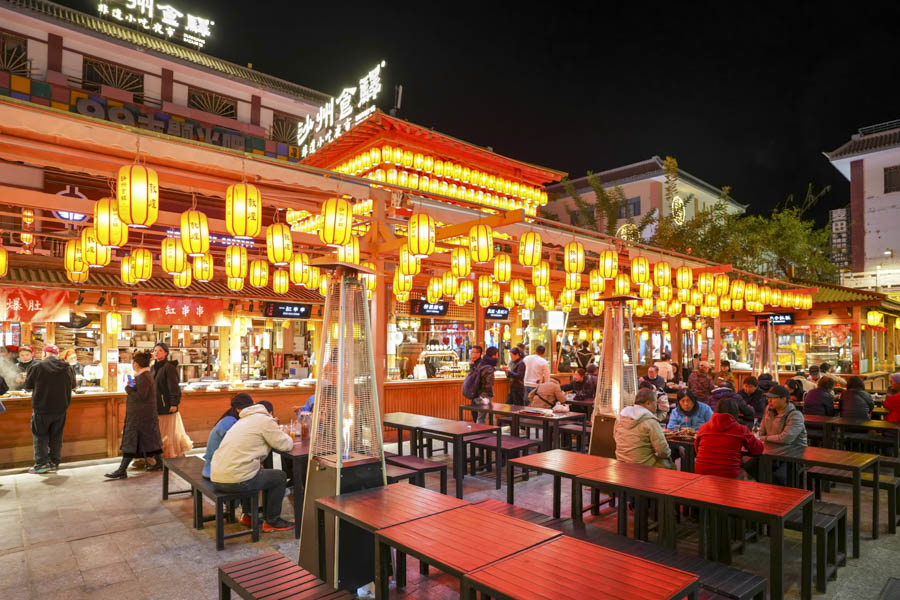
Dunhuang Night Market (敦煌夜市), also known as Shazhou Night Market (沙州夜市), is the city’s main evening shopping area. As dusk falls, gift shops and craft stalls open along the market streets, bringing colour, movement, and the aroma of local snacks to the centre of Dunhuang.
Browse for decorative wall panels depicting desert landscapes, lightweight silk scarves with colourful patterns, carved gourds (葫芦雕刻, húlú diāokè) associated with good fortune and prosperity, and traditional wood carvings. Another characteristic local souvenir is the Jiuquan Luminous Cup, or yeguangbei (夜光杯, yèguāng bēi), a drinking cup made of jade traditionally originating from Jiuquan and often sold in Dunhuang. You will also find sand-art bottles, small ornaments, and other artisans’ gifts.
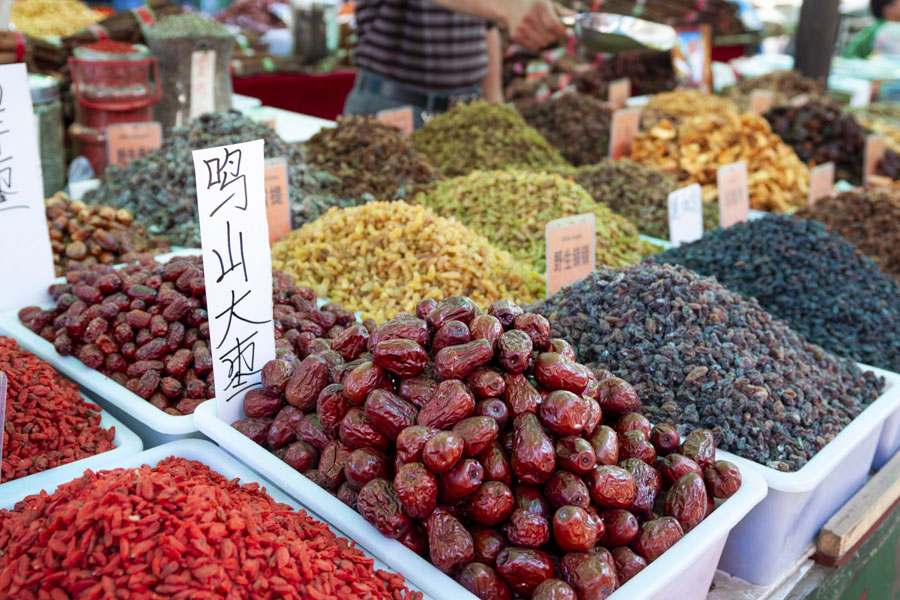
Stalls selling nuts and dried fruit are especially common throughout the market. They can be bought in packs as simple gifts or kept as snacks for the journey.
Food in Dunhuang
Chinese Cuisine
Dunhuang’s cuisine reflects the city’s long Silk Road setting: wheat noodles, roasted meats, spices, and dried fruits all belong naturally to the local table. In the evenings, the mouthwatering scent of grilled lamb and fresh noodles drifts through the streets, especially around the night market and small local restaurants.
Dunhuang Yellow Noodles (敦煌黄面, Dūnhuáng huángmiàn) are the city’s best-known local dish. These thick, springy noodles have a warm golden colour and are usually served with a spicy garlic sauce and savoury seasonings. Simple in appearance but rich in flavour, they are particularly satisfying on cooler evenings. In many local restaurants, they are served with donkey meat, a speciality associated with Dunhuang and the wider north-west.
Shunzhang Huang Noodles Restaurant (顺张黄面馆) is Dunhuang’s oldest noodle house, said to have a history of more than a century.
Location: No. 1, Binhe Jiayuan, Jinshan Road, Dunhuang (敦煌市金山路滨河世纪家园1号)
Another popular street snack is niangpizi (酿皮子, niàngpízi) – cold, chewy strips of starch-based dough served with vinegar, garlic, chilli oil, and seasonings. Refreshing yet filling, it is especially welcome in the summer heat. Charcoal-grilled lamb skewers are just as common, with small pieces of meat cooked over open coals and seasoned with cumin and chilli.
Also worth trying is braised lamb with huyang menbing (胡羊焖饼, húyáng mènbǐng), a dish especially loved by locals. The lamb is slowly cooked with spices until tender, then covered with thin sheets of wheat dough, which steam above the meat and absorb its rich juices.
Jingyuan Guliu Meiwei Yanggao Rou Restaurant (靖遠尕六美味羊羔肉) is one of Dunhuang’s best-known lamb restaurants, popular with visitors who want to try the local young lamb. Its main speciality is hand-grabbed lamb (白條羔羊肉).
Location: East Gate of Shazhou Park, Beitai Lane (北台巷沙州樂園東門口)
For more adventurous diners, Dunhuang also offers dishes made with camel meat. Camel hump, often prepared as yóubào tuófēng (油爆驼峰), is quickly stir-fried over high heat and served with vegetables such as carrots and peppers along with aromatic spices. Another rarer dish is camel hoof, or Silk Road camel hoof (丝路驼掌, sīlù tuózhǎng), made from camel tendon braised for several hours until soft and gelatinous. It is sometimes served on a bed of whipped egg whites, arranged to suggest snow-covered mountain peaks.
Vegetarian Restaurants
Green Lotus Vegetarian Restaurant, also known by its Chinese name, Qinglian Sushi (清莲素食, Qīnglián Sùshí), is a rare fully vegetarian option in Dunhuang and certainly one of the city’s most distinctive places to eat. The menu includes vegetarian dumplings, bao buns with various fillings, tofu in a sweet and savoury sauce, and a seasonal elm-flower dish, which is regarded as a local delicacy. The owner speaks English, and the menu includes pictures, which makes it easier for foreign visitors to order.
Dunhuang is also known for its seasonal fruit. From June to September, markets and street vendors sell honeydew melons, Mingshan jujubes, local grapes, fragrant pears, Li Guang apricots, and local peaches. Their sweetness is especially welcome in the dry desert climate, and they make simple, refreshing snacks during the main travel season.
Tea Houses, Bakeries, and Patisseries
At Dunhuang Night Market, Li Guang Ji Apricot Peel Tea (李广记杏皮茶) is a much-loved stall known for serving the city’s signature drink. Queues are often long in the evening. Alongside the classic apricot peel infusion, you may find variations with peach blossom or oolong tea, and the brand’s distinctive bottle has become a small souvenir in its own right. This is more of a street stall than a tea house, but it is one of the best places to try one of Dunhuang’s most recognisable local drinks.
City Transport in Dunhuang
The centre of Dunhuang is compact and easy to explore on foot, with many restaurants, shops, and local sights concentrated within a relatively small area. For places beyond the centre, the best transport option depends on where your destination is.
Public Transport
Buses and Shuttles
The most convenient way to reach the Mogao Caves is by tourist shuttle from the Mogao Grottoes Digital Exhibition Center, where first you buy your ticket. From there the free shuttle will take you to Mogao Caves. This is usually the most reliable option.
Address: Yangguan Avenue, Dunhung (甘肃省酒泉市敦煌市阳关大道)
City buses also run to Mingsha Mountain and Crescent Lake, about 6 kilometres (3.7 miles) from the centre of Dunhuang.
Other Transport Options
Taxis
Taxis in Dunhuang are easy to find and relatively inexpensive. For more remote destinations, such as Yumenguan Pass, Yangguan Pass, and Yardang National Geopark, it is usually better to hire a car with a driver for the whole day.
Private Car Hire
Hiring a car with a driver gives you greater flexibility, particularly if you want to visit several out-of-town sites in one day. Daily hire usually costs around CNY/RMB 500 to 600 ($74 to 89 / €63 to 76 / £53 to 64), depending on the route, season, and arrangement.
Bicycles
Bicycles can be hired in town and are a pleasant way to explore the area around the dunes in the cooler morning hours. Rental prices are usually around CNY/RMB 50 to 70 ($7 to 10 / €6 to 9 / £5 to 8) at rental points. App-based bike hire can be cheaper, often around CNY/RMB 1–2 for half an hour, with payment usually made via WeChat Pay or Alipay.
At the foot of Mingsha Mountain, camel rides are available for visitors who want to experience the dunes at a slower pace, echoing the merchants, like ,,. The route across the sand is one of the area’s most iconic tourist experiences. tourist experiences.
Please note: prices are approximate and may change without prior notice. Check current rates locally or through official sources before travelling.
Approximate travel times from central Dunhuang to the main attractions:
- Mingsha Mountain and Crescent Lake – 15 minutes
- Mogao Caves – 25 minutes
- Yumen Pass – 2 hours
- Yardang National Geopark – 2 hours
How to Get to Dunhuang
Despite its remote desert setting, Dunhuang is well connected with the rest of China by air, rail, or long-distance bus.
By Air
The city’s main air gateway is Dunhuang Mogao International Airport (DNH) (敦煌莫高国际机场), which operates flights to major Chinese cities such as Beijing, Shanghai, Xi’an, Chengdu, and Urumqi, depending on the season and schedule. The airport is about 13 kilometres (8 miles) from the city centre, and the journey by shuttle bus or taxi usually takes 20 to 30 minutes.
By Train
Dunhuang Railway Station connects the city with the wider rail network of Gansu and north-western China, including both high-speed and regular train services on selected routes. A common route is via Lanzhou, the capital of Gansu Province, then onwards to Dunhuang by train or connecting flight. The station is about 12 kilometres (7.5 miles) from the city centre, with transfers typically taking 20 to 30 minutes.
By Bus
Regular long-distance buses connect Dunhuang with other cities along the Hexi Corridor, including Jiayuguan and Zhangye. This option is most useful for travellers already moving through western China who want to include Dunhuang as part of a wider route.
Languages Spoken in Dunhuang
The main language spoken in Dunhuang is Standard Chinese, or Putonghua (普通话), although the local accent and everyday speech patterns of Gansu Province give it a distinctive regional character. The broader linguistic landscape of north-western China also includes regional forms of Mandarin, such as Central Plains Mandarin and Lanyin Mandarin, while parts of Gansu have Amdo Tibetan-speaking communities, reflecting the province’s long cultural diversity.
Historically, Dunhuang was one of the Silk Road’s great multilingual crossroads. Among the manuscripts associated with the Mogao Caves, researchers have found texts in Chinese and Tibetan, along with smaller groups of manuscripts in Khotanese, Turkic, Sanskrit, Sogdian, Uyghur, Hebrew, and other languages – a reminder of the city’s role in the movement of people, religions, and ideas across Asia.
Outside major hotels, museums, and tourist centres, English is not widely spoken. Travellers will usually find online translation tools useful and should learn a few basic Chinese phrases for taxis, restaurants, and markets.
Security in Dunhuang
Staying Safe in the City
Dunhuang is generally safe for travellers. Street crime is very low, and the main visitor areas, including those around the Mogao Caves and Mingsha Mountain, are well organised and regularly patrolled. Still, as in any popular destination, keep an eye on your personal belongings and documents in crowded places.
Sun and Sand Safety
Dunhuang’s desert climate requires preparation year-round. Carry plenty of water or tea at all times. Dry air and strong sunlight can lead to dehydration even during the colder months. Use sunscreen, and wear a hat and sunglasses to protect against UV exposure when spending time outdoors. During windy weather or sandstorms, a mask and protective goggles will help protect your respiratory tract and your eyes.
What to Wear at the Mogao Caves
For a visit to the Mogao Caves, choose closed, sturdy shoes with good grip. Long trousers and sleeves made from breathable but durable fabric are also advisable for protection from sun, wind, and dust. A light jacket or jumper may be useful too, as some cave interiors can feel cooler and slightly damp. Because there are steps and uneven areas, certain caves may be difficult or inaccessible for visitors with reduced mobility.
Flora and Fauna Warnings
The area around the Mogao Caves has its own desert flora and fauna; visitors should treat the environment with care. Potential hazards include toxic plants such as castor bean and oleander, as well as snakes, scorpions, and spiders. Stay on marked paths, avoid touching unfamiliar plants, and watch the ground when walking in rocky or sandy areas.
Healthcare and Medical Aid
Dunhuang has hospitals and clinics, including Dunhuang People’s Hospital and Dunhuang Hospital of Traditional Chinese Medicine. At popular out-of-town attractions, staff can usually help contact emergency services. It is still advisable to carry travel insurance and keep the contact details of your guide, hotel, or local operator close at hand.
Exploring Remote Locations
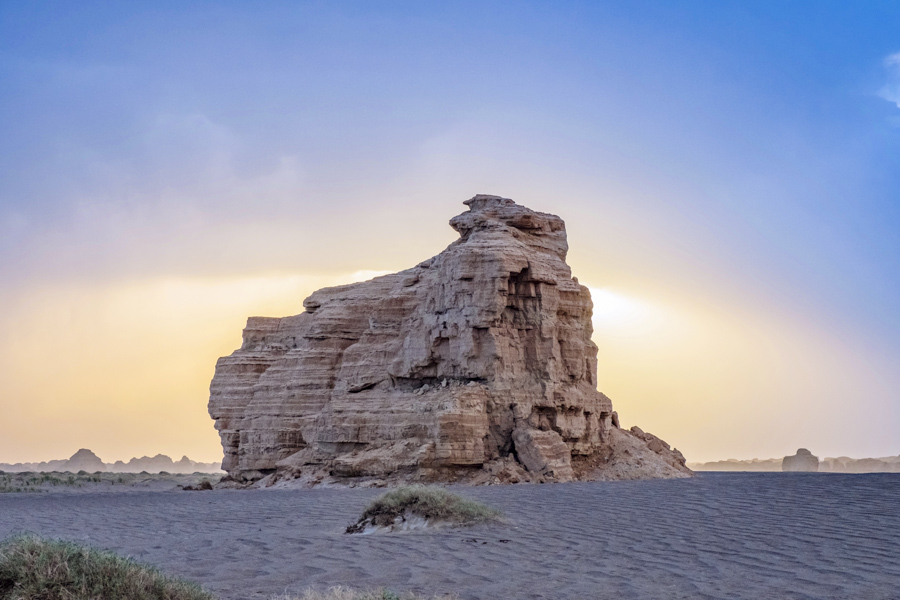
For remote and sparsely populated areas such as Yardang National Geopark, travelling with a local guide or driver is strongly recommended. Distances are long, mobile signal may be unreliable, and weather can change quickly. A guide can help with route planning, local safety rules, and practical support if difficulties arise.
Dunhuang leaves a strong impression because of its contrasts: painted Buddhist caves, desert cliffs, green pockets of city life, and dunes that shift in the evening light. Some visitors come for the Mogao Caves’ history; others remember the quiet of Mingsha Mountain at sunset or the feeling of following an old caravan route across the edge of the Gobi Desert. However you approach it, Dunhuang is best experienced with time, preparation, and an openness to the slower rhythm of the oasis.