

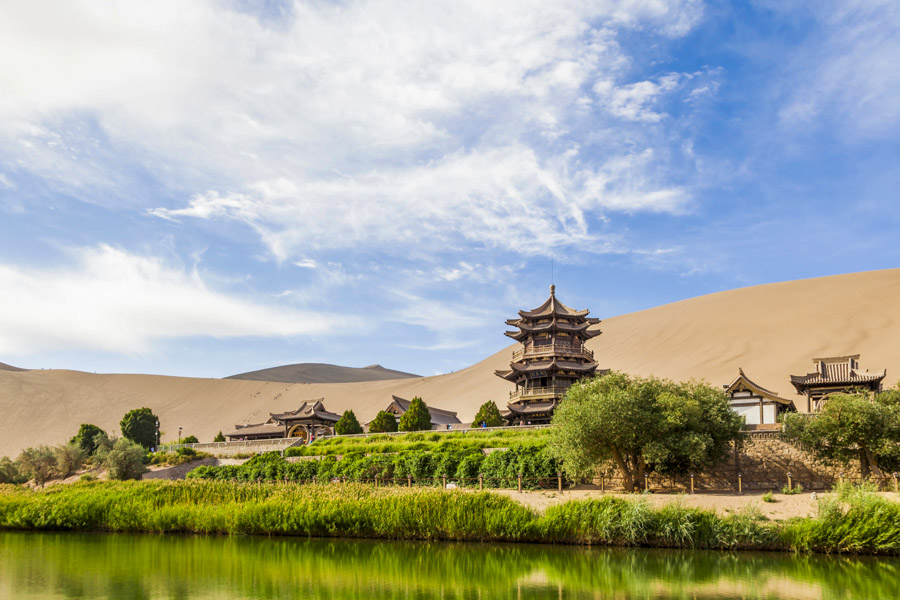
The history of Dunhuang stretches back to the 2nd century BC, before this section of the Silk Road had fully taken shape. At that time, the surrounding lands were controlled by the nomadic Yuezhi, Wusun and Xiongnu, until Han China began to look westward. A garrison was established in Dunhuang in 111 BC. Additionally, to protect trade and extend its power, the Hans built a long wall – later incorporated into the Great Wall – with outposts at Yang Pass and the Jade Gate. Many watchtowers remain and can be visited today.
In 139 BC, Emperor Wu of the Western Han dynasty sent the diplomat Zhang Qian to seek allies among the peoples of the west against the Xiongnu. Zhang spent ten years in captivity among the nomads, but on his return he brought back accounts of lands little known to the Han court – including Bactria, Persia, and Ferghana.
In the search for a secure route to these regions, Han forces drove the Xiongnu out of the area by 121 BC, and a fortified outpost was established here. Its lights served as a beacon for caravans crossing the desert, giving the city its name, Dunhuang, which is often interpreted as “blazing beacon”. The new fortification became the empire’s final stronghold on its western frontier.
By the 4th century AD, Buddhist pilgrims and monks were travelling between India, Central Asia, and China, and Dunhuang began to emerge as an important early centre of Buddhism.
In 366, according to tradition, a monk named Le Zun, also known as Yuezun, saw the golden radiance of a thousand Buddhas in the local cliffs and carved the first prayer cave. Others followed – monks, patrons, and merchants seeking merit, protection, and spiritual support for their long journeys across the desert. Over the centuries, cave walls were covered with murals, and sculpted figures appeared in niches and halls. Gradually, over almost a thousand years, one of the world’s great Buddhist cave complexes took shape: the Mogao Caves.
Dunhuang reached its height under the Tang dynasty, from the 7th to the 10th centuries. During this period, it became a cosmopolitan crossroads where Chinese officials, Indian monks, Persian merchants, and Turkic nomads moved through the same streets. The city was not merely a distant outpost but a gateway to the empire – a place where Chinese culture met the wider world, absorbed new influences, and transformed them in its own way.
After the fall of the Tang dynasty, Dunhuang gradually declined, first under Tangut rule and later under the Mongols (1271-1368).
In The Travels of Marco Polo, the Venetian merchant describes Shazhou (Dunhuang) in 1275 as an important oasis and stopping place where caravans changed camels and replenished supplies. He notes a mixed population of Christians (Nestorians), Muslims (Saracens) and local pagans and that most inhabitants were farmers rather than merchants.
As long-distance trade shifted increasingly towards maritime routes, the old caravan roads lost much of their importance. By the Ming era (1368–1644), Dunhuang had largely been abandoned, although the caves continued to draw pilgrims.
In 1723 a garrison and outpost were re-established in Dunhuang, helping the town to revive as people moved back in.
In 1900, the Daoist monk Wang Yuanlu, while clearing sand from the Mogao Caves, accidentally discovered a sealed chamber now known as the Library Cave. Inside were around 50,000 scrolls and manuscripts that had lain undisturbed for almost nine centuries, among them the Diamond Sutra of 868, widely regarded as the world’s oldest complete printed book.
Western explorers began searching for traces of the ancient cities that had once stood along the Silk Road, and Dunhuang proved to be among the most remarkable finds. Its murals, sculptures, and thousands of artefacts hidden deep within the cliffs attracted the attention of scholars, collectors, and expedition leaders.
In 1987, the Mogao Caves were inscribed on the UNESCO World Heritage List.
Today, Dunhuang is a major cultural and travel destination in western China. Its historic sites attract hundreds of thousands of visitors each year, while the city itself continues to develop around this heritage. New hotels, museums, and cultural venues have made Dunhuang more accessible, but its appeal still rests on the same rare combination of desert landscape, Silk Road history, and sacred art that first brought travellers here centuries ago.