

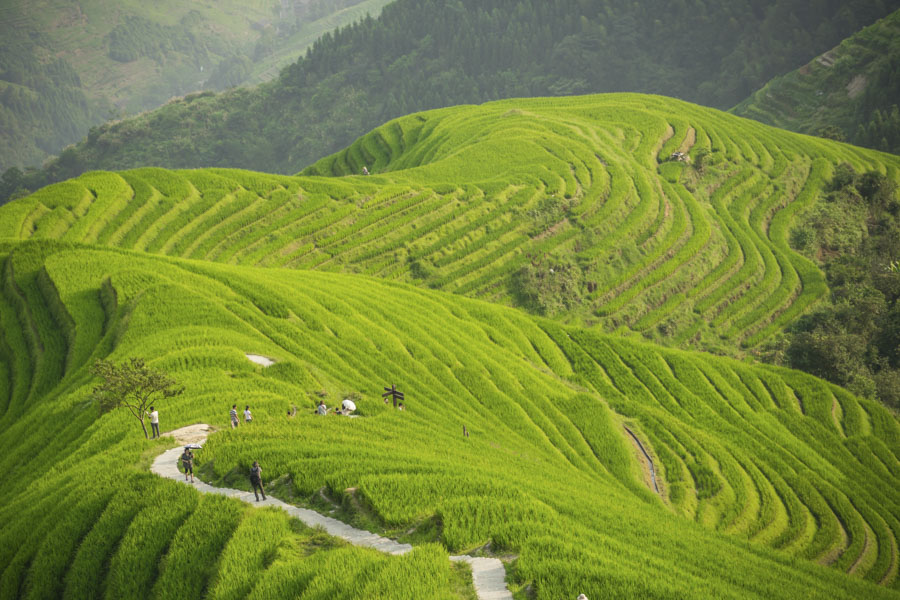
Our Longsheng (Longji) Rice Terraces hiking guide covers the best trails and viewpoints through the agricultural fields, ideal seasons to visit, and a checklist to pack for a smooth hike. Also known as the Longji Rice Terraces, the Longsheng Rice Terraces sit about 80 kilometres (50 miles) from Guilin and rise to more than 1,000 metres above sea level. From these heights the fields spread across the mountains in broad, flowing lines that resemble a dragon’s backbone and look almost like a work of art. Hiking in Longsheng is one of the most rewarding experiences in China. It combines outdoor activities, spectacular photo opportunities and the chance to discover the cultural heritage of the Zhuang and Yao ethnic minority peoples.
Best Seasons for Hiking in Longsheng Rice Terraces
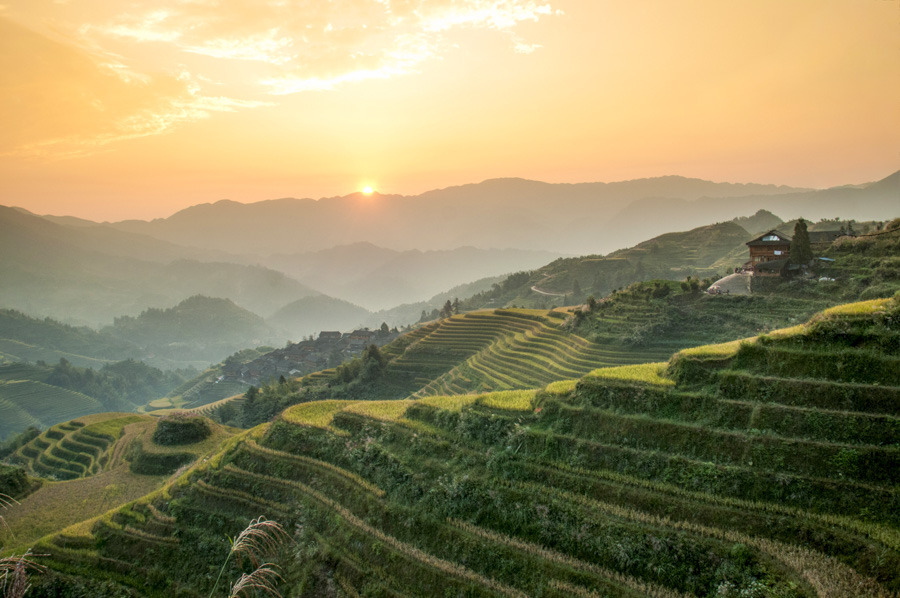
In Longsheng, the same trail can feel surprisingly different from one season to the next. Weather shapes the terraces’ appearance, the condition of the paths, and the overall rhythm of the climb. Each season brings its own balance of visibility, comfort, and atmosphere.
Spring (March and May) is a season of contrast. In April, the air is still cool and light, with temperatures around 10 to 24°C (50 to 75°F), and the climbs usually feel comfortable. By May, the temperature can rise to 30°C (86°F), and short, heavy showers become more frequent. After rain, the paths can turn slippery, especially on steeper sections and on stone surfaces smoothed by constant use and running water. When the sun returns, wet terraces reflect the light sharply, heightening the contrast between dark earth and flooded fields.
This constant shift is part of what makes spring so distinctive. Mist can soften the mountainside one moment, then lift suddenly to reveal sharply defined lines. The view changes quickly with the weather and the light.
Summer (June to August) is the most demanding season for hiking in the Longji Rice Terraces. Temperatures can reach 33°C (91°F), and the high humidity is noticeable from the first ascent. In June and July, prolonged rain is common, and the stone paths often remain wet for hours afterwards. Mist and low cloud can linger in the valleys, so visibility may change several times during a single walk.
Summer has its own character. Cloud and moisture soften the light, and the terraces often appear especially vivid in these conditions. It is best to start hiking before 9:00, when the air is still cooler and there is a better chance of clearer skies.
Autumn is generally the most comfortable season for hiking. In September, humidity remains fairly high, usually between 73 and 85 per cent, and showers still occur, but temperatures settle into a more pleasant 12 to 26°C (54 to 79°F). The air becomes easier to breathe, the paths dry out, and walking is noticeably more comfortable. The best period for hiking in Longsheng is usually from early to mid-October. Mornings at the viewpoints can feel cool, though by midday it is much warmer.
At this time of year, the air is clearer and the contours stand out more cleanly than in summer. The terraces gradually shift from green to gold, and by harvest the mountainsides are at their most striking. As the rice ripens, the fields take on a denser, softer texture that follows every fold of the terrain.
Winter (December to February) suits travellers who prefer quieter trails. December and January bring dry, crisp air, with daytime temperatures usually around 10 to 16°C (50 to 61°F). At higher altitudes it can feel much colder. However, in January, temperatures may fall to -6°C (21°F), and the wind is especially noticeable on exposed ridges.
The trails generally remain passable, though shaded and rocky sections may be damp or frosted and therefore slippery underfoot. Early morning and late afternoon feel considerably colder, particularly in windy weather, so bear in mind the difference between village level and the open viewpoints.
Snow is occasional rather than regular, but when it does fall, the terraces take on magical character. Winter is quieter and more restrained and often the best season for appreciating the shape of the landscape.
Top Viewpoints in Longsheng Rice Terraces
From one viewpoint to the next, the landscape changes in character. Allow time for at least two or three of them, as each change in elevation reveals a different aspect of the terrain.
Ping’an Terraced Fields Viewpoints
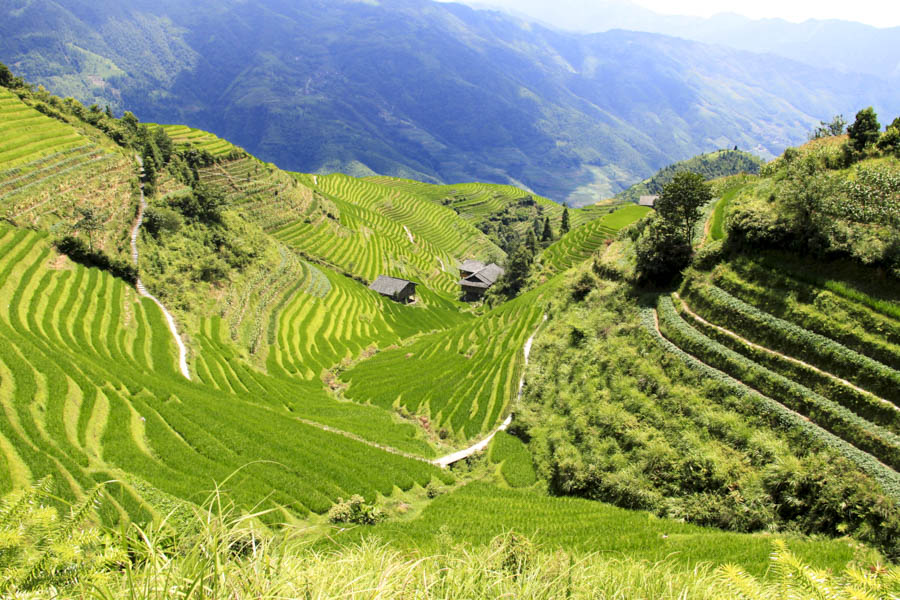
In the Ping’an area, the viewpoints are woven into the walking routes, so the views begin to open up naturally as you move through the village onto the terraces.
Nine Dragons and Five Tigers – Viewpoint No. 1 (九龙五虎, Jiǔlóng Wǔhǔ), Ping’an Village
At around 900 metres above sea level, this is one of the most recognisable viewpoints in Ping’an, where the terraces were shaped over generations by the Zhuang people. The name comes from the forms visible from the platform: nine mountain ridges winding towards the Jinjiang River (金江河) and five lower hills traditionally seen as tigers guarding the land below.
How to get there
From Ping’an Village, follow the stone path uphill through houses and terraces. The first section passes wooden façades, staircases, and guesthouses before the buildings thin out and the view opens. Follow the signs to Viewpoint No. 1. The climb usually takes around 1 to 1 hour 30 minutes.
If the weather is poor or you want to shorten the walk, you can also reach the viewpoint area from Ping’an Parking Lot by sightseeing shuttle bus in about 10 minutes.
Where to stay
Several places to stay are within walking distance. Huazhu Longsheng Yueshang Shanshe Inn (花築·龍勝月上山舍客棧) offers cosy sophisticated rooms with clear wood furnishings and large windows with panoramic mountain or terrace views. For simple but comfortable rooms with views, Longji Yunshang Homestay (龍脊·雲山居民宿) is a good choice. Travellers seeking a more traditional stay with essential amenities can opt for Yunzhongsu Inn (龙胜云中阁客栈). Visitors who prefer privacy and an intimate connection with nature can book a room with a viewing balcony at Longji Tianjian Pavilion (龍脊·田間閣); the antique décor provides a warm, authentic atmosphere.
Seven Stars with the Moon – Viewpoint No. 2 (七星伴月, Qīxīng Bànyuè), Ping’an Village
This viewpoint offers one of the broadest views in the Longsheng area. Seven terraced domes are arranged around a large circular paddy, forming the pattern that gives the site its name. In local tradition, the central field is read as the moon and the surrounding terraces as stars.
At the highest point of the ridge, the viewing platform opens onto the slopes in all directions, giving a full panorama of the terraces. Traditional Zhuang costumes can sometimes be hired nearby for photographs.
How to get there
A short trail from Ping’an Village (平安寨, Píng’ān Zhài) leads to the viewpoint, passing between houses, wooden galleries, and narrow terrace paths, gradually gaining height without becoming especially steep. The walk typically takes 25 to 40 minutes depending on pace.
The route is clearly signposted and feels like an extension of the village, where guesthouses, shops, courtyards, and fields sit side by side.
Where to stay
Staying close to the Seven Stars with Moon Viewpoint makes it easier to start early and reach the terraces before the main flow of visitors. Options include the Seven Star Resort (七星度假酒店), a mountainside hotel with a retro, pastoral style creating a warm atmosphere. Longsheng Qishanyue Homestay (龙胜栖山月民宿) welcomes you to a setting that blends rustic and modern styles, charming guests with its local rural character, comfortable amenities and views over the terraces. For a luxury experience in a traditional Chinese setting and atmosphere, the Longji Li-An Lodge (龙脊之眼) provides a peaceful escape. Many other nearby guesthouses offer comfortable services to suit all tastes.
Dazhai Jinkeng Red Yao Terraced Fields Viewpoints
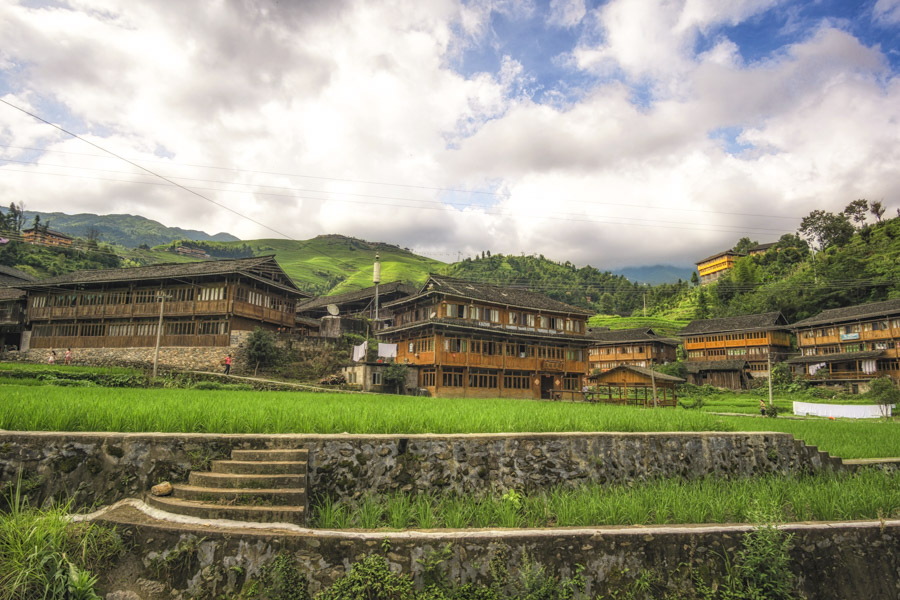
The Jinkeng area contains three of the main Longji Rice Terraces viewpoints, each giving a strong sense of the scale and relief of the mountain slopes.
West Hill Music – Viewpoint No. 1 (西山韶乐, Xīshān Sháoyuè), Dazhai / Tiantou Village
At around 1,180 metres (3,870 feet) above sea level, this is the highest point in the Jinkeng area. The view opens across the full spread of the terraces, with fields descending in broad bands along the slopes and fading into the mountain ridges beyond. It is one of the most popular viewpoints in this part of Longsheng.
The fields around West Hill Music Viewpoint are closely associated with the Yao people, and aspects of their culture remain visible throughout the area. Along the trails and at the viewing platforms, women in traditional dress can often be seen carrying woven bamboo baskets on their backs. This everyday presence is one of the Jinkeng landscape’s most recognisable features.
How to get there
The walk takes about 2 hours from Dazhai Village (大寨村, Dàzhài Cūn) or around 1 hour from Tiantou Village (田头寨, Tiántóu Zhài), where many of the Jinkeng guesthouses are located.
Where to stay
Nearby options include Longji View Tower / Longji Guanjing Lou (龍脊觀景樓民宿), a wooden guesthouse offering a traditional local setting. Book a room at Tian Zhi Yuan (龍脊梯田田之緣客棧) to admire the sunrise from your balcony; Hezhou (龍脊梯田禾洲民宿) offers a quiet personal service; and Yunya Qinxi Sky Garden Panoramic (云雅·琴栖空中花园全景民宿), with its floor-to-ceiling panoramic bedroom windows, provides an exceptional peace retreat.
Large-scale Thousand-Layers Terraces – Viewpoint No. 2 (千层天梯, Qiāncéng Tiāntī), Dazhai / Tiantou Village
From here, the mountainside is shaped into hundreds of tightly layered terraces, like an immense staircase rising across the slope. As your eye follows the contours of the hillside, the pattern seems to continue almost without end. On the viewing platform, the openness is especially noticeable, with wind moving freely across the terraces and the mountain air carrying a light herbal scent.
How to get there
From Tiantou Village, follow the signs to Viewpoint No. 2. The route passes through residential areas before opening onto the slopes and takes about 30 minutes. From Dazhai Village, the walk is closer to 1 hour and involves a steeper climb.
Where to stay
Accommodation near the viewpoint includes the Maple Hotel (龙胜枫叶客栈), which sits in harmony within the landscape. The luxurious Longsheng Huanlongge Panorama Inn (龙胜环龙阁全景客栈) gives you the feeling of being surrounded by nature thanks to its large bay windows that open directly onto the breathtaking terraces. For a stay in a traditional establishment, the Encounter Inn / Yujian Hotel (龙脊梯田遇见客栈) is the best choice.
Golden Buddha Peak – Viewpoint No. 3 (金佛顶, Jīn Fódǐng), Dazhai Village
Set on the summit of Jinfo (金佛顶) in the upper Jinkeng area, this highest viewpoint, known as Golden Buddha Peak, offers one of the widest views over the rice terraces. Its name derives from its shape resembling a Buddha Maitreya. From here, the lines of the landscape extend far beyond the nearest ridges, emphasising the scale of the slopes.
The name is most apt at sunset, when the upper terraces catch the evening light and take on a warm golden tone. As the light softens and the sharper shadows recede, the whole mountainside reads as a single, continuous surface.
How to get there
The viewpoint can be reached on foot in about 1 hour and 30 minutes or by cable car from Jinkeng Parking Lot in around 22 minutes. Many travellers take the cable car up and walk down, which allows more time to stop en route; with this plan, the round trip usually takes about 2 hours and a half.
Where to stay
Nearby guesthouses include Wangyue Lou (旺悦樓民宿) and Lehua Yinlu (樂樺·隱廬民宿), which offer comfortable, modern rooms with excellent terrace views. Chenyun Xuan (晨雲軒) features bedrooms with a 180° panoramic starry-sky roof and a family suite with a 270° panoramic bathtub. Lanxing Miyue (攬星覓月) seems to be a jewel nestled in a natural setting on the mountainside.
Longji Rice Terraces Hiking Routes
By morning, as the mist lifts and the villages stir, the Longji hiking trails are already in use. The routes vary in length, difficulty, and character. Some focus on the main viewpoints; others link villages and quieter stretches of the terraces. Together, they offer different ways to experience the landscape on foot.
Route 1: Short walk between terraces and villages (Ping’an loop)
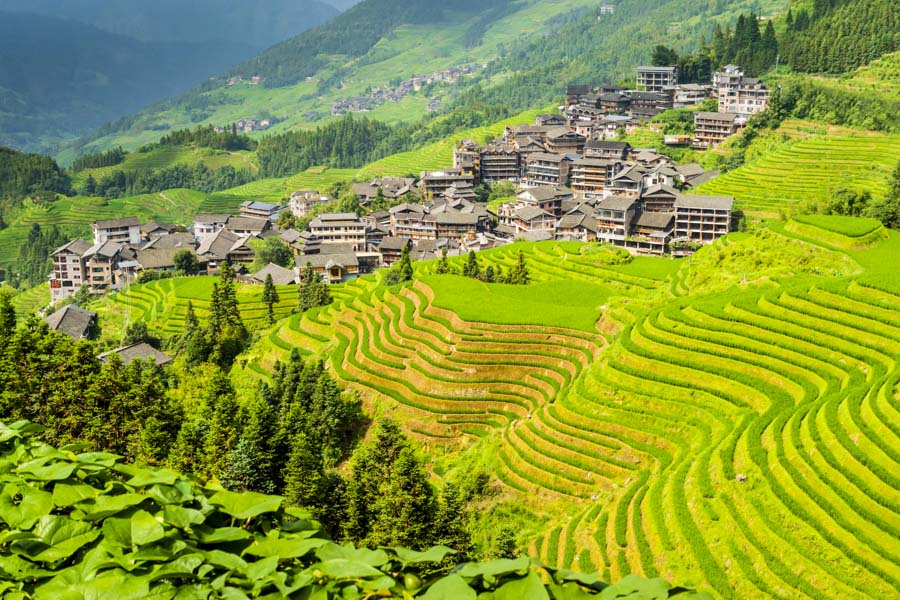
Route: Ping’an → Nine Dragons and Five Tigers → Seven Stars with Moon → Ancient Zhuang Village → Ping’an
Distance: approximately 10 kilometres (6.21 miles)
Duration: 4 to 6 hours
Difficulty: easy-moderate
Route type: out-and-back
Surface: mixed – paved stone and dirt, occasional steep and loose sections.
This route suits a day trip, especially for travellers wanting to see several of the main viewpoints in limited time.
Start in Ping’an Village and follow the stone path towards Nine Dragons and Five Tigers. Pause to take in the scale of the terraces before continuing to Seven Stars with Moon. The route stays close to the fields, and in warmer months you may see insects and butterflies among the rice plants.
From there, the path descends gently towards the Ancient Zhuang Village, where wooden roofs appear through the greenery. Village life remains closely tied to the terraces. You may see chillies drying in courtyards, women embroidering in open doorways, and poultry moving between the houses. Traditional wooden buildings and stone features survive here, and small family-run restaurants offer good places to rest.
On the return to Ping’an, the terraces often look quite different again, particularly in late afternoon, when the ridges become more sharply defined.
Route 2: Classic hike across Longji (Dazhai → Ping’an)
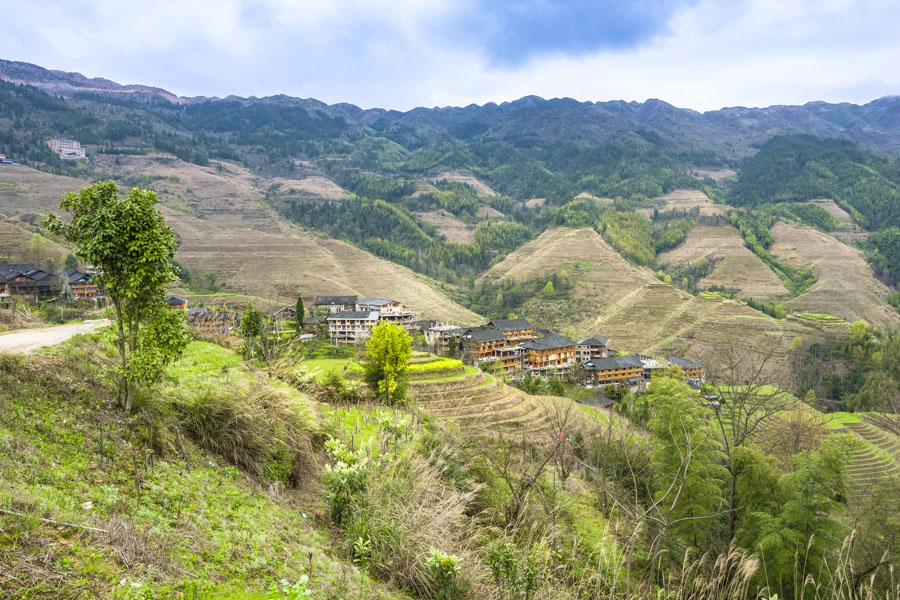
Route: Dazhai → Tiantou → West Hill Music → Thousand-Layer Terraces → Zhongliu → Nine Dragons and Five Tigers → Seven Stars with the Moon → Ping’an
Distance: 17 kilometres (11 miles)
Duration: 5 hours
Difficulty: moderate
Route type: point-to-point
Terrain: mixed – stone steps, narrow ridgeline paths, dirt tracks
This route suits hikers who want to cross Longsheng and experience the contrast between the Jinkeng and Ping’an sections.
From Dazhai, the trail quickly enters a quieter part of the terraces, with stone steps alternating with earth paths. The first major climb to Tiantou Village is one of the most demanding parts of the day but offers excellent views across the Jinkeng section.
Zhongliu Village is a useful halfway stop for a rest, snacks, and water. Beyond Zhongliu, the route becomes gentler, with more shade and a more gradual descent.
The final stretch leads to the Nine Dragons and Five Tigers, and Seven Stars with the Moon viewpoints, then a straightforward descent into Ping’an Village.
Hiking it in reverse: Ping’an → Dazhai
The route can be walked in the opposite direction. In that case, the climb to Seven Stars with the Moon comes earlier, while the tougher section before Tiantou falls later in the day. Finishing in Dazhai can be convenient if you plan to start the next morning from one of the Jinkeng viewpoints.
Route 3: Dazhai panoramic loop (Jinkeng terraces)
Route: Dazhai → Tiantou → Thousand-Layer Terraces → West Hill Music → Golden Buddha Peak → Dazhai
Distance: 5 to 6 kilometres (3.11 to 3.73 miles)
Duration: 4 hours
Difficulty: moderate
Route type: loop
This route is ideal for those who want to focus on the most expansive views in the Jinkeng area.
The ascent begins from the Jinkeng Car Park, with a long staircase up towards Tiantou Village. Once above the first rise, the scale of the terraces becomes much clearer.
From there, the route continues towards the Thousand-Layer Terraces viewpoint along ridges and side paths that rise and fall with the mountain. West Hill Music follows. Although the trail is only about 1.5 kilometres (0.93 miles), steep steps and uneven ground make progress slower than the distance suggests, and it may take at least an hour.
After this section, many hikers descend to Dazhai for a short rest before continuing to Golden Buddha Peak. This final viewpoint is the most memorable part of the route, especially later in the afternoon, when the slopes catch the softer evening light.
Off-the-beaten-path
Route 4: Thousand Layers to the Heaven Trail
Route: Thousand-Layer Terraces (Jinkeng car park) → Ridge path → “Heaven” viewpoint → return
Distance: 5.8 kilometres (out & back)
Duration: 2 to 2 hours 30 minutes
Difficulty: moderate
Route type: out & back
Terrain: steep stone steps, rocky ridge paths, compacted earth
By early morning, when mist still threads the terraces and the few remaining roosters call from courtyard eaves, the Thousand Layers to Heaven Trail slips quietly into life. This out-and-back route is a less frequented spine of path that concentrates on the Jinkeng (Thousand-Layer) sector’s raw ridgelines and panoramic hollows. This trail is ideal for walkers seeking space, solitude and close encounters with the landscape.
Longsheng Trails Etiquette: How to Visit with Respect
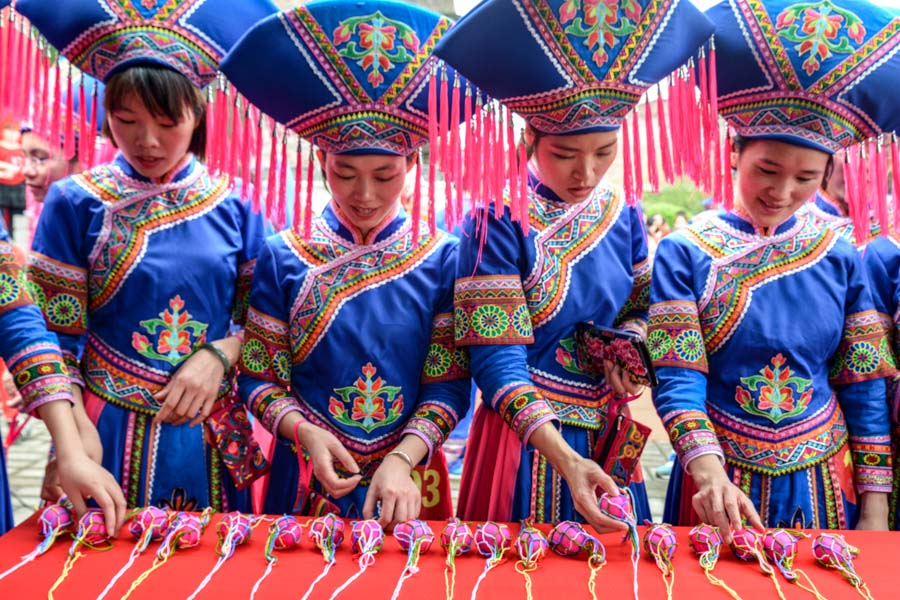
The Longsheng villages receive visitors warmly, but these mountainsides are first and foremost a lived-in landscape shaped by the Zhuang and Yao communities. Move through it with care.
If you wish to photograph residents, ask first in a quiet and respectful way. A smile and a simple gesture are often enough.
Stay on marked paths. The trails are working routes through agricultural land. And stepping off them can damage terrace edges and crops.
If you are invited in for tea or conversation, a small purchase from a local shop or guesthouse, or another modest gesture of thanks, is usually appreciated.
And finally, help preserve the environment by taking your rubbish with you. Avoid leaving litter behind, and where possible reduce single-use plastic. Small habits matter in a place where the landscape is still actively maintained.
What to Pack for Your Hike in Longsheng?
When planning a hike in Longji, it is worth preparing in advance. It is more convenient to bring essentials with you to be ready for your exploration.
A lightweight daypack (15 to 25 litres). You will be able to carry all your belongings and be at ease trekking.
Comfortable footwear with a good grip. The trails include uneven stone steps and narrow mountain paths, so stable shoes make a real difference.
Lightweight, layered clothing. Conditions change throughout the day, especially between villages and open viewpoints. Breathable fabrics are the most practical choice. Lightweight gloves and a scarf or shawl are useful in case of cold and wind.
Compact rain protection. A light waterproof jacket is useful even outside the wettest months.
Sun protection. Sunglasses and sunscreen (UV protection for high viewpoints) and a hat are always useful.
Water and light snacks. Food options can be limited between villages, and some routes are longer than they first appear.
Power bank. Phones are quickly drained by navigation, photos, and video, and charging points are not always available.
Headlamp or compact flashlight. More particularly, one with 100 to 300 lumens and an adjustable beam would be useful in case your hike extends into dusk or after dark.
Cash. Small restaurants, guesthouses, and shops may still prefer cash, so it helps to carry smaller notes in advance.
A small first-aid kit. Plasters, pain relief, insect repellent, and personal medication are worth bringing, especially for longer walks.
Wipes and hand sanitiser. Facilities in some villages remain basic, so these simple items are useful to have on hand.
Plastic bags with zips. They are particularly useful and waterproof to carry your phone, trash and wet clothes.
Map or GPS offline routes. When you trek without a guide, it is recommended to download an offline map to find your way.