

Most people, driving through the northeastern countryside of Ankara in Central Anatolia, pass the turning without a second thought. There are no crowds, no queues, and no souvenir sellers blocking the view. What there is – once you enter those ancient gates – is the Alacahöyük archaeological site (Alacahöyük Ören Yeri), one of the most remarkable ancient ruins in Turkey (Türkiye).
This Bronze Age locale saw not one, but several civilisations rise and fall on the same ground. Long before the Hittites arrived, the Hattians buried their royals here. Layer upon layer of history, all pressed into a single mound (Turkish höyük).
While famous historical landmarks such as Ephesus draw the crowds, the underrated archaeological sites in Turkey, like this one, reward anyone willing to seek them out. If you have already visited the Museum of Anatolian Civilisations in Ankara and found yourself wanting more context and more raw evidence, Alacahöyük is where to go.
Why is Alacahöyük Important?
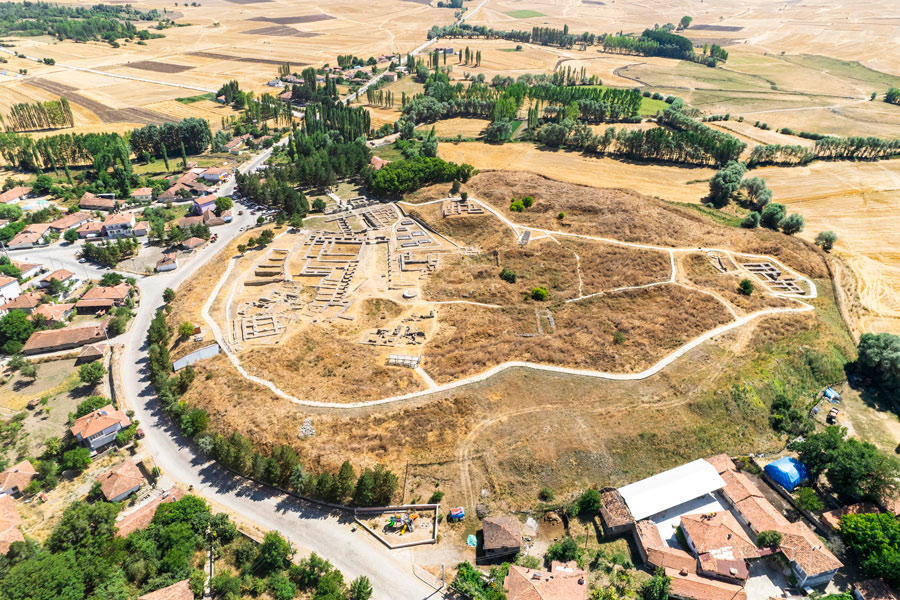
Alacahöyük is important for two reasons. On the surface, it is a Hittite site in Turkey near the capital of the Hittite Kingdom, Hattusa – a ceremonial city with gates, carved reliefs, and ruins of a palace complex. Dig a little deeper, literally, and it becomes something older: a Hattian necropolis, housing the graves of the ruling family from around 2,500–2,200 BC, predating the Hittite presence by more than a millennium.
Turkish archaeologists Hamit Zübeyir Koşay and Remzi Oğuz Arık started systematic excavations in 1935, sponsored by the Turkish Historical Society (Türk Tarih Kurumu). They unearthed thirteen Early Bronze Age royal tombs from 1935 to 1939. Each burial contained objects such as gold diadems, copper and bronze standards, silver goblets, and more. Many of those artefacts now sit in the Ankara Museum of Anatolian Civilisations. The site itself, however, reveals the full story.
The Alacahöyük archaeological site provides a direct, physical explanation to “What ancient civilisations lived in Turkey?” The Hattians first, then the Hittites, with evidence still visible in the ground beneath your feet.
The Hittite Civilisation and Alacahöyük – Historical Context
Like many Anatolian settlement mounds, the Alacahöyük Historical National Park (Alacahöyük Tarihi Milli Parkı) features several occupation layers: Chalcolithic, Early Bronze Age, Hittite, and Phrygian periods. An English geologist, Willian John Hamilton, was the first to identify it in 1835.
The Hittites established one of the ancient world's great empires in the ancient Near East from their Anatolian heartland. At their height, between roughly 1,600 and 1,200 BC, they controlled vast territories stretching from western Anatolia to northern Syria, and they negotiated as equals with Egypt and Babylon.
Their capital was Hattusa, located about 25 kilometres from Alacahöyük. But Alacahöyük held a different kind of significance. When the Hittites colonised this site by 1,850 BC, it already had deep symbolic significance. The Hattians had been burying their royal dead there for centuries. Rather than clear it, the Hittites built over it and around it, transforming the ground into a cult centre. The Sphinx Gate, the palace-temple complex, the carved stone reliefs – all of it signals that.
The city was destroyed by fire in 1,180 BC, during the collapse of the Hittite Empire, following a war with enemies. Centuries later, in 750 BC, the Phrygians occupied the plateau. Since then, the site has been continuously inhabited by various people, with the nearby small village of Alacahüyük today.
This accumulated history – the Hattian foundation, the Hittite transformation – is what makes Alacahöyük such a compelling historical site near Ankara. It is a site where two distinct cultures, separated by centuries, both chose the same ground for their most important rituals.
What Can Visitors See at the Alacahöyük Archaeological Site?
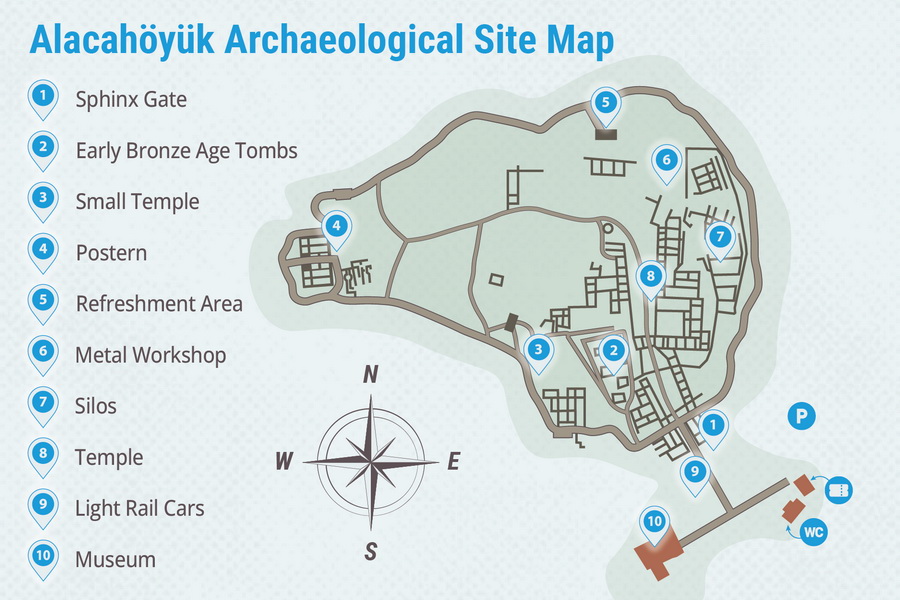
The site is well set up for independent exploration. There is a site map, clear signage, and a logical, paved route through the excavations. What follows is a guide to the key stops – because without a little context, what looks like scattered stone becomes something far more interesting.
Before reaching the main gate, visitors pass the on-site museum, the ticket office, and WC facilities. Just before the entrance, look to the right: a set of small light railway cars sits along the pavement. Archaeologists used these to haul excavated material – artefacts and rubble alike – away from the mound as they worked through the site's many layers.
Stone Reliefs Leading to the Central Gate
Just before the Sphinx Gate, carved stone reliefs line either side of the approach. The originals are held in the Museum of Anatolian Civilisations in Ankara. What you see here are replicas, but detailed ones. They depict a ritual procession: dancers, musicians, the Hittite deity, the king and queen, and animals brought for sacrifice. Dating to c. 1,400 BC, these orthostat relief blocks are the clearest evidence that Alacahöyük functioned as a sacred city rather than just a fortified town.
Sphinx Gate
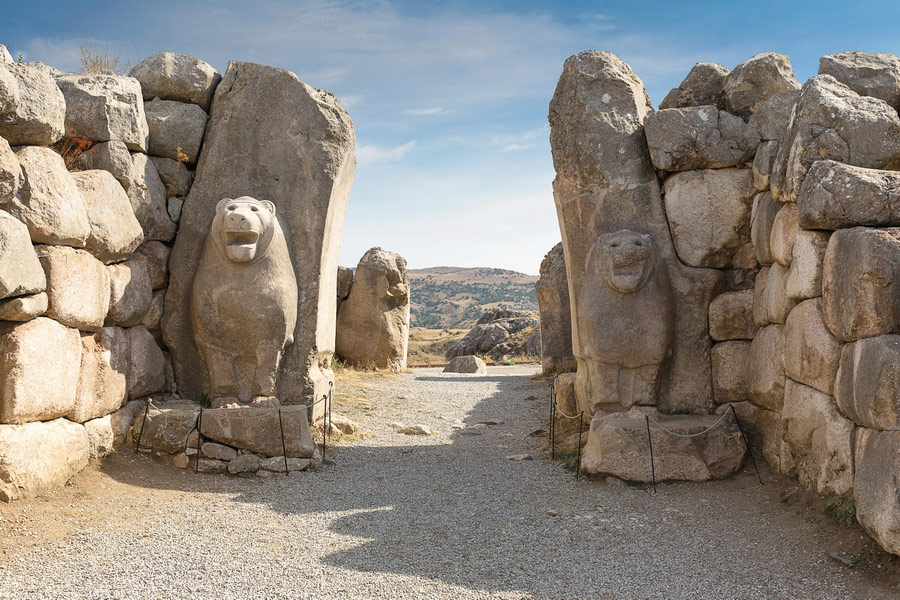
For those looking for unique experiences, Alacahöyük is one of the finest examples of off-the-beaten-path Hittite ruins in Turkey and the best answer to what to see in Central Anatolia outside the conventional tourist trail. And here is why.
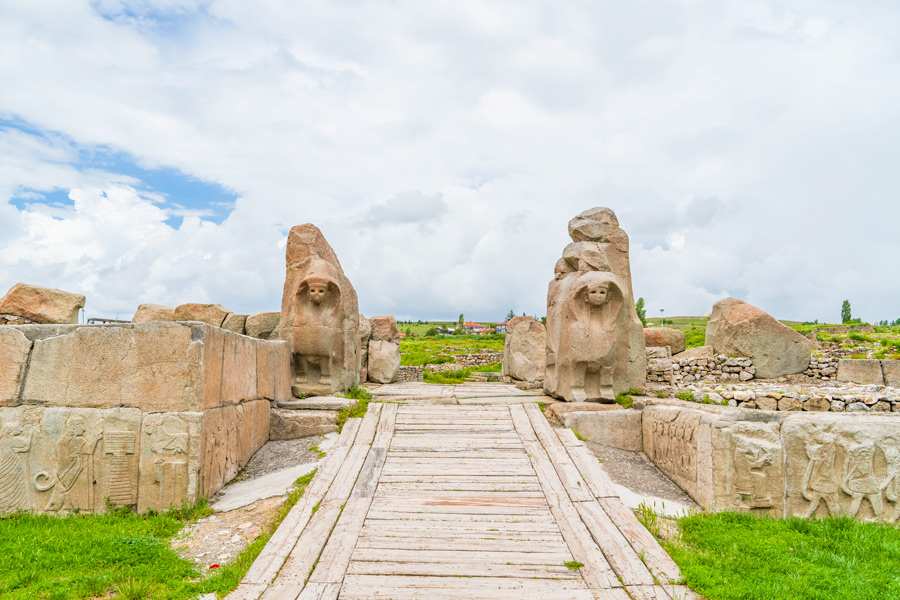
Picture the ancient town divided into quadrants along north-south and east-west axes. The main entrance at the Alacahöyük archaeological site is the southern gate, known as the Sphinx Gate. Built by the Hittites in the 14th century BC, it was originally flanked by towers and guarded by sphinxes carved from four-metre single monolithic stones.
These mythical creatures were placed here to intimidate enemies and indicate the city’s sanctity. Similar sphinx gates appear in Hattusa, the Hittite capital nearby. Their presence at Alacahöyük confirms this was no ordinary settlement.
Double-Headed Eagle
On the lower stone at the base of the right-hand sphinx, look for a double-headed eagle clutching a hare in each claw. The image is immediately familiar. Variations of it later appeared in the heraldry of empires from Byzantium to Russia.
Its exact origins are debated among scholars, but the motif was already present in Anatolia during the Hittite period. Seeing it here, carved into a 3,000-year-old gate, is a small but startling moment that brings ancient history to life.
Section of Amazing Polygonal Stonework
To the left of the gate, before reaching the tombs, there is a short section of polygonal stonework worth pausing at. The stones are fitted together with incredible precision. No mortar, no gaps, just careful shaping and placement. Some scholars believe this section may predate the Hittites. The polygonal wall is easy to walk past, but it represents a level of masonry technique that amazes us even today.
Early Bronze Age Tombs
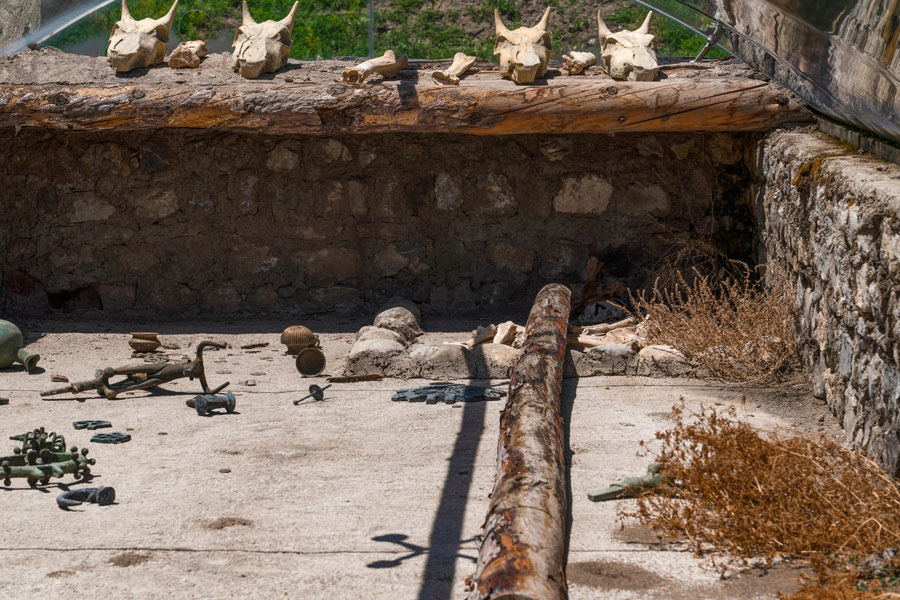
A short walk to the west brings you to the Bronze Age tombs.
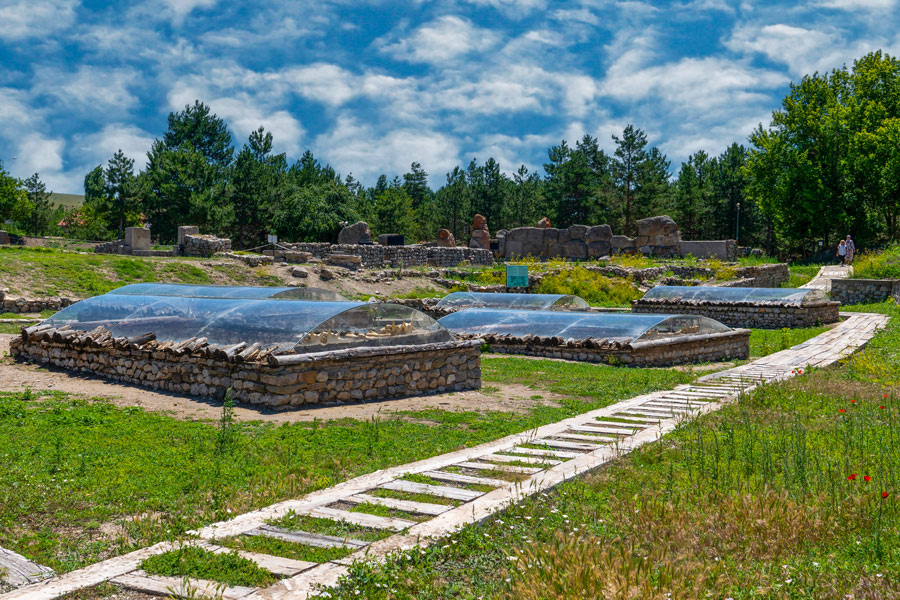
Thirteen tombs were discovered at the Alacahöyük archaeological site between 1935 and 1939, dating to around 2,500 BC. Each is large and rectangular. They are covered with glass panels today to protect the interiors. The objects found inside – gold, copper, iron, jewellery, weapons, ceremonial items, pottery – are among the most significant Bronze Age finds in Turkey. What is visible in the graves is only a glimpse. Smaller objects are now in the on-site museum, and major finds are in the Museum of Anatolian Civilisations. Interestingly, the bodies were laid in a contracted, fetal-like position.
Why Are the Tombs So Large?
The scale of the tombs from the Bronze Age of this part of Anatolia often surprises visitors. These were not ordinary burials. Each tomb was constructed to hold the remains of a member of the royal family, along with everything they would need in the afterlife. Size reflected status.
Postern
On the northwestern side of the Sphinx Gate, there is a narrow stone tunnel built into the city's western wall. This postern formed part of the city’s defensive system, a common feature of ancient fortifications. It may have provided a concealed route during times of danger.
Residential Rooms and the Temple Palace
At the centre of the site, as you pass the gates, are the ruins of residential and administrative quarters. To the east of these stand the ruins of Temple-Palace (Mabet Saray). This complex served as the religious and administrative heart of the city. It included a granary, an archive, a storage area for sacred objects, and even a metalworking workshop.
Why Do Some Stones Have Round Holes?
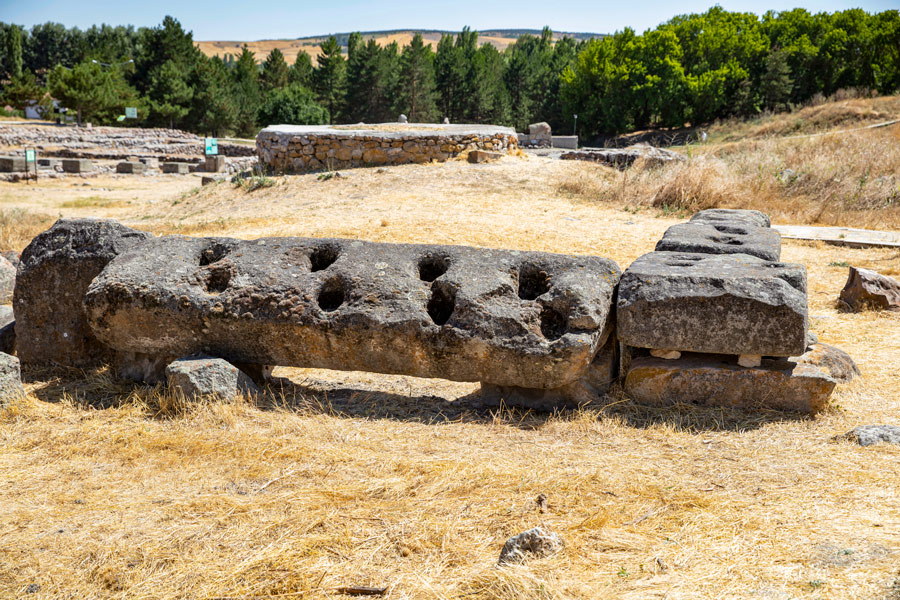
As you walk the Alacahöyük archaeological site, you will notice stones with holes cut into their surfaces. These held the bases of wooden pillars that once supported walls and roofs. The timber is long gone, but the holes are still there, recording where the structure once stood. It is a small detail that repays a close look.
Hittite Dam Nearby
A short distance from the main site – nearly 1.5 kilometres away – is the 3,000-year-old Hittite infrastructure, Gölpınar Dam, also known as the Alacahöyük Dam. Its Hittite origins are supported by an inscription found in the surrounding area that refers to a prolonged drought that struck the kingdom. In response, King Tudhaliya IV (1,245-1,215 BC) reportedly ordered the construction of ten dams.
The dam is fed by natural springs within the lake itself and continues to supply water for local farming to this day. Turkish archaeologists first identified it in 1935. Between 2002 and 2007, it was fully excavated, restored, and returned to active irrigation use.
On-Site Museum
The Alacahöyük Museum (Alacahöyük Müzesi) is home to many excavated artefacts. These are clay vessels of various kinds, jugs, pitchers and bowls, alongside jewellery from both the Hittite period and the earlier Bronze Age layers. Photographs of the iconic solar discs (bronze standards) discovered in the royal tombs are presented here; the original discs themselves are kept in the Ankara Museum of Anatolian Civilisations. Look out for a particularly striking figure: a deer's head with long, branching antlers.
One room contains a scale model of the city as it would have appeared in its original form. The lower floor exhibits architectural elements removed from the city walls, along with more ceramics: bowls, ladles, and objects resembling needle points and tools.
Which Alacahöyük Artefacts to Look for in the Museum of Anatolian Civilisations?
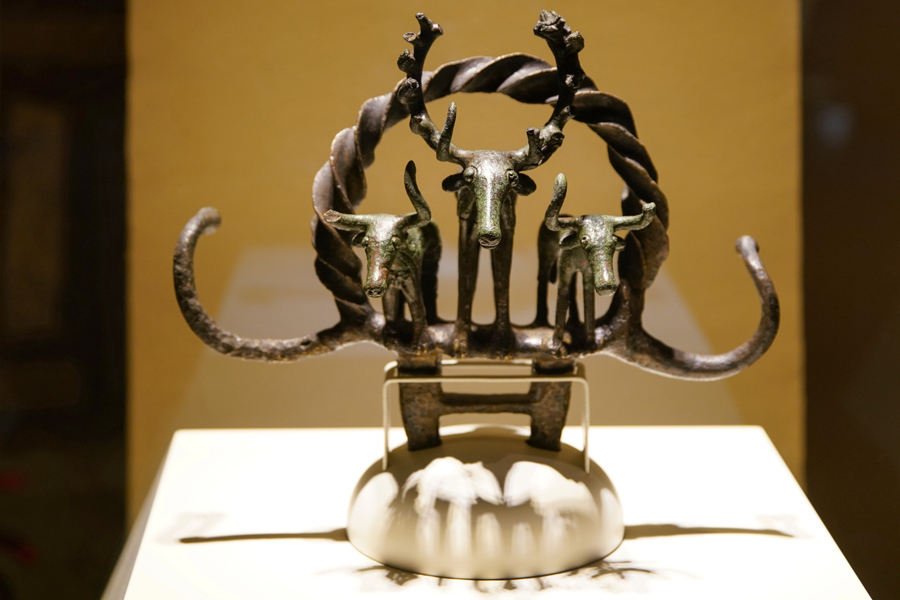
The most significant finds from Alacahöyük ended up in the Museum of Anatolian Civilisations (Ankara). The collection displays artefacts in gold, silver, copper, bone, iron, and stone – royal tomb objects that range from jewelled diadems and ceremonial goblets to weapons and elaborately decorated pottery.
The most unusual are small figurines of female forms and the bronze “sun disks”. Also, keep an eye out for a dagger with an iron blade and a gold handle – an exceptionally early example of iron use in Anatolia. The museum visit and the site visit complement each other. If you do both, the objects begin to make sense in the landscape they came from.
Visiting the Alacahöyük Archaeological Site Today
Alacahöyük is open to visitors year-round, though spring and autumn offer the most comfortable conditions for exploring an open-air archaeological site. Summer temperatures in Central Anatolia can be fierce; if you visit between June and August, go early in the morning.
The site is compact enough to cover in two to three hours at a comfortable pace, including the on-site museum. There are signs throughout, and a printed site map is available at the entrance. Comfortable shoes are worth wearing as the ground is uneven in some sections.
From April 1 to October 31, the site and museum are open from 08:00am to 7:00pm, with the ticket office closing at 7:30pm.
The museum admission fee is very affordable, and the site is rarely crowded. For anyone looking for things to do in Ankara or asking what to see in Ankara, this is the place to visit, besides the museum.
How to Get to Alacahöyük from Ankara
The Alacahöyük Historical National Park (Alacahöyük Tarihi Milli Parkı) is approximately 200 kilometres northeast of Ankara, near the town of Alaca in Çorum Province. The drive usually takes three hours by car.
The route from Ataturk Boulevard in Ankara follows the D200 / E88 highway towards Kırıkkale and Yozgat. Then it turns onto the D785 road towards Çorum and continues to the village of Alacahöyük.
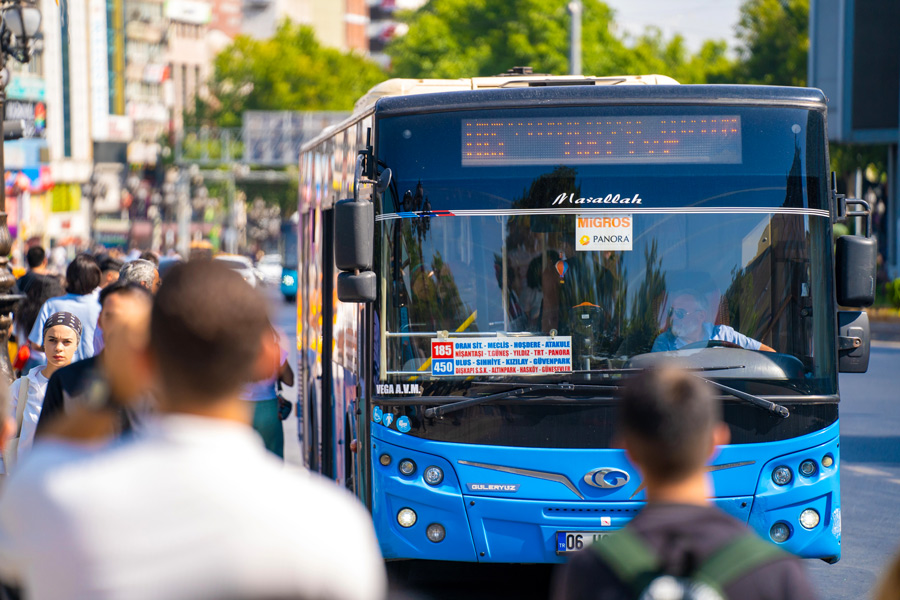
The site is well signposted from the Alaca town centre. Public transport options exist but require changes and additional planning. A rental car or private car is more convenient if you are combining Alacahöyük with other sites in the area.
Alacahöyük and Other Hittite Sites Nearby
The great advantage of visiting the Alacahöyük archaeological site is the surrounding area. This is a Hittite country, and within a short drive, two other major sites complete the picture.
Hattusa, the Hittite capital, is situated 38 kilometres to the southwest of Alacahöyük near Boğazkale. A UNESCO World Heritage Site, it is the largest and most thoroughly excavated Hittite site in Turkey, with monumental walls, temples, and the famous Lion Gate and King's Gate still remaining. Visiting Hattusa near Alacahöyük in the same trip is a logical way to understand how both sites fit into the same empire.
Just outside Hattusha, the open-air rock sanctuary of Yazılıkaya is one of the most atmospheric ancient places in Turkey. Carved directly into the rock face, it depicts a procession of Hittite gods in vivid, expressive relief.
Together, these three sites – Alacahöyük, Hattusa, and Yazılıkaya – comprise complete Hittite itineraries anywhere in the world. This triangle of sites is the ideal starting point if you are serious about ancient ruins in Central Anatolia or looking for historical places near Ankara that go well beyond the expected.