

Walk through Hadrian's Gate into Kaleiçi Old Town, and the atmosphere shifts. The wide streets of modern Antalya fall away, replaced by a maze of cobbled lanes, flower-draped walls, and glimpses of turquoise water at the end of almost every alley.
Kaleiçi – the name means simply "inside the walls" – has been continuously inhabited since Attalus II founded the city here around 150 BCE. The fortifications that surround it today are layered with vivid historical evidence: Roman masonry reinforced by Byzantine builders, Seljuk towers rising above earlier foundations, Ottoman mansions occupying ground that was already ancient when they were built.
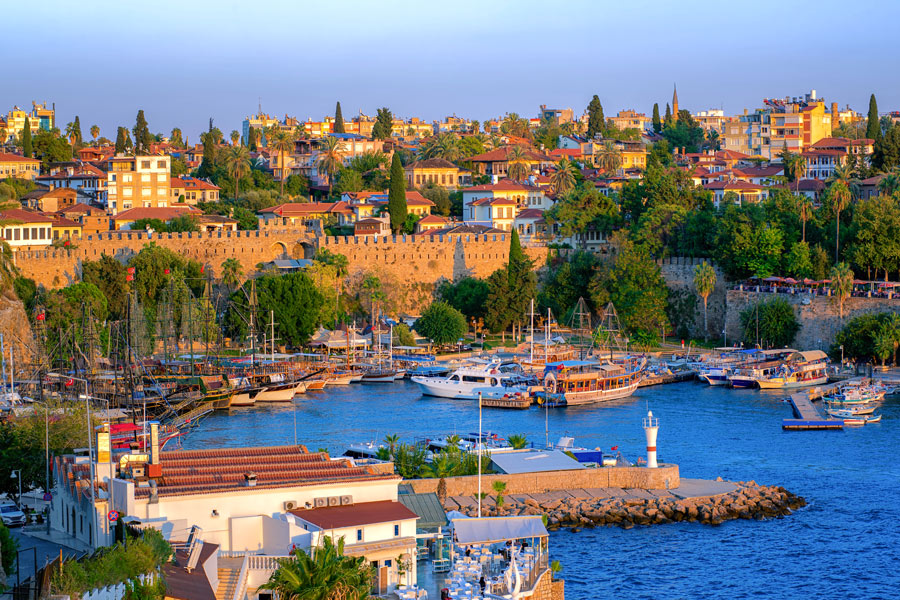
The walled district sits on a rocky promontory above the Gulf of Antalya, dropping sharply to the sea on three sides. Below the cliffs, the original Roman harbour is still in use – yachts and tour boats where merchant galleys once unloaded.
On summer evenings, the quay fills up fast. Visitors can smell grilled fish and hear boats knocking against the dock. Above it, every century left its trace. A Seljuk minaret frames the skyline. An ancient gate marks the main entrance to the quarter. A few streets away, a building that outlasted three religions stands open to the sky.
Inside the area, the rhythm slows. Ottoman mansions line the passages, their courtyards full of orange blossom. Small workshops stay open through the afternoon. Along the ramparts, column drums and inscribed Roman slabs sit built into the walls – easy enough to walk past without noticing.
Best Time to Visit Kaleiçi Old Town
Spring and early autumn are the most rewarding seasons – the heat is manageable, the light on the stonework is particularly good, and Kaleiçi has not yet filled up with summer visitors.
Spring (April–May) is probably the finest time to come. Temperatures sit around 18–25°C, the bougainvillaea is in full colour, and mornings feel almost private. On clear days, the snow-capped peaks of the Taurus Mountains are visible on the horizon from the cliffs above the harbour. This is an unexpected scene in that setting, and one of the season's finer surprises. The lanes before 09:00 are as quiet as they ever get.
Autumn (September–October) runs it close. The crowds have thinned, the air has cooled into the mid-20s, and the low afternoon sun gives the Roman stonework and Ottoman facades a warmth that photographs well. October is a favourite among repeat visitors.
Summer (June–August) is busy and hot – temperatures regularly hit 35–38°C, and the waterfront fills up fast. An early start before 10:00 or a return in the evening changes the experience entirely. Kaleiçi after 18:00 is a different place – the heat lifts and the restaurants spill out onto the cobbles.
Winter (November–March) strips the place back to its bones, which is its own kind of pleasure. Some guesthouses close and the harbour goes quiet, but the gate, the minarets, and the old circuit are all still there. The mild Mediterranean winter is ideal for a comfortable stroll on most days, and the absence of crowds is reason to come early.
Opening Hours and Entry
Kaleiçi has no single opening time. Most of the district is accessible at all hours and free to enter. That said, individual sites keep their own schedules.
Hadrian's Gate, the city walls, Hıdırlık Tower, and the Kesik Minaret ruins are all free to enter throughout the day.
Yivli Minaret Mosque: open to visitors outside prayer times. Free entry. Modest dress.
Suna and İnan Kıraç Museum: Tuesday to Sunday, 09:00–18:00. Closed Monday. Admission approximately 60 TL (March 2026). Museum passes do not apply; tickets purchased on site.
Mermerli Beach: open seasonally from 09:00. Entry around 500 TL per person (2026 rate), includes sunbed and umbrella. Access via the Mermerli Restaurant terrace.
For current information: Antalya Provincial Directorate of Culture and Tourism
Tel: +90 (242) 238 11 11 | Email: antalya@ktb.gov.tr
Practical Information
Kaleiçi is straightforward to visit independently. No guides are needed, and most sights require no advance booking. Daytime is best for monuments and stonework; evenings suit the harbour and the restaurants.
Address: Kaleiçi, 07100 Muratpaşa, Antalya
Parking: limited within the district; park outside the walls and walk in.
Language: signage is primarily in Turkish; most restaurants and hotels have English-speaking staff.
How to Navigate Kaleiçi
The walled district covers roughly 25 hectares and can be crossed in under 20 minutes. However, most visits take considerably longer because the streets reward slow progress. There is no prescribed route and no strict grid.
Two gates mark the main entry points: Hadrian's Gate on the eastern edge is the most commonly used and the most architecturally significant; a second gate on the western side opens towards the waterfront. From either entrance, the alleys branch off without obvious logic and with no signposting between them.
Download an offline map before arriving – phone signals can be patchy in the narrower passages. Both Google Maps and Maps.me support offline downloads for Antalya and work reliably throughout Kaleiçi. The walk from Hadrian's Gate to the waterfront takes about 15 minutes at a relaxed pace, passing the Yivli Minaret square and the Kesik Minaret along the way.
History of Kaleiçi
The city was founded around 150 BC by Attalus II, king of Pergamon, who named it Attaleia – the origin of Antalya. From the beginning, it was designed as a working port city, with a harbour, fortifications, and the layout of a Hellenistic urban centre.
The Romans absorbed Attaleia in 133 BCE, and the city grew into a prosperous regional port. It was Hadrian's visit in 130 CE that prompted the construction of the triple-arched gate remaining at the entrance to the district. Byzantine builders later rebuilt the city substantially. The fortifications visible today are largely their work, designed for a city that was expected to be tested, with sections of the earlier Roman circuit modified but not erased.
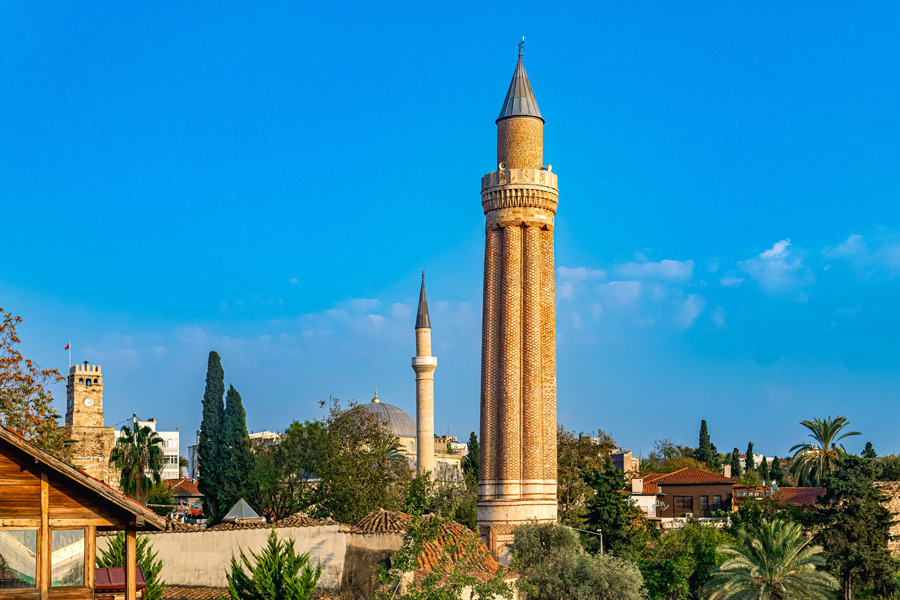
The Seljuks captured Antalya in 1207 and built above what they found rather than clearing it. The Yivli Minaret, raised in the early 13th century by Sultan Alaeddin Keykubad I, became the defining element of the skyline. Venetian merchants were active in the port for a period, and the steps carved through the rock to the marina – still used today – are attributed to them. The Ottomans took the city in 1391 and held it continuously thereafter, adding the mansions, hans, and neighbourhood structures that give Kaleiçi much of its present character.
Highlights
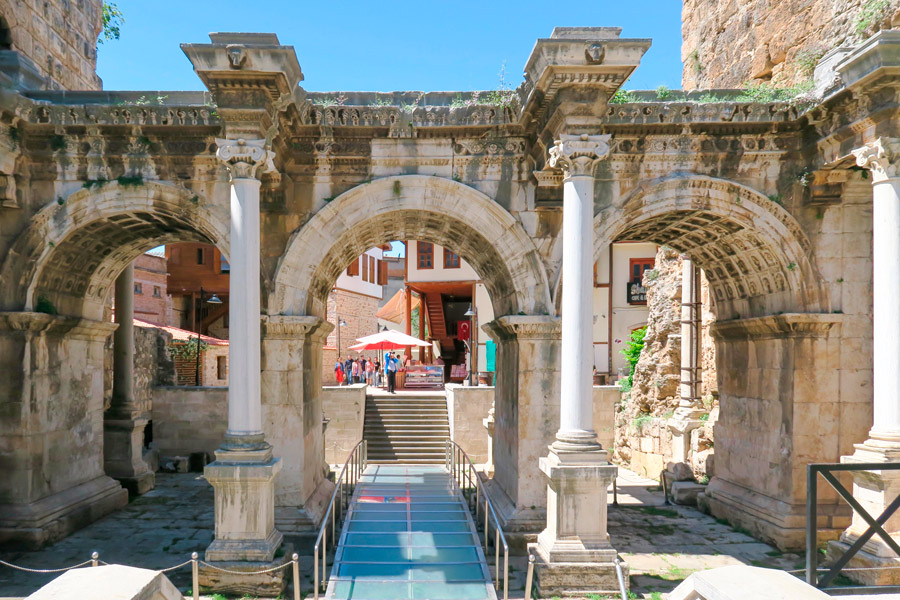
Kaleiçi packs more things to do into a small area. The highlights below cover the main Antalya sights that will anchor any visit.
Hadrian's Gate – Antalya's Ancient Welcome
Hadrian's Gate was built in 130 CE to mark the visit of Emperor Hadrian, and it has served as the main entrance ever since. Nearly nineteen centuries of continuous use make it one of the most quietly remarkable monuments in Turkey.
Yivli Minaret – The Symbol of Antalya
The Yivli Minaret – "fluted minaret" in Turkish, for the eight interlocking cylinders that form its distinctive brick shaft – was raised in the early 13th century and has defined the Antalya skyline for over 800 years.
Kesik Minaret – Temple, Church, Mosque
The Kesik Minaret takes its name from the broken shaft above it – "truncated minaret" – that was never replaced. It takes a moment to read the layers of Roman foundations, Byzantine proportions, and a minaret shaft left unfinished. Yet it is a moment well spent – no other building in Kaleiçi covers as much ground in as small a space.
Hıdırlık Tower and the City Walls
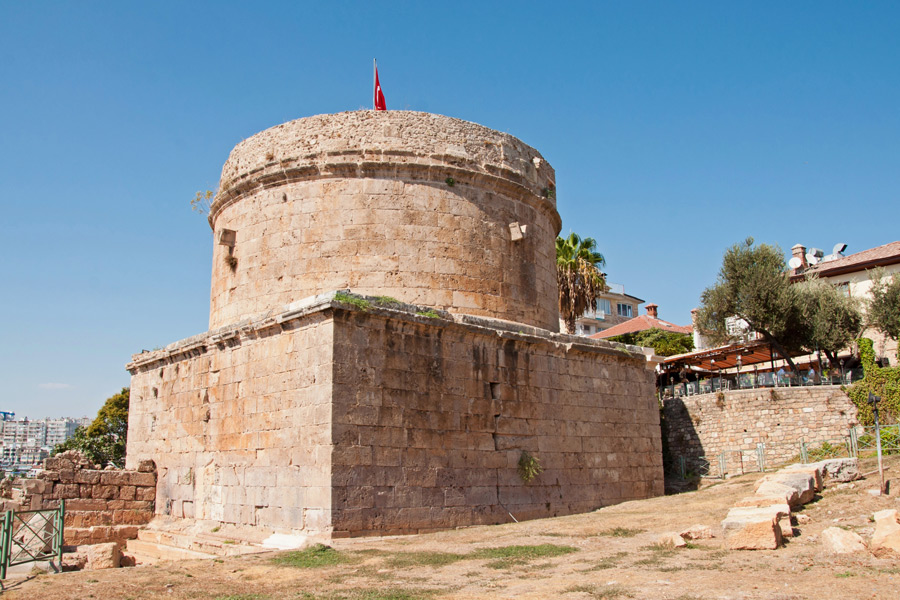
The 2nd-century AC Hıdırlık Tower near Karaalıoğlu Park is located at the south-western tip of the promontory, where the cliffs plunge sharply to the sea. It commands the best uninterrupted view in Kaleiçi. The Roman circuit nearby is among the best-preserved in the district. Most visitors find this corner by accident rather than design – and it feels better that way.
The Old Harbour
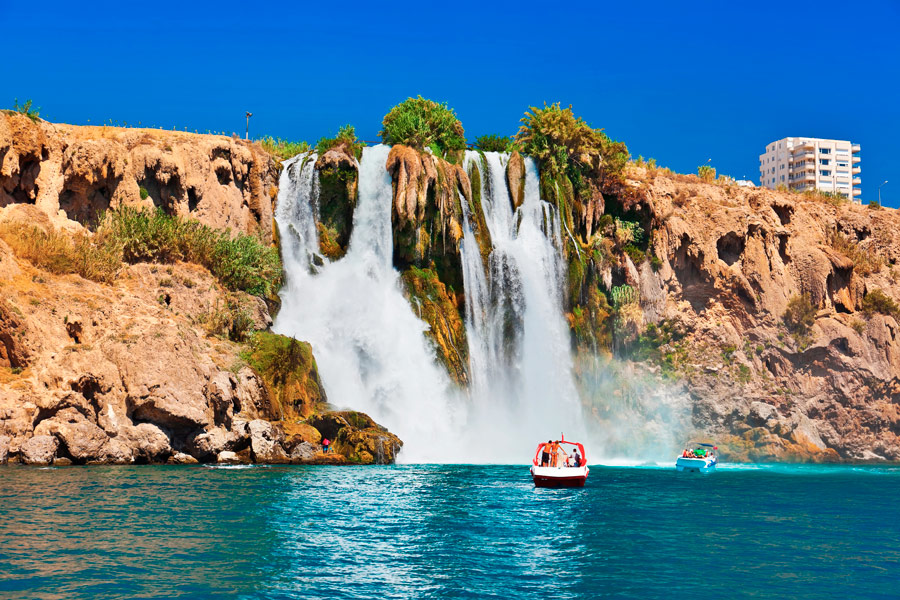
The Old Harbour basin below the old town has been sheltering boats since around 150 BC. Today they are yachts and tour vessels rather than merchant galleys, and the quay is lined with restaurants and cafés. The port has changed its cargo but not its outline. Boat trips along the Gulf of Antalya, to the nearby Düden Waterfalls, and longer coastal excursions all depart from here. There is a restaurant built directly into the old city wall above the marina – one of those tables you remember for the setting alone.
The Venetian Steps
The steps carved through the cliff face link the upper district to the waterfront below. They have been used by Venetian merchants, Ottoman traders, and generations of visitors finding their way down to the sea. They are steep, uneven, and every step earns its view: the route opens up different angles on the marina and the ancient fortifications, and reaching the bottom gives a clear sense of how high Kaleiçi sits above the water – and of how long people have been taking this same descent to the sea.
Mermerli Beach
Mermerli Beach sits at the foot of the Roman walls, directly below the old town. It is a small stretch of pebble and sand, accessible through the terrace of the Mermerli Restaurant. The beach charges a modest entry fee. Ancient stonework rises on one side, the Mediterranean stretches ahead, and the harbour mouth is visible to the west.
The Streetscape and Bazaar
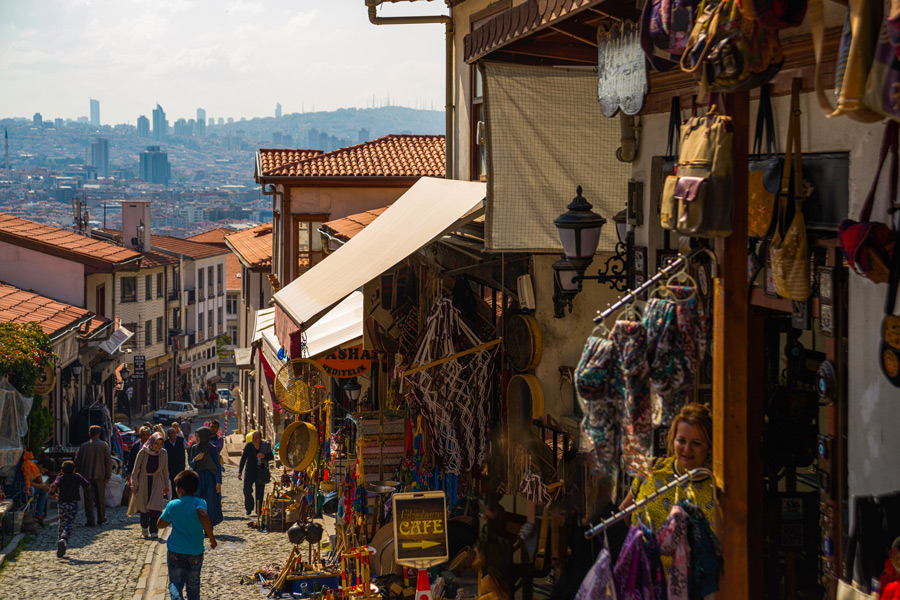
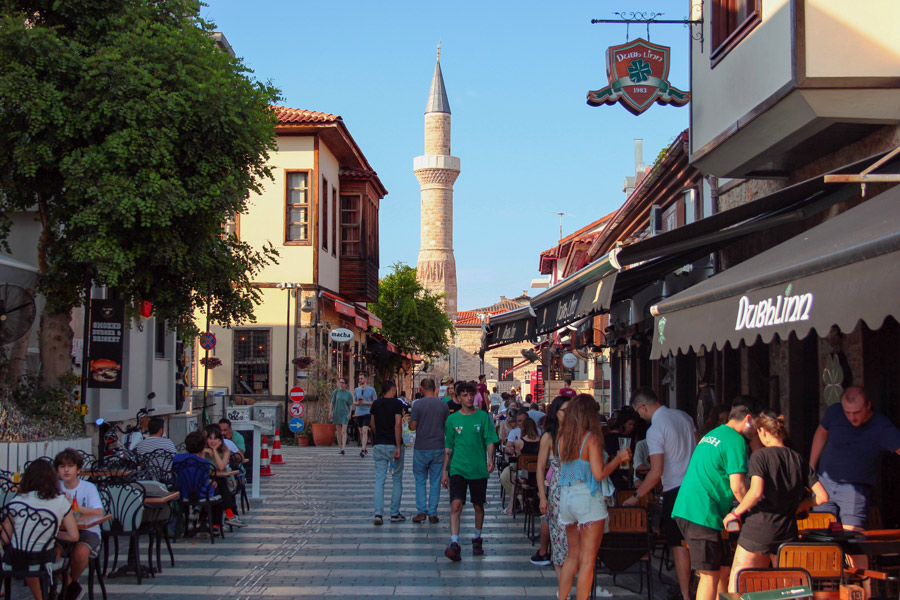
Kaleiçi is worth extending because much of it lies between the specific sights. The residential streets are lined with late-Ottoman mansions, which are now boutique hotels. As you move towards the eastern edge, you see small shops selling leather goods, textiles, ceramics, and local produce alongside souvenir stalls. Some of the lanes here are barely wide enough for two people to pass – laid out before wheels were common and left that way.
Suna and İnan Kıraç Museum
The Suna and İnan Kıraç Museum, housed in a restored Ottoman mansion, holds a well-presented ethnographic collection covering the domestic and ceremonial life of Ottoman Antalya. The dioramas, as well as the building’s exterior and interior, are fascinating. There is a restored 19th-century Greek Orthodox church on the ground, the Church of Hagios Georgios. A quiet hour here, after a morning on the streets, makes much of what has just been seen easier to place. The museum is open Tuesday to Sunday, 09:00–18:00. For current hours and any changes to admission, check the website.
How to Get to Kaleiçi Old Town
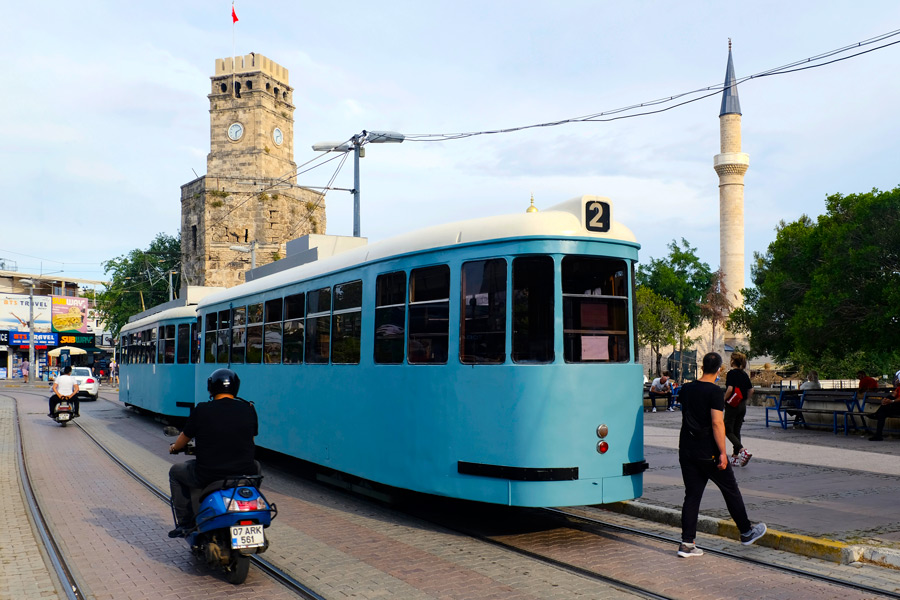
By tram: The nostalgic T2 tram line runs from the Museum district through the city centre to Kalekapısı – the stop directly in front of Hadrian's Gate. Trams run every 30 minutes from 07:00 to 23:00. For real-time schedules and route maps, use the official Antalyakart Mobil app or Moovit, both available on iOS and Android.
On foot from the centre: Kaleiçi borders Cumhuriyet Meydanı (Republic Square). From the main square, Hadrian's Gate is a 5–10-minute walk east along Atatürk Caddesi.
By taxi: Taxis from the city centre reach Hadrian's Gate in approximately 10 minutes, depending on traffic. Ask to be dropped at Üç Kapılar (Hadrian's Gate) for the main entrance, or at the harbour gate for the waterfront approach. All licensed yellow taxis in Antalya run on meters.
Tips for an Optimal Visit
Recommended duration: Allow at least 2–3 hours for the main sights and a stop at the waterfront. A half-day covers the museum, the clifftop stretch near Hıdırlık Tower, and a swim at Mermerli Beach without feeling rushed.
Best time of day: Early morning is when Kaleiçi feels most like itself – the light is sharp, the streets are nearly empty, and footsteps echo on the cobblestones. By mid-morning, the tour groups arrive and the mood shifts. The evening is equally rewarding: the waterfront is best after 19:00, the restaurants find their rhythm, and the gate is lit up in a way that suits it well. Street musicians play late; if the hotel is near the bars, pack earplugs.
Suggested route: Enter via Hadrian's Gate and proceed west towards Hıdırlık Tower, pausing at the Kesik Minaret along the way. Continue to the marina and descend to the waterfront via the Venetian Steps. On the way back, stop at the Yivli Minaret square and allow time for the Suna and İnan Kıraç Museum before finishing at one of the cafés near the gate.
Footwear: Flat, comfortable shoes. The stone underfoot is uneven throughout, and the Venetian Steps are steep in both directions. Modest dress is appropriate for the Yivli Minaret Mosque.
What to bring: A small amount of cash for Mermerli Beach, smaller cafés, and bazaar shops that do not take cards.
Most visits to Kaleiçi run longer than planned. The alleys branch without logic; a turn that looks promising leads somewhere unexpected. It can be a courtyard with a fig tree, a terrace not on any map, a view of the sea through a gap in the rooftops. Getting lost here tends to become part of the visit rather than an inconvenience.
Music drifts through the district at most hours – from café terraces, open windows, and courtyards that are hard to locate. By the time the waterfront comes back into view or the gate reappears on the return route, most visitors find they are already thinking about what they missed.
Come for the morning. The evening tends to take care of itself.