

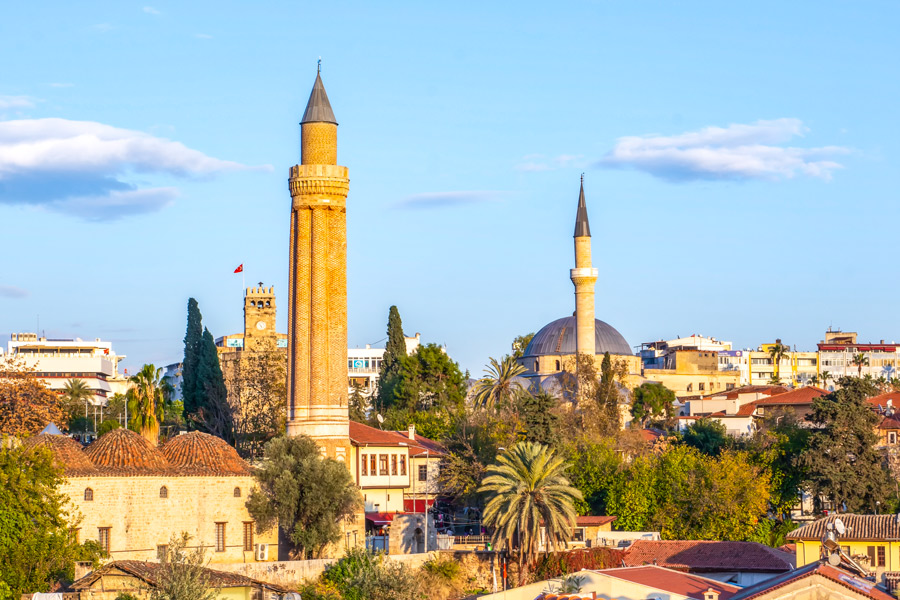
Most people know Antalya in Türkiye as a beach destination. And even those who come purely for the sea, boat trips, and nightlife can't miss a tall red-brick minaret of the Yivli Minaret Mosque (Yivli Minare Camii or Alaaddin Camii or Ulu Camii). This is the symbol of Antalya, rising above the rooftops of Kaleiçi, the historic old town. It is visible from virtually every corner of the city.
The Turkish name “Yivli” means “fluted,” which is why visitors may also see it referred to as the Fluted Minaret or Grooved Minaret. The Seljuk architecture here reveals itself in a truly unusual way. Yivli is not just a 13th-century mosque but the oldest mosque in Antalya.
While you are in Turkey's tourism capital, take time to wander its charming, colourful streets and discover Antalya's historical landmarks. And this guide will make your visit to this Mediterranean seaside resort smoother and far more rewarding.
History of the Yivli Minaret Mosque Antalya
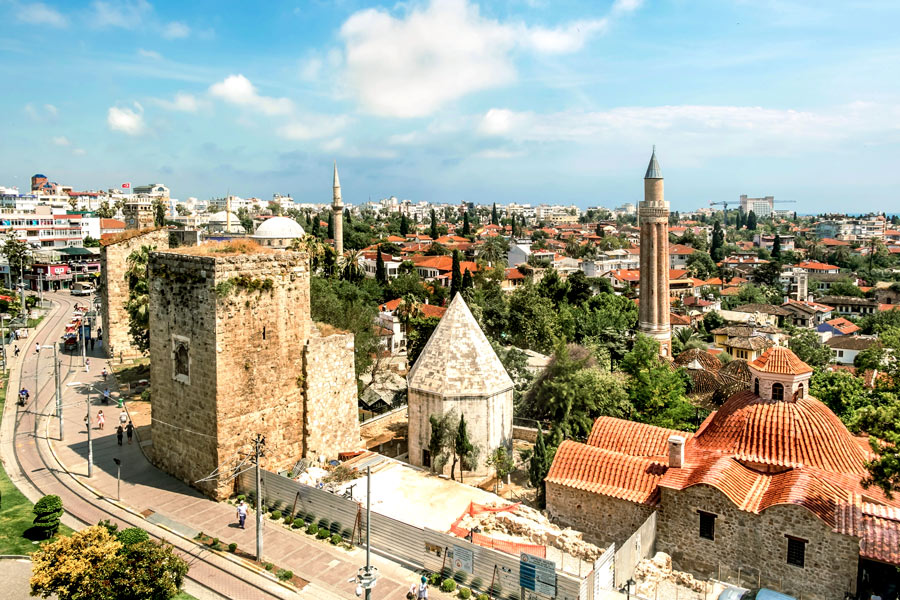
The history of the Yivli Minaret Mosque is closely tied to the medieval past of the old Kaleiçi quarter. This fluted shaft represents a curious architectural element of the 13th-century mosque in Turkey. It is often called the Alaeddin Keykubad Mosque because Seljuk Sultan Alaeddin Keykubad I (1220-1237) envisioned it as a place of worship on the earlier Byzantine-period church remains around 1230.
The original prayer hall was destroyed and rebuilt in 1373 at the orders of Mehmet Bey. This time, six domes rested on twelve ancient capitals. So, where was the Yivli Minaret built? On this very spot overlooking the Mediterranean. Who commissioned the Yivli Minaret? The Sultan Keykubad I, a ruler renowned for his wide-ranging architectural projects across Anatolia. What he did – he transformed a former church into a lasting Turkish heritage site.
Since then, the tall brick tower at the highest point of Kaleiçi has dominated the Antalya skyline as a landmark for eight centuries. And only a few monuments in Turkey carry as many layers of history as this one.
Architecture of the Yivli Minaret Antalya
Among the things to do in Antalya, visiting the Yivli Minaret Mosque deserves special attention. Visitors witness not just a postcard stop, but one of the most accomplished surviving examples of Seljuk architecture in the Mediterranean world.
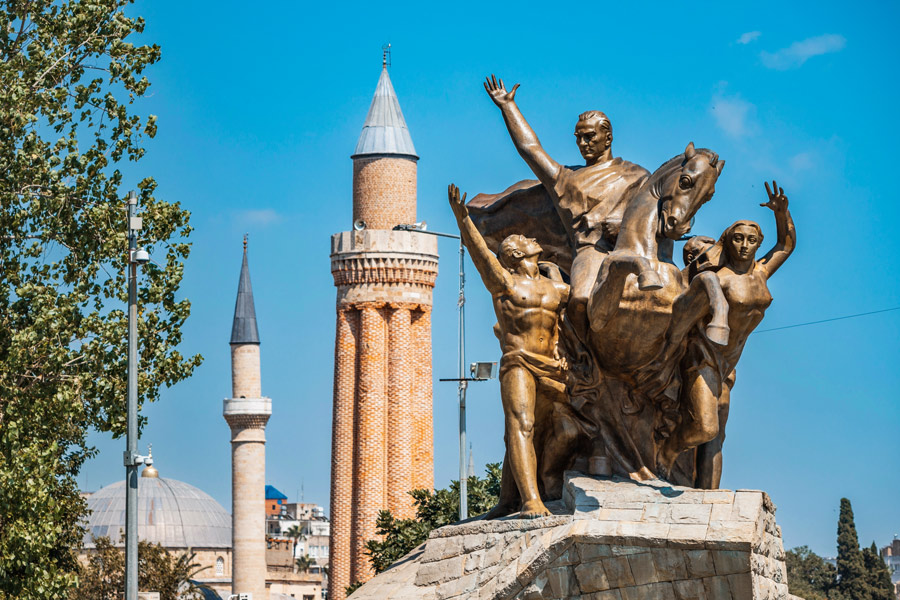
The eight-fluted minaret itself is the most popular element. Rising 38 meters (124.7-feet) tall above the old city walls, it is constructed from deep red brick laid in tight horizontal courses. The turquoise-tiled minaret details are woven into alternating rows to create an illusion of vertical striping that climbs the shaft.
Eight semi-circular grooves – the "yivli" – run the full height of the tower, giving it a unique, ribbed, almost organic profile. The base is cut stone, square and massive, transitioning through an octagonal zone adorned with blind niches before the brick shaft begins.
That shaft was once far more vivid. The original decoration included a dense mosaic of turquoise and cobalt-blue tiles on the niches of the transitional zone. Only traces remain today. However, in certain angles of morning light, the ghost of those tiles still catches the eye. The minaret ends with a narrow balcony supported by stone muqarnas consoles, then a simple cylindrical turret, and finally a lead-covered conical cap.
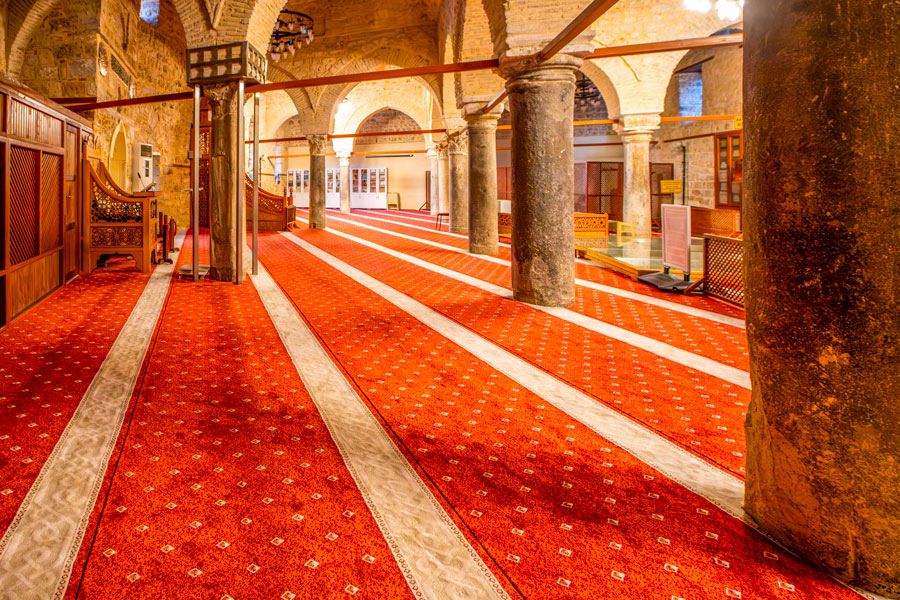
The plan of this Kaleiçi mosque is rectangular, and the hall is covered by a six-domed mosque arrangement: two rows of three domes, each supported by twelve columns. Several are fitted with reused older capitals. This makes the Antalya Yivli Minaret Mosque one of the oldest multi-domed examples of Islamic architecture in Anatolia.
The walls are cut stone, the interior decoration is minimal in the early Seljuk architectural style, and the mihrab is set at a slight angle from the southern wall.
During the 2007–2010 restoration, workers discovered an ancient water system underneath the prayer hall. Rather than conceal them, a glass floor section was installed so visitors can look directly down at the Yivli Minaret glass-floor water channels.
Inside the Yivli Minaret Mosque Today
The mosque complex sits at the top of Kaleiçi, Antalya's walled old town, on Cumhuriyet Street beside Kalekapısı Square. Following it on foot through the narrow lanes is a natural way to approach the site.
Entry to the mosque is free. The complex is open to visitors throughout the day, with closures during the five daily prayer times. It is worth checking local prayer schedules before planning a visit, especially around midday and afternoon, when the closures are longest.
What to expect inside: On entering the prayer hall, to the right, there is a low wooden bookshelf holding Qurans and introductory Islamic literature in English, German, and Russian, including material suitable for children. There is also a collection box for voluntary donations toward the mosque's upkeep. The women's prayer area is separated from the rest of the hall by a dedicated section to one side. The atmosphere is calm and welcoming; the mosque sees a steady stream of visitors alongside regular worshippers, and both seem to coexist without friction.
Before entering:
- Shoes must be removed at the door.
- Shoulders and knees should be covered. Modest dress is expected for all visitors.
- Headscarves and wraparound skirts are available at the entrance for women who need them.
- Photography inside the prayer hall is not permitted during prayer times. Outside of prayers, photos are generally acceptable.
Do not leave without looking down at the glass floor section near the entrance. Those stone-lined channels beneath the surface are over a thousand years old.
The Külliye: A Complex Hidden in Plain Sight
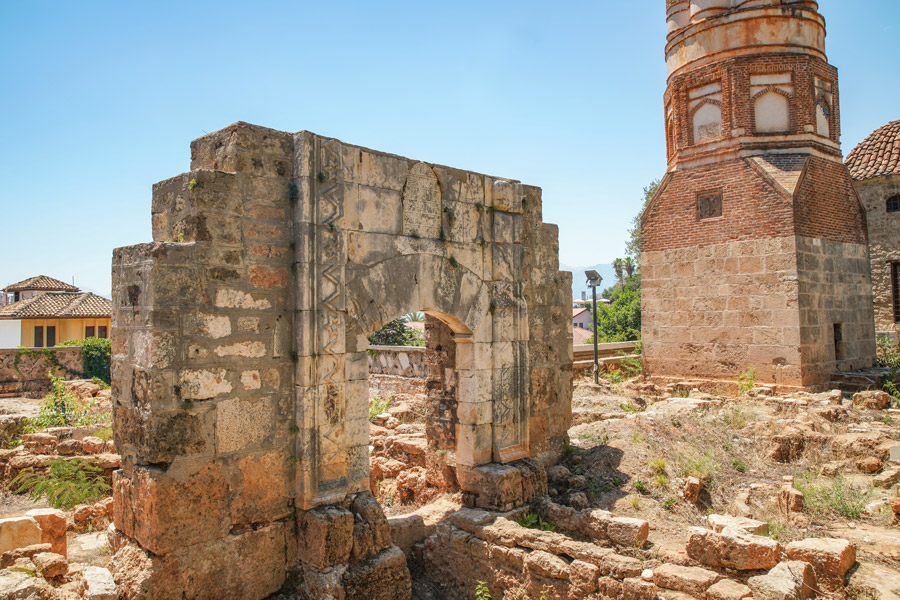
What most visitors see as simply "the minaret and mosque" is actually the fragment of a much larger Seljuk religious complex, known as a külliye. At its height, the compound comprised the mosque, madrasas, a Mevlevi dervish lodge, two domed mausoleums, and likely a hammam.
The İmaret Madrasah, also known as the Zarbhane Seljuk and Ulu Mosque Madrasah, is a 13th-century structure right next to the Yivli Minare Mosque. It was part of the other four-iwan madrasahs within the original kulliye. İmaret Medresesi is now occupied by vendors selling a variety of products and souvenirs.
The Atabey Armağan Madrasah, built in 1239, is just east of the minaret. Its grand stone portal still endures, heavily carved and impressive even in its partly ruined state.
The Dervish Lodge Museum (Mevlevihane Müzesi), to the northwest of the mosque, is also a Seljuk-era structure. It now functions as a museum.
Two mausoleums (türbe) flank the Sufi dervish lodge complex – the Zincirkıran Tomb (Zincirkıran Mehmet Bey Türbesi) and the Nigar Hatun Tomb (Nigar Hatun Türbesi). Both are small domed structures.
What to See near the Yivli Minaret
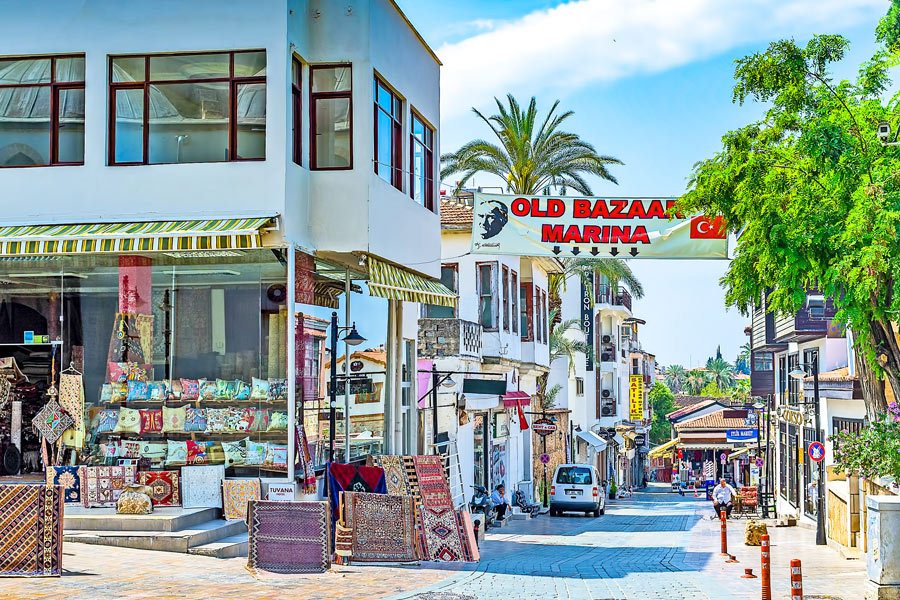
Almost everything you can see in Kaleiçi is within comfortable walking distance because the Yivli Minaret Mosque is located at the natural gateway to Antalya’s old city. Here are the famous Kaleiçi landmarks.
Hadrian's Gate (Hadrian Kapısı) is the most prominent nearby landmark – a triple-arched Roman triumphal arch built in 130 AD to mark Emperor Hadrian's visit to the city.
Kaleiçi itself, the historic district, is ideal for a slow afternoon walk. The narrow streets wind between Ottoman-era stone houses, many of which have been converted into boutique hotels or restaurants. And the Roman harbour at the far end boasts a view of the water that has barely changed since antiquity.
Kesik Minaret Mosque (Kesik Minare Cami). Seljuk builders added the minaret in the 13th century during the building’s conversion into a mosque. The structure earned its "Broken Minaret" nickname after an 1896 fire left the brick tower jagged and roofless. A restoration launched in 2018 finally replaced the missing cone. The mosque reopened for service in 2021 after 125 years of silence.
The Antalya Museum (Antalya Müzesi), a short distance west of the old town, holds one of the finest collections of Graeco-Roman statuary in Turkey.
Old Town Bazaar. The Old Town Bazaar is a clean, lively shopping spot set amid historic streets. Most stalls sell replica goods, but the atmosphere is relaxed, with friendly vendors who allow visitors to browse without pressure. Even without buying anything, it is easy to spend hours here, enjoying the conversations and the setting.
Plan Your Visit to the Yivli Minaret Mosque, Antalya
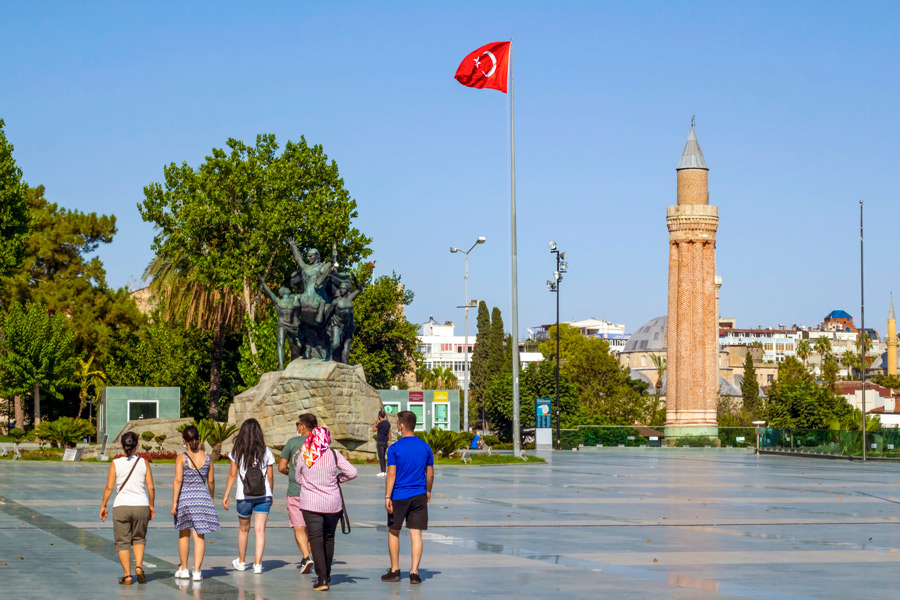
Finding Yivli Minare is simple. Its red-brick silhouette serves as a North Star for newcomers wandering Cumhuriyet Street near Kalekapısı Square. The AntRay light rail offers the most efficient route for those arriving from further out. Then, a short walk from the İsmetpaşa stop leads directly to the gates. Travellers arriving by air can expect a 20-minute taxi ride from Antalya Airport (AYT). Yet the tram system (T1A) provides a scenic alternative for the 13-kilometre journey.
The narrow, labyrinthine alleys of Kaleiçi were never designed for modern traffic. That is why driving into the old town is often a headache. The smoothest option is to leave vehicles in the parking lot at the district's edge and enjoy the atmosphere on foot.
Admission to the site is free, and the doors are open daily. Even so, visitors should plan around the five daily prayer sessions, during which the mosque closes to the public for about 30 minutes.
Timing is important to capture the spirit of the Antalya Yivli Minaret. The quiet of the early morning is perfect for a peaceful perspective of the architecture before the midday crowds arrive. However, the late afternoon can also surprise. The low light reflects in the brickwork as the sun dips and the remaining turquoise tiles shimmer against the sky.
The festive energy of Ramadan evenings is truly a sight to behold. And the mild temperatures of April, May, September, and October provide the most comfortable climate for exploring.
Famous Minarets in Turkey
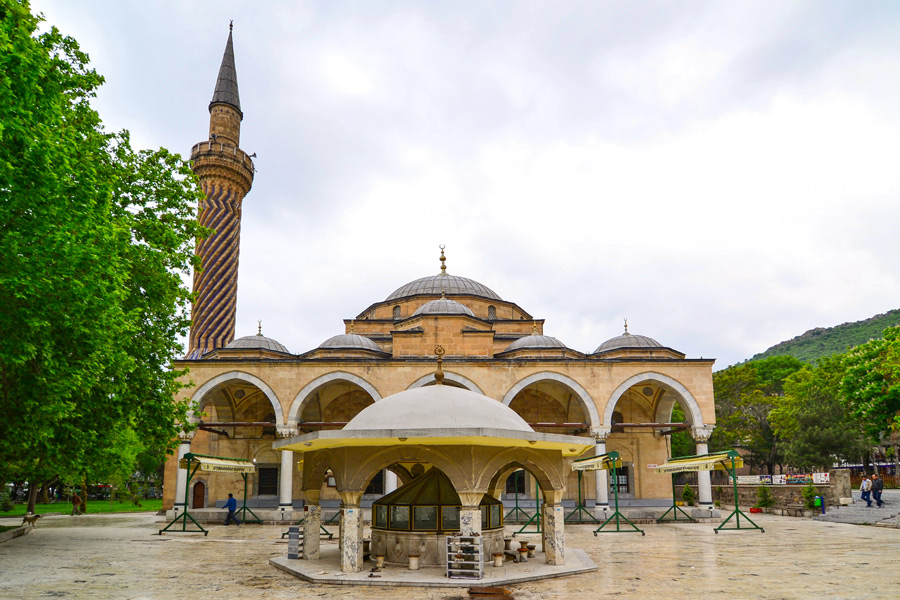
The Turkish landscape features several remarkable towers that showcase the evolution of Islamic masonry. Notable structures include the spiralled brickwork of the Amasya Burmalı Minaret Mosque and the intricate geometric patterns of the Gedik Ahmet Paşa Mosque in Afyonkarahisar. In the Aegean region, the Tire Karahasan Mosque displays a unique zigzag brick design. And the soaring, fluted minaret of the Edirne Üç Şerefeli Mosque represents a pinnacle of early Ottoman engineering.
Yet among these Antalya sightseeing highlights, the Yivliminare Camii stands apart. Its eight vertical grooves and cobalt-tiled shaft are rare in Anatolia. It chronicles the city's transition from Byzantine to Turkish rule. Eight centuries on, the minaret still reads that way. As one of the must-visit Antalya cultural landmarks, it rewards visitors who take the time to understand what it was built to convey.