

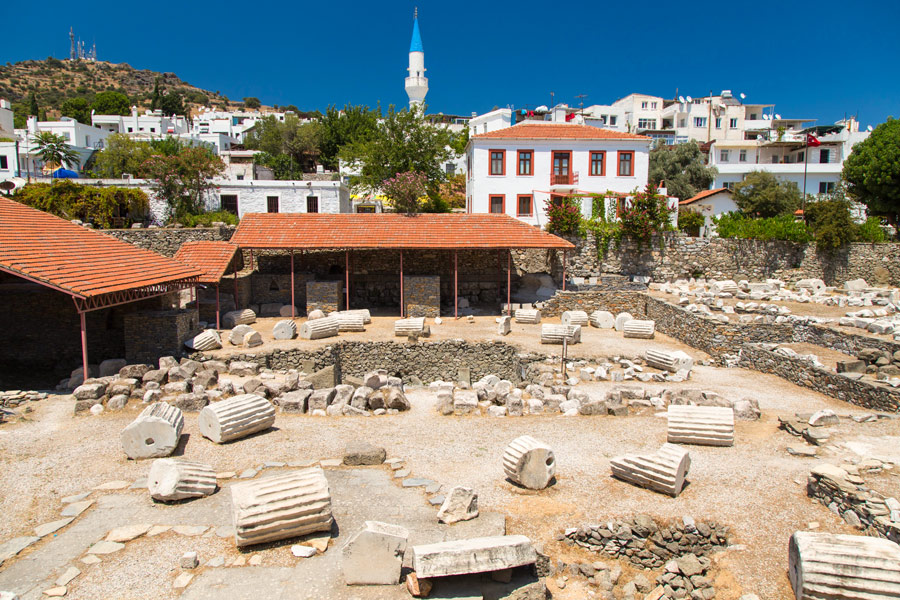
Turn off Turgut Reis Caddesi, away from the shop awnings and the crowds, and the noise falls back within a few steps. A gate opens into a walled garden of oleander, fig and cypress. The ground falls away into a broad sunken rectangle, deeper than it first looks.
Nothing here stands higher than a person. Yet this quiet enclosure once held one of the Seven Wonders of the Ancient World. A king was buried on this spot. A cat dozes on the warm stone while, a street away, Bodrum carries on without a glance.
History of the Mausoleum at Halicarnassus
The story begins with a marriage and a death. Mausolus ruled Caria, a small kingdom on the western edge of the Persian Empire, from his capital at Halicarnassus – the ancient name for Bodrum. He governed for 24 years, admired Greek art and manners, and rebuilt the city on a new plan. His wife was also his sister, Artemisia, in the fashion of the Carian court. When he died in 353 BC, her grief became famous in its own right: ancient writers claimed she mixed his ashes into her drink, so that she might carry him with her.
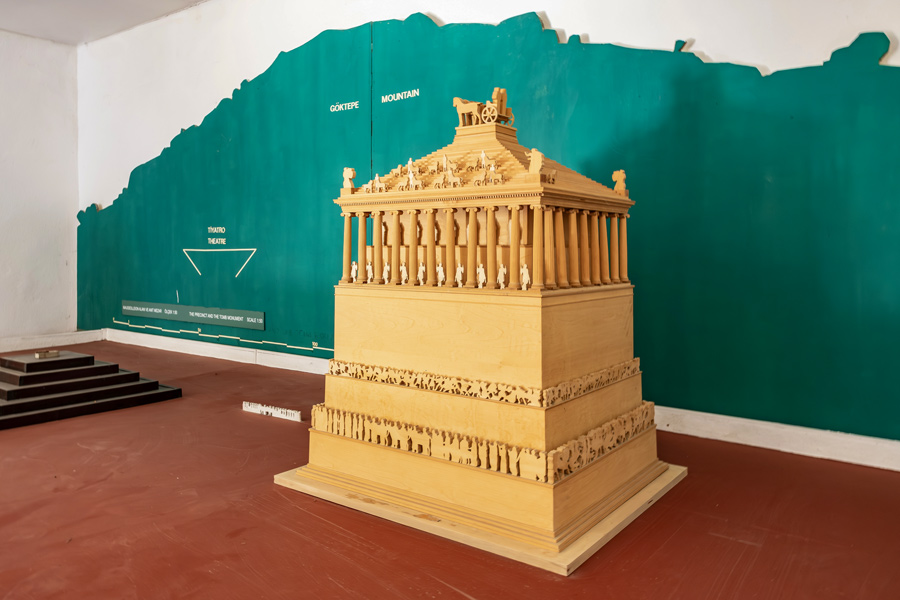
She resolved to give him a tomb beyond anything the Greek world had seen, and sent messengers out to find the best artists of the age. Two architects, Satyros and Pythius of Priene, drew the plan. Four sculptors took a side each: Scopas, Bryaxis, Leochares and Timotheus. The result rose in three tiers to roughly 45 metres – a tall podium, a crown of 36 columns, and above them a stepped pyramid. A four-horse chariot stood at the very top, with the king and queen riding in it.
Artemisia did not live to see it finished. She died two years after her husband, and both were laid inside a tomb still under construction. According to Pliny, the craftsmen chose to stay and complete the work without their patrons, treating it as a memorial to their own art as much as to the dead. Their name for the building outlived every one of them. Because the tomb honoured Mausolus, grand tombs everywhere came to be called mausoleums.
For seventeen centuries the tomb outlasted the city around it, until a run of medieval earthquakes finally cracked it open. The Knights of St John did the rest. Across the late 15th century and into the 16th they broke up what still stood, burned the stone for lime, and hauled the cut blocks down to the fortress they were raising by the water.
In the 1850s the British archaeologist Charles Newton traced the buried foundations, lifted out what the earth still held, and shipped the best of the carving to London. The colossal figures thought to be Mausolus and Artemisia, with long stretches of the battle frieze, have sat in the British Museum ever since.
Highlights
Nothing here is more than a few steps from the gate. Take your time exploring the garden slowly, and let each piece hold the eye for as long as it asks.
The Foundations
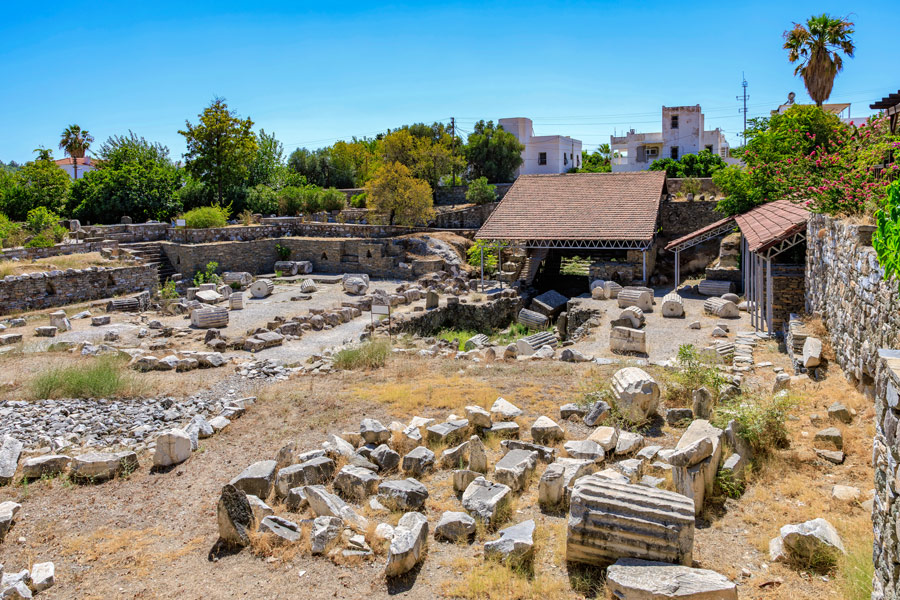
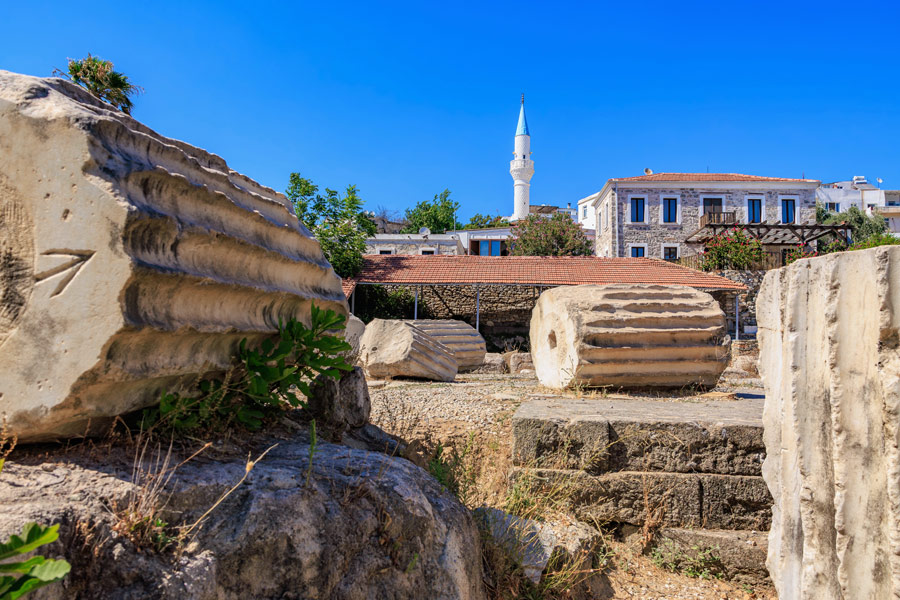
What survives best is the monument’s footprint. The dug-out floor marks the base of the podium, and pacing its edge gives the only honest measure of scale the ruins still offer – there is space enough to lose a modern house inside. Steps on the eastern side lead down to the burial chamber cut into the rock, where the urns were sealed behind rubble after the funeral. Its walls still carry the marks of the tools that shaped them. From the centre, with the sides of the pit at roughly knee height, it takes real effort to picture 45 metres of architecture towering overhead – and that struggle is the reason to come.
The Scattered Marble
Around the garden, the pieces lie more or less where the excavations left them. Column drums rest in rows on the grass, each a slice of a shaft that once stood among the 36. A few carved lions have weathered to soft grey, their faces almost gone. Sections of the coffered ceiling show the geometric cutting that ran above the colonnade. Read the surfaces closely and you can spot the timeline: crisp 4th century tooling on one block, the blunt scars of a later age on the next.
The Exhibition Hall
A covered pavilion near the entrance shows what the ruins alone cannot. A scale model rebuilds the tomb tier by tier, complemented by a short film detailing its history. Glass display cases hold original stone fragments and plaster casts of the reliefs – Greeks locked in combat with Amazons, close enough to follow the line of a raised arm or the fold of a carved tunic.
Practical Information
Address: Tepecik Mahallesi, Turgut Reis Caddesi No. 93, 48400 Bodrum, Muğla. Located in the streets above the marina, roughly halfway between the harbour and the ancient theatre.
Opening hours: Daily in summer, around 08:30–19:00 (1 April–1 October). Winter hours are shorter, closing nearer 17:30, and the site may close on Mondays out of season.
Entry: A small fee (around 70 TL / €3), payable in Turkish lira at the booth; the Museum Pass Türkiye is accepted and covers the castle and other state sites. Check the official Ministry of Culture website for the most up-to-date pricing before your visit.
Parking: Difficult. The surrounding lanes are narrow and largely residential. It is easier to leave a car near the harbour or the bus terminal and walk the last 10 minutes.
How to Get There
On foot: The simplest approach. From Bodrum Marina or the castle the walk is around 10 to 15 minutes uphill through the old streets, and the site is signposted from the main roads.
By dolmuş: Shared minibuses run to Bodrum Merkez from Gümbet, Bitez and the other peninsula towns, all arriving at the central bus terminal (otogar). From there it is a short walk. Fares are paid on board in cash.
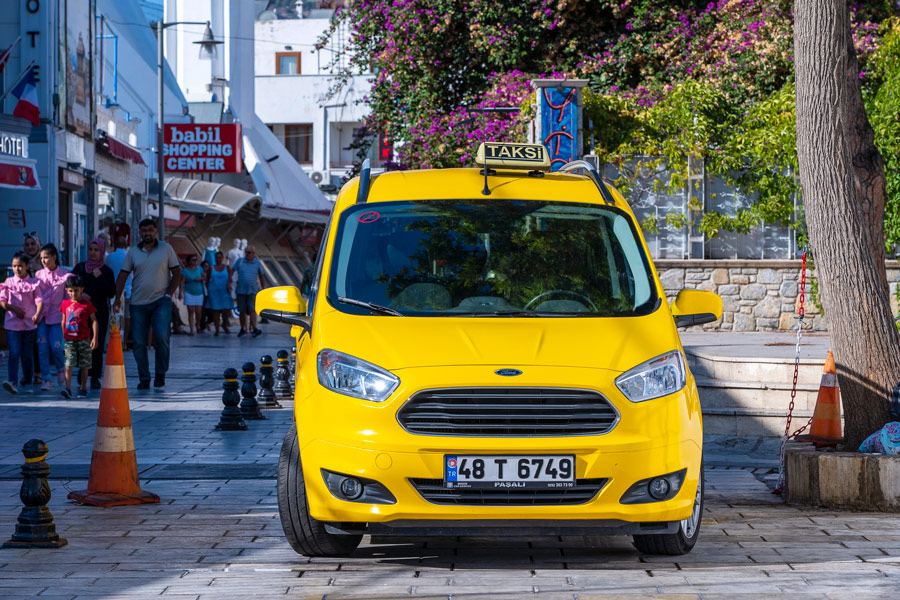
By taxi: Metered taxis wait across central Bodrum and at the bus terminal. This is a convenient option in the heat of the day, though the narrow streets mean the final stretch may still be on foot.
Tips for an Optimal Visit
Recommended duration. 30 to 45 minutes is enough. This provides ample time to watch the film, walk the pavilion, and take in the foundations without hurrying.
Best time of day. Early morning or late afternoon. The open centre gets no shade, the midday sun is heavy in high summer, and softer light rakes across the old stonework.
What to bring. A hat and water in the warm months. The garden keeps some shade at its edges, but the centre has none.
See the model first. Walk through the covered pavilion before heading out to the ruins. The miniature reconstruction lends them a height and a shape, making the outdoor site much easier to interprete.
Combine with. Bodrum Castle sits 10 minutes downhill, and the ancient theatre is a similar walk uphill.
For a Wonder of the Ancient World, remarkably little of it is still here – and that, in the end, is the story. Over the centuries the tomb left in every direction, carried off piece by piece. In a museum far to the north a single horse from the rooftop chariot still strains behind glass at a load that vanished long ago. Only the historic ground it was raised on stayed where it was. Stand among the fallen drums, where the old drainage channels still run beneath the grass, and the point settles without a word: this is the one part of the wonder that never travelled.