

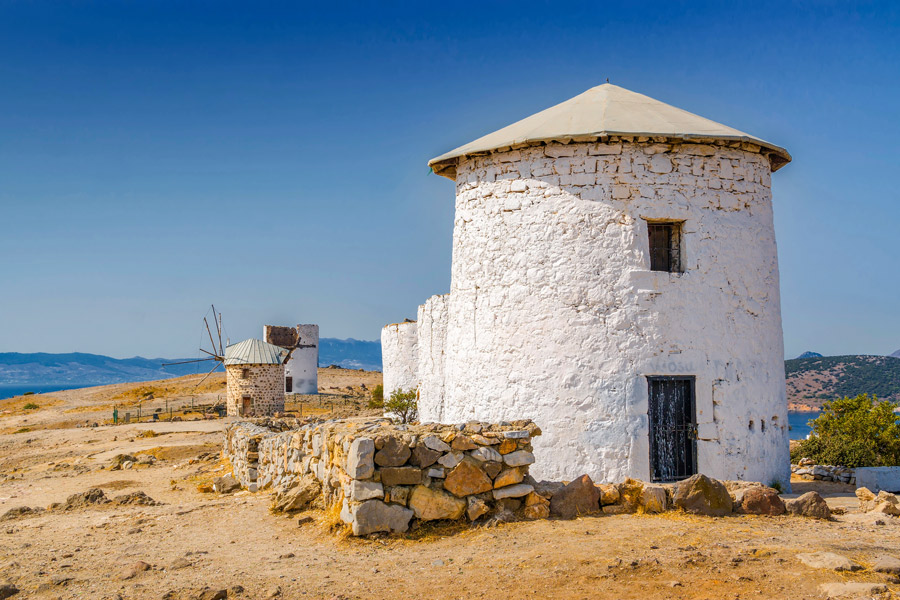
The wind gets to the top of the ridge first. It comes off the Aegean in a steady stream and does not ease, which is the whole reason anything was ever built up here. Seven stone towers stand along the crest, round and pale, spaced a few strides apart. Some are intact. Others are open to the sky – a ring of old masonry, a doorway, and the slope falling away behind it. The climb from Bodrum is short and steep, and it ends on the crest, where the wind hits properly.
History of The Yel Değirmeni
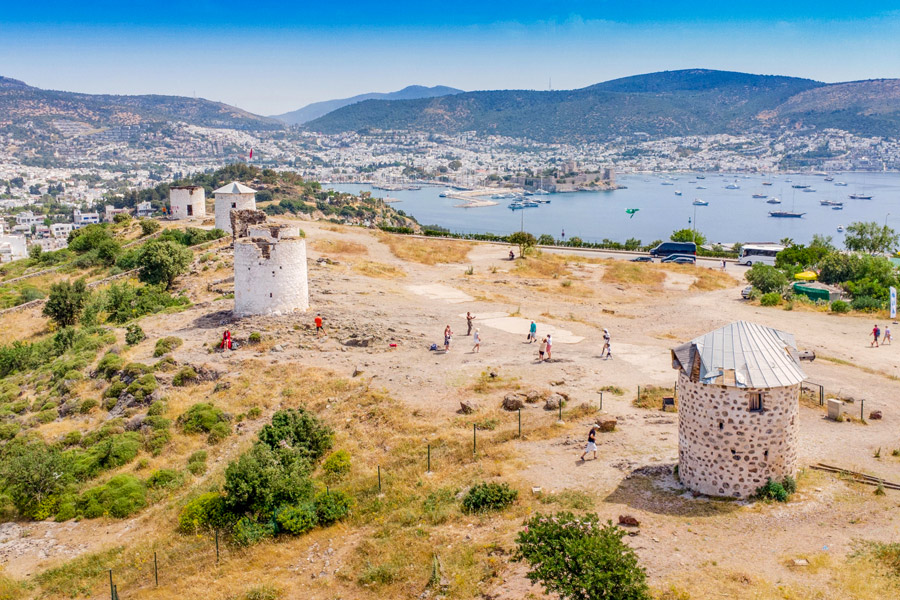
For most of two centuries this hill was a place of work, not a viewpoint. Under Ottoman rule, from the eighteenth century onward, the farms of the peninsula sent their grain up here to be ground. The millers lived by the wind. Each tower held a pair of heavy grindstones, turned by sails of timber and canvas. The whole mill set faced the steady north-west wind so the sails caught it without anyone having to chase the gusts. Wheat, barley, corn and bulgur all went through the same stones.
The work followed a simple rule: the grain never moulds, but, the flour does. A sack of wheat could sit in a store for months, but once milled it soon turned. Households ground only what they needed for the coming weeks, then returned when it ran low. That kept the mills spinning through most of the year. The miller took his share of flour.
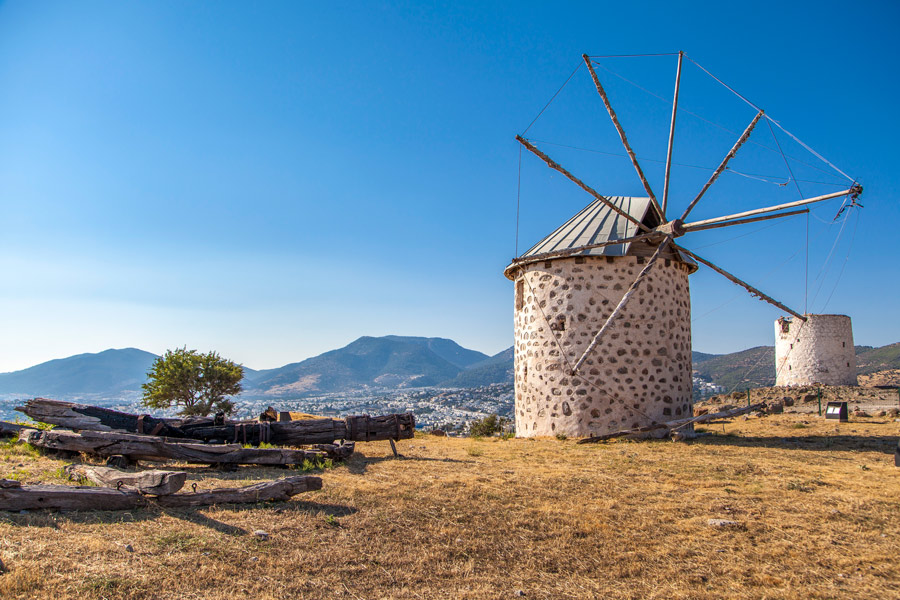
These seven survive on this crest. The rhythm held until the 1970s, when new small motor mills made the climb pointless almost overnight. The sails came down or were left to rot, and the grindstones fell still. Elsewhere on the peninsula, a handful of mills have since been rebuilt as cafés and restaurants. These seven were not.
Highlights
Nothing up here is far from anything else. The standing towers draw the eye first, then the open ones invite a look inside, and the edge of the hilltop offers the outlook every visitor climbs for. A slow circuit of all three takes under an hour.
The Standing Mills
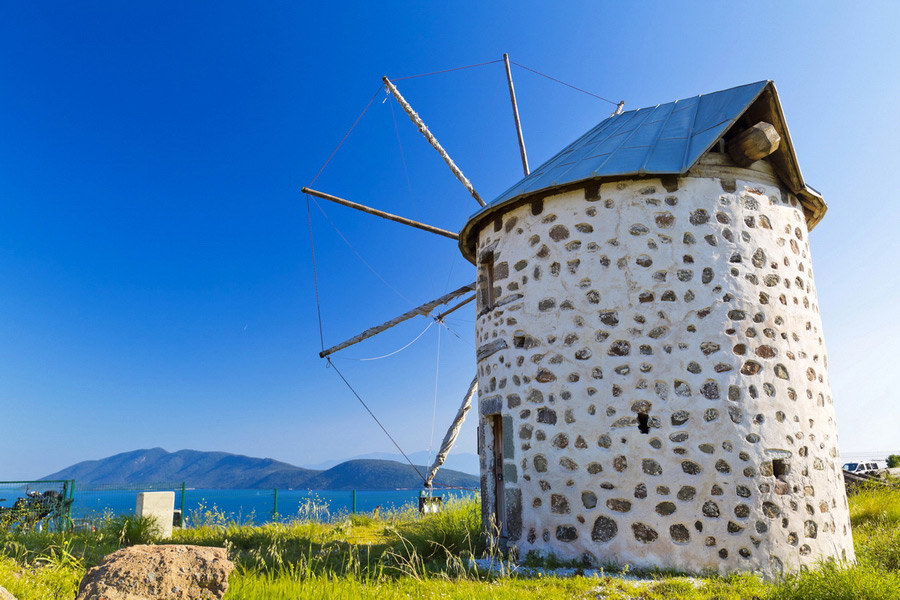
Two or three of the seven still stand more or less whole, their walls patched and their conical caps rebuilt. One still carries its sail frame – a wooden lattice that once held canvas – and it is fenced off, the only one given that protection from the hands of tourists. Up close the build is plain to read: rough stone quarried from the hill beneath it, thick walls, a low door on the sheltered side. Olive trees and dry scrub run up to their bases, and on a quiet morning a few goats may have the slope to themselves.
Inside the Open Towers
The ruined mills are worth the same slow look as the whole ones, because they show what the others hide. Step through a doorway and the tower is hollow to the top, a stone shaft open to the light. The floor is bare. The machinery is long gone, but its logic survives in the shape of the room – grain was hoisted to the upper level, fed down into the eye of a turning stone, and the flour worked its way out at the rim to be gathered below. Standing in the shaft, with the bright doorway behind, the whole operation shrinks to something graspable: one room, two grindstones, and a long drop of empty air overhead.
The View Across Both Bays
The ridge splits two different versions of the same coast. On the Bodrum side the harbour is tight and busy, the castle squared off on its point, the white town packed up the slope behind it. Turn ninety degrees and Gümbet is all open beach and hotels, softer and more recent. Beyond both, on a clear day, the Greek island of Kos sits low on the horizon. The crest fills in the last hour before sunset, when the light goes long and gold and the heat finally drops. People gather. They come up with a drink and wait for it, and the mills, seen end on, make a row of dark shapes against the colour.
Practical Information
Address: Yel Değirmenleri, Eskiçeşme Mahallesi, Haremtan Sokak No:10, 48400 Bodrum, Muğla. Marked on Google Maps as "Bodrum Windmills."
Entry: Free. The site is open at all hours and unstaffed, with no ticket office and no set visiting times.
Parking: Limited. A few short-stay spaces sit near the end of the access road, which is narrow and uneven.
How to Get There
On foot: from Bodrum Marina the climb takes around 20 minutes, steep in places but on pavement throughout. It is the most direct route from the centre.
By dolmuş: the Bardakçı bus runs from Bodrum bus station along the seafront and passes the windmills. The drop-off is on the main road, leaving a walk of around 400–500 metres uphill to the site. Tell the driver where you are going – showing a photograph works better than words.
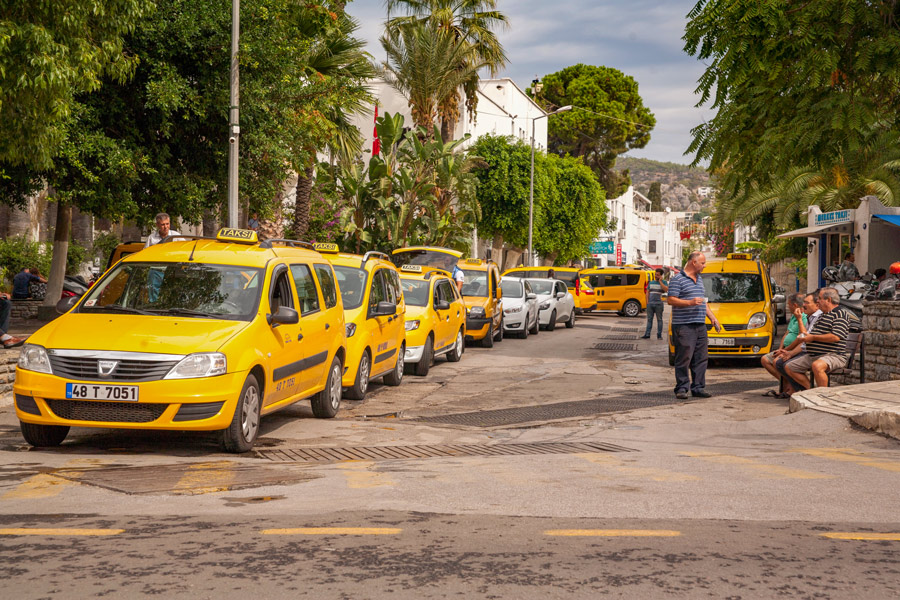
By taxi: available across Bodrum town and the resort districts. Most useful for the return journey, when the dolmuş may have stopped and the path down in the dark is uneven.
Tips for an Optimal Visit
Best time: Early morning or the hour before sunset. Both bring softer light and a cooler climb, where midday in summer is hot and fully exposed.
Footwear: Sturdy, flat shoes are essential. The ground is rocky and uneven, with broken glass in places, so open sandals are a poor choice.
What to bring: A light layer earns its place even in warm months – the hill stays breezy when the rest of the town is still. There is no shade, so sun cover matters in daylight. A small stand by the mills sells cold drinks, tea, coffee and fresh juice, though it is basic and prices are not always posted, so bringing a bottle along is the safer option.
Combine with: The ridge sits a short way above the centre, so the climb pairs easily with the other things to do in Bodrum – the castle, the covered bazaar and the ancient theatre are all within reach the same day.
A note on the site: The mills are not maintained, and litter and graffiti are part of the picture. The towers and the outlook are the draw. A visitor arriving in hope of a restored museum piece will be disappointed; one who comes for the windswept crest and the shells of the towers will find exactly what is there.
How long to allow: 30 to 45-minutes covers the towers and the view at an unhurried pace.
Every working part of this place has been carried off or has rotted away – the canvas, the gearing, the great millstones that did the grinding. What is left is the shell and the thing that powered it. The wind still pours over the hill exactly as it always did, moving through the open towers and finding nothing now to turn. On the single mill that kept its frame, a hard gust will still shift the lattice a few degrees before it settles back. The work was finished half a century ago, but the wind has never stopped coming.