

Address: Nalbantoğlu Mahallesi, Uzunçarşı Caddesi, Koza Han, 16010 Osmangazi, Bursa.
Contact information: Bursa Provincial Directorate of Culture and Tourism, bursa.ktb.gov.tr.
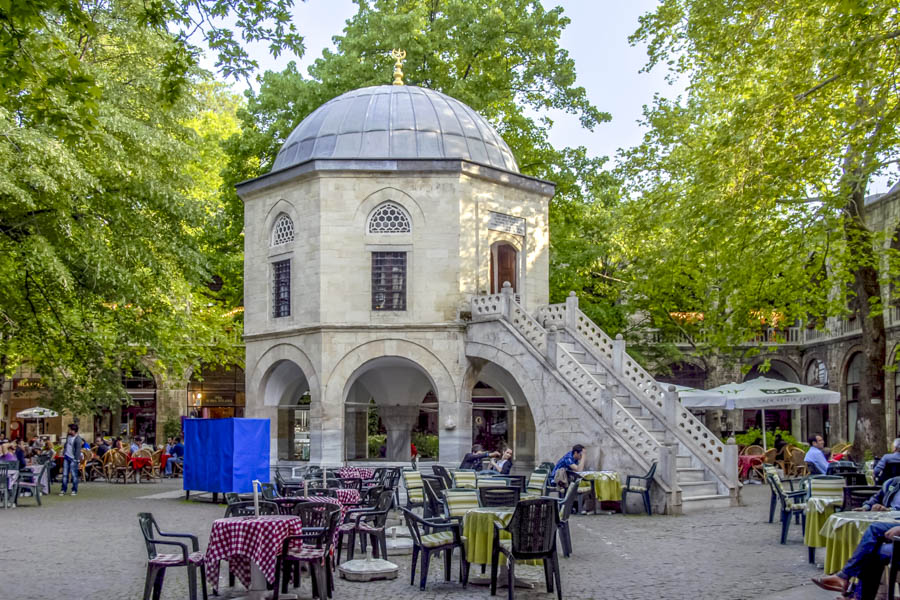
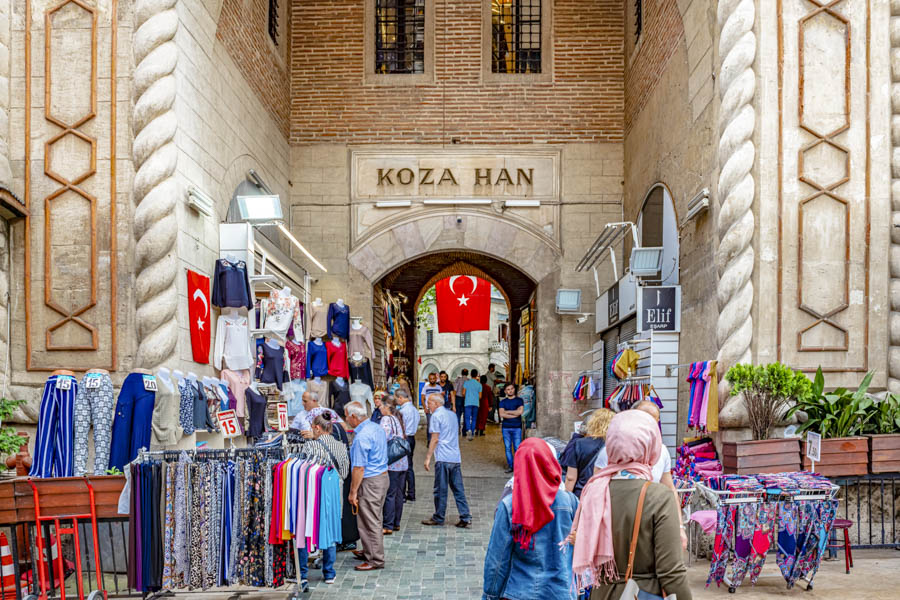
Koza Han is a two-storey Ottoman inn dating from 1491 in Bursa’s historic bazaar. Its gate rises above the lane, taller than any shop beside it. One step through the gate on Uzunçarşı and the bazaar goes quiet. The light changes with it, arriving green and broken through leaves, and the air comes down a few degrees. Somewhere beneath the trees, a spoon turns in a tea glass. Outside, the lane is all barrows and bargaining; in here the pace belongs to men who have ordered tea and have nowhere else to be.
History of Koza Han
Bayezid II, son of the conqueror of Constantinople, was building a mosque complex in Istanbul, and needed income to support it. Bursa was an obvious source of revenue. The old capital sat where Persian silk arrived by caravan and Italian buyers waited to meet it, and a large inn in the middle of that traffic would pay for itself many times over. Land was bought from several owners in March 1490. The work went to an architect named Abdülali, son of Puladşah. The doors opened on 29 September 1491, and the deed of the Istanbul foundation lists the han among the properties that kept it running.
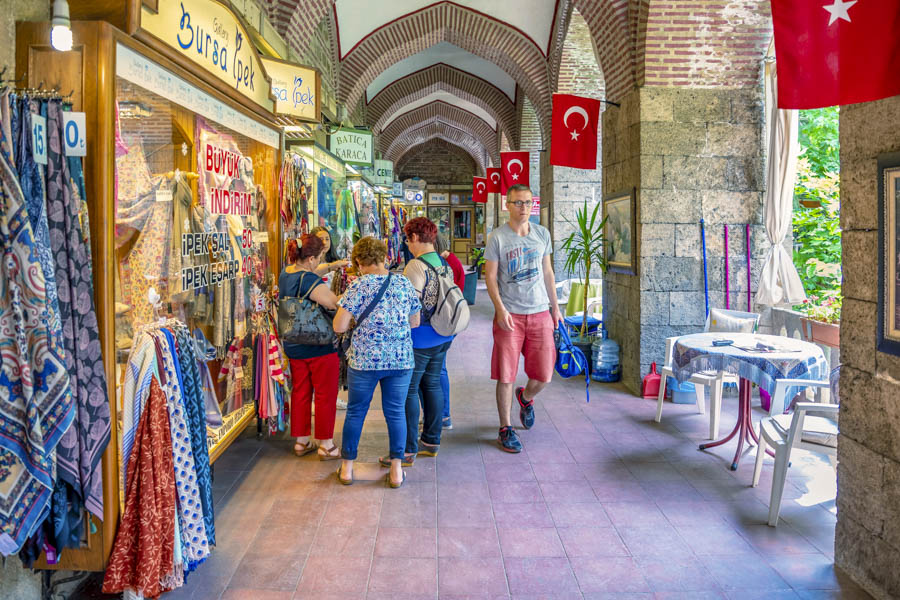
The trade through the gate was international from the start. Within a generation the Medici of Florence kept their agent in one of these rooms. Merchants from Iran and Azerbaijan took the upper floor by the season, and the official who collected duty on their silk sat here to meet them. Evliya Çelebi, passing through in 1640, almost certainly knew the place as the Persian han. Other names came and went with the tenants — Yeni Han, Beylik Han, Sırmakeş Han — and well into the 19th century it was simply the Silk Han. The name that stuck was given by people who never rented a room here. Villages across the plain fed silkworms on mulberry leaves, and every June the cocoons came to town in sacks.
That market outlived the empire, and men now in their sixties grew up inside it. A bell at the gate rang at ten on weekday mornings, and the yard broke into a run. Sacks went up in stacks that reached the roof of the prayer room. Dealers weighed and argued through the morning, then paid in cash after twelve, which was the thing the villagers prized above everything: no credit, no waiting, money in the hand before the bus home. Children worked the scales for the Red Crescent. Each held a basket up towards the weighman and shouted the charity's name, and three handfuls went in from every lot, clean cocoons to one pannier and stained ones to another. At midday the baskets were carried to a tent beneath the prayer room. What they had gathered was auctioned late in the afternoon.
At its height the trade reached far past Bursa. Villages across dozens of provinces raised cocoons, and in 1990 the national crop came to more than 2,100 tonnes. Then imports were freed, Chinese thread arrived at a price no grower could match, and the sums stopped working. Families gave up one by one, and the old mulberry trees were cut for firewood. The cocoon market closed at the beginning of the 1990s. By 2001 the annual crop was down to 47 tonnes, and it has never climbed back within reach of the old figure.
The building lost less than the trade did. Domes once covered the galleries, but the lead was stripped and the roofs retiled, and the arches that carried them can still be picked out. Repairs are recorded in 1671 and 1785, and a thorough restoration around 1950 removed many later additions. In May 2008 Queen Elizabeth II came through the gate with the Duke of Edinburgh and bought silk. Six years afterwards the bazaar quarter entered the UNESCO World Heritage list.
Highlights
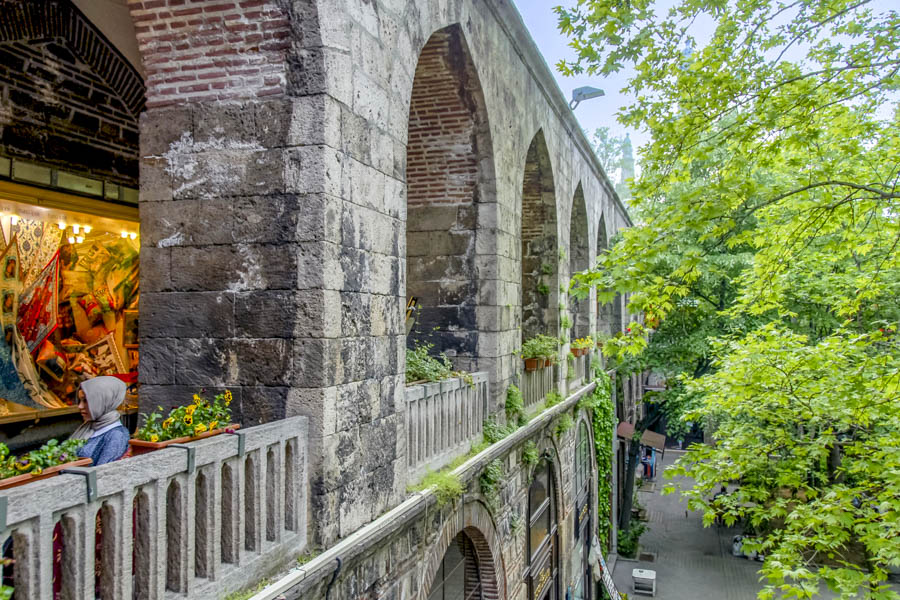
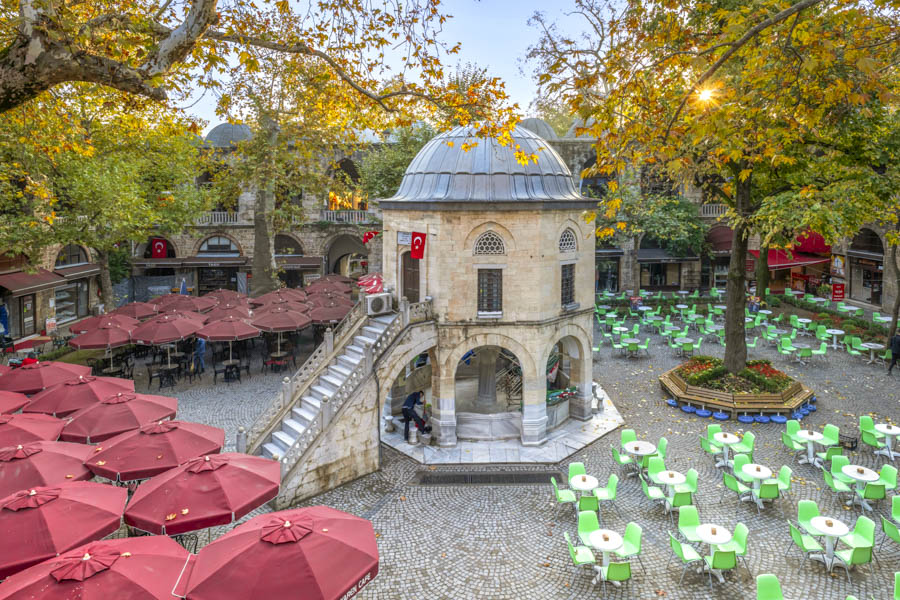
The whole of Koza Han can be taken in from one table beneath the trees. It repays a slow circuit even so: gate, yard, mosque, gallery.
The Gateway
The entrance from Uzunçarşı is a tall portal pushed out from the wall, with a rope moulding climbing both sides and crossing the arch. Above the arch, geometric patterns are set in coloured stone. That is the whole of the decoration. Behind it, the walls were left comparatively plain, banded in the early Ottoman manner with one course of stone to two of brick. Below the eaves, a chain pattern in brick runs around all four sides. The neighbouring Orhan Gazi Mosque uses the same alternating masonry.
The Courtyard and the Plane Trees
The courtyard runs about 46 by 38 metres, near enough a square, and six great plane trees grow in it. They are counted among the monument trees of the bazaar quarter. In summer their canopy closes over the whole space. The trees are the reason the yard became a tea garden at all: nothing could be built beneath them, so tables moved in instead. Retired men take the first glass of the day here. By mid-afternoon the same chairs hold shoppers resting their feet, and some cafés offer traditional fortune-telling from the coffee grounds after Turkish coffee.
The Raised Mosque
Raised prayer rooms of this type have precedents in Seljuk caravanserai architecture. According to the historian Hasan Basri Öcalan, only one other has come down to us in Turkey with its original form intact, at Kayseri. Height solved a practical problem, since pack animals were unloaded on this ground and a prayer room at ground level would have been impractical. The basin beneath was built for ablutions and stands dry today; worshippers wash at taps to one side. The room takes about thirty people, and the shopkeepers fill it at midday. Two of its windows are the originals of 1491.
The Upper Gallery
A stone stair beside the gate leads to the first floor, where an unbroken arcade runs round all four sides under low brick domes. Close to fifty vaulted rooms open off each level. Goods were traditionally stored below while merchants slept above. Today, almost every upstairs room is a shop; spaces that once held beds are easily large enough for counters and stock. Most sell scarves, shawls and lengths of cloth, with bolts standing in the doorways and stock hung from the railings. Not everything hung there is pure silk. From the railing the yard finally reads as a single thing. The stables opened off the eastern side into a second, lower court, which now holds cafés.
Practical Information
Opening hours: Individual shops generally follow bazaar hours, roughly 08:00–20:00 from Monday to Saturday, with shorter hours common on Sundays and in winter. Café hours vary.
Entry: Free. There is no ticket, as this is a working market.
Facilities: tea gardens and cafés below, silk and gift shops on both floors. Lavatories are in the bazaar close by. The prayer room is in use and is not a museum.
Parking: The lanes around the bazaar are pedestrian, and the car parks fill early. Public transport is the easier choice.
How to Get to Koza Han
Public transport tickets: a rechargeable BursaKart covers the metro, trams and city buses. It is sold at station kiosks and newsagents showing a Bu Kart sign.
By metro: the Bursaray line stops at Şehreküstü, north of the bazaar. From the station, Ahmet Hamdi Tanpınar Caddesi climbs south as a pedestrian street. The Ulu Cami appears after about 5 minutes. Koza Han is directly beyond it.
By tram: the red T1 line has an Ulucami stop, 4 minutes away. The line also calls at Heykel, Osmangazi and Altıparmak. That links the bazaar to the rest of the centre.
By bus: many city routes stop at Ulucami PTT, about 3 minutes away. Others terminate at Heykel, a 5-minute walk east along Atatürk Caddesi.
By taxi: metered taxis wait across the centre. The last stretch is on foot, as the lanes are closed to traffic.
From the Otogar: the intercity terminal is 10 km north of the city centre. The T2 tram leaves the terminal every 10 minutes or so and reaches Kent Meydanı in about 25 minutes, connecting there with the T1 line for Heykel. The last one goes at around 22:40. Bus 38 follows the same corridor and is slower once traffic builds. A taxi covers the distance in around 20 minutes, longer at peak.
From Istanbul: fast ferries cross to Mudanya or Güzelyalı in about 2 hours. Buses connect the piers to the Bursaray metro. By road over the Osmangazi Bridge the drive takes about 2.5 hours.
Tips for an Optimal Visit
Recommended duration. 45 minutes to an hour. A circuit of both floors takes 20 minutes; the rest is for tea.
Best time of day. Early morning, before the shops have finished opening. The prayer room is emptiest then, and the stair can be climbed unhurried. The tea gardens are busiest from mid-afternoon into the evening. Saturdays are full from the start.
Best entrance. Arrive by the Uzunçarşı portal, since the carved decoration is on that side. The park gate opposite is the quieter way out. It opens straight onto the Orhan Gazi Mosque.
Buying silk. The specialists are upstairs, and the ground floor is mostly gifts and cafés. Several upper-floor families have traded here for generations. Ask whether an item is pure silk or a mix. The price should show the difference. A little bargaining is usual on larger purchases, not on a single scarf.
Dress and conduct. There is no dress code for the han. Shoes come off inside the prayer room. Shoulders and knees should be covered there. Around prayer times the stair is for worshippers, not photographs.
Photography. The mosque is best seen from the far side of the gallery. The whole yard fits in one frame from there. Tables in the tea gardens are intended for customers, so order something if you want to sit and photograph the courtyard from there.
Accessibility. The courtyard is on one level and reached through the gate without steps. The gallery is reached by stone stairs only, and there is no lift.
Combine with. The Ulu Cami is a minute away across the lane. The covered bazaar and the bedesten begin a few steps north. Emir Han, the oldest inn in the quarter, stands beside the Grand Mosque. The tombs of Osman and Orhan Gazi are a 10-minute climb to Tophane. Together they fill a slow morning in the old centre.
The cocoon trade that gave Koza Han its name has gone, but silk has not disappeared from the building. The sacks and scales have given way to tea tables, while the rooms above still sell scarves, cloth and silk goods. Late in the afternoon, light filters through the plane trees onto the courtyard where the auctions once took place.