
Tours and Attractions of Florence
Florence, located in central Italy, 230 kilometres (145 miles) northwest of Rome, is known to Italians as Firenze and is the largest city in Tuscany. It was here that art, thought and culture came together in the late Middle Ages and the Renaissance, transforming the Western outlook in ways that remain influential today. At the heart of this revolution was a new humanism, in which renewed interest in the classical past rekindled the importance of the individual, the imagination and beautiful forms. The most visible manifestations of the Renaissance are its paintings, sculptures and architecture, but these tangible achievements were accompanied by a transformed collective mindset and radical developments in fields such as banking, science and philosophy.
Imagine Botticelli’s Birth of Venus and Michelangelo’s David, then consider that in Florence you can see these two visions of beauty for yourself, linked by little more than a stroll. Between them – from the top floor of the magnificent Uffizi Gallery to the halls of the Accademia Gallery – lie still more masterpieces of art and architecture, not least Brunelleschi’s vast red dome rising above the Duomo. A route that can be walked in little more than ten minutes may take many hours to explore, for few cities contain such an extraordinary concentration of works of genius. This is Florence.
While Florence possessed political operators such as Niccolò Machiavelli, its power was never primarily military. Its success had subtler and more enduring foundations: wealth, civic pride, the ability to attract talent, the organisation of guilds and the patronage of innovation by great merchant families. The most famous dynasty, the Medici, used its banking fortune to support Renaissance artists and creators. As a result, the city holds an array of sublime works by Brunelleschi, Donatello, Botticelli, Michelangelo and Leonardo da Vinci. Its list of great figures also includes the astronomer Galileo Galilei, for during the Renaissance there were no rigid boundaries between art and science.
Florence Tours
If you are a lover of history, art and architecture, there is more than enough in Florence to keep you very busy for a whole week. Its museums alone – the Uffizi, the Bargello, and the Palazzo Pitti – could fill days, to say nothing of its churches, palaces and gardens. A trip solely to Florence would be deeply rewarding.
Another option would be to combine the pace of the city experience with some restorative calm in the peaceful countryside of Tuscany. The hills and vineyards around Florence are particularly special in late summer and early autumn, so consider Chianti, Fiesole or Val d’Orcia for balance.
Florence works particularly well as one of the centres in a wider Italian holiday, particularly as it is well linked by railways. It fits perfectly within an itinerary taking in cities like Milan, Venice, Bologna and Rome, all of which have their own tales to tell of the years before, during and after the Renaissance. Seen together, they help the traveller understand that while these city-states may have been rivals, they learnt from each other and collectively thrived.
Best Time to Visit Florence
Florence, with its Mediterranean climate, is most delightful when temperatures are gentle and when softer light highlights its architectural marvels. The two ideal seasons with this formula are spring and autumn, when the city is at its photogenic best, meaning that May (a lull between the peaks of Easter and the summer) and September/October are the months to go to Florence.
Spring (March to May): Typical daytime temperatures rise from 15 to 18 °C (59 to 64 °F) in March to 21 to 25 °C (70 to 77 °F) in May. Throughout this period, nights are mildly cool, giving you comfortable evenings. The city’s gardens, such as Bardini and Boboli, are at their verdant best, and the hills that surround Florence are lushly green. April can be a month with showers, and rain can never be ruled out for the entirety of spring, so pack and umbrella to accompany a light jacket and comfortable shoes. If you are in Florence for Easter, don’t miss the Scoppio del Carro (Explosion of the Cart) firework spectacular in the piazza of the Duomo. As spring turns to summer, Florence hosts a gelato festival.
Summer (June to August): Enclosed by a circle of hills which trap the air, Florence can feel hot and intense in summer. The narrow streets of the historic core, far from bringing down the temperature with shade, can seem to amplify it. Daytime temperatures often exceed 30 °C (86 °F) in July and August, with nights rarely dropping below 20 °C (68 °F). Locals traditionally take time off in August, often from two weeks to about a month, so many shops close or run reduced hours and the city slows down. This is the best time for sun and heat lovers; just expect very warm days in a quiet setting.
Autumn (September to November): Early autumn is glorious. September still feels eminently summery, with highs around 26 °C (79 °F), and crowds thin as school holidays end. By November, daytime temperatures fall to around 15 to 17 °C (59 to 63 °F). The golden light of autumn is perfect for photographing the textures and colour palette of the city, and walking conditions are excellent, though rain increases from October onwards, so bring an umbrella. Autumn also marks the wine and olive harvest in Tuscany, so it’s the best time to taste wine and combine Florence with a countryside stay.
Winter (December to February): This season is cool but relatively mild, with daytime temperatures typically around 10 to 13 °C (50 to 55 °F). Rain is relatively frequent, though it’s quite common for January to be dry and crisp, with this month’s average rainfall not much more than August’s. If you are clothed appropriately for the season, winter in Florence is still a delight, particularly as you’ll share the city with fewer people. December brings the F.Lights Up Festival, when the buildings, monuments and bridges are illuminated artistically.
History of Florence
Before becoming the site of an Etruscan colony, the Florence-Prato-Pistoia plain was covered by a lake; once the waters drained, populations settled there. These Etruscan communities planted vines and perfected wine production, well before the Roman conquest of Tuscany.
Founded in 59 BCE at a narrow crossing point of the River Arno, the Roman colony of Florentia grew on the Etruscan settlement, around the twin nuclei of a forum and a bridge which was the ancestor of the Ponte Vecchio. This ‘old bridge’ was so named when others were added, though it remained the city’s only way of accessing the other bank from this point on the river right up until the 13th century. In the Middle Ages, it was lined with the premises of tradesmen – butchers, tanners, grocers and the like – who made use of the flowing waters below to wash their wares. At this stage of its history, Florence was not much more than this bridge, which remains one of the city’s important symbols.
When the western Roman Empire collapsed, Florence faced political instability, with control shifting between Byzantine authority, Lombard rule and later Frankish (Carolingian) influence. By the 11th century, however, it had established itself as a self-governing commune where guilds became both powerful and efficient. Wool and cloth production made it rich, and the accumulation of capital in the city made its bankers even richer.
Chief among the wealthy of Florence was the Medici family, who extended credit across Europe not just to merchants but also to royalty and the Pope himself. The gold currency minted in Florence from 1252, the florin, became the trusted standard across the continent, and by the 14th century Florence was reputed to be one of the richest cities in Europe.
Hoarding money was one option, but the other possibility was to spend it. One branch of the Medici chose the latter, which further increased the city’s prosperity and consolidated their power. Their patronage extended to public works and infrastructure and also to churches, palaces and art. This fervour for building and beauty drew in the most talented craftsmen, artisans and creatives from far and wide, sparking a richness of mutual discovery and thought that would have profound implications for all involved and the world beyond.
The poet and writer Dante Alighieri gave the Italian language its literary form; Giotto’s naturalism transformed painting; the architect Brunelleschi built an unmatched dome. Then came Donatello, Botticelli, da Vinci, and Michelangelo, each pushing the boundaries of what was possible and desirable.
The Medici rose from influential bankers to rulers, later giving Florence a lasting political and cultural prestige even after their line ended and the Lorraine succession took over. By the 18th and 19th centuries, the city was one of the essential stops on the European Grand Tour. Poets, authors and artists such as the British Shelley, Browning, and Wilde; the American Twain; the Swiss Böcklin; the French Madame de Staël, Stendhal, Lamartine, Musset, and Proust; the German Goethe; the Russian Dostoyevsky; and many more came here to admire the same art that you can see today and left with memories of frescoes, cloisters, and piazzas that fed their own creative work.
In 1865, during the unification of Italy, Florence was briefly chosen as the new capital before the title shifted to Rome. During this period known as the Risanamento, many architectural works were destroyed due to the urban redevelopment of the city. Today, Italians fully understand the significance of this marvellous city, and it is a focus of efforts for restoration, particularly after devastating floods in 1966 reminded them of what could be lost. It is, quite simply, one of the world’s great repositories of art and architecture.
In 1982, the Historic Centre of Florence was inscribed on the list of world heritage sites, making it an internationally recognised priority in terms of protection, conservation and long-term planning.
Things To Do in Florence
In Florence, activities aren't limited to visiting historical sites: learn to make pasta, create your own perfume at Aquaflor, visit local artisans' workshops – the possibilities are endless. You can pamper yourself by booking a room in a luxury hotel. Villa San Michele, nestled in the hills above Florence, offers panoramic views of the city in an absolutely exceptional setting. Book a cruise on the Arno River with a musician playing classical music on board for a delightful experience. Dining at Florence's only three-Michelin-starred restaurant, Enoteca Pinchiorri, is a wonderful way to discover creative contemporary Italian cuisine. From the dining room to the plate, everything is surprisingly refined. The list of the best things to do in Florence is as long as you can imagine it to be.
Places to Visit in Florence
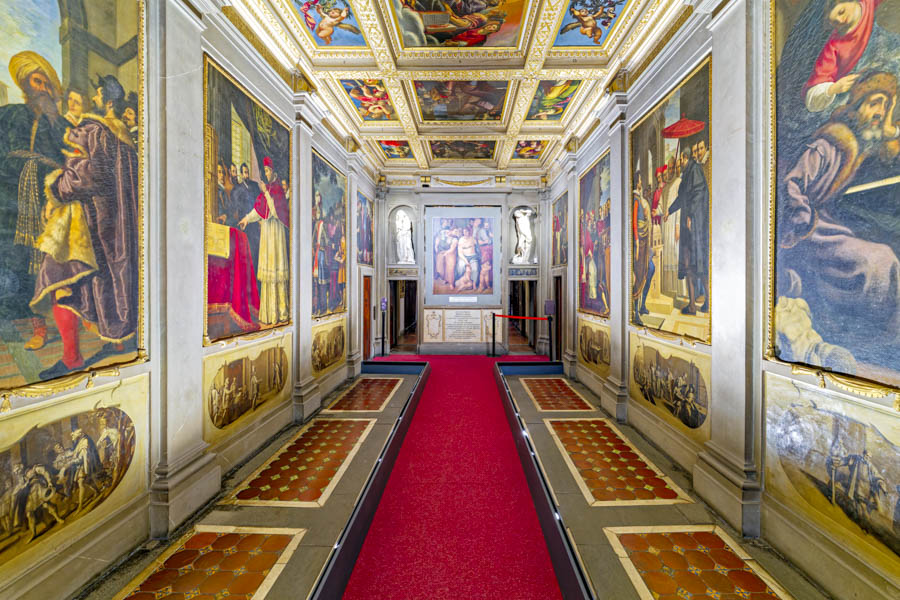
One of the most rewarding things to do in Florence is simply to walk its streets. Unlike the rather haphazard development of many European cities, Florence grew in a planned manner, with a grid pattern aligned with the compass. It was inherited from the structure of an original Roman garrison town (castrum). As you stroll, grand vistas, intimate piazzas and glimpses of the cathedral or other domes will be your reward.
When you explore, make use of the “panca di via” stone benches built into palace facades. These were once a compulsory feature of Florentine architecture and demonstrate the generosity of spirit inherent in Florence. Property taxes, the patronage of guilds, and a healthy competition between wealthy families trying to outdo each other in the game of prestige were channelled for the benefit of all.
Anyway, your steps will inevitably lead you to the Historic Centre of Florence, which is listed as a UNESCO World Heritage Site. Florence’s historic centre covers 505 hectares and features material and urban fabric spanning from Etruscan and Roman origins through mediaeval Florence to the Renaissance. Its major monuments and works of art date primarily from the 15th and 16th centuries.
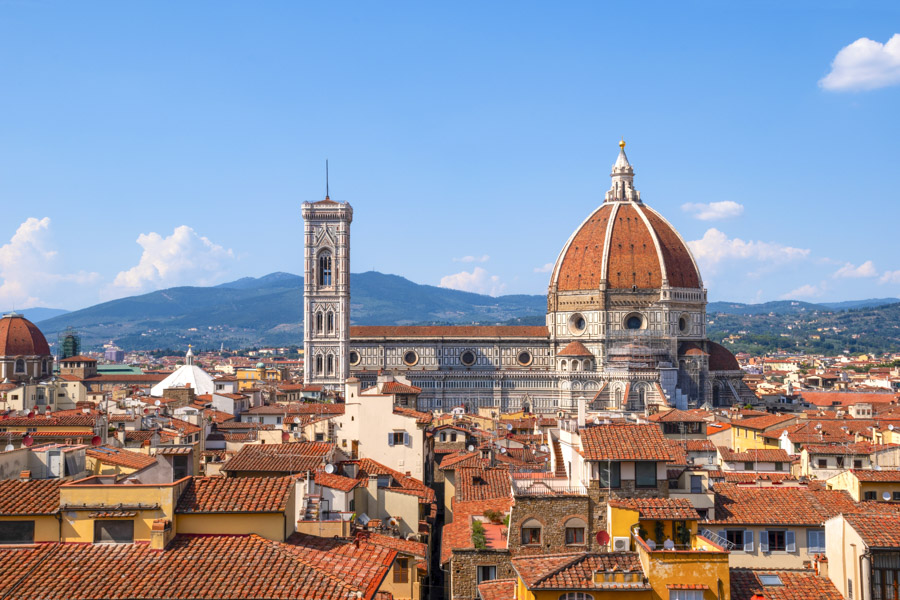
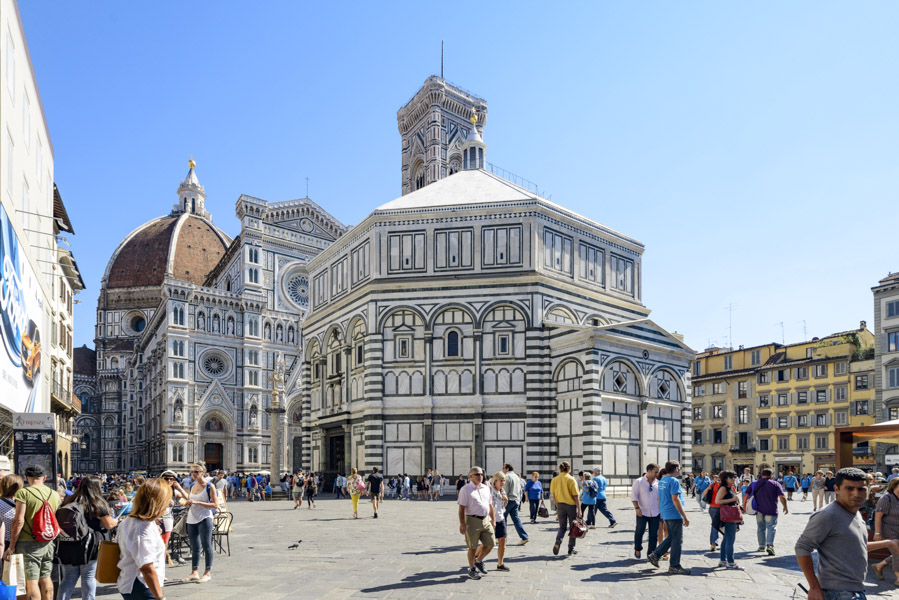
The very definition of the classic Florentine skyline is a view that includes the Duomo, part of the Cathedral of Santa Maria del Fiore. This great dome, completed in 1436 without the use of scaffolding, is Brunelleschi’s Renaissance masterpiece and, at the time it was built, the largest in the world. From inside, you can gaze at the 3,600 square metre fresco of the Last Judgement or climb the 463 stairs for a closer view and a breathtaking panorama over the city.
You will also want to ascend Giotto’s Campanile (bell tower), elegant and adjacent, for the classic photo of the dome itself. The other unmissable attraction of the cathedral piazza is the octagonal Baptistry of St John (Battistero di San Giovanni), where thousands of Florentines have been baptised, including Dante himself. The Baptistery’s golden bronze doors, known as Lorenzo Ghiberti’s “Gates of Paradise”, are more than five metres high and weigh more than 8 tonnes.
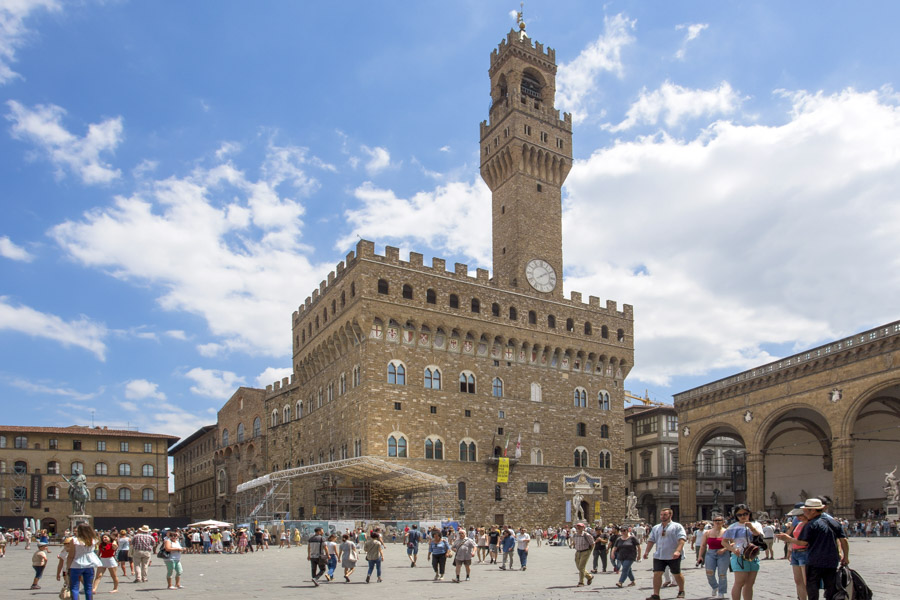
A walk south towards the river Arno will take you to the Piazza della Signoria, dominated by the seat of government of Florence, the Palazzo Vecchio (currently Florence’s town hall), and its striking mediaeval tower. Directly in front is what appears to be Michelangelo’s statue of David, but this is just a replica to mark where it originally stood. To see the real thing, you will need to go to the Galleria dell’Accademia. Another famous statue found in the piazza, beneath one of the arches of the Loggia dei Lanzi, is Cellini’s Perseus with the head of Medusa. If you go into the Palazzo Vecchio, you will see Machiavelli’s office from when he was secretary of the republic, along with courtyards, staterooms and apartments adorned with art.
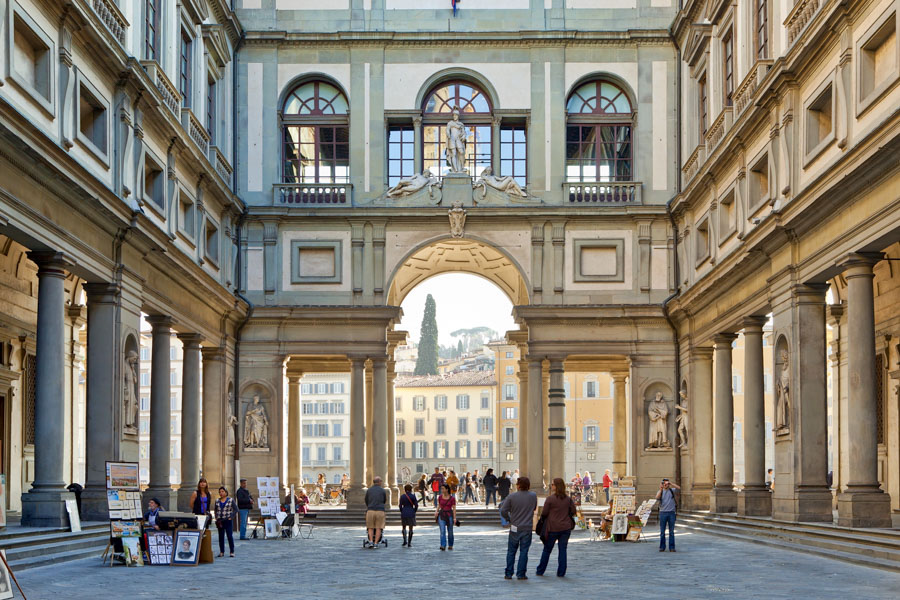
When the Medici art collection outgrew their palace, they started using the top floor of the nearby administrative offices and thus began the treasure trove that now forms the Uffizi Gallery. They could, in fact, access it from Palazzo Pitti, on the south bank of the river, without having to mingle with the crowds thanks to the raised, covered and private Vasari Corridor. If you book ahead, you too can walk this kilometre-long VIP shortcut, which will take you right over the Ponte Vecchio bridge.
From the Palazzo Vecchio, it passes through several private palaces, goes around the Mannelli tower, passes by the church of Santa Felicity and then the Boboli gardens to reach the Pitti palace. When you cross the Arno at ground level in the other direction, browse the high-end jewellery shops that now occupy its length.
The area surrounding Palazzo Pitti is known as Oltrarno (literally ‘beyond the Arno’), and it’s here that you will discover Florence’s more bohemian side. San Frediano and San Niccolò are two districts of Oltrano that are eminently walkable and full of artisanal activity. The Basilica of the Holy Spirit (Santo Spirito) and the Boboli Gardens are located in this area.
Other jewels of the historic centre of Florence that testify to its past power include the Rucellai, Strozzi, Gondi, Riccardi-Medici, Pandolfini, and Pitti palaces, as well as the Basilica of the Holy Cross (Santa Croce), the Basilica of Saint Lawrence (San Lorenzo), the Basilica of Santa Maria Novella, the Medici Chapels, and the San Marco Museum/Convent.
Further from Florence
The Florentine countryside, in Tuscany, stretches out around the city of Florence, offering a landscape of rolling hills, olive groves, and vineyards whose colours shift with the changing seasons. Small villages and farmhouses dot the scenery, connected by narrow roads lined with cypress trees and wildflowers. Bathed in the warm light of morning or late afternoon, the mosaic of fields and forests creates a timeless tableau. A view that has inspired artists for centuries.
A self-drive tour of the Chianti region between Florence and Siena is a rustically bucolic experience of olive groves, hilltop villages and wineries welcoming visitors. It is particularly lovely in the early autumn when there are harvest festivals to enjoy.
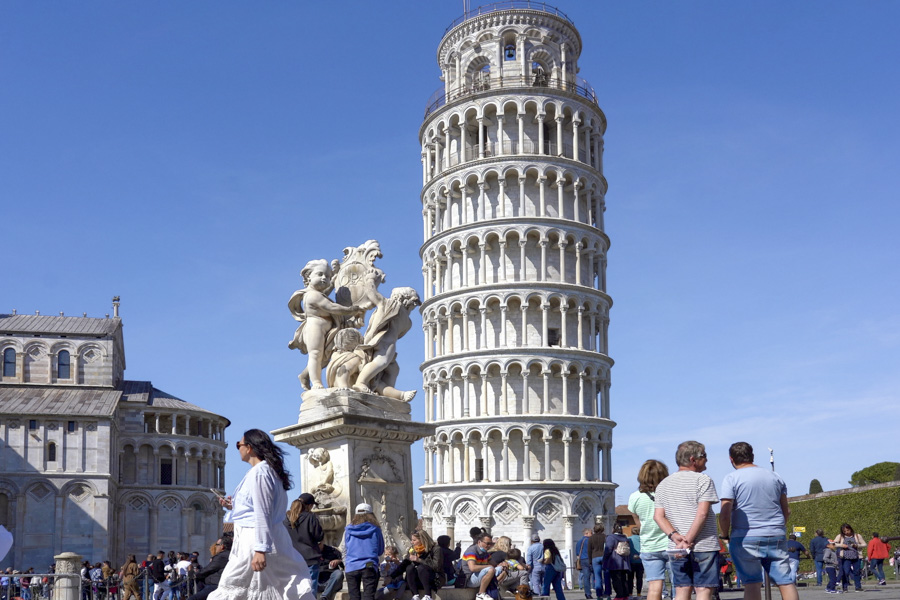
By car or by rail, neighbouring historic cities are also a draw. Siena, with its fan-shaped piazza and Gothic architecture, is an easy day trip by train, and similarly straightforward is a trip to the Leaning Tower, and much more, in Pisa. For a gentle experience, perhaps for a cycle along its tree-lined walls, venture out to Lucca, a city that was a booming silk producer in the 11th and 12th centuries.
If you have been to the Museum of Galileo in Florence, a follow-up excursion to Villa Il Gioiello, Galileo’s final home in the hills of Arcetri, would complement it well. It was here that he was held under house arrest for stating, correctly, that the earth revolves around the sun.
Museums and Galleries in Florence
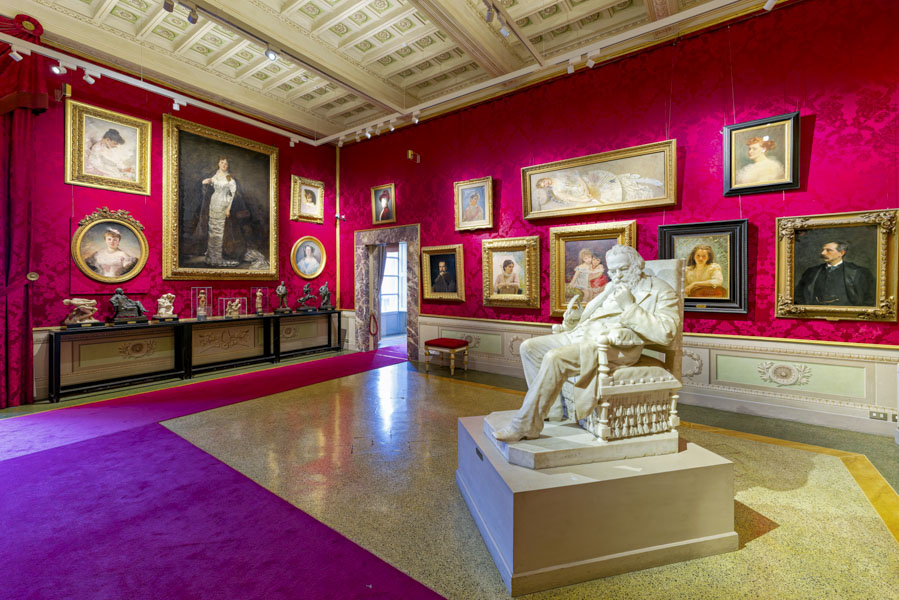
Lovers of art and history will be delighted by the fact that Florence has one of the highest densities of museums and galleries in Europe. Top of the list for most visitors is to spend at least a couple of hours – though it warrants four hours at least – in the Uffizi Galleries. This unmatched collection of Renaissance paintings includes Botticelli’s Birth of Venus and Primavera, along with works by Leonardo da Vinci, Michelangelo, Raphael, Titian and Caravaggio.
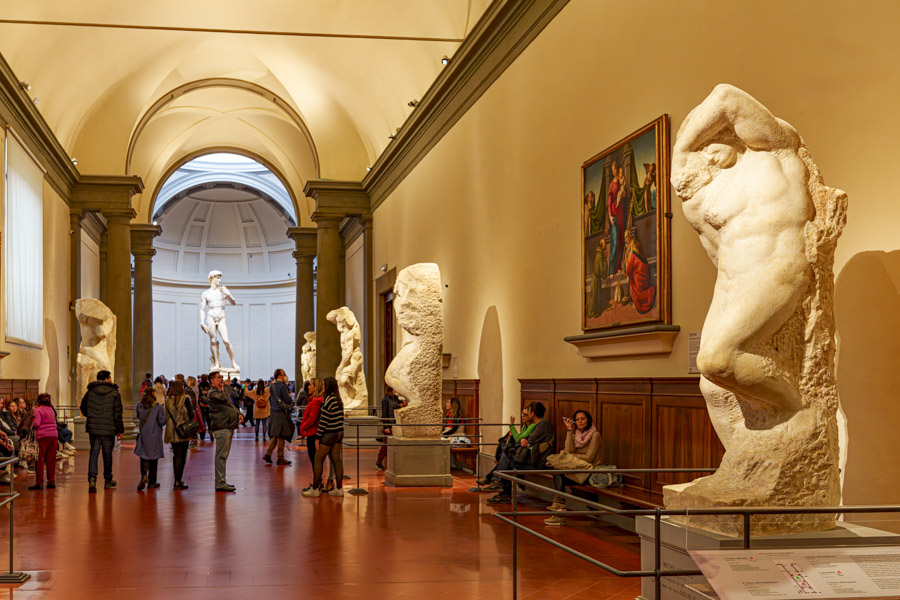
Vying with the Uffizi as a magnet for those drawn to the great works of art is the Galleria dell’Accademia, where the original, staggeringly large and instantly recognisable statue of David stands. This work by Michelangelo – fashioned from one block that had lain ignored for its apparent imperfections – is complemented by the unfinished Prisoners, giving insight into the working process of a genius.
Another depiction of the biblical hero David can be seen in the Museo Nationale del Bargello. This one, by Donatello, dates from the 1440s and was the first unsupported bronze sculpture of the Renaissance. The Bacchus by Michelangelo is also here, and with other works by the likes of Cellini and Giambologna, this museum is perhaps the best place to gain a thorough understanding of Renaissance sculpture.
The huge home of the Medici family – Palazzo Pitti – is the largest museum complex in Florence. The most famous of the options available here is the Palatine Gallery, a mammoth collection of more than 500 Renaissance paintings spread through 28 grandly decorated rooms. Other galleries in the palace include those devoted to modern art, costume, and porcelain.
Another museum worth visiting is one that houses works specifically created for Florence’s cathedral complex: the Museo dell’Opera del Duomo. One of its most striking pieces is Donatello’s Magdalene, a wood sculpture of astonishing realism and sadness.
The Renaissance was wider than art. It was also about expansion and the rediscovery of knowledge that challenged faith in God. This is otherwise known as science. One of its central figures of the scientific revolution was Galileo Galilei, a resident of Florence, whose telescopes can be seen in the Museo Galileo on the bank of the river not far from Ponte Vecchio. From here, it is only a short walk to the Basilica of Santa Croce to see Galileo’s tomb.
Other museums that bring the characters of Renaissance Florence to life include Casa Buonarroti (Michelangelo’s family home) and Casa di Dante (a museum dedicated to the life of the poet).
Florence Theatres
There are a multitude of theatres in Florence; however, if you wish to enjoy the setting as much as the play, some theatres are unmissable. The Teatro della Pergola is a central neoclassical theatre with a traditional Italian-style stage and a diverse programme of plays and performances. The Teatro Niccolini is an intimate and elegant theatre, renowned for its plays and carefully crafted productions in a refined atmosphere. The Teatro Verdi is a modern, adaptable theatre and auditorium offering a rich and varied programme, ranging from plays to jazz and rock shows. Finally, the Teatro del Maggio Musicale Fiorentino is Florence's flagship venue for classical music and opera, as well as modern shows, designed to host major performances by internationally acclaimed artists.
Entertainment, Parks, and Shopping in Florence
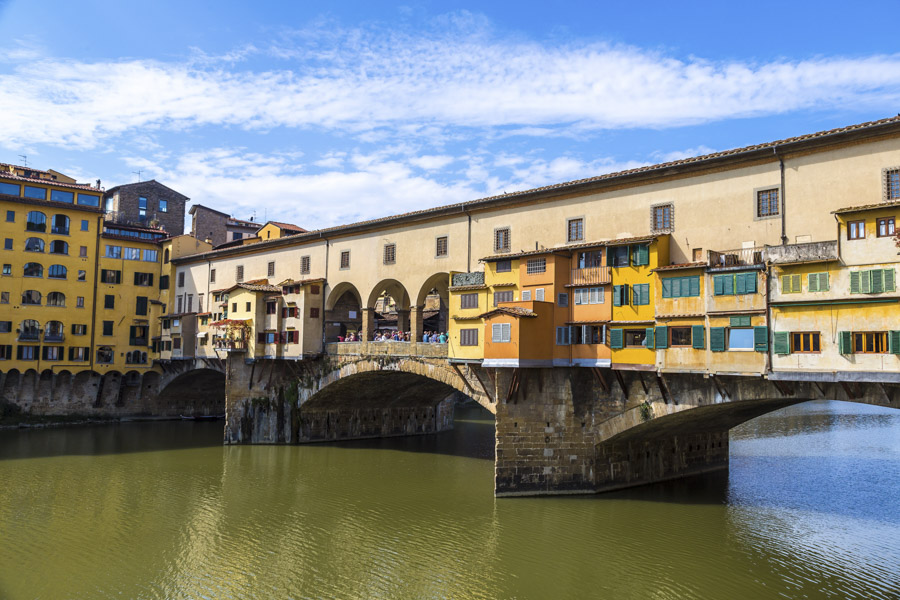
Plan your trip to make the most of what Florence has to offer and fill your days. With its rich cultural scene, you can attend a local festival; stroll in its parks and gardens to relax, especially during the long, hot summer months, while admiring artworks; and shopping is a must in its historic streets, where boutiques, artisan workshops, and iconic fashion districts coexist harmoniously.
Entertainment in Florence
Florence is in full swing when its historic centre comes alive with music and festivities. New Year's Day is marked by concerts in the city's piazzas where locals join to celebrate. For a stylish yet relaxed atmosphere, attend the Pitti Immagine Uomo, Florence's premier menswear event. Held twice a year, in January and June, it takes place in the historic Basso Fortress.
In early February, the city's historic centre provides the backdrop for the Grand Carnival Parade, a great time for family fun.
In March or April, depending on the liturgical calendar, the most important events are those of Holy Week, including the Passion of Christ at Grassina and the Scoppio del Carro. On Easter morning, a musical procession culminates in a spectacular finale that lights up the sky.
In April, experience Notte Bianca, a festive evening with concerts in the city's squares, where shops stay open late and the streets transform into lively pedestrian hubs offering entertainment for the whole family.
May is the month with the most festivals in Florence. Among them, the Maggio Musicale Fiorentino fills theatres and gardens with internationally renowned classical concerts. And if you're in town around June, the Calcio Storico Fiorentino, held in Piazza Santa Croce, is a unique event that brings history to life through a costumed 16th-century sporting competition. In the heart of summer, numerous local festivals and concerts take place throughout Tuscany. Jazz lovers can enjoy the Firenze Jazz Festival, usually held in September, whose concerts transform iconic venues into open-air stages. Film enthusiasts can attend the 50 Days of Cinema in Florence in October and take the opportunity to visit the International Ceramics Fair. Sports lovers will delight in participating in the Florence Marathon on the last Sunday of November, whose course through the city is considered one of the most beautiful in the world. For the holiday season, Florence lights up, and the Christmas market in Piazza Santa Croce resembles a small mountain village, where artisans from around the world offer their creations. During the Christmas holidays, the parish community of Santa Brigida in Pontassieve (20 kilometres / 12 miles from Florence) presents a traditional living nativity scene on Christmas Eve, with two further performances on Boxing Day and Epiphany. Florence knows how to showcase its historical cultural heritage while adapting to modernity to offer a wide range of attractive events throughout the year to a large public.
The Parks of Florence
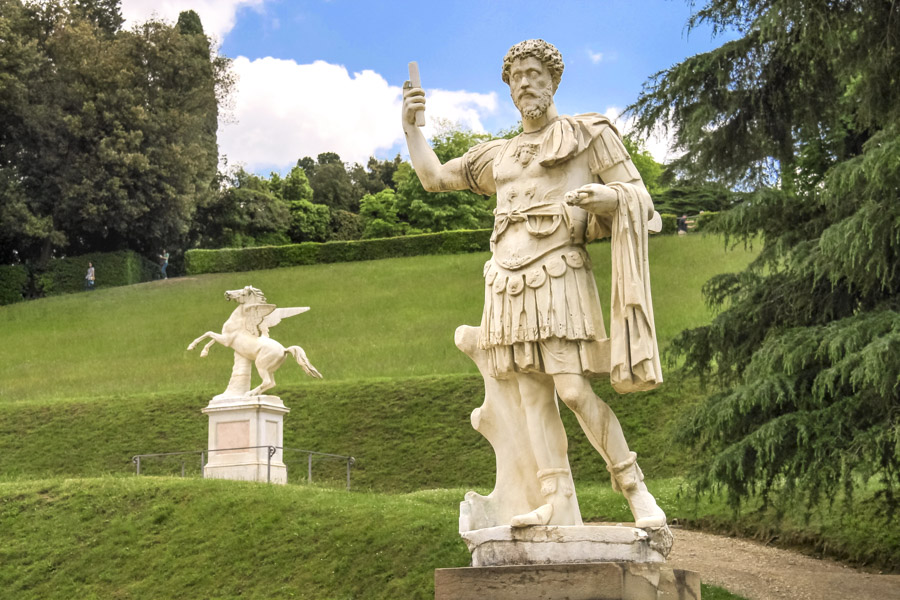
The beauty of Florence extends beyond its buildings to its open spaces, and if you start with the grandest, the Boboli Gardens of the Medici’s Pitti Palace, you will see how the Renaissance played out in landscape design. Lavishly appointed with statues and fountains on terraces looking out over the city, this garden became the blueprint for aristocrats to emulate all across Europe.
Quieter and more intimate, the Bardini Gardens are also in Oltrano and give one of the best elevated views of Florence, particularly in spring when the surroundings are alive with blooms. The wisteria tunnel and the baroque staircase are particular draws here.
Although a terrace rather than a garden, Piazzale Michelangelo is Florence’s most visited viewpoint. The space has many bronze copies of Michelangelo’s most famous marble works, including yet another rendition of David. The view from here takes in the whole sweep of the Arno, Ponte Vecchio, the Duomo, Palazzo Vecchio, the Bargello, and the octagonal bell tower of Badio Fiorentina. If you come here at sunset, you certainly won’t be alone, but the scene you will be looking at is magical and romantic.
For a less formal experience of an open space, head to the Cascine Park, Florence’s largest public park and once the Medici hunting estate. It’s where Florentines come to run, walk, cycle and have picnics.
Shopping in Florence

Specialising more in art than anything else, there are other cities better known for shopping than Florence. Even so, because this is Italy, you will find elegant fashion houses and luxury brands liberally sprinkled along streets such as elegant Via de Tornabuoni.
Seek out the more specialised artisanal goods such as gold jewellery on the Ponte Vecchio and high-quality stationery and marbled paper. In Oltrano, small studios house those who specialise in ceramics, metalworking, bookbinding and bespoke perfumes. And if you are after gourmet Tuscan produce, Mercato Centrale is the place to buy it.
The art of silk in Italy was introduced by missionaries returning from China in 1100. Located in the San Frediano district of Oltrano, the Antico Setificio Fiorentino (the Old Silk Factory) is a place where you can buy the types of silk and linen brocades and silk damasks that have been woven in Florence since the Renaissance. Make an appointment to see the weavers using warping machines of the design by Leonardo da Vinci if you want to do more than shopping.
Leatherworking is a Florentine speciality, and you will encounter excellent leather goods for sale all around the city. Nowhere will you find better products, however, than at the Scuola de Cuoio (Leather School). It’s a place that also offers hands-on workshops ranging from 3 hours to a day or two, or a whole week.
For a purely Florentine experience, visit the Officina Profumo-Farmaceutica di Santa Maria Novella, the world’s oldest pharmacy. Founded in 1221, the interior of the shop – complete with ornate gilding, beautiful frescoes and walls lined with jars – is worth seeing even if you don’t buy anything. You might be tempted, however, by Acqua della Regina, a fragrance they first created for Catherine de Medici’s wedding gift to Henri II of Valois, her future husband, in the 16th century.
Food in Florence
Italian Cuisine
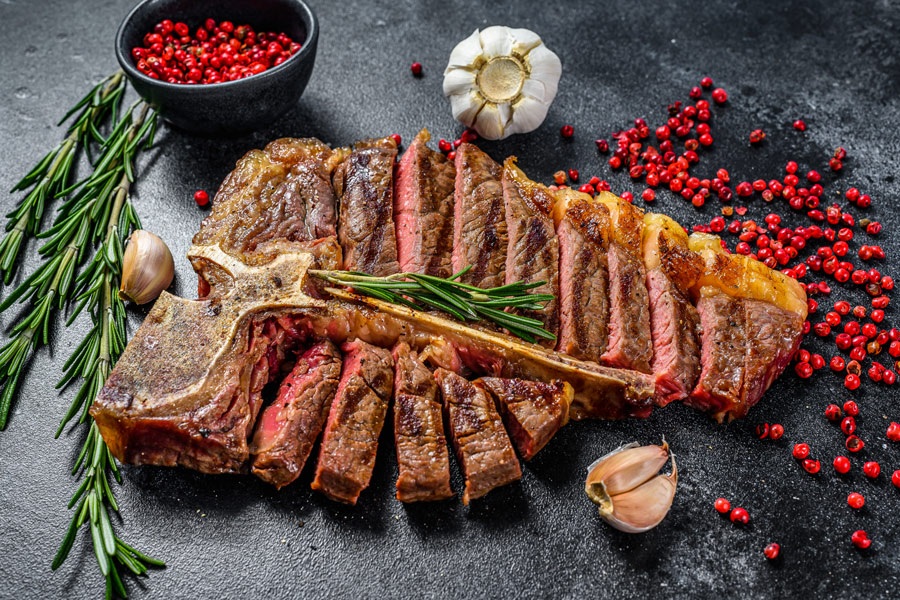
The dishes to try in Florence are those of wider Tuscany, and if you start an evening with crostini (chicken liver or wild boar pate on baked or fried baguette-style bread) and finish it with cantucci (almond biscuits dipped in sweet wine), you will have had appropriate bookends to whatever comes in between. Tuscans enjoy their soup, and two classics are Tuscan minestrone and ribollita (bread, bean and kale, reheated over two days). Classic Florentine main courses include the massive beef T-bone bistecca alla fiorentina and arista (pork roasted with garlic).
Three long-standing restaurants with excellent reputations are Trattoria Camillo, a place with an extensive menu that’s been a favourite with locals since 1945; old-world Ristorante Buca Lapi, which has been serving bistecca since 1880; and even older Trattoria Sostanza, which is a tiny no-frills place known for its popular butter chicken dish but is often fully booked.
Vegetarian Restaurants
Vegetarians are well looked after with generous portions in the casual atmosphere of Il Vegetariano. About a ten-minute walk from the Duomo, it’s reassuringly away from most tourists and a genuine escape into a more Florentine experience.
Coffee Houses, Bakeries, and Patisseries
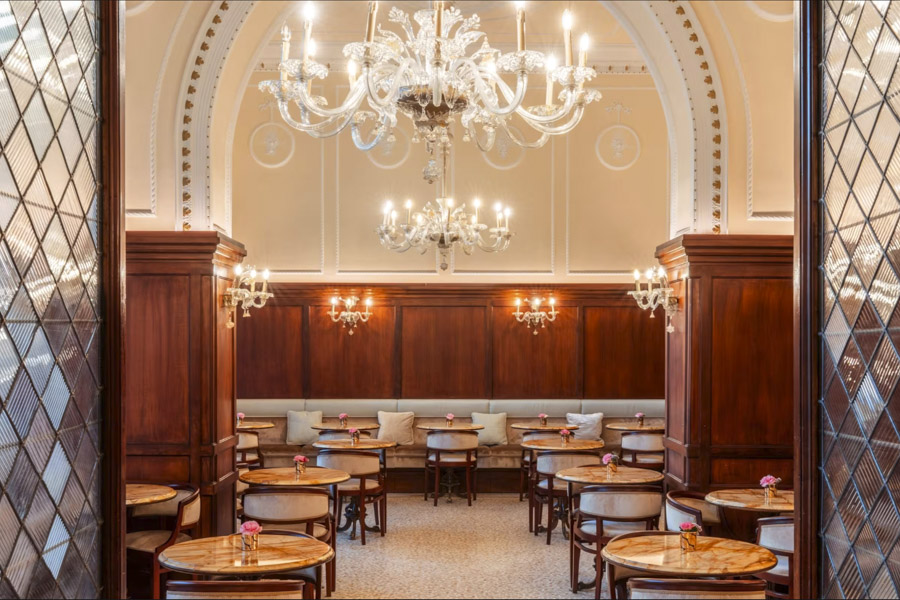
Some cafés in Florence predate the restaurants. Caffé Gilli was founded in 1733 by the Gilli family from Switzerland and has an impeccable air to go with superb pastries. Since 1872, Caffé Rivoire has overlooked Piazza della Signoria, and it’s worth paying the extra to sit outside to soak up the atmosphere of this part of Florence. Caffé Paszkowski, serving not just great coffee but also Paszkowski beer, has always been a favourite of the literary set and was listed in the ‘World’s 500 Best Bars’.
City Transport in Florence
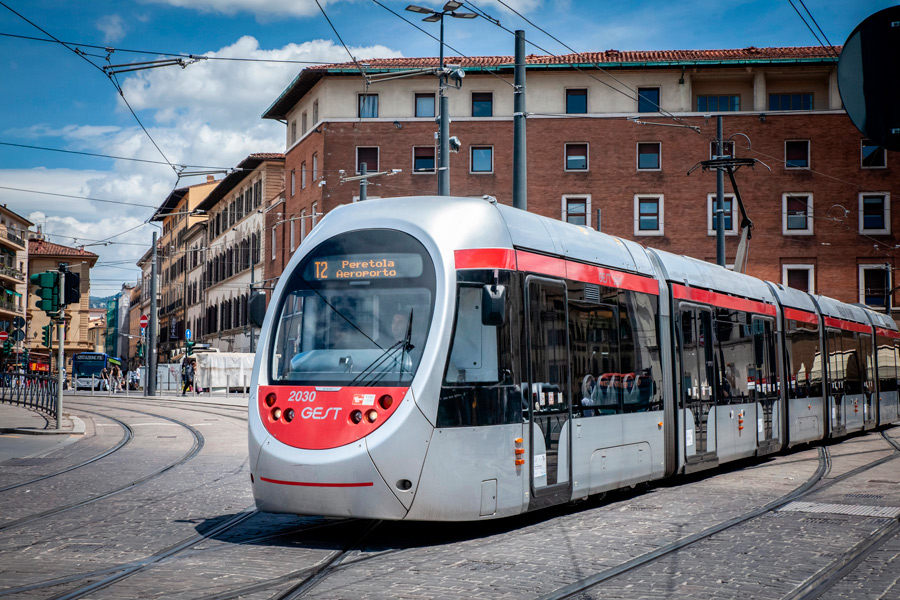
Getting around historic Florence is very straightforward because of its compact size and well-organised public transport. Most of the main sites can easily be discovered on foot, but if tiredness prevails, then there are buses, trams and taxis to take the strain.
Tickets and Payment
Florence uses an integrated ticketing system, with the most common option being the ATAF ticket, which is valid on both buses and trams. You can buy single tickets, 90‑minute passes, or day tickets from newsstands, tabacchi shops, tram stop machines, or via the official mobile app. Do not forget to validate your ticket when you board. Increasingly, contactless payment is available on buses and trams, simplifying the whole process, but it can be cheaper to pre-purchase tickets.
Public Transport
Buses, Shuttles and Trams
The buses and trams of Autolinee Toscane (AT) cover the entire urban area, running from early morning until late evening. Frequencies vary from 5 to 20 minutes depending on the route and time of day.
Smaller ‘shuttle’ buses operating on lines C1, C2, C3 and C4 connect the main tourist sites such as the Uffizi Gallery and the Pitti Palace via Ponte Vecchio. Their compact size allows them to navigate the narrow streets.
The tram system is one of the most efficient ways to move around Florence. Line T1 links the city centre with the western suburbs, while Line T2 connects the centre to Florence Airport (FLR), making it the quickest and most convenient way to reach the terminal. Trams run frequently, are fully accessible to the disabled, and avoid the traffic that can affect buses.
Other Modes of Transport
Taxis
Ride-sharing services are not fully operational in Florence, so getting a taxi is generally a case of going to one of the major stands such as the Santa Maria Novella train station, Piazza del Duomo, and Piazza della Repubblica. They can also be hailed or booked by phone. Fares are well regulated but expect to pay a small luggage supplement if you have large bags or suitcases. A taxi from the city centre to the airport costs around €30.
Car Rental
Some streets in Florence city centre are narrow and therefore require special attention when driving. The historic centre is a ZTL limited-traffic zone that is monitored by cameras, so driving into this area by accident will result in an automated and substantial fine. To discover the countryside and smaller towns of Tuscany by car, it is best to rent a car from the airport.
Bicycle Share
To rent a standard pedal bike or e-bike in Florence, download the RideMovi app before scanning the QR code to unlock it. Pay-as-you-go prices start from just €1 and a 24-hour pass for numerous short rides on multiple bikes can be purchased for €10. Bikes can be particularly useful for reaching districts beyond the historic core of the city.
How to Get to Florence
By Plane
The closest airport to Florence, Florence-Peretola (FLR), formerly known as Amerigo Vespucci Airport, is only 6 kilometres (3.7 miles) away from the city, to which it is connected by the T2 tram line. Flights arrive here from many European hubs. Long-haul travellers tend to land in Pisa International Airport (PSA), located 80 kilometres from Florence and a train journey of 50 to 70 minutes away. Other feasible options include flying to Bologna or Rome.
By Train
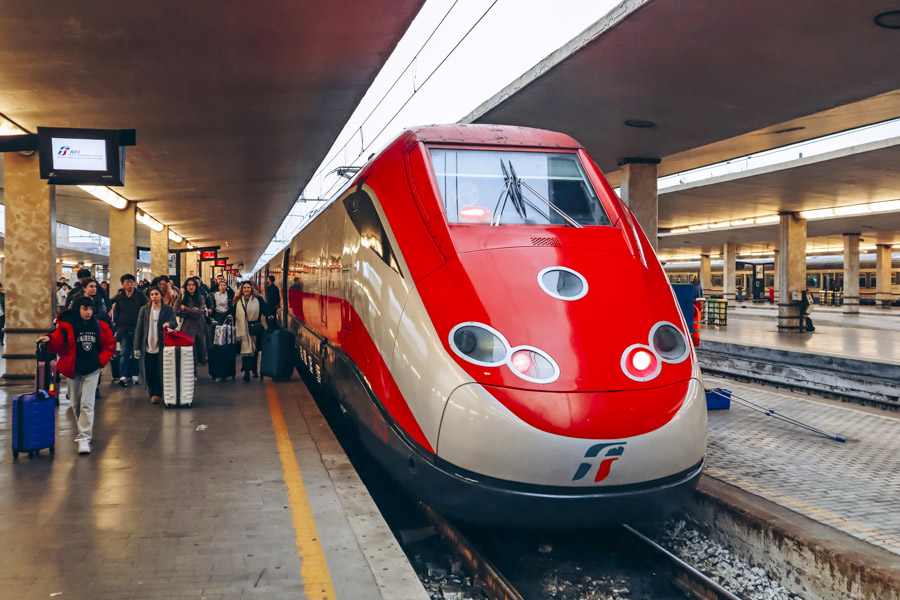
It is easy to get to Florence by train as it is well connected to other cities by the high-speed network on which Frecciarossa, Frecciargento, and Italo services operate. Getting to Florence from Rome (90 minutes), Milan (100 minutes), Venice (2 hours), Naples (3 hours), Bologna (37 minutes) and Verona (90 minutes) is straightforward. The main station in Florence is Firenze Santa Maria Novella (SMN), with a secondary high-speed station called Firenze Campo di Marte. There are regional services to and from towns such as Pisa, Lucca, Siena, and Arezo. A train journey to Florence from Paris via Milan or Turin will take you approximately 9 hours.
By Bus
Florence lies close to the A1 Autostrada, the main arterial north-south road connecting Milan, Bologna, Florence, Rome, and Naples. Travelling from Europe to Florence is highly affordable and convenient.
By Car
If you prefer the comfort of a car, it is sensible to use a park-and-ride rather than attempt to drive to the centre of the city. The Villa Costanza park-and-ride on the A1 has a tram service to the centre.
Languages Spoken in Florence
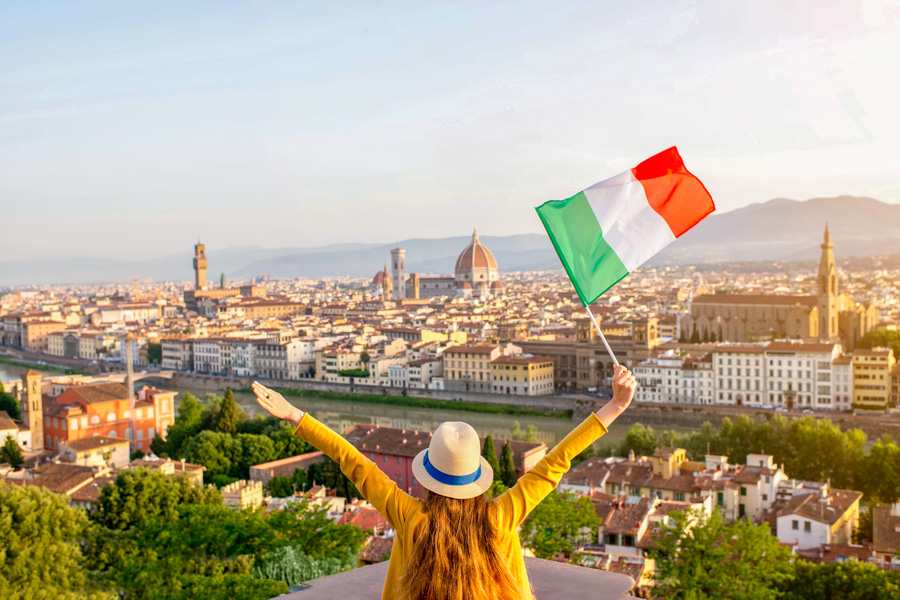
As mentioned earlier, Dante Alighieri is considered the father of the Italian language. However, the standard modern language as we know it today began to take shape in the 19th century. People in Florence speak standard modern Italian, though with a slight Florentine accent that has a breathy sound to the letters “c” and “t”. English is widely spoken by the staff in all historic attractions in Florence, and signs are often bilingual. It is a straightforward city to navigate without much knowledge of Italian, but knowing a few stock phrases and words will endear you to the locals. At a minimum, use “Grazie” (thank you) and “Buongiorno” (hello).
Security in Florence
While Florence is generally a safe place to visit, it is still useful to consider precautions to avoid the potential problems that almost all Italian tourist destinations face.