

Address: Nalbantoğlu Mahallesi, Ulucami Caddesi, 16010 Osmangazi, Bursa.
Entry: Free. There is no ticket desk, as Bursa Ulu Cami is a working mosque rather than a museum.
Visiting hours: The mosque is generally open to visitors from around 08:00 to 20:00, with access pausing during the five daily prayers. Friday midday prayers are particularly busy
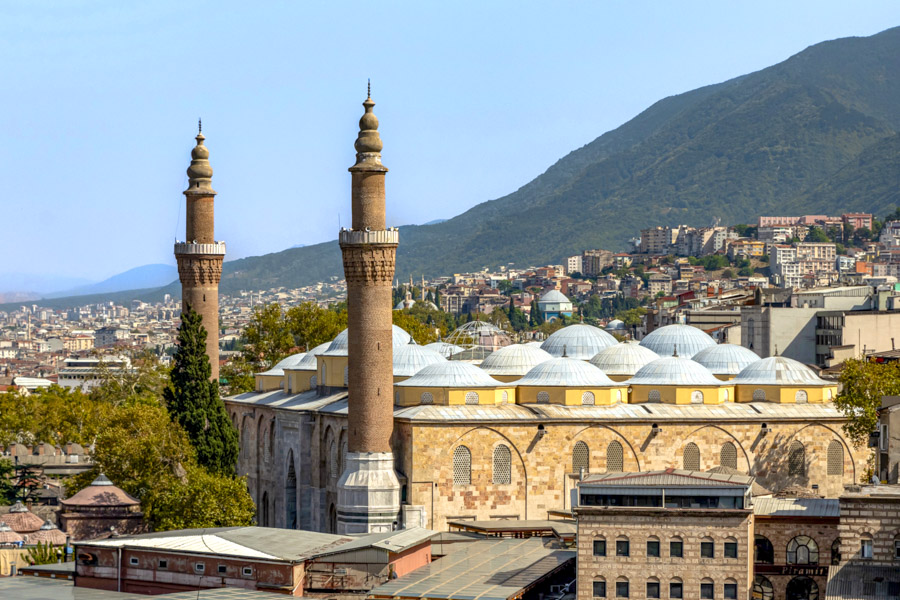
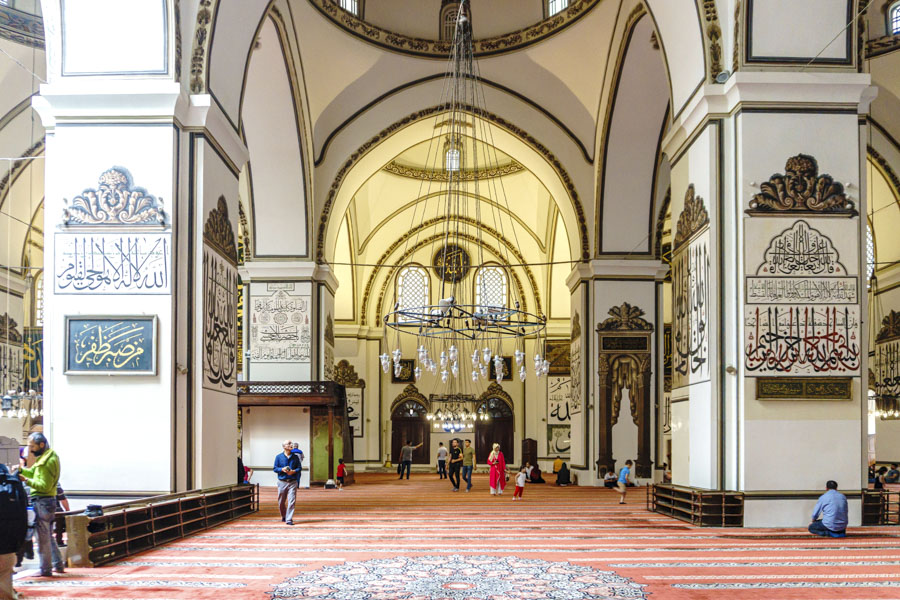
The Ulu Cami, the Grand Mosque of Bursa, stands at the edge of the covered bazaar, its 20 domes rising over the old city centre. Shoes come off at the north door, and the noise of Atatürk Caddesi stops in a single step. The room beyond is dim and low. Light arrives sideways through two ranks of windows set deep in the walls, and stone piers block the view in every direction. Somewhere out in the middle of the floor, water is running.
Raised at the end of the 14th century, when Bursa was the Ottoman capital, the mosque has been in use ever since, apart from the years it spent under repair. The bazaar presses against it on three sides. Traders come in off the shop floors in their working clothes, settle with their backs against a pier and stay a while.
History of Bursa Ulu Cami
The mosque began as a promise made in a tight corner. In 1396 Sultan Bayezid I met a crusading army at Nicopolis on the Danube and vowed that if he won he would build 20 mosques in his capital and he won. Back in Bursa his son-in-law Emir Sultan, a scholar whose advice carried weight at court, argued that 20 small mosques would serve the city less well than one large one under 20 domes. Work started that year. The design is generally credited to an architect named Ali Neccar, and the building was ready by 1399.
Two of the labourers on that site are better remembered than the architect. Karagöz was a blacksmith and Hacivat a mason, and the pair are said to have kept up an argument so entertaining that the other men downed tools to listen and the work fell behind. The sultan had them executed and later regretted it. A courtier called Şeyh Küşteri then stretched a white cloth, lit a lamp behind it and brought the two back as moving shadows. No document proves that either man ever lived, and the versions disagree even about which sultan gave the order. They became the two lead figures of Turkish shadow puppetry all the same.
The opening sermon did not go to anyone at court. Through the building years a man had come to the site each morning with bread for the workmen, and the town knew him only as Somuncu Baba, the baker. Emir Sultan pointed him out when the question of a preacher arose. In the traditional account he climbed to the pulpit and read the opening chapter of the Qur'an seven different ways. Molla Fenari, the most learned man in the congregation, said afterwards that everyone present had followed the first reading, some the second and very few the third, and that the rest had gone over the heads of the whole gathering. Somuncu Baba left Bursa soon after, remarking that his secret was out, and he died and was buried at Aksaray, at the far end of Anatolia.
The first imam appointed here was Süleyman Çelebi, a vizier's son born in Bursa around 1351. One day a visiting preacher told the congregation that no prophet stood above any other. The argument spread through the hall, and Süleyman Çelebi answered it from the floor with a single couplet, which he then went on expanding for years. By 1409 he had 768 of them, in 16 chapters, on the birth and the life of the Prophet, composed in plain Turkish instead of Arabic or Persian. The poem is the Mevlid. It is still chanted today at Turkish funerals, births and memorial gatherings in villages that have no reason to think about Bursa at all.
The building itself was attacked and burned more than once. Timur took the city in 1402, and the accounts have the mosque turned into a stable, its floor covered with straw, and the straw fired when the troops moved on. A Karamanid siege is blamed for a second burning about a decade later. Worse came in 1855, when an earthquake brought down 18 of the 20 domes in a night, leaving only the one in front of the mihrab and the one at the foot of the western minaret. Sultan Abdülmecid sent the best calligraphers in Istanbul down to Bursa to repair the great inscriptions, and they added work of their own while they were there. The mosque reopened for prayer in 1862. Since 2014 it has stood inside the UNESCO listing that covers the bazaar quarter and the early Ottoman complexes around it.
Highlights
The mosque is a single room, with nothing round a corner and nothing upstairs. Tradition ranks it fifth among the mosques of Islam, after Mecca, Medina, Jerusalem and Damascus, and Turkish visitors still arrive knowing that.
The Piers and the Twenty Domes
The roof carries 20 domes in four rows of five, over a rectangle of 55 by 69 metres. They rest on 12 free-standing piers, each one as thick as a small tower, with 18 more built into the walls. The wall piers show on the outside as heavy relief in cut limestone, with two tiers of windows set between them. The marble portal on the north side is the only decoration on an otherwise plain exterior. From within, the effect is closer to a forest than a hall. The eye keeps meeting stone before it reaches the far wall, so the size of the place has to be paced out. Later Ottoman architects would clear the ground with one great dome and make the scale plain at a glance. This is the older Seljuk idea worked out at its largest.
The Fountain Under the Open Dome
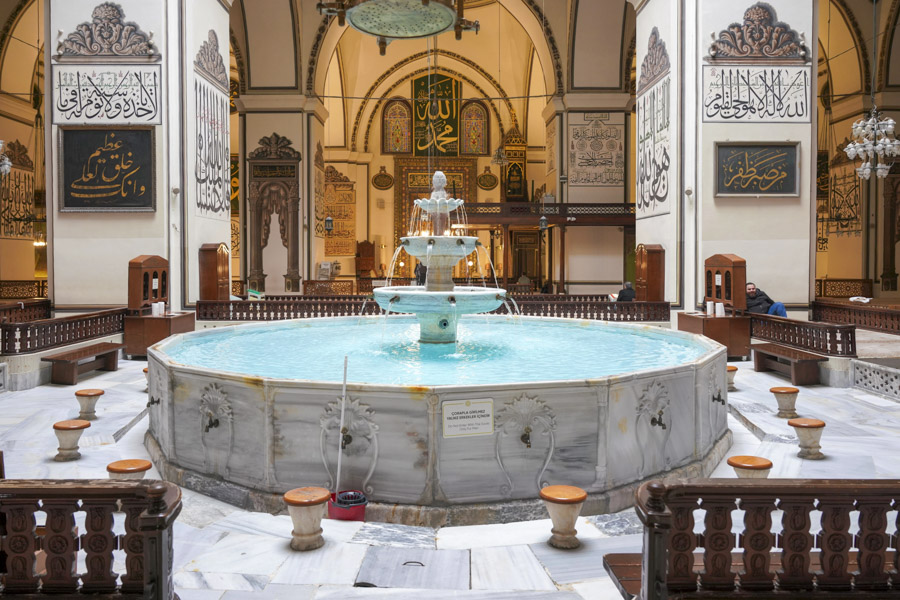
The central dome is glazed rather than solid, and directly beneath it stands a 16-sided marble basin with a three-tiered fountain playing into it. Ablutions are performed indoors, at the centre of the prayer hall. That keeps the mosque in motion all day. People cross to the taps, wash, and walk back to their places, and the running water carries into every corner, so the room never settles into the hush a visitor might expect. The opening above was bare to the sky for centuries, and rain fell straight into the pool. Evliya Çelebi came through in the 1640s and called the building Bursa's Hagia Sophia, the greatest of mosques. He noted that the supply was piped down from the mountain, with trout swimming in it.
Bursa explains the arrangement with a story. An elderly woman is said to have refused to sell the one plot the site still needed, her ground fell in the very centre of the plan, and rather than take it from her the builders left it out of the prayer floor, so the water went there instead. The basin standing there now is a good deal later than the mosque. The version on record was built in the 17th century, at the order of the şeyhülislam Karaçelebizade Abdülaziz Efendi. The story attached to it is roughly 250 years older.
The Writing on the Walls
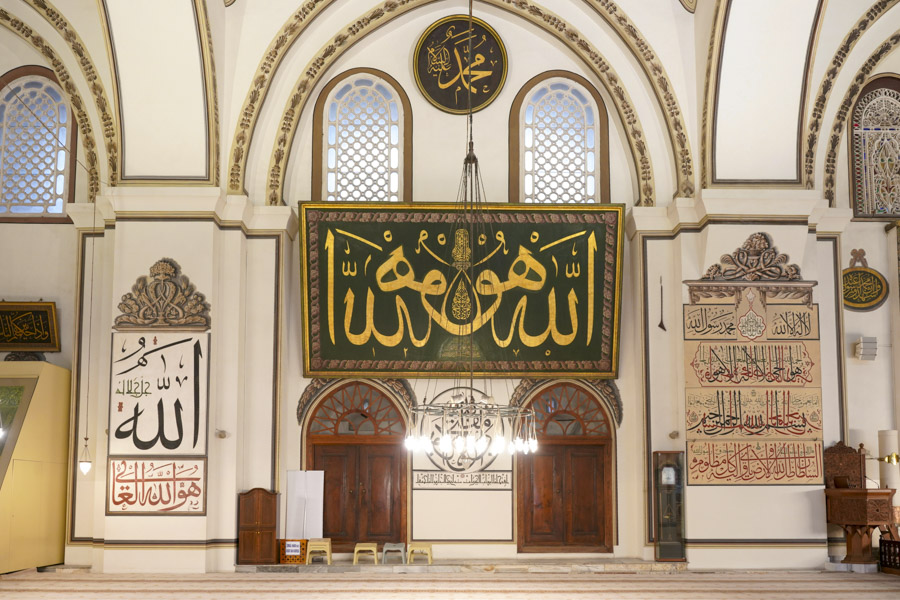
Almost every flat surface carries calligraphy. The count runs to 192 pieces in 13 different scripts, the work of 41 hands. Of those, 87 are painted directly onto the walls and piers, and the rest hang as framed panels. Nearly all of it dates from between 1778 and 1938, which makes the lettering about 400 years younger than the masonry beneath it. Among the signatures are Kazasker Mustafa İzzet, Sami Efendi, Mehmed Şefik Bey and Abdülfettah Efendi, and one panel is the work of Sultan Mahmud II, who took lessons like any other student. Şefik Bey went over a great many of the others after the earthquake, correcting and rewriting where the damage had eaten into them.
The letter that recurs most is vav (و), a single deep hook of a character, read as the shape of a person bent in prayer. A large example on the qibla wall has a following of its own. Local tradition holds that Hızır, the immortal wanderer of Islamic belief, prays in front of it every day, at an hour nobody has managed to establish.
The Walnut Minbar
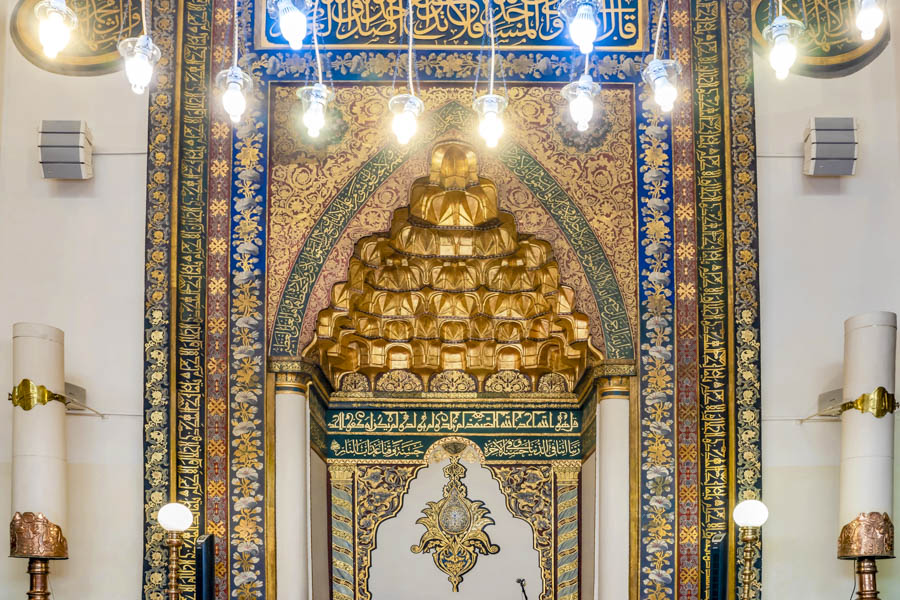
The pulpit to the right of the mihrab is walnut, cut and fitted in the kündekari technique, which locks wooden pieces together through their geometry and uses neither nails nor glue. The traditional count of those pieces is 6,666, reflecting a commonly repeated association with the number of verses in the Qur'an. Guides often point to the panels on the flanks and describe the sun with its planets on one side, a galaxy on the other. The reading has been argued over for decades, though, and rests on no inscription. An epitaph over the door carries the date that fixes the completion of the building.
The mihrab beside it came much later, carved in 1572 under a hood of muqarnas, with its gilding applied in 1905. Two more fittings in this corner carry their own dates. The muezzin's platform was built in 1549, and the preaching chair facing it went up in 1815.
The Curtain from the Kaaba
In a glazed case on the qibla wall hangs a length of black silk over four metres tall. It is the covering from the door of the Kaaba, Mamluk work embroidered in gold thread over cotton padding. The names of the Ottoman sultans are worked into the Arabic inscription. Selim I took Egypt in 1517, and the old covering came north with the relics. He gave it to this mosque and is said to have hung it himself. Ottoman writers dated the passage of the caliphate to the dynasty from that conquest, an account historians still argue over. Damp got into the fabric over the centuries, so the verses now show only under a strong light, and the tassels were stitched back on by a textile conservator within the last few years. The city had not been the Ottoman capital for well over a century when the gift arrived.
The Minarets
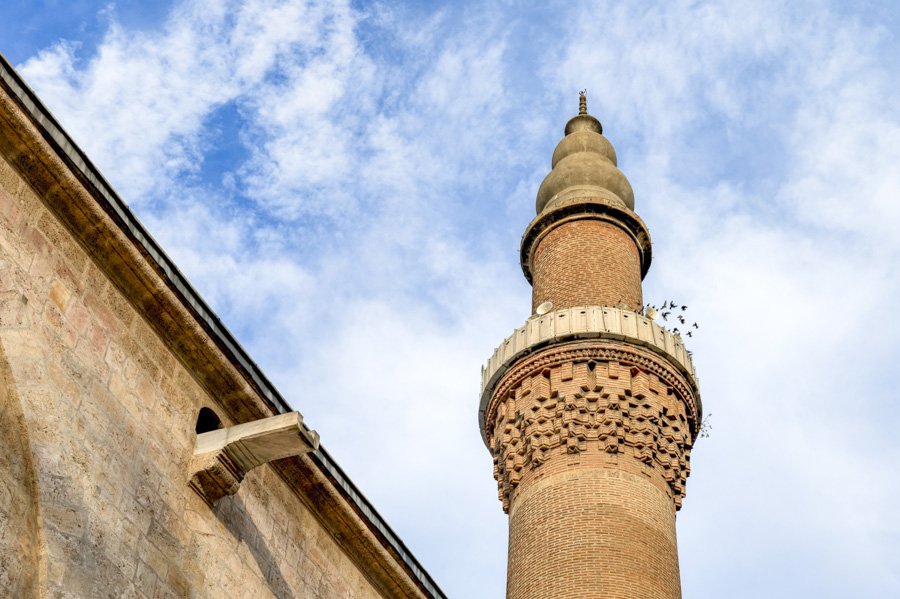
Inside the western minaret, two stairways run up without ever meeting. One is entered from the prayer hall and the other from the street, and both come out at the balcony, though only the outer stair carries on up to the roof. The doubling is a rarity in Ottoman minaret design. That minaret belongs to Bayezid's building, with an octagonal marble base under a brick shaft. The eastern one is credited to his son Mehmed I, has a square base and stands about a metre clear of the wall, so the pair look mismatched from the street. Neither rests on the mosque; both start at ground level at the corners of the north front. The lead-covered timber caps they once carried burned in the fire of 1889, and the ribbed masonry cones went up to replace them.
Tips for an Optimal Visit
Recommended duration. 30 to 45 minutes. A slow circuit of the piers gives far more than a walk to the fountain and back.
Best time of day. Mid-morning, in the gap between the dawn and midday prayers, is the quietest stretch of the day. Around noon the light drops through the glazed dome straight onto the water, and the interior brightens for a while.
Read the walls. Screens at each entrance carry QR codes, added in 2025, which open an audio and written guide to the inscriptions on a visitor's own phone. The labelling is otherwise in Turkish, and without the guide the writing stays decoration.
Dress: Shoulders and knees should be covered for everyone, and women should cover their hair. Scarves and wraps are lent at the doors at no charge. Shoes are removed and left on the racks or carried through in a bag.
Photography and conduct. Photographs are welcome outside prayer times, though flash is not. The panels, the pulpit and the mihrab should not be touched or leaned against, and the basin is not a wishing well.
Accessibility. The prayer floor is one level with no internal steps, and a ramp at the west door gives step-free entry.
Combine with. Koza Han and the covered bazaar are immediately alongside, and the tombs of Osman and Orhan Gazi are a 10-minute climb up to Tophane, on the old citadel hill. The Green Mosque and the Green Tomb lie a short ride east on the T3. Together they fill an unhurried day in the old centre, and there are more things to do in Bursa beyond the old quarter.
How to Get There
Tickets for local transport: a rechargeable BursaKart covers the metro, the trams and the city buses, and is sold at station kiosks and at agents displaying its logo. Single fares bought on board cost more, and some vehicles take the card only.
By metro: the Bursaray line stops at Şehreküstü, on the northern edge of the bazaar quarter. From the equestrian statue of Orhan Gazi outside the station, Ahmet Hamdi Tanpınar Caddesi runs uphill as a pedestrian shopping street, and the domes come into view after about 5 minutes. Osmangazi station is a similar distance to the west.
By tram: the red T1 line loops the historic centre and has its own Ulucami stop, roughly 4 minutes on foot from the north door. It also calls at Heykel, Kent Meydanı and Kültürpark, which makes it the simplest link between the mosque and the rest of the sights. The green and white T3 runs a straight route east towards Yıldırım and Emir Sultan.
By bus: a long list of city routes stops at Ulucami PTT, about 3 minutes away, and many more terminate at Heykel, a 6-minute walk east along Atatürk Caddesi.
By taxi: metered taxis wait across the centre. The last stretch may still be on foot, as the lanes closest to the mosque are closed to traffic.
From the intercity bus terminal: Bursa Otogar sits about 10 km north of the centre. Allow 30 minutes by bus or taxi in ordinary conditions and up to 45 in heavy traffic.
From Istanbul by ferry: the fast boats cross to Mudanya or Güzelyalı in about 2 hours. From Güzelyalı a connecting bus runs to the Bursaray terminus at Emek, where the metro continues to Şehreküstü. From Mudanya, bus 1/M covers the same ground.
From Istanbul by road: the drive over the Osmangazi Bridge takes about 2.5 hours, and coaches run through the day to the Otogar. The route around the bay is considerably slower.
Most of the people this mosque is remembered by left nothing behind on paper. There is no record that Karagöz and Hacivat ever lived. Somuncu Baba survives as one sermon and a sudden departure. The woman who would not sell her ground is a story told to account for a basin that arrived 250 years after her. Even the domes overhead were put up by masons of the 1860s. One man on the site did write his name down, in the place where a craftsman signs. It is cut into the panel above the pulpit door, and it reads Hacı Mehmed of Antep, son of Abdülaziz. The joints have not moved.