

Address: 8/8 Tsitsernakaberd Highway, Yerevan
Opening hours: Tuesday-Saturday, 10:00-17:00 from 15 February to 15 November; 11:00-16:45 from 15 November to 15 February. Sunday, 11:00-15:00
Closed: Monday and selected public holidays
Admission: Free; donations are welcome
Guided tours: Advance booking required
Telephone: (+374 10) 39 09 81; (+374 77) 39 14 12
The Armenian Genocide Museum-Institute is located within the Tsitsernakaberd Memorial Complex in Yerevan. Opened in 1995, the institution combines a museum with a research centre dedicated to collecting, preserving and studying documentary materials relating to the Armenian Genocide.
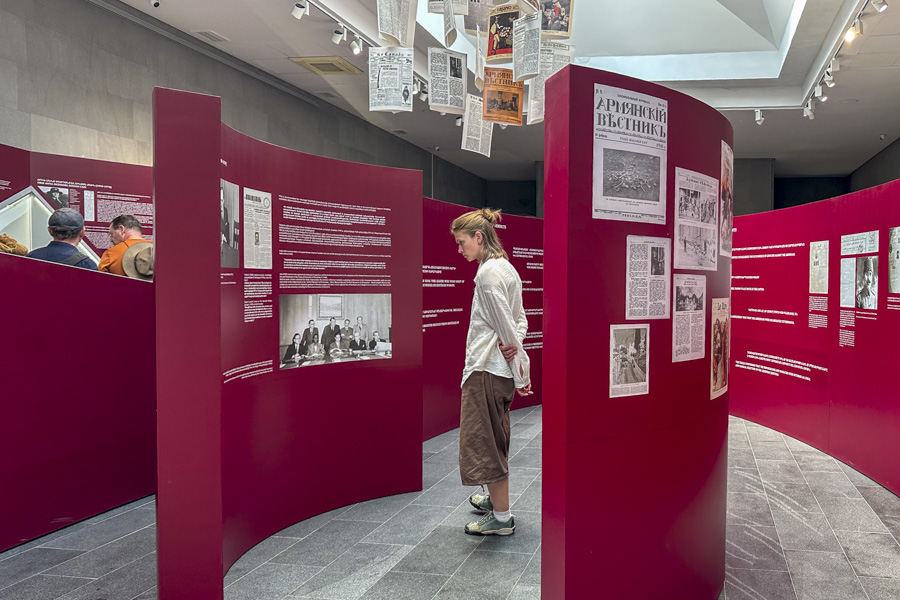
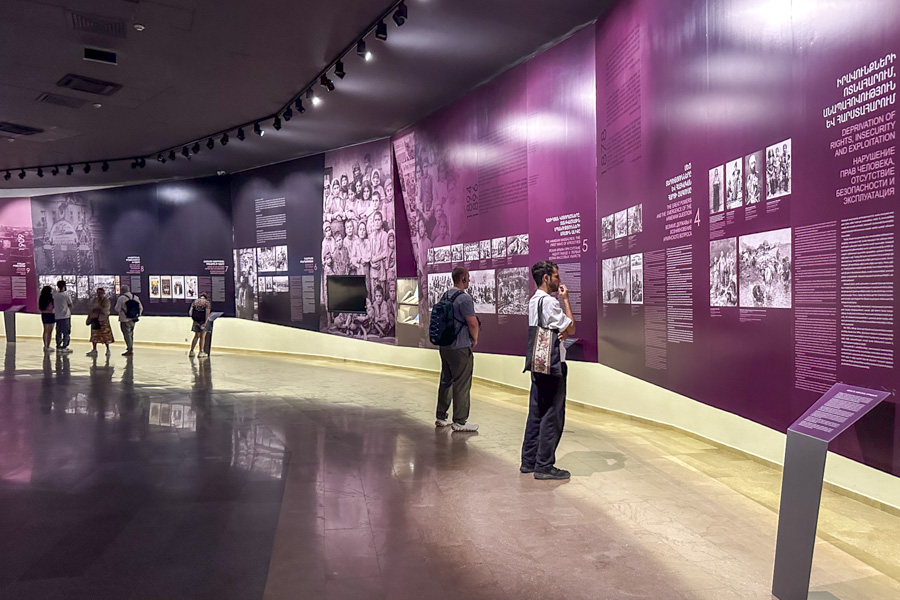
The permanent exhibition occupies twelve halls and presents photographs, archival documents, maps, publications, personal belongings and eyewitness accounts. It places the Armenian communities of the Ottoman Empire before the First World War alongside documentation of the events of 1915-1916, international responses, humanitarian assistance and the experiences of survivors. Text panels in Armenian, English and Russian, together with multimedia displays, provide historical context without requiring extensive prior knowledge of the subject.
History of the Armenian Genocide Museum-Institute
The Armenian government approved the establishment of the museum on 7 March 1995. Its first permanent exhibition opened on 29 September that year, marking the 80th anniversary of the beginning of the Armenian Genocide. The museum was built beside the memorial completed in 1967, adding an exhibition and research institution to the existing commemorative complex.
The building was designed by architects Sashur Kalashyan, Lyudmila Mkrtchyan and Arthur Tarkhanyan, with sculptor Ferdinand Arakelyan. The museum initially operated under the National Academy of Sciences of Armenia and combined exhibition work with the collection, preservation and study of historical materials. In 2017, it became a separate foundation.
Between 2011 and 2015, the Museum-Institute underwent extensive renovation. Its exhibition area was increased from three halls to twelve, covering approximately 2,400 square metres. The redesigned permanent exhibition opened on 21 April 2015 and introduced a broader collection of original objects, multilingual explanatory texts and multimedia displays.
Architecture and Setting
The Museum-Institute stands in the south-western part of the Tsitsernakaberd Memorial Complex. Much of the building lies below ground, allowing it to remain visually secondary to the neighbouring memorial. Its exterior is faced with dark stone, and the low, restrained structure follows the austere architectural language of the wider complex.
The museum is arranged around an inner courtyard. Quotations from diplomats, writers, scholars and humanitarian workers who documented or responded to the events are engraved on its twelve walls. Inside, a large map shows Armenian-populated settlements and the principal routes of deportation within the Ottoman Empire.
The flat roof forms an observation terrace overlooking Yerevan and Mount Ararat. From here, visitors can see how the museum fits into the wider layout of the Tsitsernakaberd site.
Permanent Exhibition
The permanent exhibition extends across twelve halls and presents the history of Armenian communities in the Ottoman Empire before and during the First World War. Photographs, maps, demographic records and publications establish the historical and cultural background to the events examined in the museum.
The exhibition documents the arrests of Armenian intellectuals in Constantinople in April 1915, the subsequent deportations and the mass deaths of 1915-1916. Maps and contemporary records are presented alongside diplomatic correspondence, eyewitness accounts and photographs. Materials associated with German officer Armin T. Wegner and Protestant pastor Johannes Lepsius provide two of the better-known international perspectives represented in the museum.
Contemporary press reports and documents produced by diplomats, missionaries and humanitarian organisations show how information about the events circulated outside the Ottoman Empire. The Museum-Institute's broader collections include reporting by newspapers such as The New York Times, the documentary volume The Treatment of Armenians in the Ottoman Empire, 1915-1916, and materials relating to international relief work.
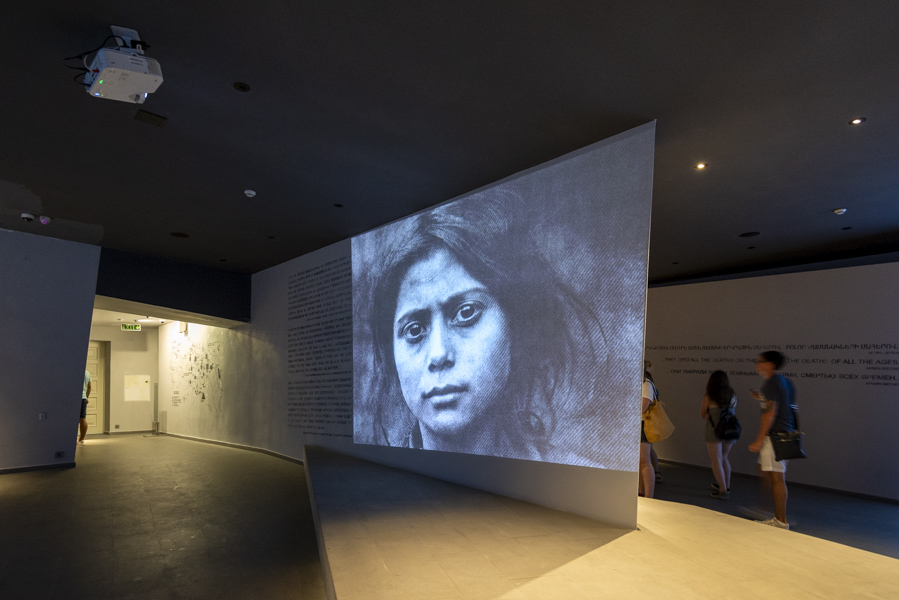
Original objects are combined with printed reproductions, projections and touchscreen displays. Exhibition texts are available in Armenian, English and Russian.
Research and Library
The Museum-Institute conducts research into the history of Armenian communities before 1915, the events of the Armenian Genocide and their aftermath. Its departments work with memoirs, press reports, archival documents, museum collections and records relating to victims and survivors. The institute also publishes books, exhibition catalogues and two peer-reviewed academic journals.
Its specialised library contains approximately 47,000 items, primarily in Armenian, English, Russian, German, modern Turkish and Ottoman Turkish, French and Arabic. The collection includes historical studies, academic papers, diaries, memoirs and personal archives. The library is open to the public for research, although its materials may be consulted only on site.
The institution also prepares temporary, travelling and online exhibitions, and runs educational programmes for school groups and history teachers.
Tsitsernakaberd Memorial Complex
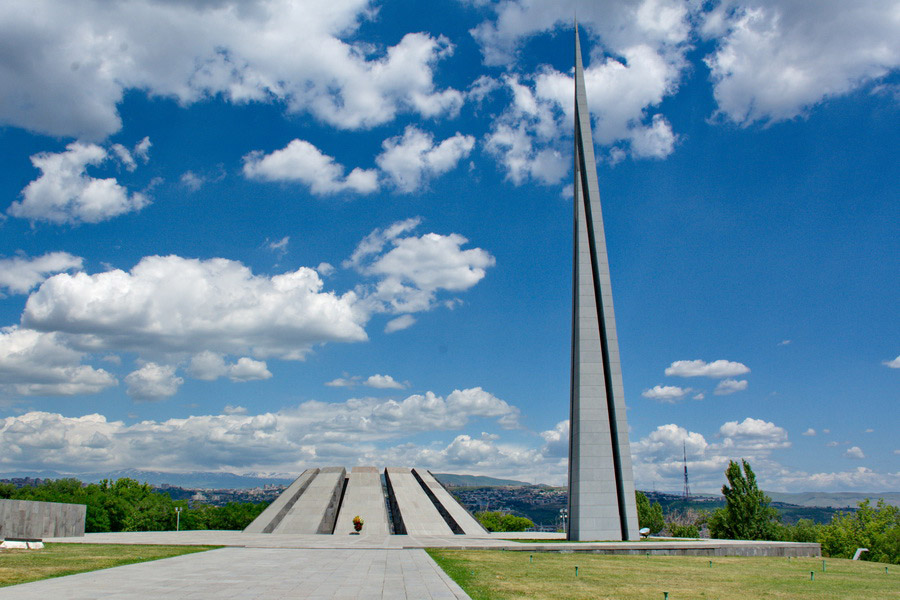
The Tsitsernakaberd Memorial was designed by architects Arthur Tarkhanyan and Sashur Kalashyan following a competition held in 1965. It officially opened on 29 November 1967, while the Museum-Institute was added to the complex in 1995.
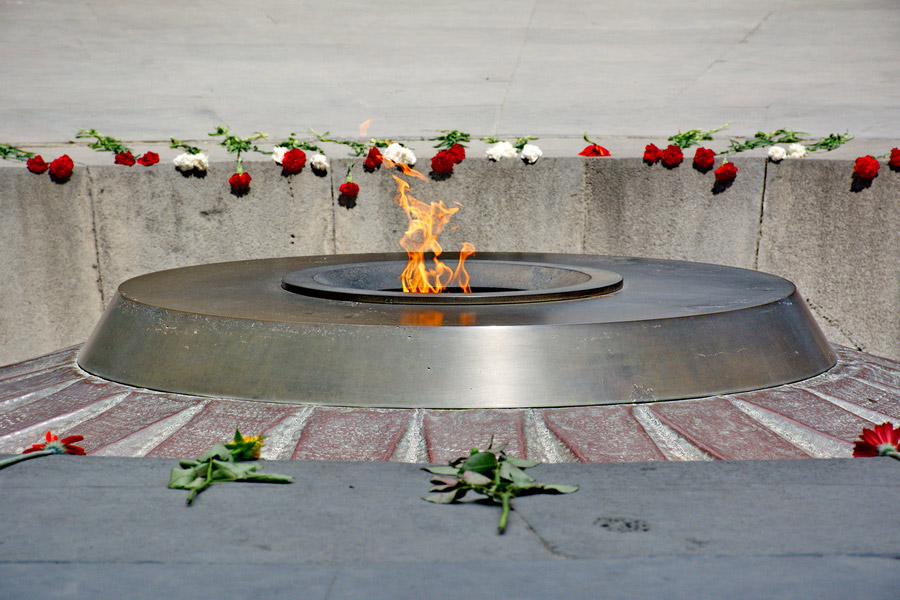
The central composition consists of twelve inward-leaning basalt slabs arranged around an eternal flame, with a 44-metre split stele standing nearby. A long memorial wall bears the names of towns and settlements connected with the Armenian communities affected by the events of the early twentieth century.
The grounds also include Memory Alley, where visiting official delegations have planted commemorative fir trees since 1997. The complex receives its largest number of visitors on 24 April, Armenia's annual day of remembrance.
Visiting the Armenian Genocide Museum
Guided tours are available in Armenian, Russian, English and French and must be booked in advance by telephone. They cover all twelve exhibition halls and normally last between 40 minutes and one hour. The museum does not provide guided tours for children under thirteen, although this restriction does not apply to independent visits.
Free parking is available near the museum. The complex can also be reached on foot in approximately 15-20 minutes from the Karen Demirchyan Sports and Concerts Complex. Eating, drinking and smoking are prohibited inside the museum.
Due to the subject matter and documentary nature of the exhibition, some sections may be emotionally difficult. Visitors may wish to take this into account when planning their visit, particularly if travelling with children.