

Tianmen Mauntain National Forest Park Complete Travel Guide
Tianmen Mountain (天门山, Tiānmén Shān) is not part of the Wulingyuan Scenic Area. It covers on 9,600 hectares (23,722 acres) and is Zhangjiajie’s second national forest park. Located southeast of Zhangjiajie city, Tianmen Mountain lies within the Wuling Mountains, known for sheer cliffs, dense woodland, cold mountain streams and deep, shadowed gorges. It is often visited after Zhangjiajie National Forest Park, whose pillar landscapes form the best-known part of the wider Zhangjiajie experience.
Rising to 1,518.6 metres (4,982 feet), Tianmen Mountain is the highest peak in the Zhangjiajie area and has long been regarded as the “First Sacred Mountain in Western Hunan”. The title may sound poetic from a distance, but it begins to feel less like a metaphor once you reach its high walkways and misty ledges. Here, rock walls emerge and vanish through cloud, forests cling to the slopes, and the mountain seems to hold the sky close to its shoulders.
Tianmen Mountain Tours
Tianmen Mountain can be included in itineraries of different lengths and formats. On a short four-day trip, it provides a striking finale after the stone pillars, forested gorges and panoramic trails of Zhangjiajie National Forest Park. The ascent offers a different sense of scale – higher, more open, and more exposed – giving the journey a clear and memorable conclusion.
On a longer route through the cities and panoramas, Tianmen Mountain appears in a different light. After historic architecture, river valleys and the more measured lines of the plains, its high-altitude walkways and cliff-edge views introduce a sharper, more dramatic rhythm to the journey.
If time allows, Tianmen Mountain also fits naturally into a two-week itinerary across central China’s natural areas and cultural centres. Here, the pace briefly widens. There is space, distance and air – a chance to linger above the valleys, among cliffs and mist, before the journey continues.
Tianmen Mountain is equally impressive as part of a group tour focused on China’s natural wonders. Set among the country’s other remarkable landscapes, its bird’s-eye views bring a powerful sense of height and openness, making it one of the most memorable mountain experiences in the Zhangjiajie area.
Best Time to Visit Tianmen Mountain
Tianmen Mountain is open to visitors year-round, and each season gives the landscape a different character. Seasonal contrasts generally mirror Zhangjiajie city’s monsoon‑influenced subtropical climate: warm, humid summers with heavy rain and cooler, drier winters. The most comfortable months to visit Tianmen Mountain are generally April and May and again September and October, when the weather is milder and the cliffs, forests and valleys are at their most expressive.
Seasonal Characteristics
Spring (March to May) brings blossom to the slopes, while drifting mist gives the valleys a softer, more mysterious atmosphere. Average temperatures rise from about 7 to 18°C (45 to 64°F) in March to roughly 18 to 27°C (64 to 81°F) by April and May. The weather is usually mild, and visitor numbers are still relatively moderate. Conditions can change quickly in the mountains: clear sunshine may give way to thick cloud within minutes. The rainy season begins as early as May, bringing short but heavy downpours. The Cherry-blossom period at Tianmen Temple is particularly striking.
Summer (June to August) is hot and humid in the city; Tianmen Mountain is generally cooler than Zhangjiajie city but can still see daytime highs in the upper 20s to low 30 s(about 22 to 33°C / 72 to 91°F) on warm days. This is the height of the rainy season. From May to July, monthly rainfall can exceed 150 mm, and in July, rain may fall on more than 20 days. The reward is atmosphere: low cloud and mountain mist wrap around the peaks, softening the cliffs and making the landscape look almost like a watercolour painting. The drawback is that the summit can become crowded, especially in June and July.
Autumn (September and October) is often regarded as the best time to visit Tianmen Mountain. Temperatures commonly fall to about 15 to 23°C (59 to 73°F), rainfall decreases noticeably, and clearer skies make the high viewpoints especially rewarding. The forests begin to take on warmer colours, adding depth to the cliff scenery. September is frequently one of the most pleasant months, partly because visitor numbers are lower than in peak summer. Though Golden Week, from 1 to 7 October, the situation changes sharply, and the Tianmen Mountain area becomes much busier.
Winter (December to February) is the low season, but it has a quiet appeal. Snow and hoarfrost can transform the mountain into an otherworldly landscape; icy conditions may lead to the temporary closure of the cable car or some glass walkways. Tianmen Temple at the summit offers magnificent snowy views. Daytime temperatures on the mountain generally range from around 8 to 12°C (46 to 54°F), while early mornings and exposed ridges can be colder and fall to about 4°C (39°F). With far fewer visitors, the mountain feels calmer and more spacious, rewarding those who enjoy colder weather and possible route adjustments.
Note on mountain vs city conditions: Mountain summits are typically several degrees cooler than Zhangjiajie city at the same time of year and are prone to rapid local changes (fog, low clouds, frost or brief sun-warmed spells).
The Dragon and the Sacred Lights of Buddha
If you are lucky during your visit, you may witness two extremely rare atmospheric phenomena.
Rising air often causes cloud and mist to stream from Heaven’s Gate, sweeping out like a dragon and known locally as the ‘Tianmen Spewing Fog’.
At sunset, when light passes through the stone arch and colours the sky in shades of purple and gold, the scene, which has long been regarded locally as a blessing from Buddha, is called the ‘Sunglow of Tianmen’.
Opening Hours
Tianmen Mountain’s opening hours vary slightly by season:
- March to November: 07:00 to 20:30
- December to February: 07:30 to 20:00
The park gates usually close at 16:00, and entry is not permitted after this time.
In case of adverse weather conditions, the entrance is closed without prior notice.
The best time to visit during the day is early morning, ideally between 8:00 and 11:00. At this time, the air is still cool and damp, and mist often drifts slowly around the cliffs and high walkways, giving the mountain a strong sense of depth and movement. Arriving early also improves your chance of clear views before clouds gather over the peaks and before the cable car, glass walkways and main viewing areas become crowded.
After Dark: Performances and Light Shows
As the day on Tianmen Mountain ends and the trails begin to empty, the scenery changes again. At dusk, the cliffs and canyon walls are lit up, turning the landscape into a dramatic open-air stage. On clear evenings, and especially around a full moon, the effect can be particularly atmospheric.
Later in the evening, a different kind of spectacle takes place at the foot of the mountain. The Tianmen Fox Fairy Show is a large-scale outdoor musical production, with the mountain itself as a backdrop. Hundreds of performers, colourful costumes, live singing, acrobatics and lighting effects combine a show rooted in local legend and staged against the stone walls of Tianmen.
Details on prices, duration and venue are in the next section.
Practical Additional Information
Tianmen Mountain is known for its dramatic scenery, yet its religious traditions also shape the atmosphere of the visit. Along the route, visitors pass temples, altars and small places of worship. It is best to move calmly, avoid loud behaviour and treat the surroundings with quiet respect.
Facilities
The main visitor facilities are concentrated near the bus parks, cable car boarding areas, escalator access points and chairlift stations. Here you will find:
- shops and gift stalls;
- restaurants and food outlets;
- rest rooms;
- rest areas and viewing platforms.
Facilities are generally available at the main transport points and key stops along the route. On the longer walking sections, however, services are more limited, so it is worth planning ahead before setting off.
Accessibility: the site has limited wheelchair access (many paths involve steps).
Tickets and Entrance Fees in 2026
Please note that prices are provided for general guidance only and may vary. We recommend confirming current rates via official channels before making any bookings.
Entrance Ticket
A standard ticket to Tianmen Mountain National Forest Park costs CNY/RMB 288 ($40 / €36 / £31)*. The ticket is valid for one day and is linked to a specific date and time slot.
What’s Included
- the main cable car route for ascent or descent;
- the sightseeing shuttle bus;
- the upper section of the transmountain escalator, consisting of seven segments for a ride between Tianmen Cave and the mountain summit;
- insurance.
Additional Costs
Some services are not included in the standard ticket and are paid for separately on site:
- lower section of the transmountain escalator, covering five segments paralleling the 999-step staircase – CNY/RMB 32*;
- Forest Sightseeing Cable Car on the upper plateau – CNY/RMB 25*;
- protective shoe covers for the glass walkways – CNY/RMB 5*.
Concessionary Categories
Discounted or free entry is available for certain visitor categories:
- children under 14 – free;
- teenagers aged 14–17 – CNY/RMB 152 ($21 / €19 / £16)*;
- seniors aged 60–64 – CNY/RMB 152 ($21 / €19 / £16)*;
- visitors aged 65 and over – CNY/RMB 116 ($16 / €15 / £13)*.
VIP Pass
A separate VIP pass is available for visitors who want priority access and faster cable car boarding. It is sold on site only and can be useful during the high season peak, when queues are especially long.
Booking Details
Tickets are issued for specific time slots between 07:00 and 16:00. Entry is permitted only during the selected time slot. During peak season, tickets often sell out in advance, and daily visitor numbers are limited to around 35,000 people.
Evening Show Prices
Tianmen Cave Light Show
| Location | Tianmenshan Cave Square |
| Times | 18:00 to 19:00 (Winter & Spring) / 19:00 to 20:00 (Summer & Autumn) |
| Admission | Free |
Tianmen Fox Fairy Show
| Location | Tianmen Mountain Gorge Theatre |
| Times | Every day, 1 March – 31 December, starts at 20:20, approximately 1 hour. |
| Children under 1.3 m | Free (no seat) |
| Standard Seat | CNY 178 / $25 / €23 / £20* |
| VIP Standard | CNY 198 / $28 / €25 / £22* |
| VIP Area B | CNY 288 / $40 / €36 / £31* |
| VIP Area A | CNY 398 / $55 / €50 / £43* |
*Note: Ticket prices, show schedules and access rules may change seasonally or without prior notice; conversions are approximate, so they should be checked before travel.
History and Legends of Tianmen Mountain
For millenia, the stunning beauty of Tianmen Mountain has inspired legends of sacred omens and lost treasure, secret powers and unexplained happenings. Ancient chronicles, Daoist traditions and local folklore coexist here with stories of mysterious floods and shifting rock, creating an atmosphere that continues to fascinate visitors and researchers alike. Enter the realm of Tianmen Mountain’s history and folklore to discover how this unique site became one of China’s most enigmatic sacred mountains. Explore it all in our History and Legends Guide.
Things to Do at Tianmen Mountain
Exploring Tianmen Mountain is a vivid, fast-moving experience, with a new view opening up at almost every turn.
Ride the Tianmen Mountain Cableway
Beginning the ascent from downtown Zhangjiajie, the Tianmen Mountain Cableway carries visitors from the city towards the summit. The route stretches for 7,455 metres (24,459 feet) and climbs 1,279 metres (4,196 feet), rising from the noise and movement of the urban streets into the cooler stillness of the mist-covered peaks.
It is one of the longest mountain passenger cableways in the world, and the journey forms an important part of the visit. Soon after departure, the level cityscape gives way to steep slopes and rocky cliffs, while the road to the mountain winds tightly along the sheer walls. By the final section, Zhangjiajie lies far beneath you, and the surrounding peaks appear and disappear through drifting cloud.
Drive or View the 99-Bend Road
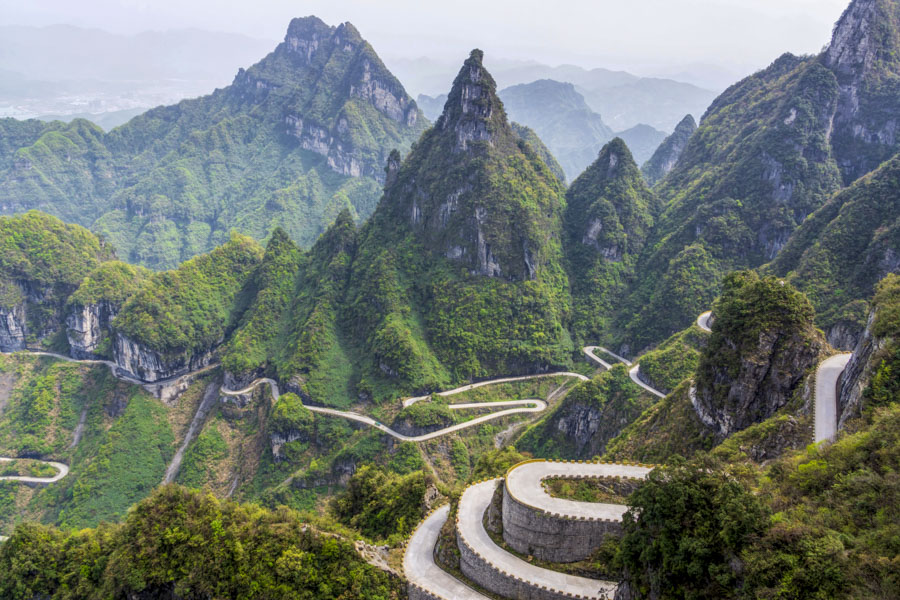
Tongtian Avenue (通天大道, Tōngtiān Dàdào), also called the Avenue to Heaven, climbs from the foot of Tianmen Mountain to Tianmen Cave Square in a dramatic sequence of 99 bends. In Chinese culture the number nine is associated with the emperor, supreme power, completeness and longevity, giving the road a symbolic resonance beyond its engineering feat.
You can take the shuttle bus along the route or admire its serpentine form from above. Seen from the high viewpoints, the road winds deep into the gorge, revealing one of Tianmen Mountain’s most cinematic views.
Walk to Tianmen Cave and Climb 999 steps of the Stairway to Heaven
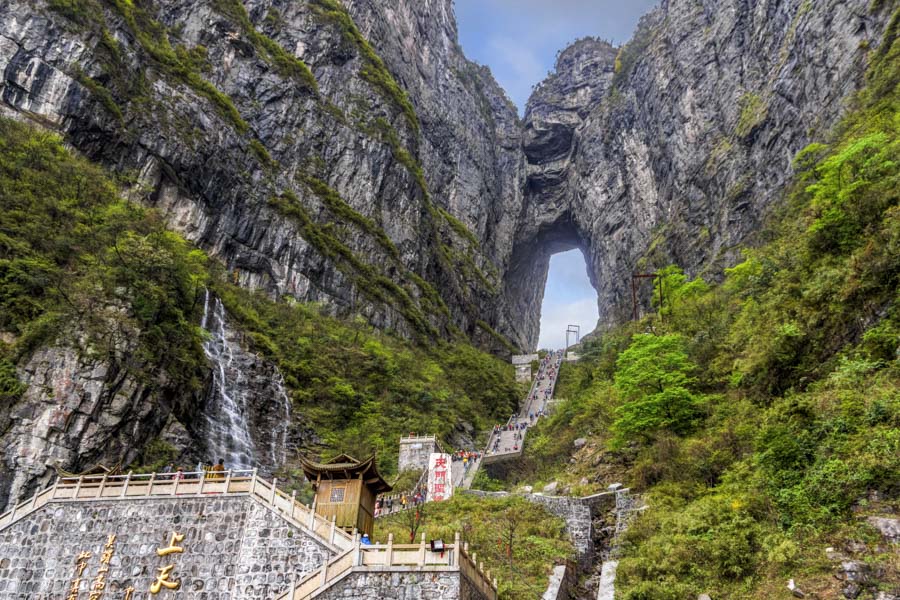
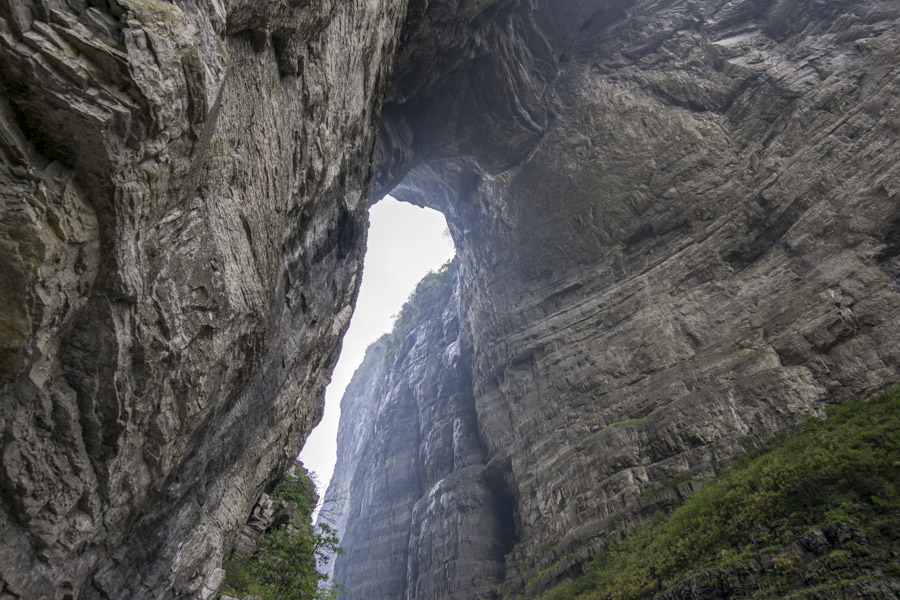
Tianmen Cave is the symbolic heart of the mountain. This vast karst arch, at around 1,300 metres (4,265 feet) above sea level, is 131.5 metres (431 feet) high and spans 57 metres (187 feet) across.
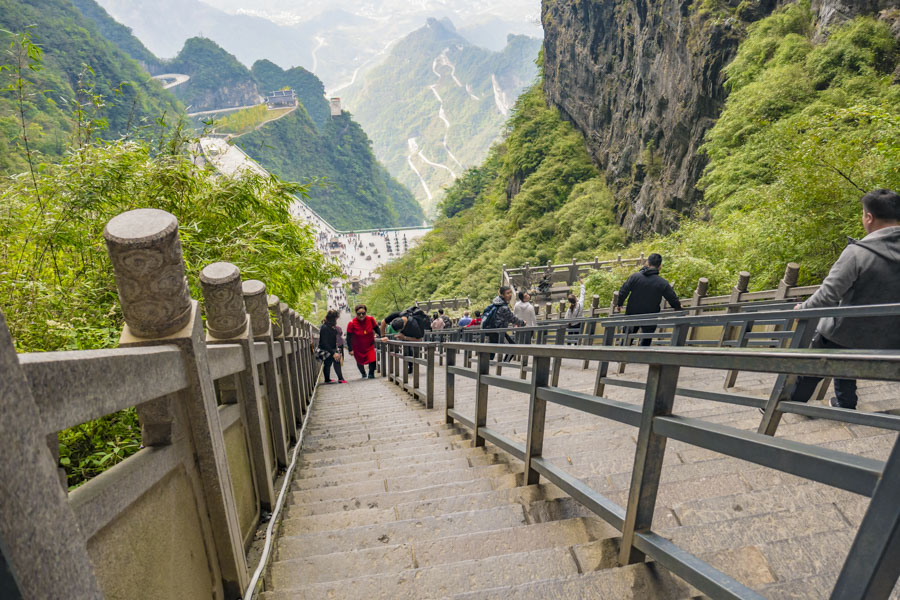
The 999 steps of the Heavenly Ladder lead up to the cave. The climb takes around 15 to 25 minutes and requires stamina, as the staircase is steep and narrow. Step through the arch and look up: above you is a great stone vault open to the sky. Underground water runs down the cave walls year-round, and at the base of the arch you may see a still pool reflecting its monumental curve.
Then look down and take in the height. The steep steps below and the green mountains stretching into the distance make this one of the most memorable moments of the route.
Walk the Glass Skywalks and Cliff-Edge Boardwalks
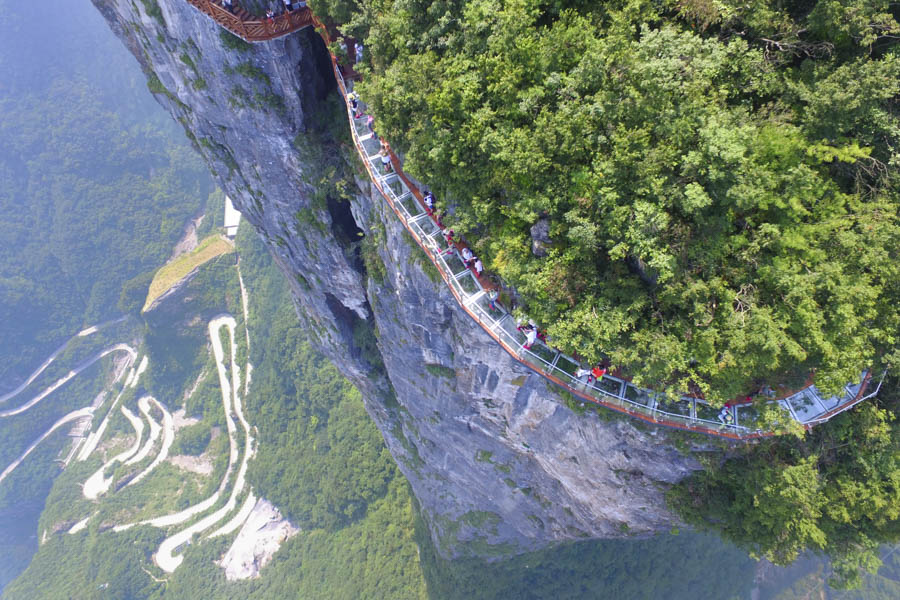
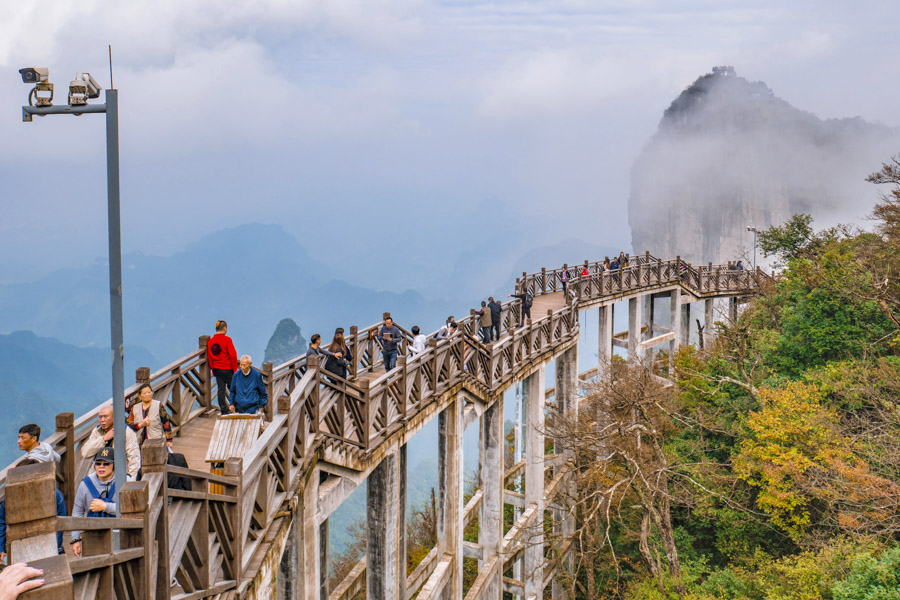
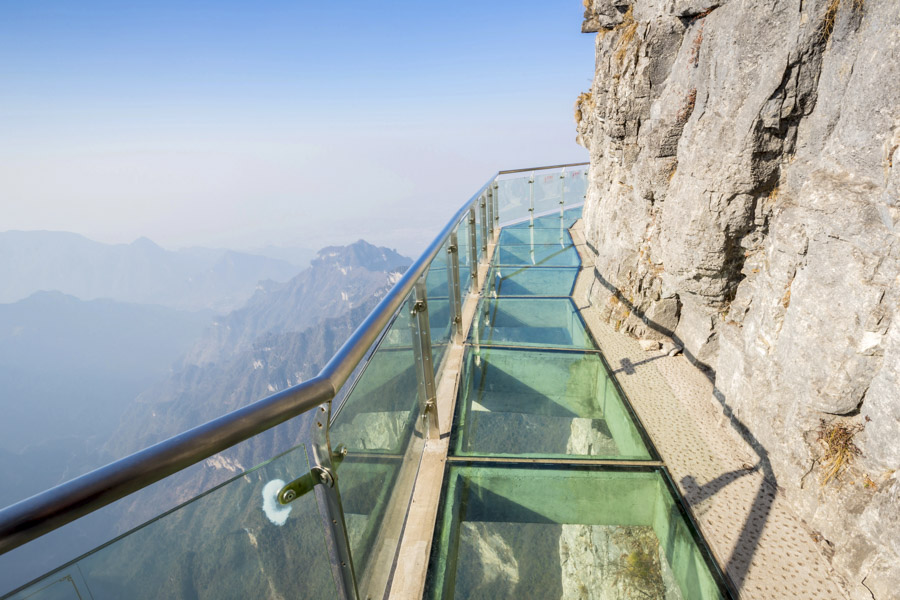
Follow the narrow walkways high above the valley and take in the wide mountain views. Tianmen Mountain has three glass walkways: the West Line Glass Skywalk (张家界玻璃栈道), the East Line Glass Skywalk (东线玻璃栈道), and the longest of the three, the Coiling Dragon Cliff Glass Skywalk, also known as Panlongya (盘龙崖玻璃栈道), which runs about 100 metres (328 feet) along the cliff.
Step onto the 1.6-metre-wide (5.2-foot-wide) transparent walkway, and the contrast is immediate: sheer rock on one side, open space on the other, and the valley far below your feet. Most panels have a pale green tint, and if you look straight down, Tongtian Avenue appears as a thin, winding line through the dense forest.
Before stepping onto the glass, remember to put on the protective shoe covers sold. They help protect the surface and keep it clear for other visitors.
Turn onto Guigu Plank Road (鬼谷栈道, Guǐgǔ Zhàndào), a 1,600-metre (5,249-foot) wooden walkway fixed to the cliff edge above the Guigu Cliffside Path. Here, clouds often drift close to your feet, while cool air rises from the forest below.
Continue to Guigu Moat, where the path narrows between two rock faces. Look down, and the height becomes clear again: beneath you is a deep drop, while the walkway carries you along the cliffs at a striking altitude.
Hike the Summit Trails and Photo Platforms
Follow the narrow paths through the greenery to reach two of the mountain’s most impressive viewing points, both excellent for photography and for enjoying the softer light of late afternoon.
Yu Hu Peak (玉壶峰, Yùhú Fēng), or Jade Pot Peak, is one of the most recognisable peaks on the plateau. Its name refers to its pointed outline, said to resemble a kettle. Reaching the top requires effort, as the route includes a steep staircase, but the views make the climb worthwhile.
Yunmeng Peak (云梦仙顶, Yúnmèng Xiāndǐng), known as the fairy summit, is the highest point in Tianmen Mountain National Forest Park, at 1,518.6 metres (4,982 feet). A spacious pavilion in Ming- and Qing-style architecture crowns the summit. From here, you get a full 360° view; on clear days all 16 peaks of Tianmen Mountain are said to be visible.
Places to Visit at Tianmen Mountain
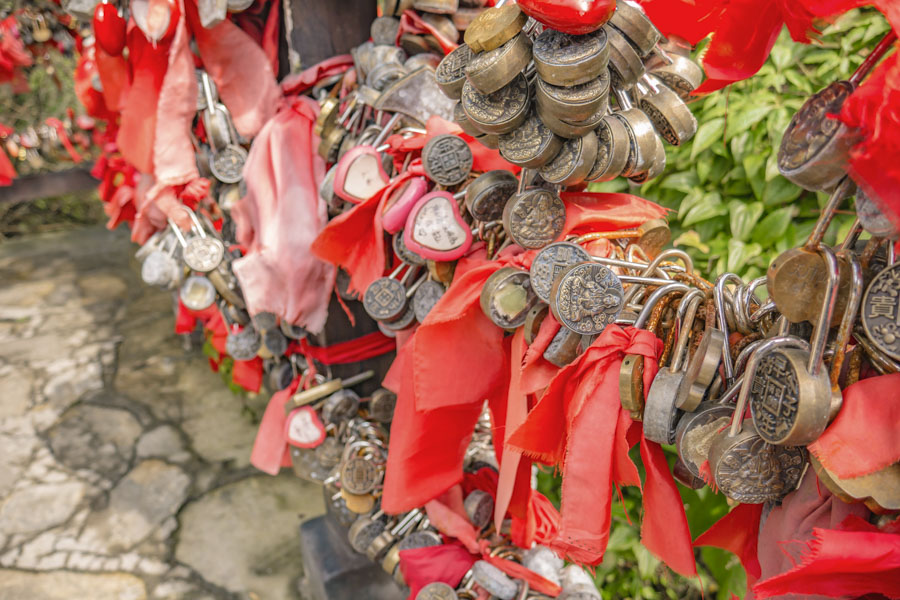
Tianmenshan Temple and Summit Shrines
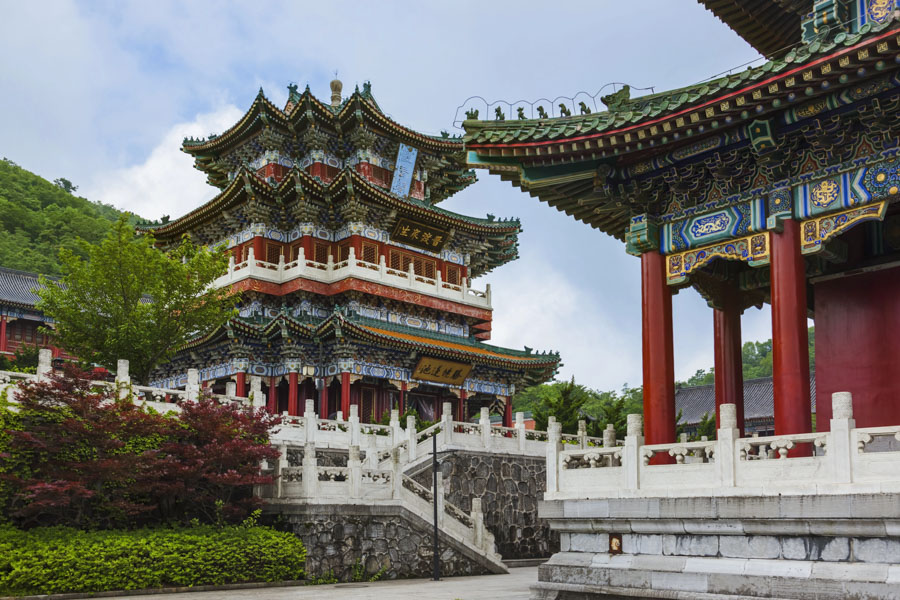
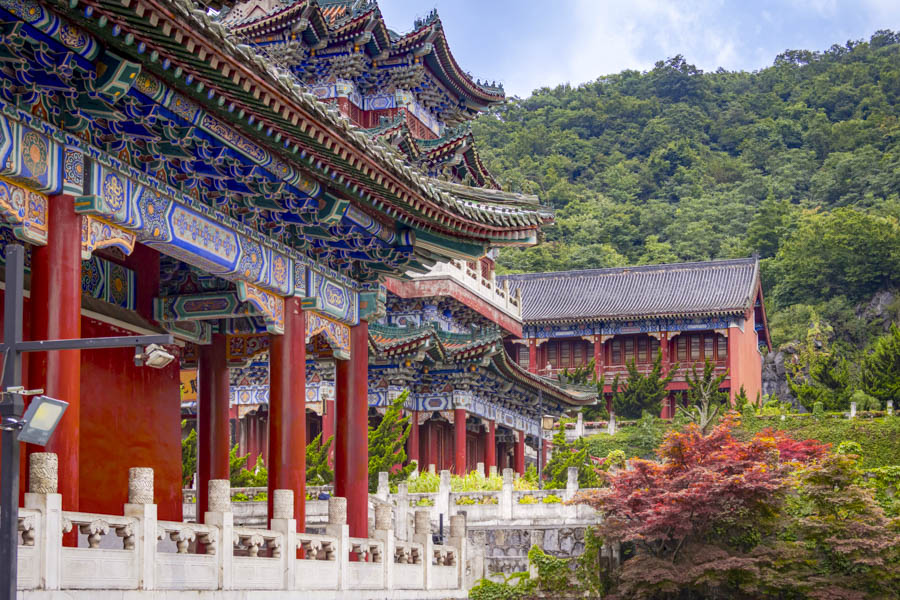
Head into the forest of “Fairy Summit Beyond Clouds”, where the busiest trails give away to quieter paths. Here you will find Tianmenshan Temple (天门山寺, Tiānménshān Sì), set among ancient trees whose branches form a gentle canopy. Step inside and let your eyes adjust: colourful arhats and the calm faces of the Buddha create a contemplative atmosphere.
This magnificent complex includes Mahavira Hall, a repository of Buddhist texts, and the Guanyin Pavilion – a multi-storey pagoda built in the classical style of Chinese temple architecture.
Nearby, it is worth visiting Qiu’er Cave (求儿洞, Qiú’ér Dòng), a small cave linked in local legend with an appearance of the goddess Guanyin. Young couples hoping for children come here to pray.
Tianmen Mountain offers a rich variety of experiences. Its landscape is built on contrasts – height and depth, wide panoramas and enclosed stretches of trail, movement and stillness. Because of this, even a short walk here can feel full and varied.
How to Get to Tianmen Mountain?
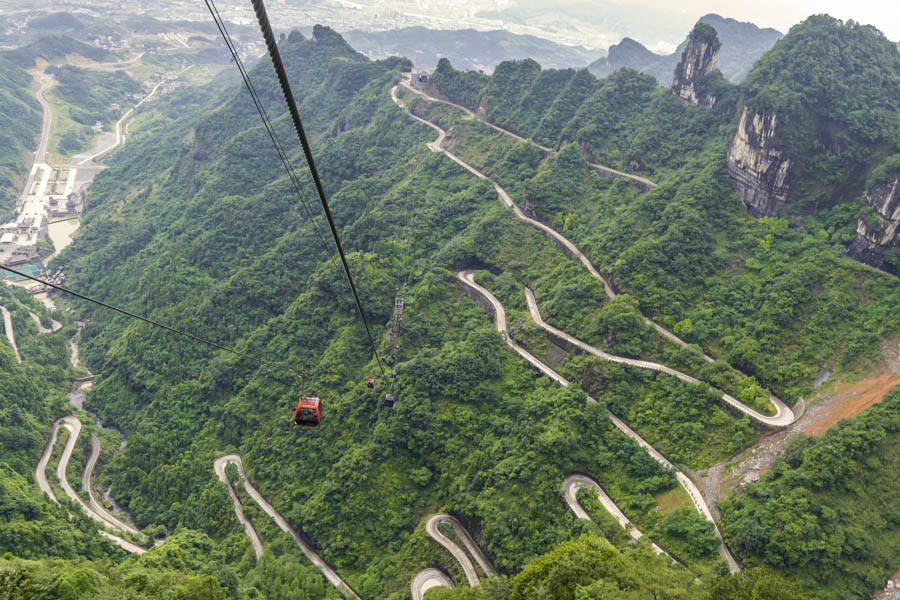
The journey up Tianmen Mountain is part of the experience. Each route is designed so that getting there feels less like mere transport and more like one of the mountain’s attractions, with changing views and a clear sense of ascent. Below are the main ways to reach Tianmen Mountain.
By Tianmen Mountain Cableway (天门山索道, Tiānménshān Suǒdào)
The Tianmen Mountain Cableway has three stations: lower, middle and upper. The lower station is located downtown Zhangjiajie, at the junction of Dayong Road and Yingbin Road, 1 kilometre north of Zhangjiajie Railway Station and 900 metres from Zhangjiajie Central Bus Station. The full journey takes about 28 minutes.
Important note: Since November 2025, the upper section of the cableway, between the middle and upper stations, has been closed for renovation. The works are expected to last one to two years. The lower section, between the lower and middle stations, continues to operate as usual, with a journey time of around 10 minutes.
By Sightseeing Shuttle Bus
The sightseeing shuttle bus stop is next to the lower station of the Tianmen Mountain Cableway. The buses take visitors to Mountain Gate at the foot of the mountain.
From there, you can either travel by tourist bus along the winding Tongtian Avenue or transfer to the Tianmen Cave Express Cableway.
By Tianmen Cave Express Cableway (天门洞快线索道, Tiānméndòng Kuàixiàn Suǒdào)
The lower station of the Tianmen Cave Express Cableway is about 6 kilometres (3.7 miles) from the city centre. This 1,200-metre (3,937-foot) cableway carries visitors from Mountain Gate to the square in front of Tianmen Cave in around 7 minutes.
Getting Around Tianmen Mountain
Within the park, several transport options connect the main areas of Tianmen Mountain.
Transmountain Escalator (穿山自动扶梯, Chuānshān Zìdòng Fútī)
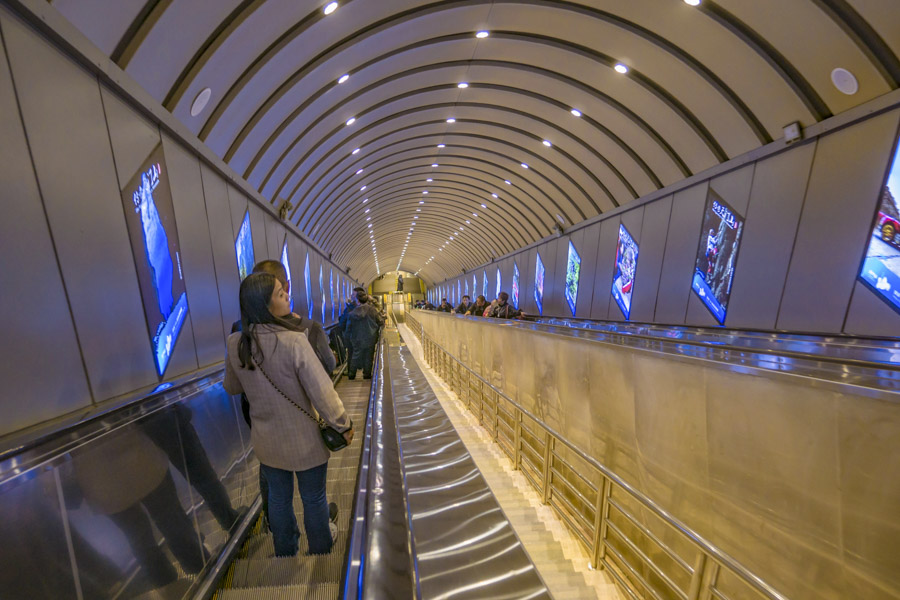
The transmountain escalator runs through tunnels inside the mountain and consists of 12 sections. It connects the square at Tianmen Cave with the summit plateau.
The upper seven sections lead from the cave to the summit, while the lower five sections run alongside the 999-step Heavenly Ladder. Passing through the illuminated mountain tunnel, the escalator turns travel between different parts of the route into an experience in its own right.
Forest Sightseeing Cable Car (森林观光缆车, Sēnlín Guānguāng Lǎnchē)
At the summit, the 800-metre (2,625-foot) Forest Sightseeing Cable Car runs between Yunmeng Fairy Peak (云梦仙顶, Yúnmèng Xiāndǐng) and the square by Tianmenshan Temple, also known as Cherry Bay Square (樱桃湾广场, Yīngtáowān Guǎngchǎng). A one-way ride takes around 10 minutes.
It is a convenient way to shorten the walk between two key points on the summit, or simply to enjoy the view over the forest canopy.
Routes and Lines of Tianmen Mountain
Planning your route ahead of time is crucial for exploring the summit plateau, Tianmen Cave, and winding skywalks, as there is a lot to discover. Take a look at all the official routes, East and West Line options, and be informed of the latest temporary arrangements on our dedicated Routes and Lines guide.
Smart Tips for Visiting Tianmen Mountain
Dress comfortably: wear well-worn shoes with good grip, as the steps, walkways and mountain trails require steady footing. Dress in layers: a light jacket is useful year-round, and warmer clothing is advisable in autumn and winter. Bring a compact raincoat rather than an umbrella, and choose quick-dry clothing where possible.
Pack a light snack: bring a reusable water bottle and a small supply of food to keep your energy up (nuts or energy bars work well).
Facilities: restrooms and other facilities are concentrated at major stations and plateau hubs. Use them before long walks.
Glass walkways: if you are prone to vertigo, sit or brace against railings when photographing.
Physical exertion: take it easy on the 999 steps and during long walks if you have heart or respiratory problems. Take regular breaks. Some visitors may experience mild symptoms from the altitude, such as lightheadedness or shortness of breath. Take it slowly and rest if needed.
ID: Take your passport with you; it may be checked at the entrance.
Weather: fog, rain and strong winds can quickly affect visibility. Check the forecast the day before your visit and be prepared to adjust your route.
Pace yourself: allow plenty of time for queues, photo stops and viewpoints. The slower you go, the more you will notice.