

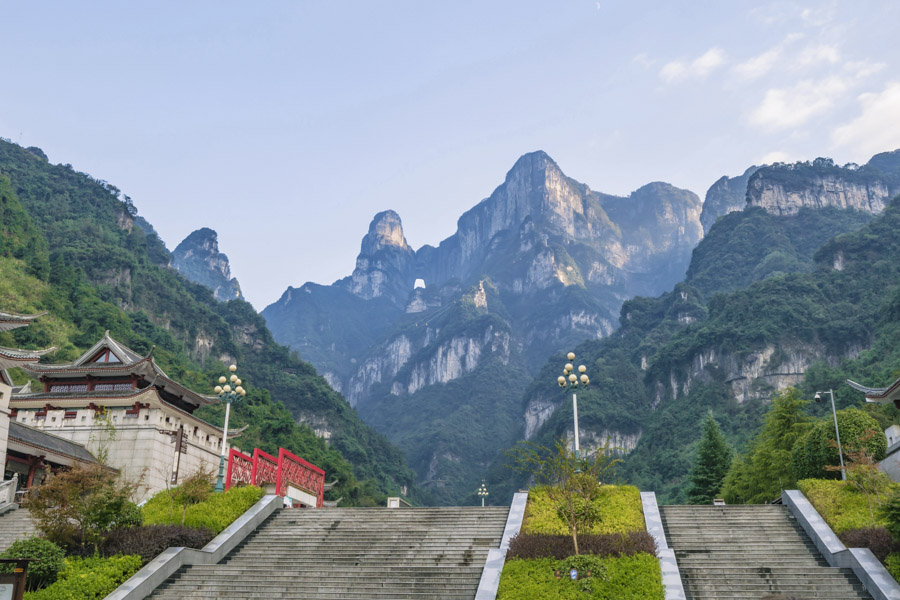
Chronicles of the Sacred Peaks: History and Legends of Tianmen Mountain, Zhangjiajie
Long before Tianmen Mountain became one of China’s most visited scenic sites, its cliffs, forests and towering natural arch had already earned a place in local memory and spiritual tradition. Over centuries, emperors, monks, travellers and storytellers have read its unusual terrain as a meeting point between the earthly world and the realm of Heaven. Historical records mingle with folklore here, while dramatic natural events gave rise to tales that still shape the mountain’s identity today. This lasting blend of history, belief and mystery remains inseparable from Tianmen Mountain’s image.
Tianmen Mountain Through the Ages
The earliest references to Tianmen Mountain appear in the Han chronicles (206 BCE–220 CE). Before it received its present name, it was known as Songliang Mountain.
The mountain was then associated with retreat, exploration and spiritual practice. Guiguzi (鬼谷子), also called Wang Xu (王诩) or Wang Li (王利) in some sources, is a semi-legendary strategist and sage said to have lived during the Warring States period (476–221 BCE). Tradition places him in the Ghost Valley (Guigu 鬼谷), often associated with the Yinchuan (modern Yuzhou) region, where he lived in seclusion and taught disciples such as Su Qin and Zhang Yi. His identity, longevity, and authorship are uncertain, and later sources give differing names and locations. However, he features in local legend: it is said that the “shadow of Guigu", a picture associated with Guiguzi, once appeared on a cave wall of Tianmen Mountain. From the Wei and Jin Dynasties (c. 220 to 420 CE) Daoism (Taoism) in China gradually developed from philosophical teaching into a living religious tradition. Tianmen Mountain became a sacred site and drew pilgrims, who saw in its cliffs and clouds a place where the earthly and the heavenly seemed to meet.
The year AD 263 marked a turning point. During the Three Kingdoms period (220–280 AD), part of the eastern cliff face suddenly collapsed, leaving a vast opening in the rock resembling a gate. Emperor Sun Xiu of the Eastern Wu Kingdom (reigned 258-264 CE) interpreted this as an auspicious sign and renamed the mountain Tianmen, the Heaven’s Gate.
Tianmen Mountain Temple was first built in the Ming dynasty (1368–1644) and later developed as a centre of Buddhism in western Hunan. It includes Shakya Mani Hall, Tianwang Hall and a rear Guanyin Hall; is surrounded by ancient trees; and has a seven-storey pagoda nearby. Dynasties rose and fell, yet Tianmen Mountain continued to draw travellers, preserving its reputation as a place linked with the spiritual path.
Local legends add further depth. It is said that whenever a great man passed away, the sky above Tianmen would suddenly darken and a thunderstorm would break out, even on a clear day. This phenomenon, interpreted as the grieving tears from Tianmen Mountain, became known locally as “Tianmen’s Mysterious Connection to Heaven”.
Modern history also includes dramatic events. In 1999, nine stunt pilots from different countries flew jet planes in succession through the stone arch of Tianmen Cave, bringing the site international fame. The skies above the mountain later hosted two World Wingsuit Championships. In 2007 the French climber Alain Robert (the “French Spiderman”) free-climbed the rock face without ropes or special equipment. His bronze statue can be seen on Heaven’s Gate.
Today, Tianmen Mountain remains one of China’s most impressive natural sites – a place where each era has left stories, legends and heroes.
The six unsolved mysteries of Tianmen Mountain
The mountain, shrouded in mystery, exudes an ethereal atmosphere. Will you be able to solve these mysteries that remain unsolved to this day?
The opening of Tianmen Cave: a natural arch whose precise origin is unexplained. Its dramatic, mirror-like aperture is regarded as a Heavenly Gate, inspiring awe and speculation.
The turbulent water of Tianmen: on the left cliff near 1,500 metres (4,921 feet), sudden roaring floods have been reported during droughts and are locally seen as ominous warnings.
The turning of Tianmen Cave: locals say the cave’s visible orientation has shifted over decades. Once clearly seen from the city riverside, it is now only visible from Dayongqiao Park, fuelling tales that the cave slowly “turns”.
The buried treasure of Yefu: Yefu (Li Guo) (c. 1631–1645), a general associated with Li Zicheng, is said to have buried looted treasure on Tianmen; numerous searches over centuries have found nothing yet.
The shadow (or picture) of Guigu: an early photograph reportedly captured the profile of the ancient master Guiguzi on a cave wall, but later attempts to reproduce it failed, leaving the image’s origin unexplained.
The auspicious unicorn: reported sightings in the forest of a red, tiger-shaped creature with a single horn, resembling an ancient auspicious beast, are said to vanish when approached, adding to the mountain’s mystique.
Tianmen Mountain still occupies a unique place in the cultural landscape of western Hunan, where natural grandeur and centuries of storytelling sit side by side. Whether seen through the lenses of history, religion or legend, the mountain retains the sense of mystery that has surrounded it for generations.