

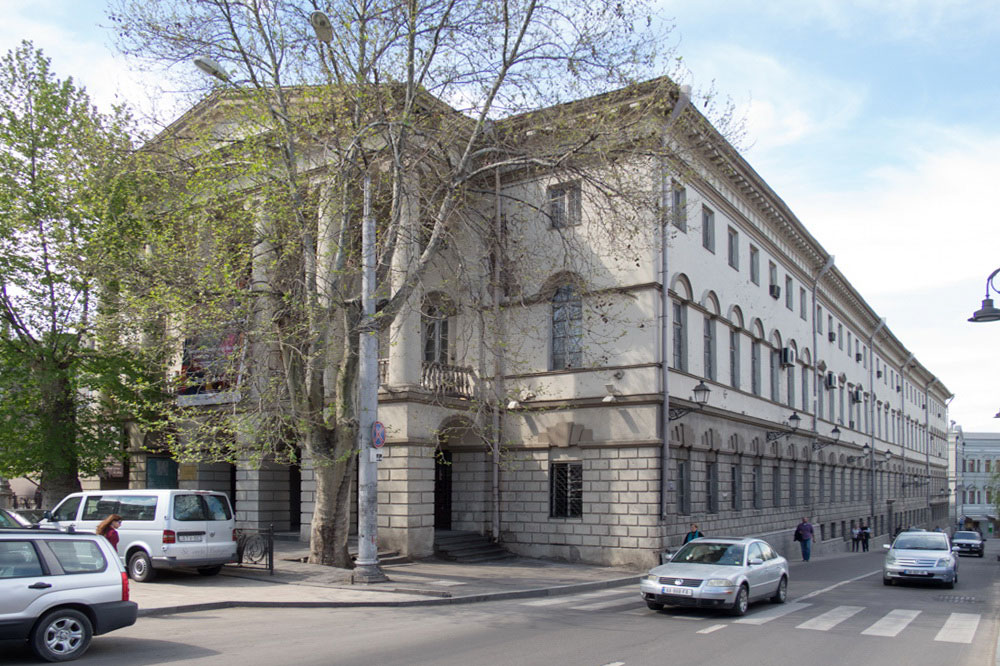
Address: 1, Lado Gudiashvili Str., Tbilisi
Opening hours: Tuesday-Sunday, 10:00–18:00
Closed: on Mondays
The Shalva Amiranashvili Museum of Fine Arts (Art Museum of Georgia) occupies a monumental classical building from 1838, close to Freedom Square metro station in central Tbilisi. A colonnade and a weighty façade set the tone before you are inside.
What is less immediately obvious is the building's other life. In the late 19th century, this was the Tiflis Theological Seminary. Among its students was a young Joseph Stalin. The museum opened here only in 1950, half a century after he left. Today it holds one of the most significant art collections in the Caucasus: around 140,000 works, from early Christian icons to European Old Masters.
History
The museum's origins lie not in a grand founding moment, but in a gradual accumulation across a turbulent century. The National Gallery opened in Tbilisi in 1920, drawing together historical artefacts and paintings for the first time. Twelve years later it became the Museum of Art. The new holdings were built on a striking foundation: sacred objects gathered from monasteries, churches, and private collections across the country.
During the 1930s, the collection was temporarily housed in the Metekhi Church – a medieval structure perched above the Mtkvari River. This gave rise to its informal name of that period: the Metekhi Museum of Fine Arts. In 1950, the institution moved to the former seminary building, where it has remained.
Some of the museum's most significant pieces had already survived one extraordinary journey before arriving here. When the Red Army established Soviet rule in Georgia in 1921, a number of national treasures were taken out of the country. The historian Ekvtime Takaishvili became their custodian in France. For more than twenty years he guarded them in near-poverty, refusing to sell even a single piece. In 1945, the treasures were returned. Knowing this history changes what it means to stand in front of these objects – they stop being artefacts and become something more like proof.
Shalva Amiranashvili, the museum's director at the time, played a central part in securing that return. An art historian of considerable standing, he led the institution for over thirty years. He shaped what visitors see today, and since the early 1990s the museum has borne his name.
In 2004, it was incorporated into the National Museum of Georgia, which brings together the country's principal cultural institutions under one organisational roof.
Collection
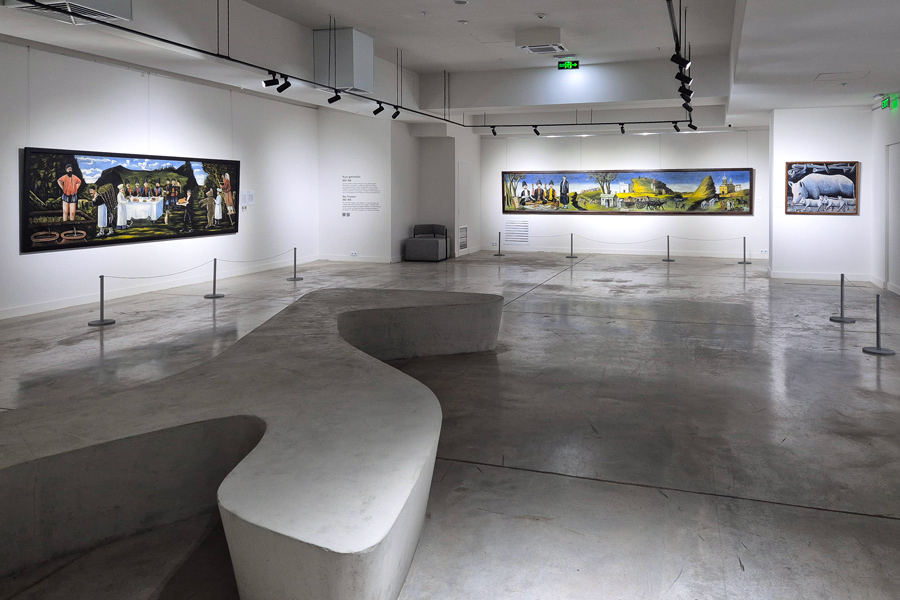
Georgia's ecclesiastical and decorative traditions form the deepest layer of the holdings, but the range extends well beyond these. The holdings span icons and medieval metalwork, European paintings, Russian academic canvases, and the boldly individual work of Niko Pirosmani. Taken together, they chart Georgian artistic heritage across a remarkable breadth of visual languages.
Icons and Religious Relics
Georgia adopted Christianity in the 4th century, and what followed shaped these holdings entirely. Over the next fifteen hundred years, monasteries and churches accumulated objects of exceptional artistic and devotional significance. It is these that define the collection's character.
The iconography galleries trace how Georgian artists evolved over the centuries. The progression moves from the austere, almost incorporeal figures of the 6th–7th centuries to the gold-laden compositions of the 12th–13th. Many of these icons came from mountain monasteries where they had been inaccessible to scholars for generations. Their arrival here was itself a kind of recovery.
The oldest known monument of Christian art in Georgia is the Anchiskhati Icon of the Saviour (6th–7th centuries). Kept for centuries in the historic region of Tao-Klarjeti – now eastern Turkey – it was later moved to the Anchiskhati Church in Tbilisi. It has been in the museum's care since around the 1920s. The medieval architectural relief fragments are equally arresting. These are large-scale carvings from ancient churches, depicting saints and ornament at a scale that makes their original setting imaginable.
Medieval Treasures: the Golden Fund
The Golden Fund occupies its own separate room, and the atmosphere is carefully calibrated to match. Crosses, chalices, icon frames, and ornaments in silver and gold set with gemstones fill the room. They illustrate the peak of Georgian ecclesiastical craftsmanship during the 10th–13th centuries – the period historians call Georgia's Golden Age.
The most important single object is the Khakhuli Triptych (10th–12th centuries). A folding icon depicting the Mother of God, it measures approximately 1.5 by 2 metres. Crafted from gold, enamel medallions, and precious stones, it is widely regarded as the largest folding icon in existence. It takes its name from Khakhuli Monastery, an important centre of Christian learning from which it came.
A gold cross set with emeralds, rubies, and pearls is traditionally linked to Queen Tamar (1160–1213). Under her reign, Georgia reached the height of its medieval power. Her image as a wise and formidable ruler has remained central to national identity ever since.
Elsewhere in the room is the chalice of Bagrat III, the first king of a unified Georgia (999 AD). Also called the Bediya Chalice – named after the Abkhazian cathedral where Bagrat deposited it – it is outstanding as a liturgical vessel. Its surface is finely worked with repoussé engraving and images of saints.
Minankari – Georgian Cloisonné Enamel
With over 200 pieces spanning the 8th to the 13th century, this is one of the world's finest collections of Georgian cloisonné enamel, known locally as minankari.
The technique is painstaking. Jewellers traced the contours of a design in the finest metal strips, then filled each cell with coloured glass powder. The piece was fired in a kiln. The heat transformed the powder into smooth, almost luminous enamel. The finest examples are comparable to miniature painting in their precision, which is reason enough to look closely.
Most of the items are of ecclesiastical origin: icon frames, crosses, liturgical vessels. The standard achieved by Georgian craftsmen in this medium is exceptional. That so many pieces have survived largely intact across nearly a thousand years only adds to their weight.
Painting
The painting galleries move across several distinct traditions. The Russian holdings include works by Ilya Repin, Valentin Serov, and Ivan Aivazovsky. An Eastern section presents Islamic art alongside Iranian works from the Qajar period (18th–20th centuries). The highlights include court portraits and battle scenes that blend Persian composition with European naturalism.
Among the Western European paintings, the most memorable is Lucas Cranach the Elder's The Procuress (1548), a celebrated work of the German Renaissance. Its story has been as eventful as anything else in the building. Removed to France in 1921, it came back to Tbilisi in 1946. Then, in 1994, it was stolen directly from the gallery. After nearly a decade, it was recovered and reinstalled in 2004.
The Georgian section is anchored by Niko Pirosmani (1862–1918). Canvases by this artist appear throughout the city's galleries, but the largest single holding is here. Self-taught and working in what came to be described as the naïve style, Pirosmani painted urban scenes, feasts, and animals against characteristically dark backgrounds. He died in poverty and near-obscurity. His reputation – and his standing as one of the most recognisable figures in Georgian art – came entirely after his death.
Practical Information
A visit requires some advance planning, particularly at present.
- In recent years, the historic seminary building has been closed for substantial restoration. During this period, a significant part of the holdings was moved to an adjacent building, which has been restored and open to visitors since 2024.
- The museum has made accessibility a priority. Tactile relief copies of selected paintings have been produced for blind and visually impaired visitors. Several exhibits also carry audio descriptions.
- A general visit takes around two hours. Those who prefer to examine objects carefully – and this collection rewards that approach – should allow more time.
- There is another institution in Tbilisi with a similar name: the Georgian Museum of Fine Arts. It opened in 2018 and holds around 3,000 works by contemporary Georgian artists exclusively. The similarity causes occasional confusion in addresses and online reviews. They are entirely separate places.