

Address: 28 Al-Farabi Avenue, Almaty
Website: almaty.art
Email: visit@almaty.art
Opening hours: Tuesday–Sunday, 11:00–20:00 (closed Mondays)
Tickets: around 2,000 tenge (approximately 4–5 USD). Discounted tickets available.
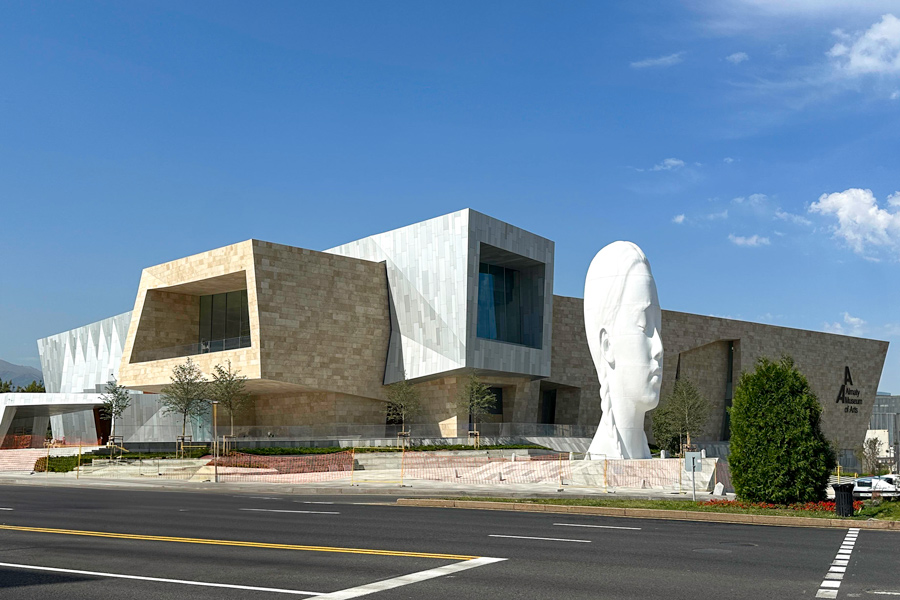
Opened on 12 September 2025, the Almaty Museum of Arts stands on Al-Farabi Avenue, near Nurly Tau and the Almaty Theatre, at the intersection with Nazarbayev Avenue. A striking 12-metre white sculpture marks its entrance.
The work, titled Nades, was created by Spanish artist Jaume Plensa. It depicts the serene head of a young girl with braided hair and closed eyes. Conceived as an image of silence and inner concentration, the sculpture combines a universal human presence with a subtle connection to Kazakhstan’s cultural context.
Since its installation, Nades has become one of the most recognisable contemporary landmarks in Almaty, naturally drawing visitors toward the museum.
The Almaty Museum of Arts is the first large private museum of contemporary art in Central Asia. It was established on the basis of the personal collection of businessman and philanthropist Nurlan Smagulov and developed as a purpose-built institution designed to meet international museum standards.
According to various estimates, around $100 million was invested in the construction of the building, its technical infrastructure, and the formation of the collection – a scale that reflects the long-term ambition behind the project.
In its first months of operation, the museum welcomed more than 150,000 visitors, quickly establishing itself as a significant new centre in the cultural life of the city. Visiting the museum is already considered one of the best things to do in Almaty, especially for those who want to discover the city’s newest cultural landmark while it is still shaping its identity.
History of the Almaty Museum of Arts
The idea of creating the museum emerged in autumn 2020, at a moment when Almaty’s cultural landscape was ready for a project of a new scale. By 2022, the concept moved from vision to construction. Over the next few years, a purpose-built space of around 10,000 square metres took shape – designed not simply as an exhibition venue, but as a contemporary platform for ambitious artistic statements.
While the building was rising, the collection was being formed with equal intensity. The founder and his team travelled extensively, attending major international exhibitions and visiting leading museums to shape a collection that would speak a global language while remaining relevant to the region. As a result, the museum now presents significant works by contemporary artists from different countries, including ambitious installations and monumental sculptures.
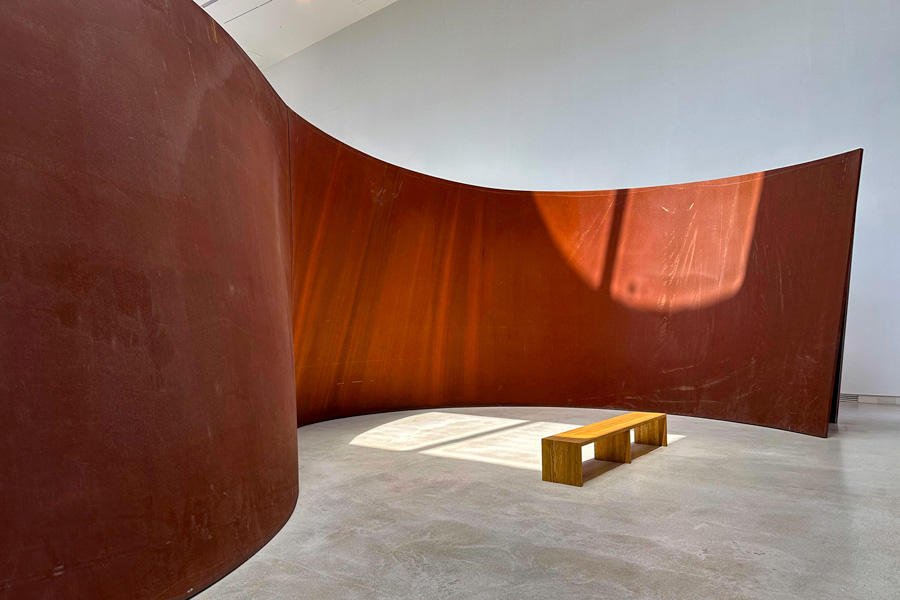
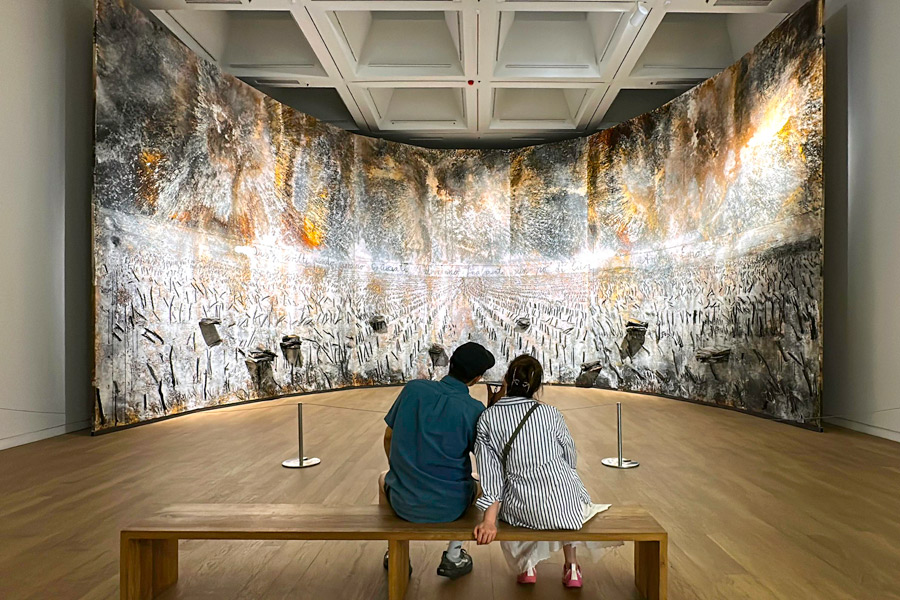
Among the key names is German artist Anselm Kiefer, whose work was among the central highlights of the 2022 Venice Biennale. The collection also includes Crossroads by American sculptor Richard Serra, internationally recognised for his powerful steel compositions shown in major museums and biennales worldwide.
The presence of Jaume Plensa’s Nades at the entrance symbolically extends this dialogue beyond the walls of the museum, connecting the urban space with its artistic programme.
Architecture and Concept
The Almaty Museum of Arts was designed by the British architectural firm Chapman Taylor, known for major international projects, including Shanghai’s Global Harbor Mall. For the museum’s technical and curatorial planning, the team also collaborated with Buro Happold and Lord Cultural Resources – consultancies whose portfolios include institutions such as the San Francisco Museum of Modern Art and the Louvre Abu Dhabi.
The building itself reflects the geography of Almaty. It consists of two intersecting L-shaped volumes that subtly echo both the city grid and the mountain horizon beyond. One volume is clad in metal, its clean lines suggesting urban movement and modern energy. The other is faced in stone, a quiet reference to the Ile Alatau (or Trans-Ili Alatau) that frame the city. Inside, this contrast continues: cool metallic surfaces give way to textured stone, and the architecture quietly mirrors the city’s setting between glass towers and mountain slopes.
Behind this restrained exterior lies carefully engineered infrastructure. Climate control, lighting, and security systems meet international museum standards, allowing the institution to host major exhibitions and safeguard significant works from around the world.
In interviews, founder Nurlan Smagulov has said that he envisions the museum as a place where visitors might encounter exhibitions of the highest calibre – even, as he puts it, works of “Rembrandt level”.
Main Halls of the Almaty Museum of Arts
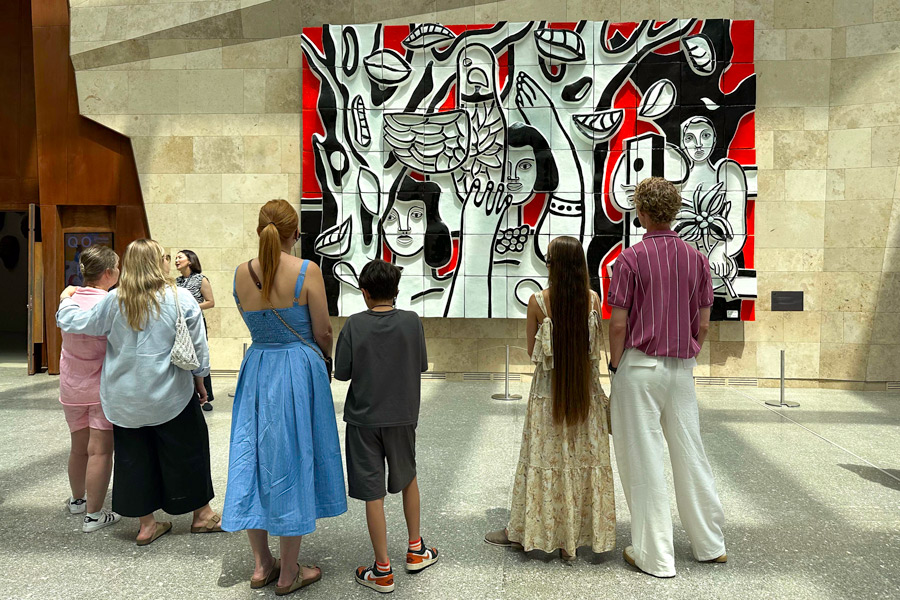
At the heart of the museum lies the so-called Street of Art – a vast, light-filled lobby that also functions as an exhibition space, with ceilings rising up to 18 metres. It sets the scale of the building from the very first step inside.
Two principal galleries, Uly Dala and Saryarka, host both permanent displays and temporary exhibitions, allowing the programme to shift and evolve. In addition, several dedicated spaces are designed specifically for large-scale installations by international artists represented in the permanent collection.
The museum’s infrastructure extends beyond exhibition areas. The Al-Farabi Hall – a flexible transformer space – is used for conferences, concerts and theatrical performances. Behind the scenes, there are extensive storage facilities, as well as educational and restoration workshops that support the museum’s long-term work with the collection.
Almaty Museum of Arts Collection
The collection of the Almaty Museum of Arts is rooted in around 700 works from Kazakhstan and neighbouring countries, assembled by Nurlan Smagulov over more than three decades. Over time, this foundation has expanded to include major international names, creating a dialogue between local and global contemporary art.
The display is regularly reconfigured, so each visit offers a slightly different perspective on the permanent holdings.
A significant place in the programme is given to the work of Kazakh artist Almagul Menlibayeva. In the Uly Dala hall, her exhibition I Understand Everything brings together painting, graphic works, photography and video installations, unfolding across media and themes.
The Saryarka hall hosts the permanent exhibition Qonaqtar, which presents artists from Kazakhstan and the wider region, including Salikhitdin Aitbayev, Sakh Romanov and Aisha Galimbayeva. Their works reflect key stages in the development of modern and contemporary art in Central Asia.
The museum also features pieces by figures associated with the avant-garde. Among them is Rhythmic Composition by Alexander Volkov, one of the founders of the Turkestan avant-garde. Most of his works are held in the I.V. Savitsky Museum in Nukus and in major institutions such as the Tretyakov Gallery in Moscow, which makes its presence here particularly notable.
Alongside regional masters, the museum presents large-scale works by internationally recognised artists.
Richard Serra’s Crossroads II required a specially designed exhibition space; transporting the monumental steel structure from the United States cost several million dollars. Walking through the curved walls of the installation alters the perception of scale and movement.
Bill Viola’s video installation Stations explores themes of life, death and spiritual transformation, drawing on the poetry of Jalaluddin Rumi.
Anselm Kiefer’s philosophical work These Writings, When Burned, Will Finally Cast a Little Light reflects on destruction and renewal through layered material and symbolism.
Yayoi Kusama’s immersive installation LOVE IS CALLING introduces an entirely different rhythm – vibrant, pulsating and disorienting.
Among other highlights are Yinka Shonibare’s striking Wind Sculpture and Alicja Kwade’s installation Pre-Position, inspired by the landscapes of the Torysh Valley in Mangystau.
Things to Do at the Museum
A visit to the Almaty Museum of Arts is not limited to its exhibition halls. The programme includes lectures, artist talks, educational initiatives and special events that deepen engagement with contemporary art and bring different audiences into conversation.
If you need a pause between galleries, Alma Café provides a calm setting for coffee or a light meal. Nearby, the Duken shop offers carefully selected books, exhibition catalogues and art-inspired gifts.
Some of the museum’s spaces, particularly the Alatau Hall, open onto panoramic views of the Ile Alatau – the northern ridge of the Tian Shan. Here, after moving through large installations and reflective works, you can step back, take photographs, and simply sit with the mountains on the horizon.