

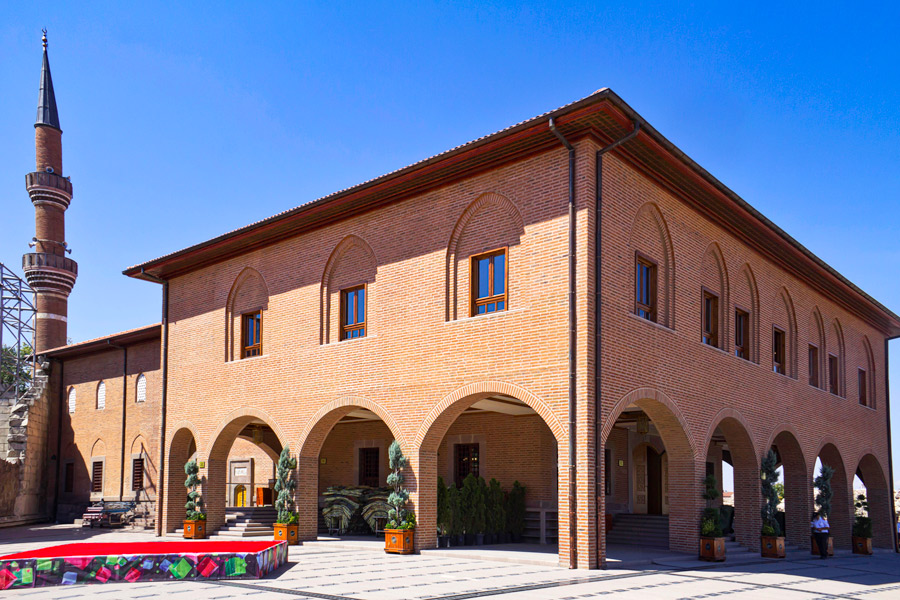
In Ankara’s historic Ulus quarter (Altındağ), the Hacı Bayram Mosque and Mausoleum stand on a hill long associated with worship.
Within a small courtyard, the Ottoman-era mosque – still actively used for prayer – rises beside the türbe (mausoleum) of Hacı Bayram-ı Veli, a 15th-century Sufi teacher and poet. Born in nearby Solfasol in 1352, he founded the Bayramiyye order and devoted his life to teaching and writing. His influence grew so steadily that it eventually drew the attention of the Ottoman court.
What makes Hacı Bayram Mosque and Mausoleum worth visiting is its rare concentration of living history. In the space of a single unhurried walk, you encounter painted timber ceilings, Kütahya tiles, and delicate plasterwork.
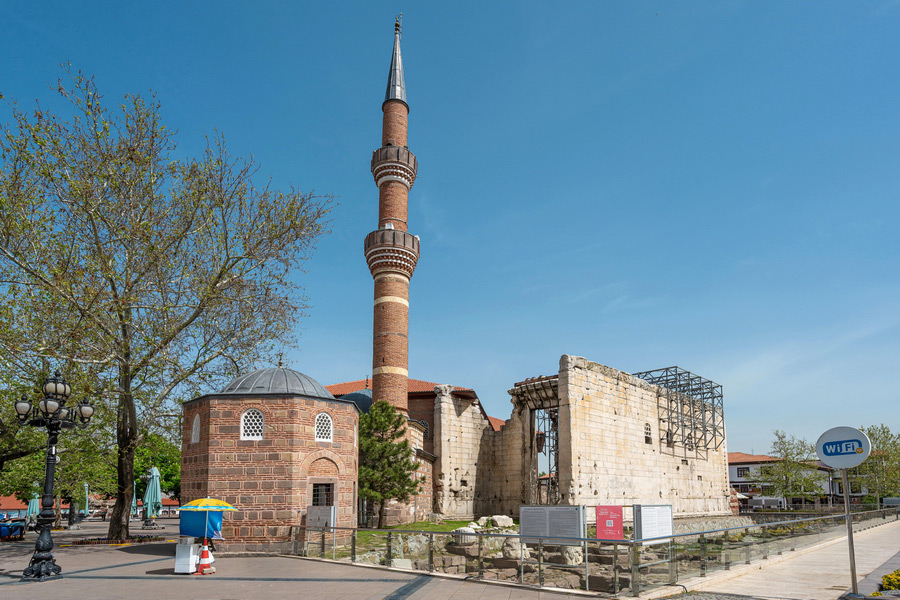
The Roman ruins of the Temple of Augustus press close against the mosque’s outer wall, a reminder that this hill was sacred long before the Ottomans arrived. Few places in Turkey compress so many layers of history into so small a space, and fewer still do so with such quiet intimacy. This density of heritage is formally recognised: in 2016, the wider district was added to the UNESCO Tentative List as part of The Historic Centre of Ankara – an acknowledgment of the site’s exceptional historical continuity.
Best Time to Visit Hacı Bayram Mosque and Mausoleum
Whenever you visit, keep in mind that the mosque is busiest on Fridays around midday, when the congregation gathers for Jumu'ah (Friday) prayer. For a quieter experience, a weekday morning is usually the best time to come.
Spring and early autumn are generally the most pleasant seasons to see Hacı Bayram Mosque and Mausoleum, when Ankara’s weather is mild and the cobbled streets of Ulus are especially pleasant to wander. Along the old lanes, small bazaars, copper merchants, and antique dealers add to the atmosphere, making the approach to the complex part of the experience itself. April can bring occasional rain, so packing a light waterproof is advisable.
In summer (June–August), daytime temperatures often reach 30–31°C (86–88°F). Ankara’s relatively low humidity makes the heat more manageable than along the coast, but it is still best to plan your visit for the cooler part of the day. Winter (November–March) is colder, with January temperatures averaging around 4–5°C (39–41°F), and the cobbled streets can become slippery. Those prepared for the cold will find the site especially calm and contemplative at this time of year.
Practical Additional Information
Opening Hours and Admission
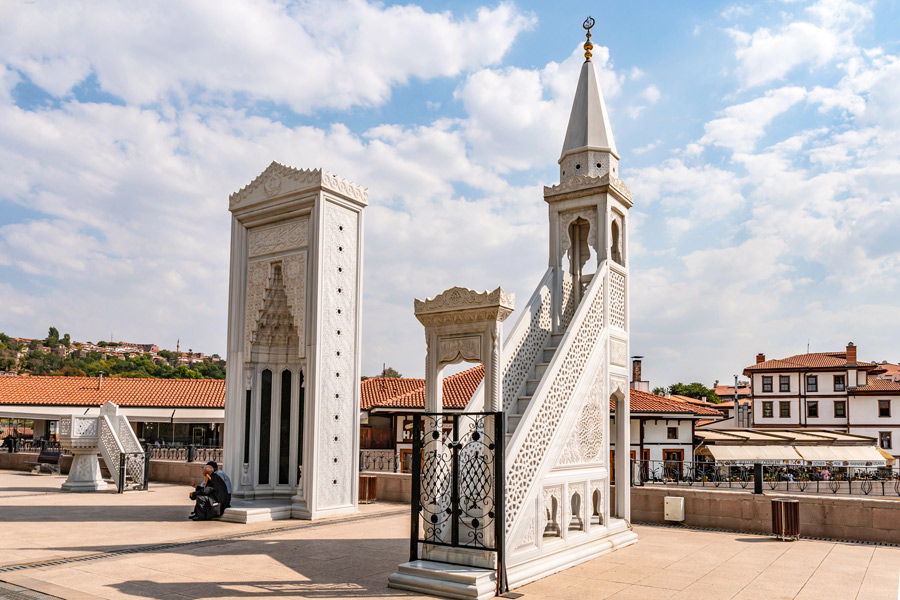
The mosque is open year-round and welcomes visitors throughout the day, though access may be limited during prayer times. The mausoleum is generally open from 08:00 to 17:00. As with many active religious sites in Turkey, these hours can occasionally vary, so a degree of flexibility is advisable.
Entry to both the mosque and the mausoleum is free of charge.
Address
Hacı Bayram Mahallesi, Sarıbağ Sokak 13, 06050 Altındağ, Ankara
Telephone: +90 312 309 09 42.
As the mosque functions primarily as a place of worship, the line may not always be staffed for visitor enquiries.
Recommended Duration of Visit
Allow between 45 minutes and one hour to explore the mosque and mausoleum at a comfortable pace. If you intend to linger in the square or look around the nearby Temple of Augustus, setting aside around an hour and a half would be more realistic – and rather more rewarding.
History of the Hacı Bayram Mosque and Mausoleum
The story begins with the man whose name the complex now bears. Hacı Bayram-ı Veli was born in 1352 in Solfasol, a village on the outskirts of Ankara. His birth name was Numan bin Koyunluca Ahmed, and he began his adult life as a scholar and teacher. In time, he turned towards Sufism (the mystical, contemplative tradition within Islam), and it was in this path that he found his calling. He founded the Bayramiyye order, a tradition that wove together prayer, contemplation, and honest physical labour, and his teachings spread steadily across Anatolia throughout the 15th century. He was also a poet, writing in the tradition of the great Anatolian mystic Yunus Emre, and some of his verses were later set to music.
His growing following did not go unnoticed. He was summoned to Edirne by Sultan Murad II, who had received word that his influence had grown large enough to raise concern. The meeting, however, proved unexpectedly cordial. The sultan received him with respect, granted tax exemptions to his disciples, and permitted him to return to Ankara to continue his work. It is a detail that speaks quietly but clearly to the man's stature.
Hacı Bayram-ı Veli died around 1429–1430, and the mosque that bears his name had already been taking shape in his final years. Built between 1427 and 1428 by the architect Mehmed Bey, it rose on a hill in the Ulus district where a dervish lodge had long been established, on ground considered sacred for many centuries before. The mausoleum was completed in 1429, positioned directly against the mosque's mihrab, the prayer niche that marks the direction of Mecca. The arrangement feels deliberate, underscoring the closeness between the man and the place built in his honour.
The complex has been thoughtfully maintained over the centuries. A significant restoration was carried out in 1714 by Mehmed Baba, a descendant of Hacı Bayram-ı Veli himself – a pleasing continuity of care within the same spiritual lineage. Further work was undertaken by the General Directorate of Foundations in 1940 and 1947, and a more recent restoration in 2011 took a careful, scientific approach, stabilising wooden elements and uncovering original hand-carved decorations in the women's section that had been hidden beneath layers of paint. What we see today is the result of nearly six centuries of devoted attention.
Architecture of Hacı Bayram Mosque and Mausoleum
The Hacı Bayram Mosque
The moment you step inside, the ceiling draws the eye upward. Carved entirely from timber, it is built around a large hexagonal rosette – six concentric rings of floral decoration that radiate outward with almost musical precision. Look across to the women's section and you will find a smaller version of the same rosette repeated there, evidence of the care that went into every corner of the space.
Along the lower walls, you will notice Kütahya tiles – hand-painted in the deep cobalt blues and soft greens that became the signature of Ottoman ceramics at their finest. These were added during the 18th-century restoration and remain among the most accomplished examples of decorative tilework in Ankara.
At the far end, the mihrab rises into a honeycomb of carved plaster recesses that catch the light differently depending on where you stand. Beside it, the geometric panels of the minbar (pulpit) are interlocked without a single nail – a technique already considered a vanishing art when this pulpit was made.
Before you leave the prayer hall, look up once more at the painted brushwork on the timber beams. These decorations, known as kalem işi, are traditionally attributed to the painter Nakkaş Mustafa. That they survive at all after nearly six centuries is remarkable. That they survive in this condition is extraordinary.
The Mausoleum of Hacı Bayram-ı Veli
The mausoleum’s marble-faced portal is framed in black-and-white stonework – step inside and the atmosphere changes. Several wooden tomb chests known as sanduka are arranged in two rows, the largest belonging to Hacı Bayram-ı Veli himself, the others to later sheikhs of the Bayramiyye tradition. People still come here daily, not to sightsee but to pay their respects.
It is worth pausing at the entrance on your way out: the original carved wooden doors have been preserved in the Ankara Ethnography Museum, and a faithful replica now stands here instead. It is a small but telling act of devotion.
Nearby Attractions
Old Ankara Classics within Easy Walking Distance or a Short Ride
The Ulus quarter has plenty more to offer beyond the mosque itself. From Hacı Bayram Square, several of Ankara’s most rewarding attractions are within comfortable walking distance, making it easy to combine this stop with a broader exploration of the city.
The most immediate neighbour is the Temple of Augustus and Rome, its ancient walls pressing against the mosque's own boundary – two civilisations sharing the same ground.
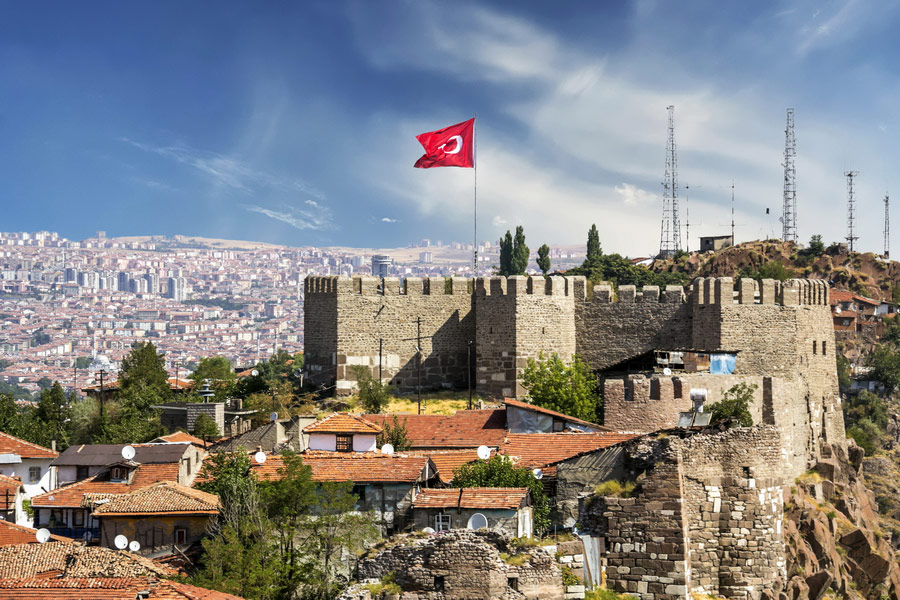
From here, a steady climb leads to Ankara Citadel, the old walled quarter that crowns the hill above Ulus. The lanes are narrow, the timber houses lean at gentle angles, and the views over the city are among the finest in Ankara. Just below the citadel walls, the Museum of Anatolian Civilisations occupies a restored Ottoman bedesten and is, by any measure, one of the finest archaeology museums in the country – well worth setting aside an extra hour.
For those with an interest in more recent history, Anıtkabir, the mausoleum of Mustafa Kemal Atatürk, is a short taxi or metro ride away and a deeply moving experience in its own right.
How to Get to Hacı Bayram Mosque and Mausoleum
Getting to Hacı Bayram Mosque and Mausoleum from central Ankara is straightforward whichever way you choose to travel.
By Metro: The easiest public transport option is the Ankara Metro. Take the M1 line (Kızılay–Batıkent) to Ulus station. From there, allow around 15–20 minutes to walk uphill. The route is well known locally, and signage in the area is generally clear.
On foot: From Ankara’s main railway station (Ankara Garı) or the edge of Gençlik Park, the complex is about a 15–25 minute walk, depending on your pace and chosen route. The walk gradually ascends towards Ulus, taking you through one of the capital’s older districts.
By Bus: Several city buses stop at Ulus and Opera, both of which are within walking distance. For example, lines 266 and 427 serve these stops (routes can change, so it is best to check EGO for the latest timetables).
By Taxi: A quick and inexpensive option from most central hotels. Simply ask for Hacı Bayram Camii in the Ulus district.
Tips for an Optimal Visitor Experience
The Hacı Bayram Mosque and Mausoleum receive both worshippers and visitors throughout the day, and the atmosphere is one of openness rather than formality. A few simple courtesies will help you feel at ease and help keep the atmosphere comfortable for everyone.
Dress modestly: Shoulders and knees should be covered for both men and women. Women are encouraged to bring a scarf to cover their hair. If you forget, scarves are sometimes available to borrow at the entrance.
Shoes: Footwear is removed before stepping onto the carpeted areas inside the mosque. Wearing slip-ons makes this a good deal easier.
Plan around prayer times: The mosque welcomes visitors throughout the day, and if you happen to arrive during a service, waiting quietly for a few minutes is all that is needed. Friday midday, when the congregation gathers for Jumu'ah prayer, tends to be the busiest period of the week.
Once inside: A gentle pace and quiet voice are naturally appreciated, particularly when worshippers are present.
Photography: Photography is permitted throughout the complex, but flash should be avoided. It is considered discourteous to photograph worshippers at close range without their permission.
After exploring the mosque and mausoleum, you may find yourself drawn back to the square. The broad steps and fountains create a natural place to pause, with shaded corners that invite a moment of rest. From the benches along the edge of the plaza, the setting comes into focus in a way that is easy to miss when moving between the buildings: Roman stone and Ottoman timber stand side by side, while the ordinary rhythms of daily life unfold around both.
In time, the architectural details may fade from memory, yet the atmosphere lingers. This is a place that has never become merely a relic. Prayers continue, visitors come and go, and the square itself remains part of the city's living fabric. In this sense, Hacı Bayram is less about grandeur than about presence – a corner of Ankara where past and present meet quietly, without ceremony.