

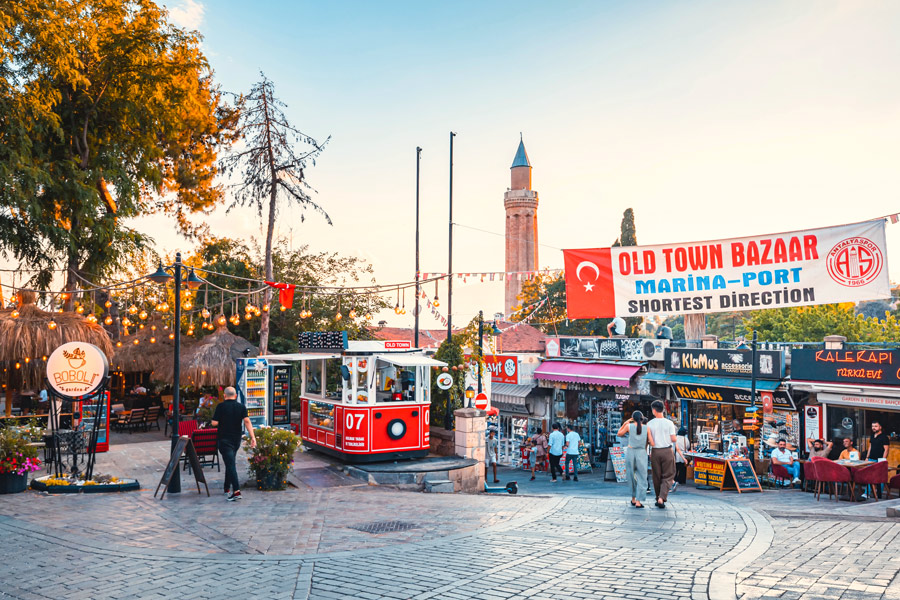
The Antalya Old Bazaar, a place of colour in the capital of the Turkish Riviera, has been trading for centuries. The moment visitors arrive, the senses take over: spice stalls on one side, the Turkish street food on the other, barber shops with bright signs, jewellery displays catching the light, and somewhere in between, a vendor arranging a fresh pyramid of dried apricots.
Look up in some sections and see strings of blue, green, yellow, and red umbrellas. In others, Turkish flags and the red-and-white banners of local football club Antalyaspor ripple overhead.
The bazaar divides into sections, though this only becomes clear after a few minutes of walking. At first, everything seems jumbled together. A single lane might offer a clothing stand, a food counter, a jeweller, and a barber facing each other across the cobblestones. And yet it works.
This is a historic bazaar in Antalya’s Kaleiçi old town — part market and part lively neighbourhood.
History of Antalya Bazaar
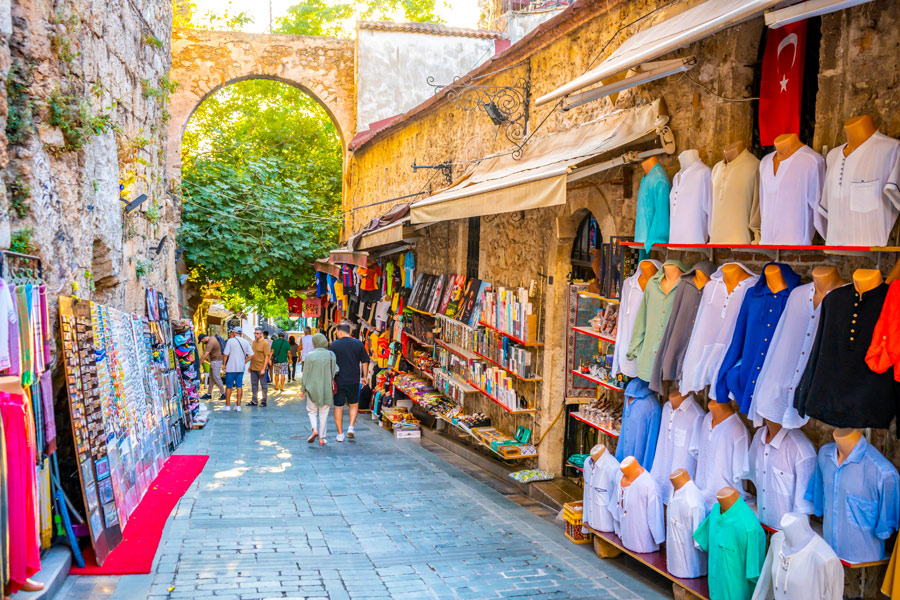
Antalya was founded around 150 BC by Attalus II Philadelphus (220 — 138 BC). When the Romans arrived, Kaleiçi had already been an established commercial centre. The bazaar area grew steadily through the Byzantine period, but it was during the Seljuk and Ottoman eras that it took the shape visitors recognise today.
The Ottomans organised trade in bedesten (enclosed roofed markets) by grouping specific crafts into dedicated street sections — coppersmiths in one lane, textile merchants in another, spice sellers in a third. Antalya’s bazaar was primarily open-air, and clustering was present but not strictly enforced. And it likely included smaller enclosed commercial structures, bedesten, found in Istanbul and other Ottoman cities.
Many of those groupings survive informally to this day. The main trading artery, Uzun Çarşı Caddesi (Long Market Street), has been the commercial spine of the Antalya bazaar for centuries.
Valuable goods were often concentrated in covered markets. At the same time, hans (urban caravanserais) supported this system by providing accommodation and storage for travelling merchants.
What to Buy in Antalya Old Bazaar
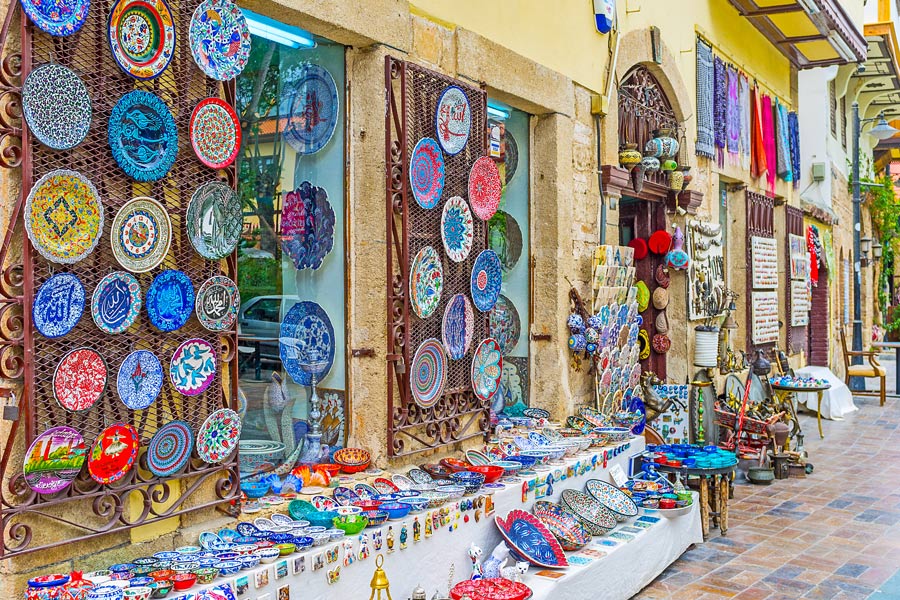
The local products in Antalya's bazaar burst with diversity. Some are made by hand in craft studios a few streets away. Others have travelled from across Turkey.
Turkish Coffee
Freshly ground Turkish coffee is a compact souvenir to buy at the Turkish market. Several shopkeepers sell it ground to order, sometimes mixed with cardamom for a richer flavour.
You can try preparing and drinking at home — a small pot, low heat, and the thick settle at the bottom of the cup. By the way, the Turkish coffee culture is recognised by UNESCO under the Representative List of the Intangible Cultural Heritage of Humanity.
Spices and Dried Foods
The heaps of spice can be mesmerising. Saffron in small glass vials, sumac in deep purple mounds, dried figs and apricots arranged by size, and shelf after shelf of selections for Turkish tea. The vendors know their stock well and are usually happy to talk through what each spice is used for.
Turkish Sweets
Turkish delight (lokum) bought loose from the Antalya Old Bazaar is a different thing entirely from the boxed versions sold at airports. The flavours of rose, pomegranate, and saffron are fresh. There is also baklava in a dozen varieties, candied nuts, and soft fruit jellies.
Ceramics
Turkey's decorative heritage is hard to imagine without hand-painted ceramics. And the bazaar features a wide selection. The deep cobalt blues and terracotta reds translate well to European interiors. Interestingly, Antalya boasts a dozen excellent ceramic workshops. You may consider attending one of them.
Glass Items
Turkish hand-blown deep blues, turquoise, and amber glasswork has a warmth and irregularity that machine-made glass simply does not. Tea glasses, decorative bowls, and small lanterns are all common finds. The nazar boncuğu, Turkey's iconic blue glass eye, is sold in every size, from small keyring pieces to large wall hangings.
Gold and Silver Jewellery
There are plenty of gold and silver jewellery shops in the Antalya Old Bazaar. In some cases, the artisan who makes a piece is the same person who sells it. The designs draw on Ottoman and Anatolian traditions. These are intricate filigree work, geometric patterns, and pieces set with turquoise, carnelian, or onyx. Bracelets, rings, necklaces, and earrings are all well represented. Many silver items have a 925-hallmark stamp.
Carpets and Textiles
A handwoven carpet (kilim) is perhaps the most exclusive thing to bring back from any Turkish bazaar. These flat-weave rugs carry the patterns of specific regions and tribes, each design with its own history. The bazaar stocks pieces from across Türkiye. Scarves, cushion covers, and embroidered textiles sit alongside the rugs for those looking for something smaller.
Unique Shopping Experiences in Antalya's Old Bazaar
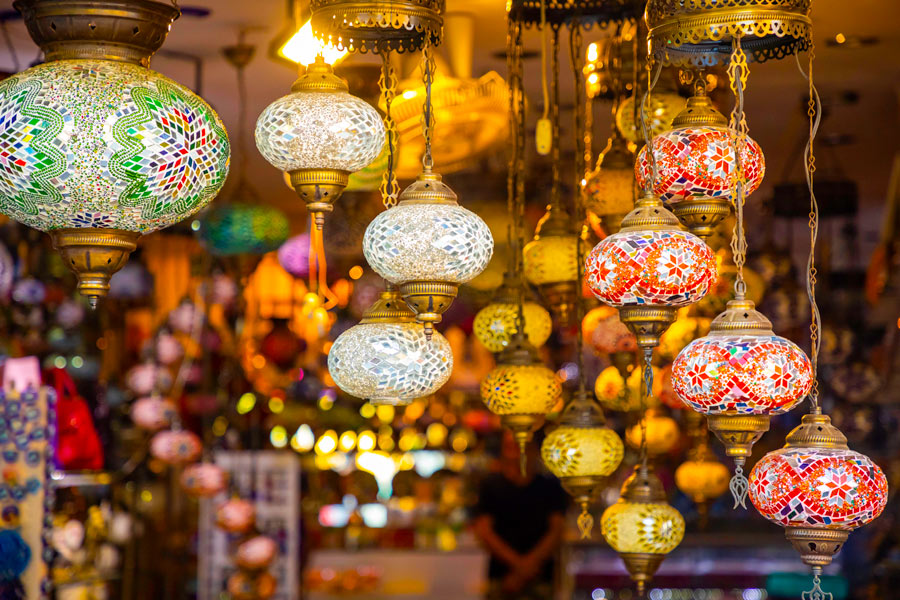
Beyond browsing stalls, the unique shopping in Antalya comes from the atmosphere itself.
- Watch a craftsman at work in the mosaic lamp workshop.
- Visit a traditional tea house mid-morning before the crowds arrive. Turkish tea culture, jointly inscribed by Türkiye and Azerbaijan on UNESCO’s Intangible Cultural Heritage list, plays a central role in hospitality and daily social life.
- Several small kahvehane (coffee houses) are just off the main street, entirely frequented by locals.
- Walking through the bazaar, visitors will almost certainly stumble upon Bindallı Hediyelik — a bridal souvenir shop. It is housed in a building that was once a hammam. The domed ceilings alone are amazing. And then there are the goods themselves, revealing what might be Turkey's most joyful tradition.
- The old caravanserais - Tek Kapılı Han (One-Gate Inn) and İki Kapılı Han (Two-Gate Inn) are among Antalya's most prominent reminders of its long history. They were the backbone of the Silk Road trade network. Today, Hans sells carpets, leather, and souvenirs.
- The bazaar spills naturally onto Kazım Özalp Caddesi. This is the pedestrianised street that has been the commercial spine of central Antalya since 1994. Named after a general of the early Republic, it connects the old town to the modern city.
Cultural Shopping in Antalya: What the Bazaar Represents
The Antalya Old Bazaar is one of the best bazaars in Antalya, not because it is the largest, but because it sits within a genuinely historic context. Walking Uzun Çarşı Caddesi represents a cultural shopping in Antalya. The buildings are real. Some trades being practised have roots going back generations. Even the arguments between shopkeepers and suppliers are part of a rhythm that has continued here for centuries.
The bazaar is a working market. That means some counters sell cheap souvenirs alongside authentic crafts. And it also means prices are negotiable, and the narrow lanes can get crowded in high summer.
Advice for Visiting the Kaleiçi Old Bazaar
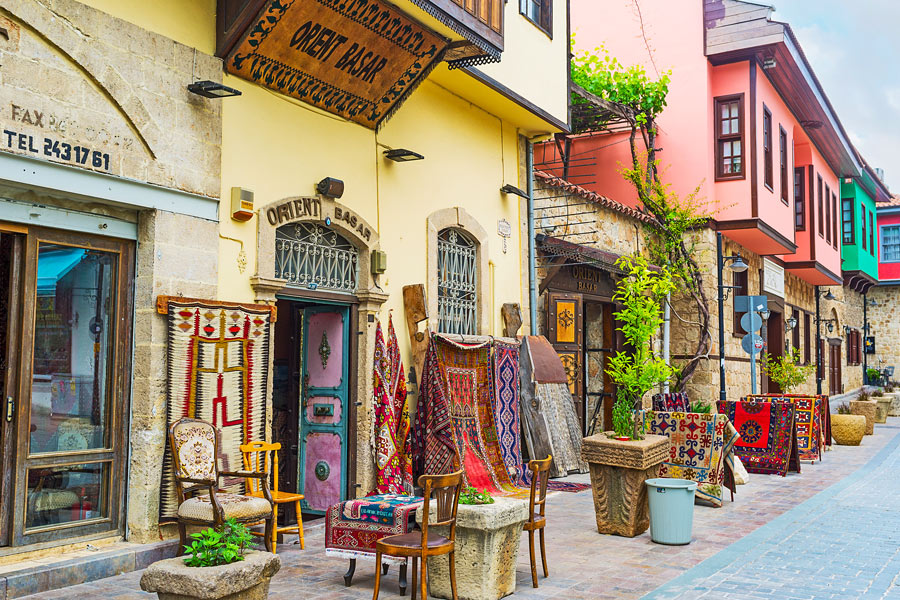
When to Visit
The bazaar district is accessible at all hours. It is a public area of the city rather than a single venue with set opening times. Most individual shops open between 9:00 and 10:00 and close between 19:00 and 21:00. In summer, many stay open later.
Best Time to Visit
Early morning, between 9:00 and 11:00, is when the bazaar belongs to the locals. Deliveries are made, shopkeepers prepare their displays, and the lanes are quiet enough to appreciate the architecture. This is the best time for photography and unhurried browsing.
Late afternoon, from around 17:00, is another good window, as the worst of the summer heat has passed. Avoid the mid-afternoon peak in July and August when tour groups move through in large numbers.
April, May, and October are warm enough to enjoy wandering without the intense summer heat. The bazaar trades year-round, though some smaller shops close in January and February.
Ramadan
If visiting during Ramadan, expect a shift in pace. Many shops open later in the morning and trade vigorously after iftar (the evening meal that breaks the fast). The bazaar in the evenings during Ramadan has a particular energy — busier, livelier, and quite different from the usual daytime atmosphere.
Money
Currency exchange offices (döviz bürosu) are plentiful along Kazım Özalp Caddesi and throughout the bazaar area. ATMs are also readily available, with several clustered near Hadrian's Gate (Üçkapılar) and along the main pedestrian street. Most larger shops accept cards; smaller ones and food vendors strongly prefer cash.
Where to Eat Nearby
For a sit-down meal after a morning in the Antalya Old Bazaar, Mekan Avicenna is well worth seeking out. It is a 5-minute stroll from Hadrian’s Gate, a pleasant spot with live music in the evenings.
Getting Around
- Wear comfortable, flat shoes: The cobblestones throughout Kaleiçi are original, beautiful, but uneven.
- On bargaining: Negotiating is expected on most goods, especially leather, jewellery, and textiles. Walking away is not rude. On the contrary, it often leads to a better deal.
- Hydration: In summer, temperatures in the bazaar lanes can climb quickly, and shade on the main street is limited. Several small cafés sell fresh juice and tea at affordable prices.
How to Get to Antalya Historic Bazaar
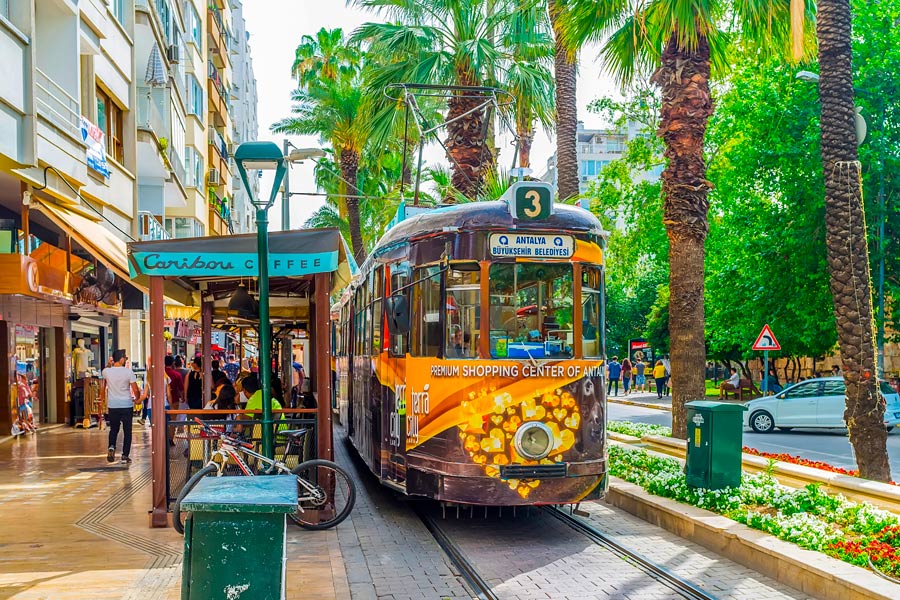
The Antalya Old Bazaar sits within walking distance of most hotels in central Antalya. The main entrance points are through Hadrian's Gate to the east and via Kalekapısı Square to the west.
- On foot: Most of Kaleiçi is pedestrianised. Walking is the most practical option if staying anywhere near the city centre.
- By tram: The Antalya tram (T2) runs along Atatürk Street with a stop near Hadrian's Gate (Nostalji Tramvay Durağı) — a short walk from the main bazaar entrance.
- By taxi: Taxis can drop you at Hadrian's Gate on Atatürk Street.
- Parking: There is paid parking along the Old Harbour below Kaleiçi, shown on Google map as Otopark. From there, it is a short uphill walk into the bazaar.
Nearby Landmarks to Include in the Trip
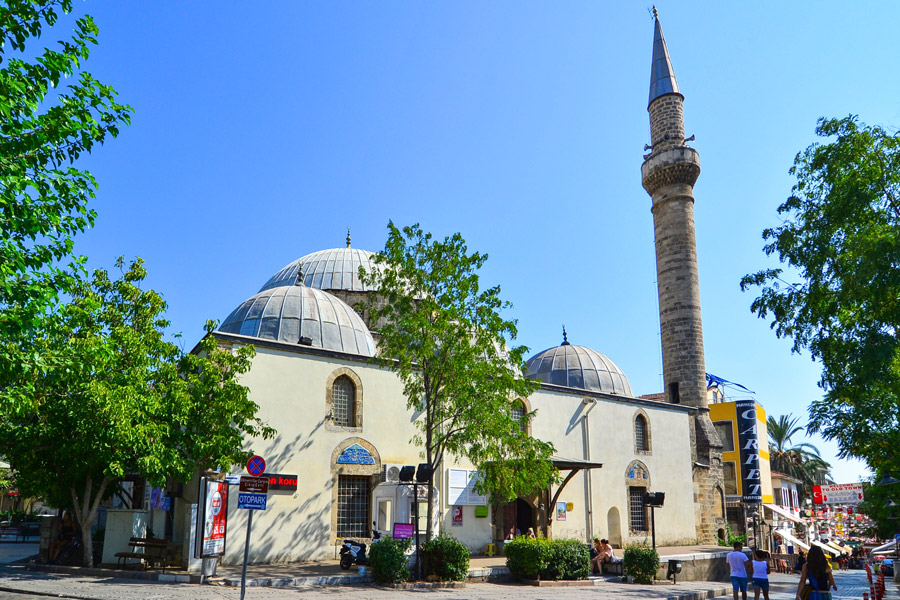
The bazaar connects naturally with several of Antalya's most significant historic sites, all within walking distance. These are Hadrian's Gate, Clock Tower, and Antalya Museum.
Several historic mosques sit within or just beside the Antalya Old Bazaar, including Tekeli Mehmet Pasha Mosque near Kalekapısı Square. Larger landmarks such as the Yivli Minaret Mosque rise just beyond the bazaar’s edge, while smaller structures like Iskele Mosque appear closer to the harbour below.
Antalya Old Bazaar and Türkiye's Other Great Bazaars
For anyone wondering how the Antalya Old Bazaar compares to the best bazaars in Antalya and beyond, the answer is straightforward: one has walls, the other does not.
Turkey has some of the most celebrated bazaars in the world, and two in Istanbul define what most visitors picture before they arrive: the Grand Bazaar and the Egyptian Bazaar (Spice Bazaar). Both are magnificent and different in character from what you find in Antalya.
The Grand Bazaar in Istanbul is a city within a city. The Spice Bazaar follows the same logic on a smaller scale. The two grew from the best tradition of bedesten: purpose-built, roofed, lockable market halls designed to house valuable goods. You arrive, you enter, you leave.
The Antalya Old Bazaar belongs to a different tradition. There is no building to enter. No gate to pass through. No roof and no clear boundary where the market begins or ends. It is a network of open streets — a çarşı in the oldest sense. Commerce simply settled where people already walked.
Frequently Asked Questions
Is the Antalya Old Bazaar free to enter?
Yes. The bazaar is part of the public streets of Kaleiçi. There is no entrance fee, no ticket, and no set boundary where the market begins or ends.
What are the opening hours?
Most shops open between 9:00 and 10:00 and close between 19:00 and 21:00. The streets themselves are open at all hours. Hours vary slightly in winter and during Ramadan.
Is bargaining expected?
Yes, on most goods other than food. Fixed-price shops usually display a sign to that effect. In all other cases, polite negotiation is entirely normal and expected.
How long should I allow for a visit?
A focused visit to the bazaar itself takes around 90 minutes. Combined with Hadrian's Gate, the Clock Tower, and Yivli Minare, allow a full half-day of three to four hours.
Is it safe?
Yes. Kaleiçi is one of the most visited historic districts in Turkey and is generally very safe for tourists. The usual precautions apply — be aware of your surroundings in crowded lanes and keep valuables secure.