

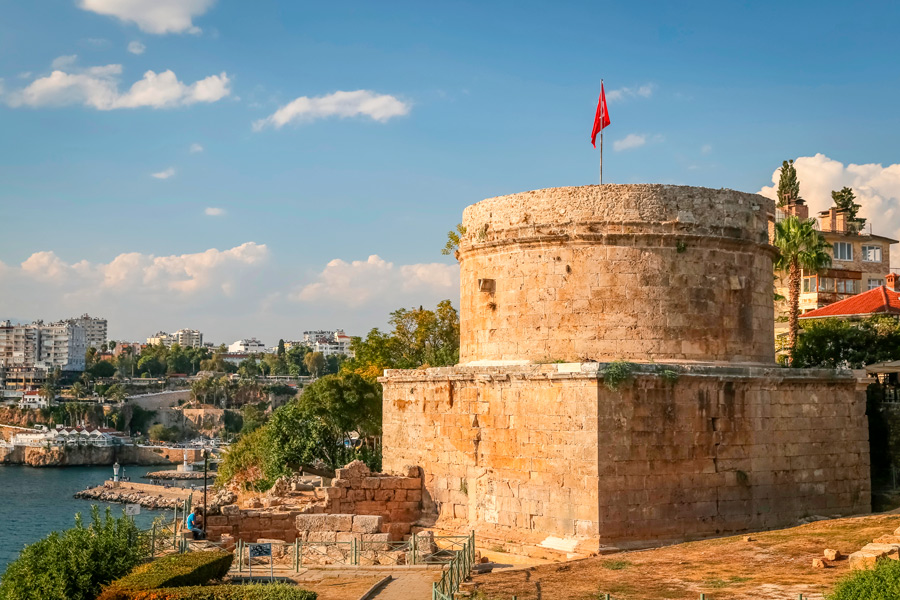
Most of Kaleiçi pulls inward – into narrower lanes, smaller courtyards, the compressed logic of a walled city. Hıdırlık Tower is where that logic stops. The old walls reach the edge of the promontory, the cliffs drop to the sea. And suddenly, there is nothing ahead but open water. The tower itself stands at this junction – fourteen metres of Roman limestone, built[1.1] in the 2nd century AD as a tomb, a lighthouse, or a watchtower. And nobody is entirely certain which.
People come to this corner of Antalya for the position – the point where the city runs out, and the view takes over. The lanes of Kaleiçi narrow as they approach, the buildings press closer, and then the ground simply ends. The Old Harbour lies directly below, the Gulf beyond it, and the horizon is uninterrupted in a way that catches even seasoned visitors off guard. It is the widest view in Kaleiçi, and the least expected.
Best Time to Visit Hıdırlık Tower
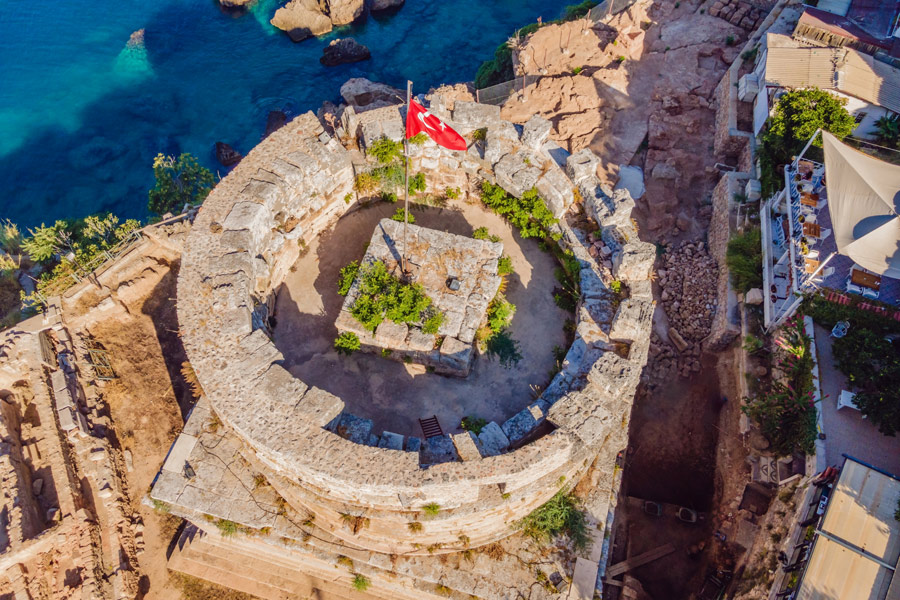
The Hıdırlık Tower rewards those who choose their moment. Spring and autumn are the most rewarding seasons – the air is clear, the light is low enough to read the stonework, and the upper ground is never crowded.
Spring (April – May) is probably the finest time to come. Temperatures sit around 18 – 25°C (64 – 77°F), Karaalioğlu Park below the tower is in full leaf, and on clear mornings the Beydağları peaks are still snow-capped on the horizon. Before 09:00, this part of Kaleiçi is very nearly empty.
Autumn (September – October) runs it close. The crowds have thinned, the air has cooled to the mid-20s °C (mid-70s °F), and by four o'clock the shadows on the Roman stonework run long enough to pick out the different building periods in a way the flat midday light never quite allows.
Summer (June – August) is hot. The clifftop is exposed and temperatures regularly reach 35 – 38°C (95 – 100°F). Come before 10:00, when the air is still cool, or return in the evening. The heat lifts after 18:00, the harbour moves into shade, and the sky over the water runs through colours that the midday glare erases entirely.
Winter (November – March) empties this area almost completely. The mild Mediterranean winter makes for a comfortable walk on most days, and the view – without haze, without crowds – has a sharpness that the warmer months cannot match.
What are the Opening Hours?
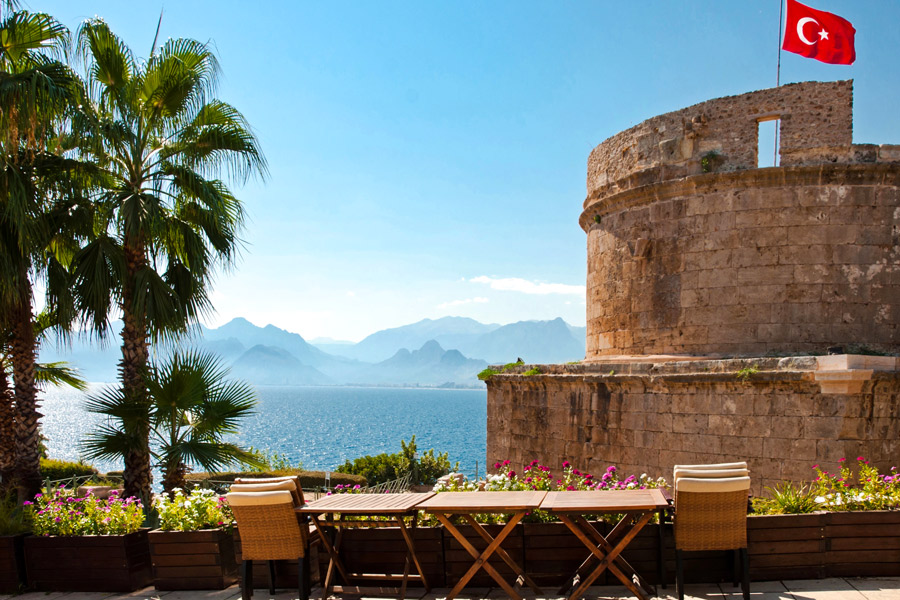
Hıdırlık Tower has no fixed opening hours. As an open-air monument within the Kaleiçi district, the tower and its surroundings are accessible at all hours. That said, the ground around the tower is uneven – come during daylight.
Practical Information
Hıdırlık Tower is straightforward to visit independently. No booking is required, and no guided tour is necessary.
Address: Selçuk Mah., Kaleiçi, 07100 Muratpaşa, Antalya Contact: Antalya Provincial
Directorate of Culture and Tourism
Tel: +90 (242) 238 11 11 | Email: antalya@ktb.gov.tr
How to Get to Hıdırlık Tower
On foot from Kaleiçi: From Hadrian's Gate, follow the old city walls westward. The route passes the Kesik Minaret and takes around 15 minutes at a comfortable pace – less if walking briskly, longer if stopping.
On foot from Karaalioğlu Park: Enter the park from Atatürk Caddesi to the south and follow the main path uphill along the cliff edge. The tower appears at the upper boundary, where the park meets the promontory.
By tram: The nostalgic T2 tram stops at Kalekapısı, in front of Hadrian's Gate. From there, walk west through Kaleiçi – around 15 minutes. Trams run every 30 minutes from 07:00 to 23:00.
By taxi: Ask to be dropped at Hıdırlık Tower or at Karaalioğlu Park. From the city centre, the journey takes around 10 minutes.
History of Hıdırlık Tower
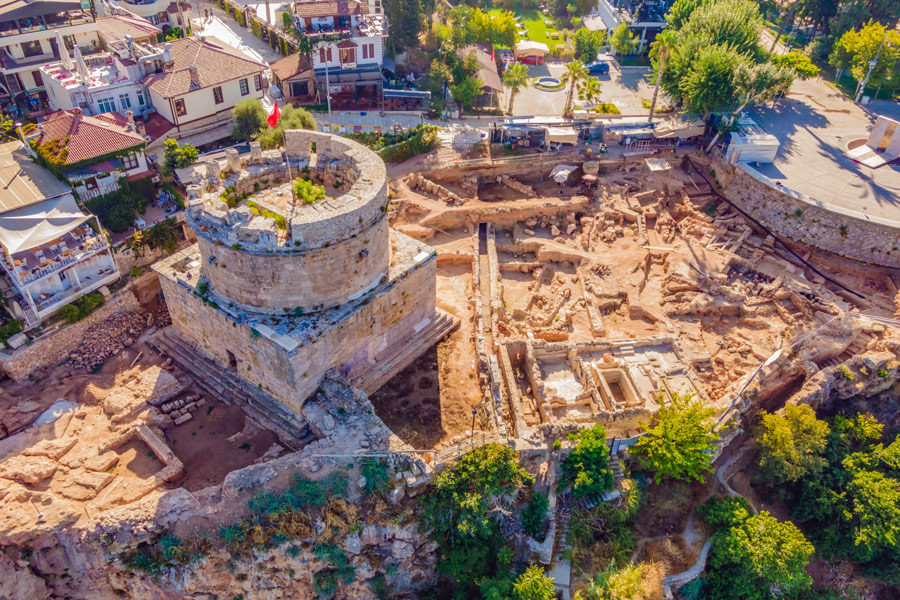
When the tower was built in the 2nd century AD, Antalya – Roman Attaleia – was a prosperous port city, and the promontory of what is now Kaleiçi was already centuries of settled urban ground. The prevailing view among scholars is that the structure began as a mausoleum: a tomb for someone of prominence, built outside the city walls as Roman burial custom required[3.1]. The cylindrical upper section, the quality of the stonework, the scale – all of it points in that direction. Whether it also served as a lighthouse is less certain, though the position above the harbour mouth made the idea an easy one for later centuries to adopt.
When the Byzantines rebuilt the defensive circuit, they incorporated the tower into the walls rather than working around it. The upper level was adapted for archers. The basement became a chapel – and remained in religious use until the 19th century. At that point, the municipality found a less distinguished purpose for the interior and used it as a storage depot until around 1950.
The name comes from none of this. Hıdırlık derives from Hıdırellez, the spring festival marking the turn of the season – a celebration with deep roots across Turkey and the wider region. The clifftop here was long associated with it, and the name has stayed on the structure ever since. The tower has outlasted the festival's prominence, the chapel congregation, and the storage requirements of the mid-20th century. It is still here.
Hıdırlık Tower Highlights
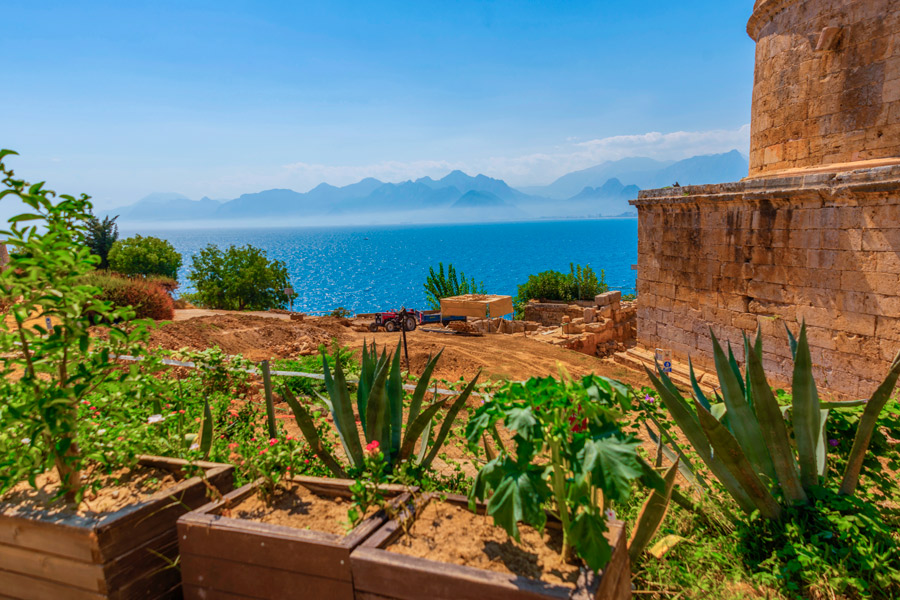
Hıdırlık Tower and the ground around it offer two distinct experiences – the tower and clifftop itself, and the municipal park that runs along the edge below it.
The Tower and the Clifftop
The stonework repays attention. The lower courses are Roman – large, carefully cut blocks of limestone, the joins still tight after nearly two thousand years. Higher up, the repairs begin to show: Seljuk work, then Ottoman, each period using what was available and leaving a slightly different texture in the wall. The point where the land walls meet the sea walls beside the tower is the most readable stretch – three centuries of repair work visible in a single glance.
From the cliff edge, the drop is more immediate than expected. The harbour basin sits directly below, the masts of the moored yachts pointing upward rather than across. Beyond it, the Gulf opens south – nothing between the cliff edge and the open sea. On a clear morning, the peaks are still white on the horizon – sea ahead, snow behind – and no land in sight.
Karaalioğlu Park
The Karaalioğlu Park that runs along the promontory below and beside the tower is a municipal park in the straightforward sense – shaded paths, old trees, benches placed for the view, small cafés open through the afternoon. Families come in the evenings. Older residents walk routes they have been walking for years. It is not a heritage zone dressed up as a garden, and that is precisely what makes it worth the time.
The section nearest the tower is open and exposed, with water visible on three sides. Walk east, and the path descends from the cliff edge, the trees thicken, and the atmosphere changes – more sheltered, more local, less concerned with the view. By the time the café appears through the branches, the tower is still visible in the distance, smaller than expected and easy to forget you were just standing beside it.
Tips for an Optimal Visit
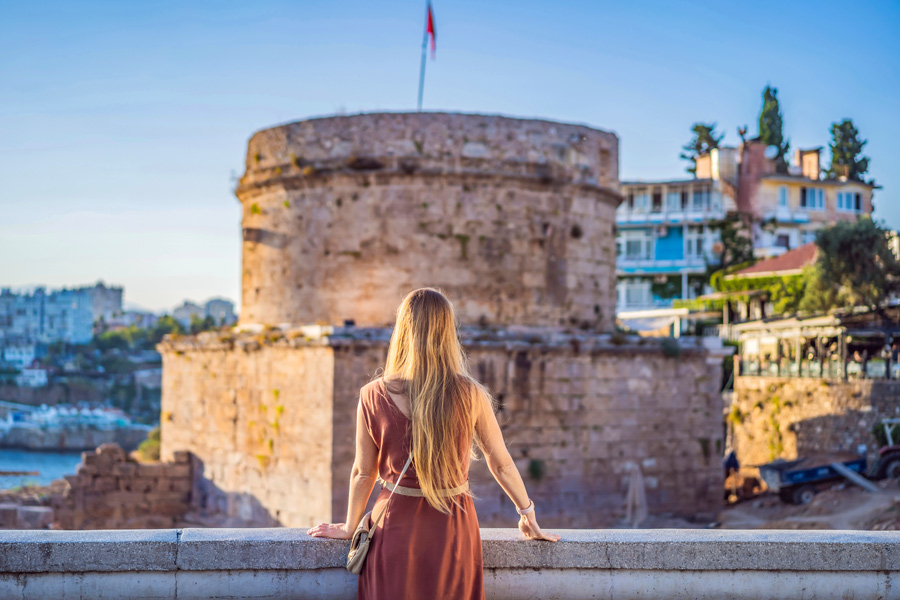
Recommended duration: The tower and its surroundings take around 20 – 30 minutes if you are moving with purpose. Allow an hour if you are not. Most visitors combine this with a half-day through Kaleiçi and the old harbour.
Suggested route: Start at Hadrian's Gate and walk west through Kaleiçi – 15 minutes to the tower, with the Kesik Minaret worth a pause along the way. From the top, descend to the old harbour via the Venetian Steps, which takes around 10 minutes and opens up angles on the walls and the marina that the higher ground does not show.
Footwear: Flat, comfortable shoes. The ground around the tower is uneven, the path through Karaalioğlu Park has some gradient, and the Venetian Steps demand care in both directions. Modest dress is appropriate if visiting the Yivli Minaret Mosque along the route.
What to bring: Sun protection for the open ground above the sea, particularly between April and October.
The best time to leave is when the light finally goes – when the harbour below shifts from gold to grey and the first lights appear on the water. Most evenings, that takes a while.