

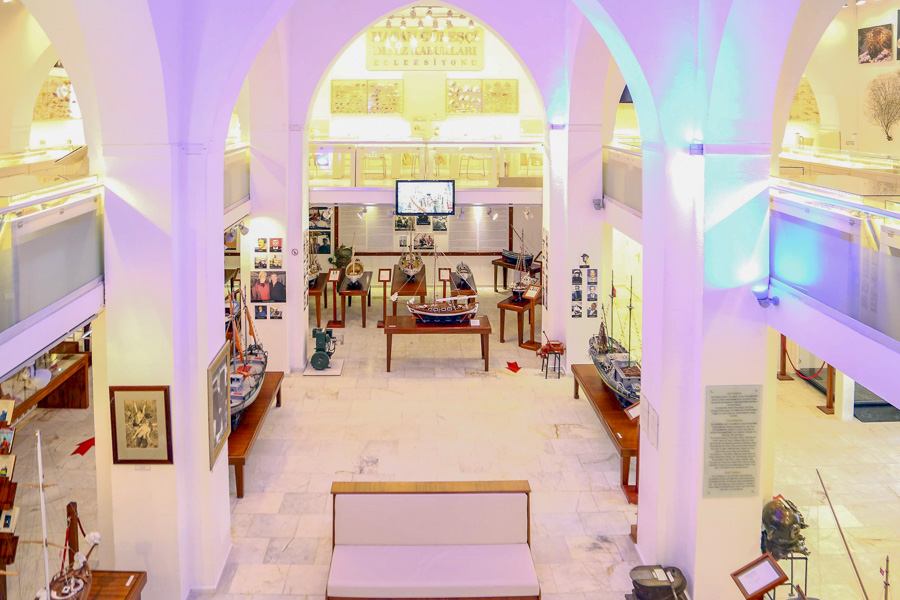
Photo source: www.bodrumdenizmuzesi.org
Please note: The museum's official channels currently list it as temporarily closed. Please confirm its reopening and current opening hours directly with the museum bbbbbbbvbefore planning a visit.
Address: Çarşı Mahallesi, Nazım Hikmet Sokak No. 4/1, 48400 Bodrum, Muğla.
Contacts: +90 252 316 33 10
Email: info@bodrumdenizmuzesi.org
The Bodrum Maritime Museum (Bodrum Deniz Müzesi) is the town's record of its own life at sea, set in a restored bedesten in the old bazaar a few streets back from the harbour. A door off the lane opens out of the heat and the noise into a cool, stone-floored room. Inside, small boats sit in rows behind glass. They are wooden, rigged and painted, some small enough to lift in one hand, others the length of a table – and every one is a scale copy of a full-size vessel that once worked this coast. The market carries on outside. The boats fill the ground floor.
History of the Bodrum Maritime Museum
Almost every model here was made by one man. Ali Kemal Denizaslanı was born into a Bodrum that still lived by the sea, the son of a fisherman, and he went out on the water before he took up a trade. He became a boat master. For years he ran his own small yard, building the wooden gulets and tırhandils his neighbours sailed. Then he sold the yard. Motor craft and fibreglass were replacing the boats he knew. He spent his last years making them again at model scale, faithful down to the rigging, so that the shapes would not go under with the men who had sailed them. Bodrum called him Büyük Usta, the Great Master. He died in 2012, in his late sixties, and left the fleet he had carved to the town.
The boats themselves came out of one upheaval. When the 1923 population exchange sent Muslim families across from Crete and Cos to this shore, some brought sponge diving with them, and the harbour soon needed boats of its own. The first were built almost by accident. A Cretan settler called Mehmet of Nami set out to make himself a boat knowing nothing of the craft; his father took one look and called it a barge. Stung, Mehmet sailed to the Greek island of Kalymnos, where the good builders were. When they would not teach an outsider, he climbed a cypress tree beside a yard and watched them work from the branches. He came home and built a proper one. In 1933 he laid down Bodrum's first tırhandil, a ten-metre boat named Atilla, for a sponge merchant, and the sponge money did the rest. Within a generation the town had scores of yards, and its boats had grown from small divers' craft into far bigger sailing vessels.
The museum came late to all this. It began in 2010 as a single tent pitched in front of the castle during the yacht festival, with eighteen of Ali Kemal's models inside. The response was enough to win it a permanent home. The town restored a two-storey bedesten – an old covered market of some 450 square metres in the Çarşı quarter – and the Bodrum Maritime Museum opened there in October 2011.
Highlights
The visit follows the plan of the building, starting downstairs.
The Model Fleet
Around forty-eight models stand on this floor. The full-size boats they copy fell into three Bodrum types. The tırhandil is pointed at both ends, the gulet has a clipper bow and rounded stern, and the aynakıç is the same hull with a square stern. Panels on the walls, in Turkish and English, trace how boatbuilding here was lost for centuries and then rebuilt from almost nothing in the twentieth. Many models carry the name of the real boat and the family that owned it. Between them they record the families who fished, dived and carried freight along this coast.
The Sponge Divers' Room
Sponge diving was the hardest of Bodrum's sea trades. On show are the tools of the work. The heavy pump-fed suit the divers called mancorna hangs beside the surface pump that once fed it air. Nearby sits the older method: a flat marble stone, the skandalopetra, that a naked diver clutched. The new diving suit brought a different danger. Nobody yet understood decompression, and men trained for centuries to surface as quickly as they could were now coming up too fast from far greater depths. Between the 1880s and 1910, thousands of divers across the Aegean were killed and many more left crippled before the cause was known. The sponge disease of the 1980s and cheap synthetic sponge finished the trade, and diving for sponges is now banned in Turkish waters apart from one small stretch of the northern Aegean. The suits and pumps in these cases are what is left of it.
The Fisherman of Halicarnassus
One corner belongs to the man who carried this seafaring world to the rest of the country. Cevat Şakir Kabaağaçlı was sent to Bodrum in exile in 1925, went out with the sponge crews, and wrote about their lives under the name the Fisherman of Halicarnassus. His writing gave this seafaring world a wider audience and helped popularise the coastal journeys that became known as the Blue Voyage. His family gave the museum his papers, photographs and personal effects, shown here beside the boats he wrote about.
The Shell Collection Upstairs
Upstairs, the boats give way to shells. The floor holds one man's collection – several thousand of them, gathered from beaches and reefs around the world and arranged by family in lit cases. Hasan Güleşçi and his wife Gülsen picked up their first shell in 1961, the year they married, on the coast near Adana, and kept at it for half a century wherever his work took him, from Japan to Zanzibar. The cases run through cowries, cones, conches, murexes and a giant clam, no two repeating a colour or a shape. A note on the wall adds the thing a visitor might miss in a room this decorative. Every shell was built by the animal that once lived in it, and stays behind as the house it left.
How to Get There
On foot: the museum sits inside the pedestrian bazaar, on Nazım Hikmet Sokak just off Cevat Şakir Caddesi, directly opposite the post office. From Bodrum Castle the walk is 5 to 10 minutes through the bazaar lanes; from the marina, closer to 10 minutes.
By dolmuş: shared minibuses from Gümbet, Bitez and the other peninsula towns run to the central bus terminal (otogar) on Cevat Şakir Caddesi, a 5-minute walk from the museum. Dolmuşes run frequently throughout the day, and fares are paid on board in cash.
By taxi: metered taxis wait throughout the town centre and at the bus terminal. Since the museum sits inside the pedestrian bazaar, the final few minutes are on foot regardless of how a visitor arrives.
Tips for an Optimal Visit
Recommended duration. Half an hour to an hour. It is a compact museum, best taken slowly.
Accessibility. The shell collection is reached by an internal staircase, and step-free access to the upper floor is limited. The model boats and the sponge-diving room are all on the ground floor.
Combine with. The two museums split the same subject between them. Bodrum Castle and its Museum of Underwater Archaeology, five minutes away, hold the ancient wrecks and cargoes raised from the seabed; this one carries the story into living memory, with the boats. The Mausoleum at Halicarnassus is a similar walk uphill. Together they fill an easy half-day.
Almost nothing in this building is the thing itself. The boats are models of boats, the originals long since broken up or motorised out of use. The diving suit hangs empty, in a trade these waters no longer allow. The writer is fifty years dead, and the shells upstairs are the houses their animals grew and left – echoing the note on the wall: what remains once the life has moved out. The sea it all describes has not stopped, though. A few hundred metres downhill the harbour is full of gulets, the broad descendants of the little tırhandils in the cases, built by the men Ali Kemal trained. They are still the first things out on the water.