

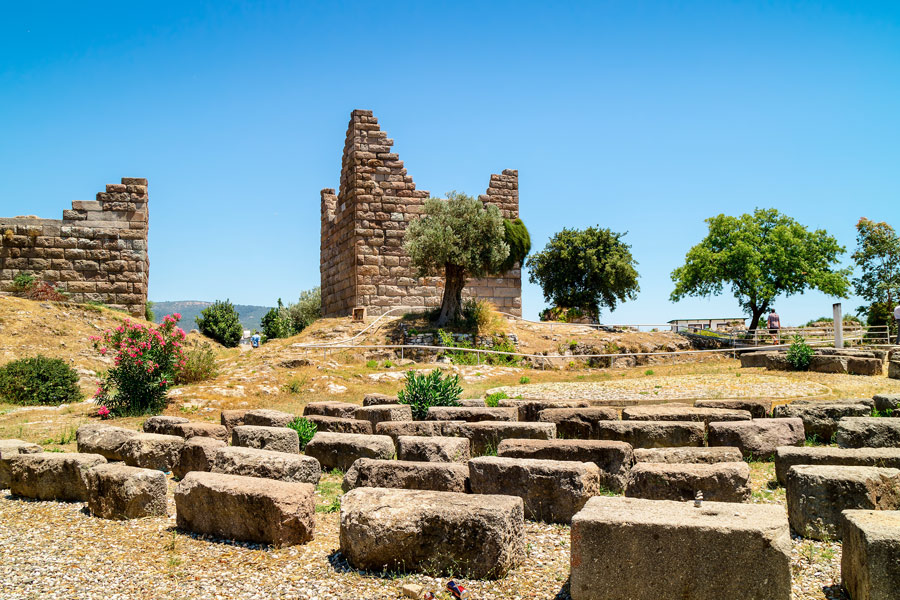
The coast road west out of Bodrum runs past the last of the hotels and turns dusty at its edges. Two stone towers stand off to one side, the colour of dry earth. A shallow ditch runs in front of the nearer tower. The gap between them is wide enough for a road and a little more. This was once the way into a city, and an army spent weeks trying to get through it.
Almost nothing of that city is left standing today. The gate is among its very last pieces, partially holding the shape it had when the wall ran through it. Few travellers walk this far out. The castle and the marina keep the crowds, while this stretch of old stone is left mostly to whoever is heading along the coast towards Gümbet. Even so, Myndos Gate is consistently listed among the top things to do in Bodrum, thanks to its historical importance and its connection to ancient Halicarnassus.
History of the Myndos Gate
The city was largely one man's work. Mausolus, the Carian ruler who governed this coast for the Persian Empire, moved his capital here in the 370s BC and rebuilt it on a grand scale. He pushed a new harbour out into the bay and raised a palace on the promontory. A wall some 7 kilometres long enclosed the whole city. It was broken by two monumental gates: one facing east towards Mylasa, the other west towards a small port called Myndos. The western gate is the one that survives, and it still carries the name of the road it once opened onto.The walls were tested within 20 years of his death. Alexander the Great (Alexander III of Macedon) crossed into Asia in 334 BC and worked his way down the coast, taking the ports one after another to deny the Persian fleet its bases. Miletus fell in July. He camped outside Halicarnassus in August, when he was 22 years old.
The defence was led by Orontobates, the Persian satrap, and by Memnon of Rhodes. Memnon was a Greek soldier in Persian pay, and the ablest commander the empire had in the field. The city had every reason to believe it could hold out. Its walls were new, its harbour sheltered a Persian fleet, and Alexander had arrived by land with no navy to close the sea behind it.
The heaviest fighting of the whole siege took place at this gate. Macedonian siege towers were rolled up to the moat, and the defenders answered with catapults and burning missiles before the attackers could get close. The defenders came out to burn the siege engines and were driven back hard. The men crowded onto the bridge over the ditch as they ran for the gate, and it gave way under them. Those who reached the gate found it already shut. Close to a thousand of the defenders died that day, against some 40 Macedonians, several of them among Alexander's own officers.
When Macedonian troops finally broke through the wall nearby, Memnon judged the city lost and set it alight, withdrawing his surviving men by sea to the island of Kos. Alexander led his army in through the burning streets, ordered the fires put out, and spared those who had stayed behind. The city itself he did not spare.
Highlights
The ditch comes first, then the towers, then the gap between them. That was the order in which the Macedonians met them.
The Two Towers
Three monumental towers of grey andesite once stood here, set around an inner courtyard, with a single passage running between them. The central tower was destroyed long ago. The two outer towers still stand, and one keeps close to its original shape at roughly 7 by 8.5 metres. A stone stair climbs one tower to a cramped platform near the top. From up there the purpose of the layout shows itself. Anyone in the passage below is caught from both sides at once.
The Moat
In front of the southern tower the line of the moat can still be read in the ground, some 56 metres long, 7 wide, and once about 2.5 deep. The water drained away centuries ago, and grass has taken over the floor of the trench. The ditch was too broad to jump and too deep to cross quickly. The towers stood on the far side of it.
The Roman Tombs
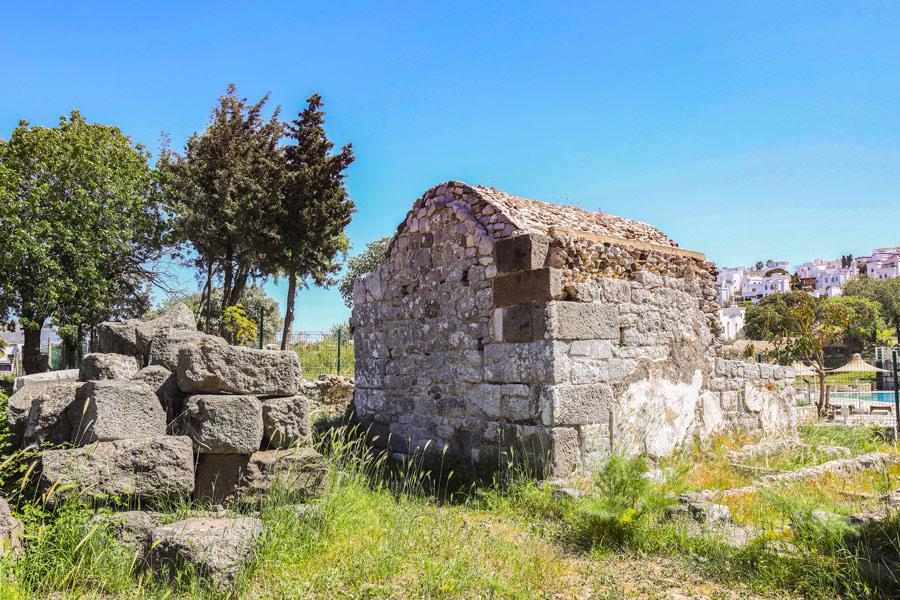
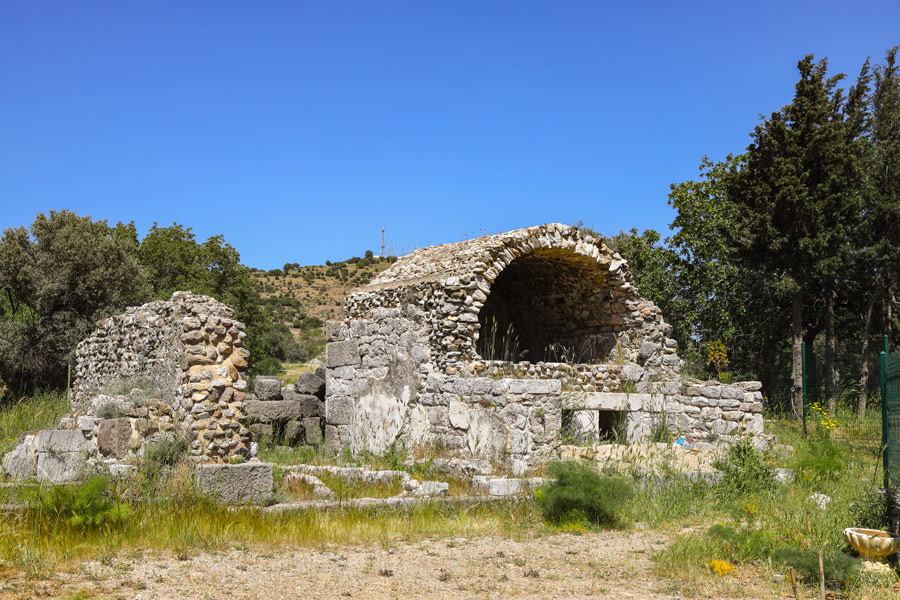
About a hundred metres west of the towers, a cluster of vaulted tombs sits low in the ground, easy to walk past without noticing. Only 17 of them survive, cut roughly 7 centuries after the siege, once Halicarnassus had settled into a long and quiet life as a Roman provincial town. [Text Wrapping Break]One tomb keeps its floor mosaic almost intact, a pattern of vine leaves and birds laid by someone who expected the dead to be visited for generations. A hotel paid for the restoration. It also kept the mosaic from going under a car park.
The View Towards Bodrum
From the top of the tower the town opens out to the east. Rooftops and hotel balconies run down to the two bays, with the pale shape of the castle on its point. Construction cranes and satellite dishes stand in the view as plainly as the sea does. Memnon's men watched the other way, out across open country, for relief that never came.
Practical Information
Address: The Myndos Gate stands in the Eskiçeşme district on the western edge of Bodrum, near the junction where the coast road bends towards Gümbet and Turgutreis. The Roman tombs lie about 100 metres further west.
Opening hours: Open access, unfenced and with no ticket booth. Information panels in Turkish and English stand by the towers and the moat.
Entry: Free.
Parking: Limited. A little roadside space sits near the site, though it is often easier to leave a car by the harbour or the bus terminal and walk the final stretch.
How to Get There
On foot: From Bodrum Marina or the castle the walk runs about 2 kilometres, some 20 to 25 minutes along the coast road, and it is signposted along the way.
By dolmuş: Shared minibuses running between Bodrum and Gümbet pass close to the site, and the fare is paid on board in cash.
By taxi: Available across the town centre and marina, the drive out takes only a few minutes.
Tips for an Optimal Visit
Recommended duration. 20 to 40 minutes covers the towers, the moat and the tombs, with a little longer needed to climb the tower or linger over the mosaic.
Best time of day. Early morning or late afternoon are the most comfortable, since there is almost no shade on site and the midday sun is heavy in summer. The lower light also rakes better across the old stone.
What to bring. A hat and water in the warm months, and flat closed shoes for the tower stair, which is uneven underfoot.
Combine with. Bodrum Amphitheatre lies about fifteen minutes further on foot, while the Mausoleum and the castle sit back towards the harbour, together making an easy half-day among the remains of Halicarnassus.
Every use this ground has been put to has ignored the one before it. The Romans chose it for their dead because it was quiet and lay beside a road. The hotel that owns their field today is there for the sea. Neither had the siege in mind, and neither needed to. The towers stand a few metres from the tarmac, and the grass at their feet is the same grass as the verge.