

Address: Orak Adası lies in the Gulf of Gökova, Bodrum district, Muğla Province.
Opening hours: No fixed hours; accessible on boat trips running mainly from May to September.
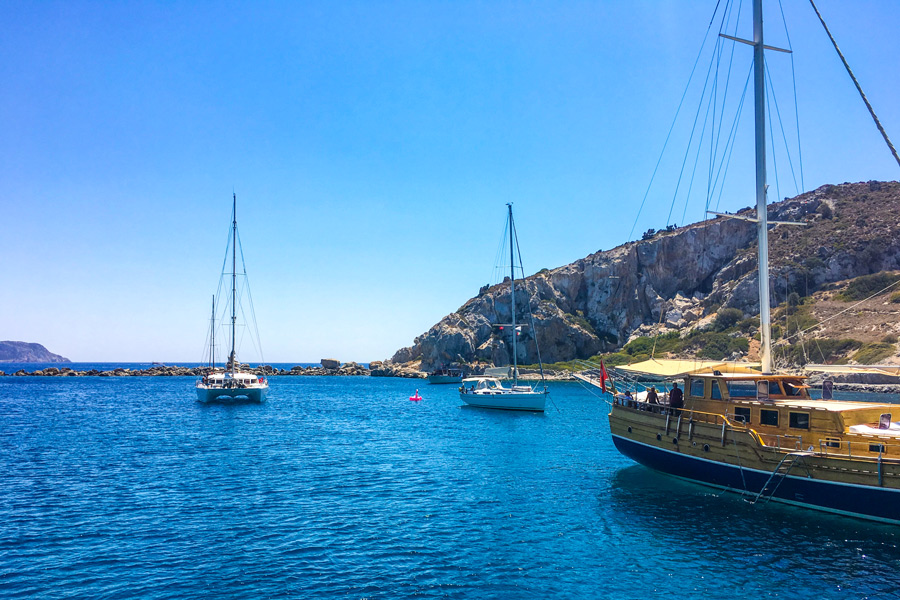
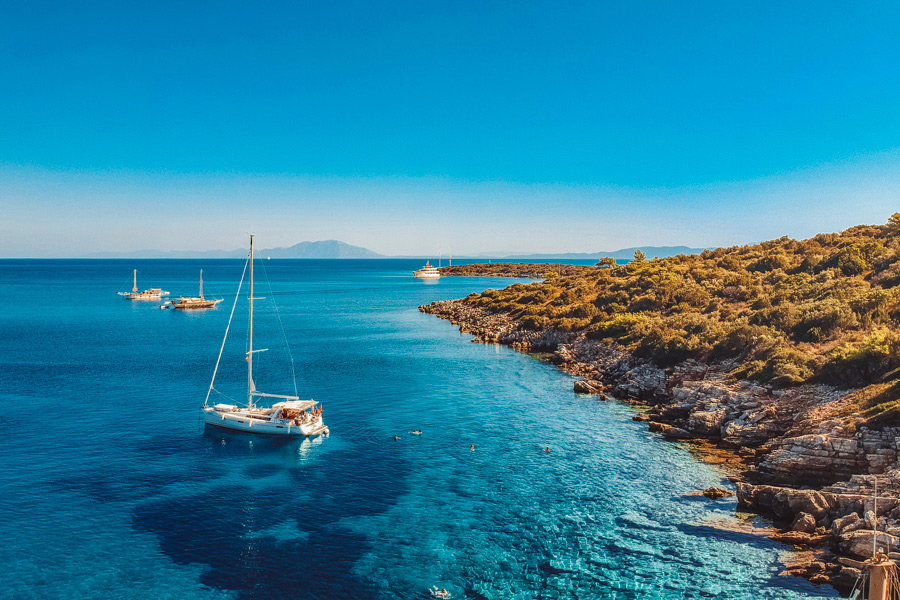
Orak Island sits out in the Gulf of Gökova, an hour or so south-east of Bodrum by boat. The water changes colour on the way in, from ink-blue to a pale, glassy turquoise. A few metres down, sand gives way to patches of weed and bare rock. It is a long, low ridge with olive trees along the top.
Boats anchor off the rocks, and people swim straight from the deck. Almost nobody goes ashore. Most stay an hour or two, then move on to the next bay along the coast.
History of Orak Island Bay
Nobody has ever lived on Orak. There is no fresh water, and an island with no spring grows olives and little else. People come out to it for a different reason, one that goes back to a single man and the boats he first went out on.
In 1925 the writer Cevat Şakir Kabaağaçlı was sent to Bodrum in exile. He went out with the sponge fishermen, learned the coves of the Gulf of Gökova by the names the crews gave them, and took the pen name Fisherman of Halicarnassus. Friends came down from Istanbul to visit – writers, painters, translators – and he put them on the boats and showed them the water. The first trip made for pleasure rather than sponges went out around 1945. Within twenty years it had a name – mavi yolculuk, the Blue Voyage – given by one of the writers aboard, and later the title of a book about the trips.
That route still runs past Orak: wooden gulets have replaced the sponge boats, and the people aboard swim where the divers once worked. The moorings have not moved – a skipper today drops anchor in the same spots the sponge crews used. Orak has been one of the fixed stops on the run since the boats were still under sail.
Highlights
The bay works on two levels – a snorkeller's and a diver's – and they barely overlap.
The Water
The colour comes off the seabed. Over pale, clean sand the water glows turquoise; over weed and rock it sinks to green, then a deeper blue. A swimmer crossing the line between them feels the temperature change with the colour. On a calm day the visibility runs to many metres. It is the best snorkelling stop on a standard day out from Bodrum, which is why the boats call the island the Turkish Maldives. The comparison is about the sand and the water. There are no palms, and no resorts.
The Reef Wall Below
Near the shore the seabed slopes down gently. Off the point that faces the open gulf, it stops sloping and drops away in a near-vertical wall, past thirty metres and on down towards seventy. Divers follow it the way they would a cliff face, with open blue on one side and rock on the other. At around thirty-two to thirty-four metres a cave cuts into the wall, its roof and sides thick with purple sponge. The wall itself is the draw. There is marine life to spot along it – a lobster in a crevice, sea bass hanging in the current, now and then a thornback ray out over the sand below – but not in great numbers.
The state of the water here goes back to a decision made in 1988, when the Gulf of Gökova was declared a Special Environmental Protection Area. For years Orak and nearby Akyarlar Point were the only two spots on this coast where diving was allowed at all. Foreign divers still have to go down with a licensed Turkish guide. Fewer boats and tighter rules have kept the water much as it was.
The Island Above the Waterline
The island itself is worth a look up from the water, though most people keep their heads down. It runs about 1,800 metres end to end, low and dry, with old olive trees growing across the slopes. A lighthouse stands at one end, white and simple, and flashes through the night for passing boats. Two anchorages sit on opposite shores, and the skipper takes whichever one is out of the wind that day. A small islet, Kıstak Adası, lies just off the western tip. Orak is the Turkish word for a sickle, though the shape is clearer on a map than from the water.
Practical Information
Access: By boat only. There is no road, no ferry service and no jetty. The island is reached on a day cruise or a private charter, most of which leave from Bodrum's harbour beside the castle between about 10:00 and 11:00 and return in the late afternoon – a round trip of some six hours.
Entry: Free. There is no ticket, since nothing on the island can be charged for. The cost is the passage: a shared day cruise is inexpensive and usually includes lunch on board, while drinks are commonly billed as extra. Private charters cost more and set their own timing.
Facilities: None on the island. Food, water and lavatories are all on the boat.
Diving: Arranged through the licensed dive centres in Bodrum and Gümbet, which run their own boats to the site rather than the general day fleet.
How to Get There
Day cruise: the usual way. Shared boats advertise along the harbour and marina and through the resorts, most running a set loop of three or four bays with Orak as the centrepiece. Booking a day ahead is enough in season.
Private charter: a hired gulet or motor yacht for a day or longer, with the route and the timing set by the party rather than the operator. The more flexible option, and the more expensive.
Blue voyage: on a multi-day gulet cruise into the Gulf of Gökova, Orak is a common first or second night's anchorage out of Bodrum, before the boats push east towards the Seven Islands and beyond.
Tips for an Optimal Visit
Choosing the boat. The boat is the one real choice, since the island is the same whichever one brings people out. A large party boat is cheap and sociable, but crowded and slow to arrive. A smaller one, or a private charter, reaches the anchorage earlier, before the midday crowd builds. That head start is the single thing that most improves the day.
Best time of year. June to September brings the warmest and clearest water, from midsummer well into the autumn. Spring is cooler and quieter, the sea a shade short of its summer best.
Best time of day. Late morning into early afternoon, once the sun climbs high enough to reach the seabed and set the sand alight. Early and late, the low light rakes across the surface and the colour drains from the bay.
What to bring. A mask and snorkel above all – the bay is wasted without them, and the sets loaned on board are rarely good. Sun cover matters, as the only shade is the boat's own awning. Water shoes help on the rockier edges.
For divers. The wall suits intermediate divers and up. It is booked through a Bodrum dive centre rather than a general day boat, and the deeper cave is for qualified divers only.
Combine with. Orak rarely stands on its own. The standard day threads it together with two or three neighbouring bays – commonly German Bay and Rabbit Bay (Tavşan Burnu) – so the outing becomes a tour of the south coast's water as much as a visit to one island. On land, Bodrum Castle and the Mausoleum at Halicarnassus fill the days between crossings.
Almost everything else worth seeing around Bodrum was built and then, over the centuries, carried off – the tomb quarried for the castle, the theatre buried under its own hillside. Orak had nothing built on it, so there was nothing to take. Its value is the water and the bright sand under it. Nobody can stay, either, so the boats hand the island back every evening. Late in the day the last of them lifts anchor and turns for the harbour, and the bay goes flat and empty behind it. After dark the only light on Orak is the lighthouse, still marking the bay for boats that have all gone home.