

Address: Kumbahçe Mahallesi, Zeki Müren Caddesi No. 11, 48400 Bodrum, Muğla.
Opening hours: Daily except Mondays, 08:30–17:30, with the ticket desk closing at 17:00. Hours are shortened in the winter season, so it is sensible to check the Ministry of Culture museum website before setting out.
The Zeki Müren Arts Museum sits a few streets back from Kumbahçe Beach, behind a low wall on a quiet residential lane. It is a white two-storey house with a garden, plain enough to walk past without noticing. Across the front, in a looping hand, three words are set into the render: Sevgilerimle, Zeki Müren – With love, Zeki Müren. The house itself is plain enough to walk past without noticing, with its flat roof, shuttered windows and a fig tree leaning into one corner. Bodrum's loudest run of bars begins two minutes away, and almost nobody heading towards it looks up at the wall.
For 16 years this was a private address, and the man who lived behind it was the most recognisable performer in Bodrum and in the country beyond.
History of the Zeki Müren Arts Museum
Zeki Müren was born in Bursa on 6 December 1931, the only child of a timber merchant whose family had come from Skopje (the capital of the Republic of North Macedonia today). In 1950 he won the soloist competition run by Istanbul Radio, and on 1 January 1951 he sang his first broadcast programme. At the same time he was enrolled at the Istanbul State Academy of Fine Arts, studying decorative arts and pattern design. Those two trainings never came apart. The student who learned to draw a repeating motif became the singer who designed the clothes he performed in.
Fame arrived quickly and stayed for 45 years. Zeki Müren composed close to 200 works and filled over 600 records and cassettes, alongside 18 films and a book of poems published in 1965. In 1976 he became the first Turkish artist to sing at the Royal Albert Hall in London. By then the costumes had become an event of their own: sequins, capes, platform boots and full make-up, all worn by a man singing the most classical repertoire his country had. In 1991 the state gave him the title of State Artist.
Müren bought the house in 1977 from the sociologist Fatma Mansur, and by 1980 he was living here for good, in a fishing town that had not yet been discovered by anyone else.
Heart disease and diabetes closed in through the decade that followed. For his last six years he stayed off the stage entirely, describing the time as a chance to listen to himself. He used only the ground floor, because the stairs had become too much. The upper storey stood empty, which is why it could later be filled with glass cases.
On 24 September 1996 Zeki Müren travelled to the TRT (Turkish Radio and Television Corporation) studios in İzmir for an evening arranged in his honour. The gift prepared for him was the microphone he had first sung into on the radio, 45 years earlier. He was taken ill during filming and died of a heart attack that night, at 64. Thousands followed the funeral in Bursa. His will had already left everything to the Turkish Education Foundation and the Mehmetçik Foundation, while the Bodrum house passed to the Ministry of Culture, which restored it and opened it to visitors in 2000.
Highlights
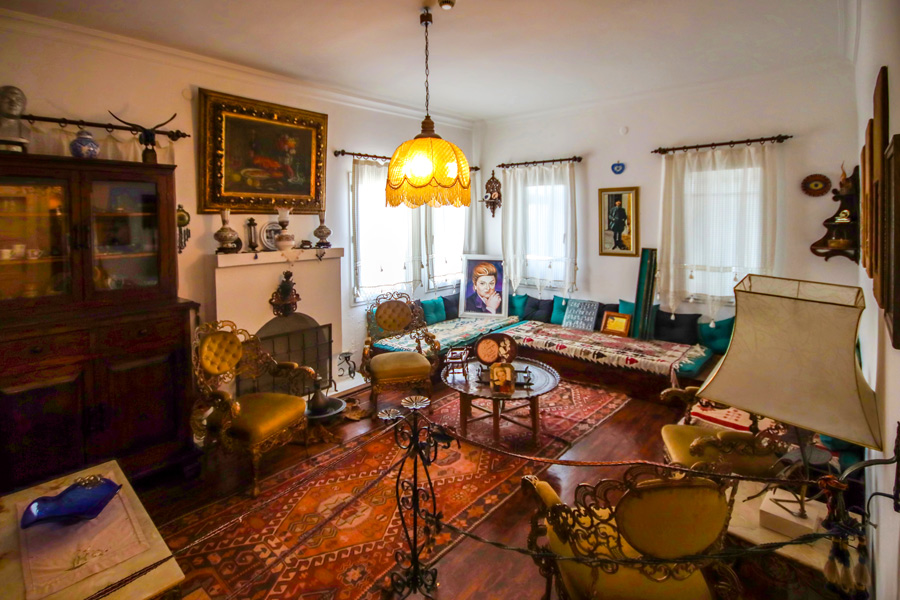
The plan of the visit is fixed by the plan of the house: garden, ground floor, staircase, upper rooms.
The Garden, the Statue and the Buick
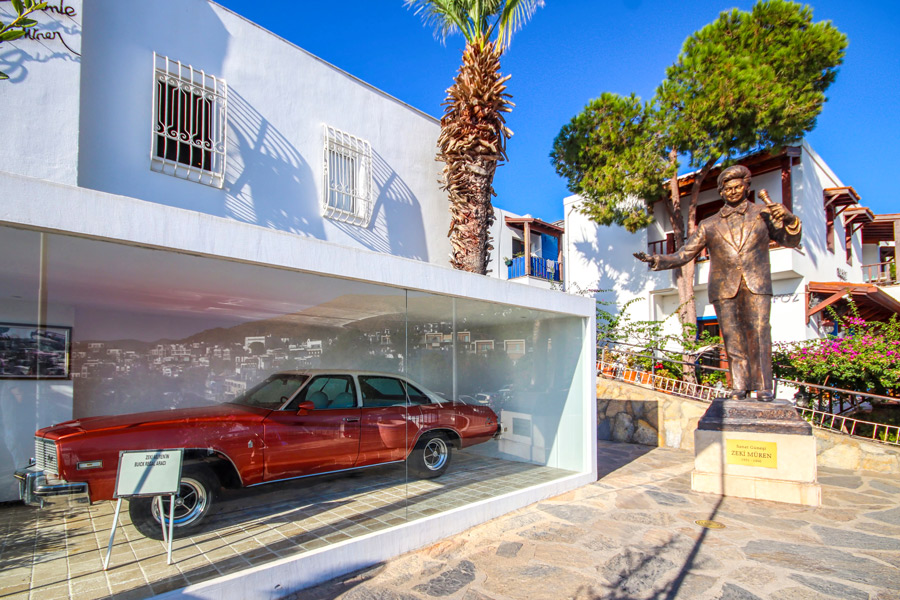
A bronze figure stands near the gate, made by the sculptor Tankut Öktem, microphone raised and mouth open on a note. Behind it, in a glazed pavilion, sits a 1976 Buick Regal, a four-door saloon in deep maroon, kept exactly as he left it. The car is the single most photographed object on the site, and it explains something the photographs of him do not. A car of that width, in a peninsula town of one-car lanes and donkeys, announced its owner from several streets away. He drove it for years, and by the end it was as familiar in Bodrum as the voice.
The Ground Floor
Plastic covers are handed out at the threshold and go over shoes before anyone steps inside, in the ordinary Turkish manner of a home rather than a museum. The floorboards are the ones he walked on. The front room holds an armchair, a television, a table where the newspapers were read and poems were written, and space enough for the two or three guests he saw in the afternoons. Some of the furniture and a gramophone were brought down from his Istanbul flat after his death. Nothing in the room would have cost much even at the time. Anyone arriving from the photographs of the sequinned stage will find the modesty of it the most surprising thing in the building.
The Costumes Upstairs
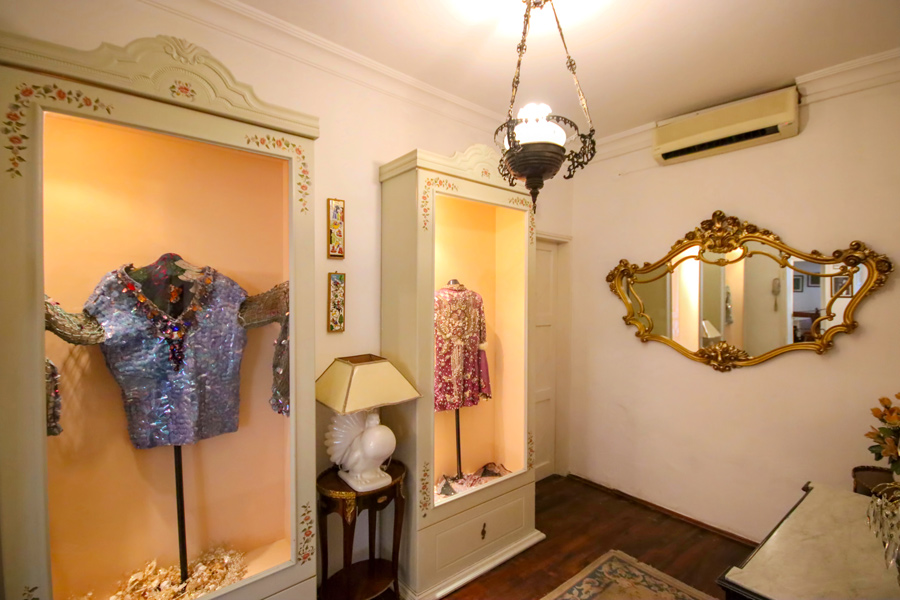
The upper floor is the museum proper, and it changes register the moment the stairs end. Stage costumes stand in lit cases: tunics worked in sequin and stone, capes, wide-legged trousers, boots built up on platform soles. Rings, bracelets and cosmetics are laid out beside them. His own drawings hang alongside — the working designs, in his hand, for garments he then had made. The Academy training runs straight through the glass. A man trained in decorative arts spent his career wearing his own coursework.
Müren painted for himself, without exhibiting much, and the pictures are hung through the upper rooms. The titles circle steadily around loneliness, distance and longing, with one small canvas called Mutluluk — happiness — standing almost alone against the rest. Letters from admirers are shown in cases nearby, along with awards, records and photographs drawn partly from the personal archives of the broadcaster Erkan Yolaç and the director Ülkü Erakalın. Read together, the letters and the paintings sit oddly against one another: adoration arriving by the sackful, and privately a body of work about being on one's own.
The Voice in the Rooms
His recordings play through the house all day, from small speakers in every room. Turkish visitors tend to react at once, and it shows on their faces. Anyone arriving without a word of the language still hears what he sounded like while standing in his front room, a few feet from his armchair.
How to Get There
On foot: from Bodrum Castle the walk runs about a kilometre east along the harbour and then the Kumbahçe seafront, roughly 10 to 15 minutes. From the beach itself it is five minutes uphill.
By dolmuş: shared minibuses run into Bodrum Merkez from Gümbet, Bitez and the other peninsula towns, arriving at the central bus terminal. From there the walk takes about ten minutes. Fares are paid on board in cash.
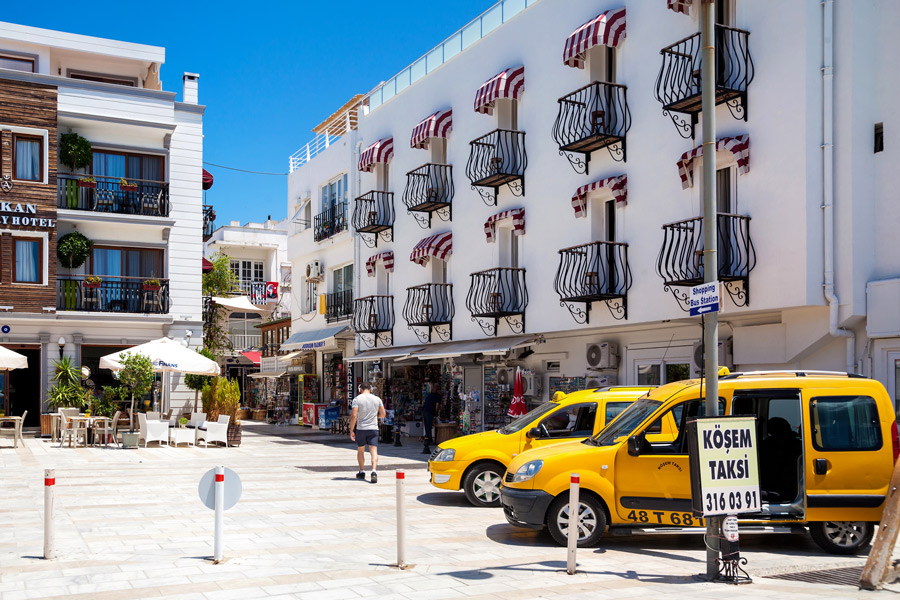
By taxi: metered taxis wait throughout the town centre and at the bus terminal. The final approach may still be on foot, as the lane is narrow.
Tips for an Optimal Visit
Recommended duration. Half an hour to an hour. The ground floor is two small rooms and takes a few minutes; most of the visit is spent upstairs among the costume cases.
Best time of day. The first hour after opening. Coaches arrive from the resorts later in the morning, and one group fills the upper floor.
Listen first. Labelling is almost entirely in Turkish, with a short English biography in the entrance hall. Half an hour with his recordings beforehand does more than any caption here, and the museum shop sells them by the door.
Accessibility. A narrow internal staircase runs between the floors, and there is no lift. Both the statue and the car stand in the front garden, in view from the gate.
Combine with. The castle sits ten minutes west along the water, and the Mausoleum at Halicarnassus a similar walk uphill, so the three fit comfortably into a half day.