

Address: Muradiye Mahallesi, Prof. Dr. Halil İnalcık Sokak, 16050 Osmangazi, Bursa
Location: Google Maps
Telephone: +90 (224) 716 37 37 (Bursa Museums); +90 (224) 716 37 32 (Qur’an and Manuscripts Museum)
Please note: the mosque has been closed for restoration since January 2026 and no reopening date has been announced.
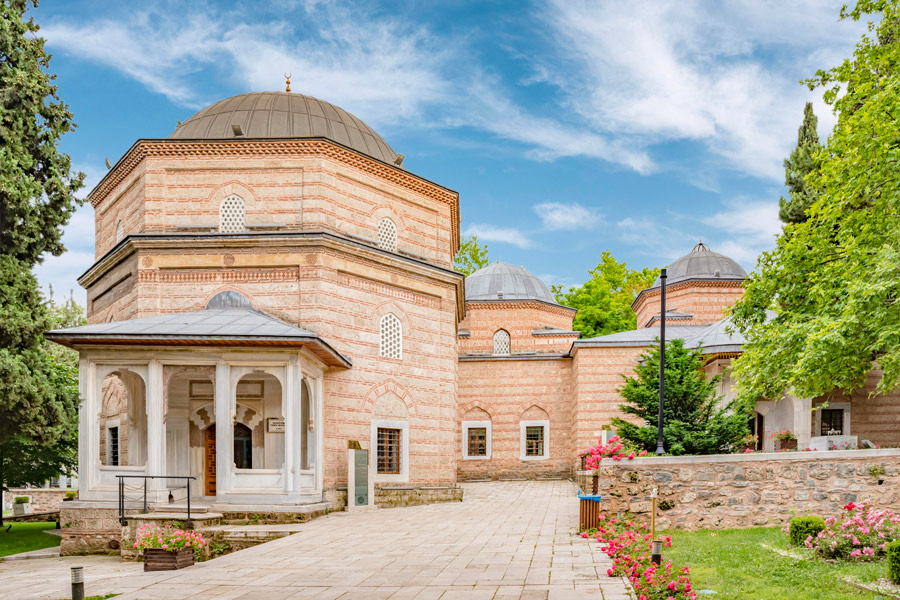
Founded by Sultan Murad II in the 1420s, the Muradiye Complex was conceived as a complete Ottoman külliye: a mosque, a madrasa (theological college), a public soup kitchen, a bath and a fountain, later joined by a walled garden of royal tombs. It gave its name to the Muradiye neighbourhood in the Osmangazi district on the western side of Bursa. A gate between the mosque and the madrasa opens onto paved paths. Cypresses and magnolias shade them, and roses grow along the edges. Low domes rise among the trees, in bands of brick and pale stone, and a small marble fountain still runs beside the path. Behind the garden wall, the traffic on the road outside fades to a murmur.
This was the last sultan’s complex built in Bursa, and few historical sites in Bursa feel as intimate. The garden holds a sultan, his consort and children, and princes of later generations, hardly any of whom lived to grow old.
History of the Muradiye Complex
Murad II, the sixth Ottoman sultan, spent his first years on the throne fighting his own family. After his succession in 1421, first an uncle and then a younger brother, both named Mustafa, laid claim to his crown. He had defeated them both, and then he began to build. In 1425 work started on a mosque west of the old citadel, and by November 1426 it was complete – the first part of the complex to be finished. The madrasa, the bath and the soup kitchen soon rose around it; houses followed, and the whole district took the name Muradiye.
Contemporaries remembered the sultan as a soft-hearted man, who loved music, poetry and the company of dervishes. In 1444 he did something no Ottoman ruler had done before: he gave up the throne to his 12-year-old son, the future Mehmed II, intending to spend his remaining years in prayer. Within weeks a crusading army crossed the Danube, and he was recalled. After defeating the crusaders at Varna that November, he withdrew once again. However, in 1446 the viziers brought him back to rule for good.
That summer Murod set down his wishes for his burial. He asked to be laid to rest in Bursa, beside his son Alaeddin, who had died in 1443, in a tomb with four walls and a roof open so that rain could fall on his grave. He also asked that none of his descendants should share the tomb with him. The wish was respected, as his children lie in the adjoining room rather than at his side. Murad died in Edirne in 1451, and his body was brought back to Bursa. His son Mehmed II – later known as Mehmed the Conqueror - built the tomb that same year. Murad was the last sultan to be buried in Bursa, as his successors were laid to rest in Istanbul. Over the next 130 years, princes and royal women filled his garden. Several of those princes died on the orders of a brother or father.
The earthquake of 1855 split the minaret and damaged the walls of the madrasa. The repairs that followed covered much of the old painting with plaster. Restorers working between 2012 and 2015 uncovered a good deal of it. In 2014 the complex joined the UNESCO World Heritage List as part of the ‘Bursa and Cumalıkızık: the Birth of the Ottoman Empire’.
Highlights
A map at the gate numbers the tombs along a single looping path. The route passes all twelve and ends back near the entrance.
The Mosque of Murad II
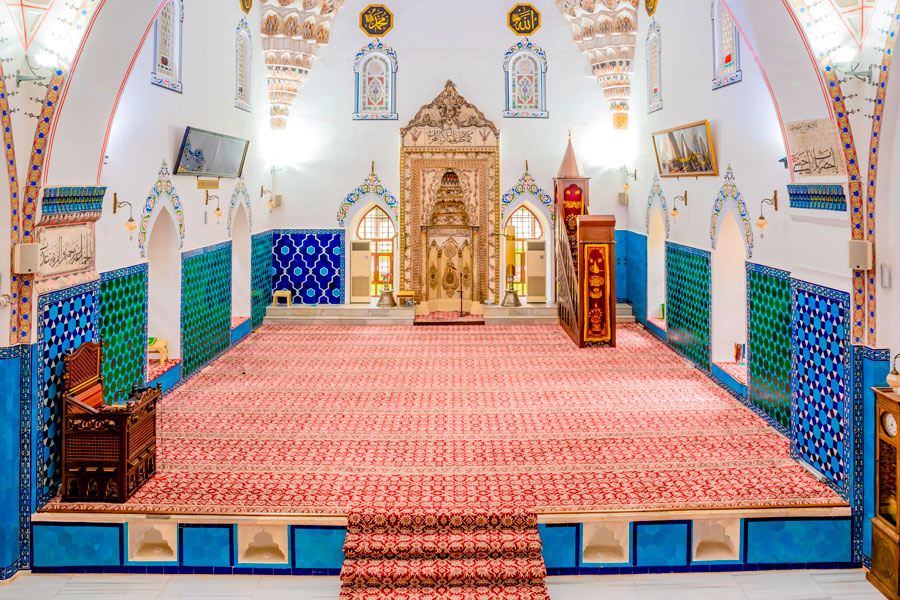
A porch of five arches runs across the front of the mosque, and above it the brickwork is laid in fifteen different geometric patterns. The wooden door is carved with inscriptions and assembled using kündekari technique, its pieces interlocking without nails or glue. Inside, two domed halls lead back towards the mihrab, flanked by raised side rooms that once lodged travelling dervishes. Hexagonal tiles in turquoise and emerald green line the lower walls; they were made by the same Tabriz craftsmen who tiled the Green Mosque. The white-and-gilt mihrab, by contrast, dates only to the 19th-century repairs that followed the 1855 earthquake.
In March 2026, restorers uncovered the remains of an octagonal pool inside the mosque. Edged with tiles, it appears to date from the building’s foundation. According to the restorers, the sound of its water masked the dervishes’ voices. The Ulu Cami and the Green Mosque still have similar pools in use.
The Tomb of Murad II
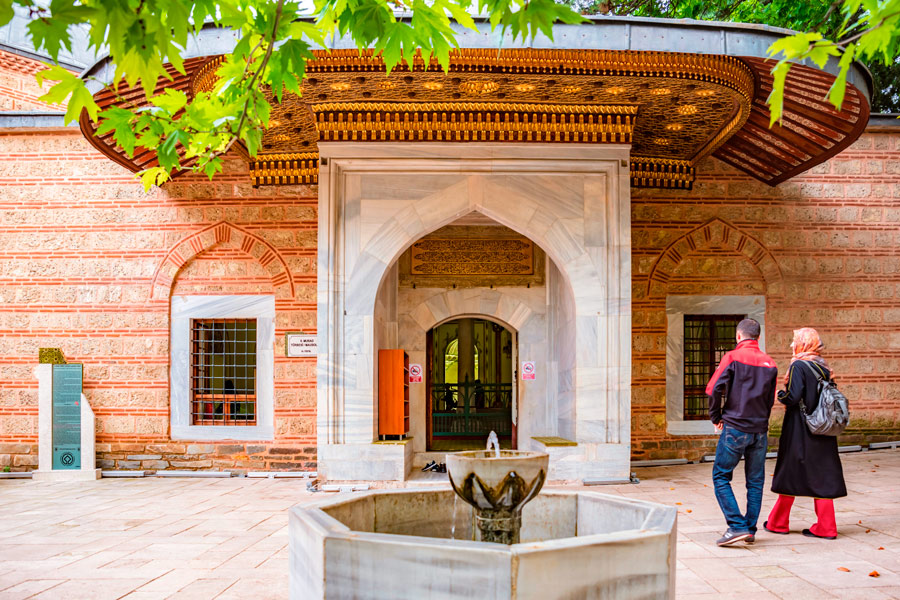
The founder’s resting place is plain, apart from its porch. A broad wooden canopy over the door is carved into tiny honeycomb niches and painted in deep red and gold. The doors beneath are decorated with twelve-pointed stars and silvered nail heads.
Inside, columns and piers carry the dome over a white-walled room. The columns’ bases and capitals were taken from Byzantine buildings, and behind them runs a gallery where reciters once read the Qur’an. The sultan lies at the centre, buried directly in the earth within a marble frame. Above him, the crown of the dome is open to the sky. On clear days a disc of sunlight crosses the floor, and when it rains, the water falls on his grave, just as he wished.
The Tomb of Şehzade Alaeddin
A doorway in the east wall of Murad’s tomb leads into a plain square room built for Prince Alaeddin, the son beside whom the sultan asked to be buried. Alaeddin, who had served as governor of Amasya, died there in 1443, the year before his father’s first abdication. Two of his brothers, Ahmed and Orhan, and a sister, Şehzade Hatun, lie with him. Ahmed was still an infant when Murad died in 1451, and he is usually identified with the young prince put to death on the orders of Mehmed II soon after his accession – one of the earliest cases of the fratricide that would shadow the dynasty for generations.
The Tomb of Cem Sultan
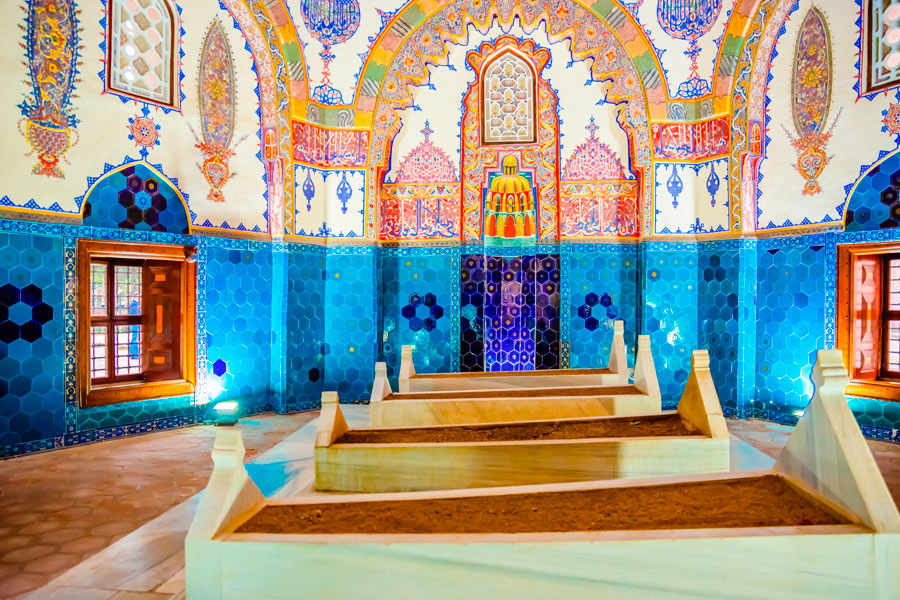
The garden’s most richly decorated building is a hexagonal tomb with a marble porch. It was most likely built around 1479 for Prince Mustafa, a son of Mehmed II, who died in 1474. He should not be confused with Süleyman the Magnificent’s son of the same name, whose tomb stands nearby. The building, however, takes its name from Mustafa’s younger brother, Cem. After their father’s death in 1481, Cem proclaimed himself sultan in Bursa and fought his brother Bayezid II for the throne, but lost. He fled to the Knights of Rhodes and became their hostage. For thirteen years he was held in France and then in Rome. A gifted poet who wrote in both Turkish and Persian, he died in Naples in 1495, and his body was only brought home in 1499.
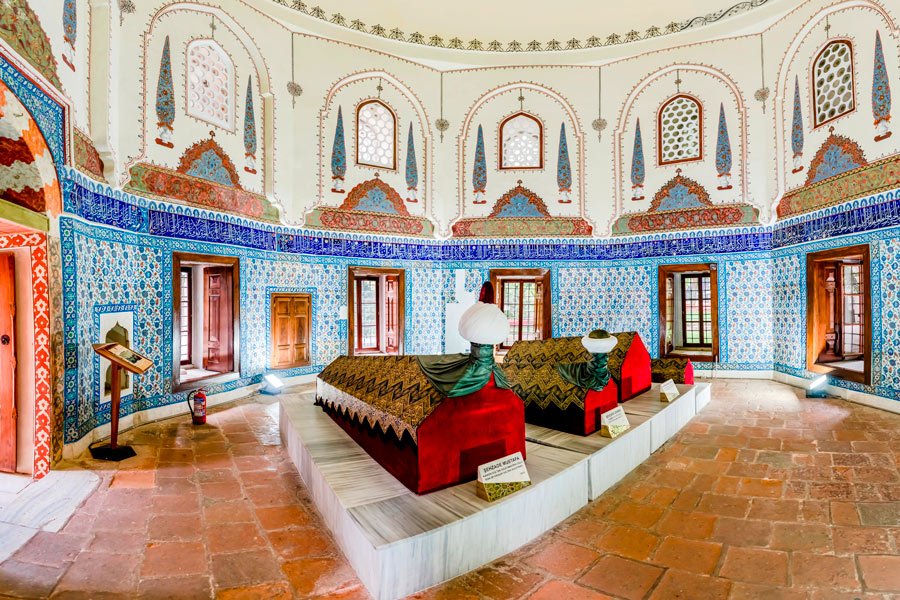
Turquoise hexagonal tiles, each framed in gold, cover the lower walls. Above them, painted vases send tall flowering stems up beside the windows. The dome is painted from rim to crown in floral and arabesque motifs. Four marble sarcophagi stand in a row. They are attributed to Mustafa, Cem and two of Bayezid II’s sons, Abdullah and Alemşah, but none bears an original inscription, so no one can say for certain which of them holds Cem.
The Tomb of Şehzade Mustafa
Nearby lies a different Mustafa: Süleyman the Magnificent’s eldest son and the army’s favourite, who died almost eighty years after his namesake. In 1553 he was strangled in his father’s tent at Ereğli. Twenty years later his half-brother, by then Selim II, built this tomb. İznik tiles cover the walls to well above head height. Tulips, carnations and hyacinths climb across them in blue, green and red. That bright red belongs to the best years of the İznik kilns. A band of white calligraphy on a cobalt ground run above the flowers. Higher up, painted cypresses stand on either side of each window.
His mother, Mahidevran, outlived him by almost thirty years, spending them in Bursa, where she fell deep into debt until Selim II settled what she owed. She was buried here beside her son in 1581. Two of Süleyman’s grandsons, Ahmed and Orhan, sons of Prince Bayezid, also rest here.
The Tomb of Şehzade Ahmed
An eight-sided building near the mosque and Murod’s tomb holds Bayezid II’s favoured heir. In 1512 his younger brother Selim seized the throne instead. Ahmed fought for it, lost, and was strangled in 1513. The order to build his tomb came from Selim himself, by then Selim I. Its wooden doors are carved using the same interlocking kündekari technique as the mosque’s. Korkut, another of their brothers, was executed the same year; he was first buried in Orhan Gazi’s tomb and later moved here.
The Tomb of Şehzade Mahmud
Prince Mahmud, another son of Bayezid II, died in 1507. His tomb shows two generations of tilework. Older-style turquoise and dark blue hexagons rise to almost three metres. Blue-and-white İznik panels, then a new fashion, frame the mihrab and windows. His three sons lie beside him, each in a marble sarcophagus.
The Women’s Tombs
Most of the smaller domes belong to women of the dynasty. Hüma Hatun, Murad II’s consort and the mother of Mehmed II, died in 1449, only four years before her son took Constantinople. Gülşah Hatun, one of Mehmed’s wives and the mother of Prince Mustafa, had her tomb built while still alive. And two of Bayezid II’s consorts, Gülruh Hatun and Şirin Hatun, rest under domes of their own. One tomb is simply an open pavilion under a small dome. Tradition says it shelters the midwife who delivered Mehmed the Conqueror. A second open pavilion contains two graves, whose occupants remain unknown.
The Gravestone Garden
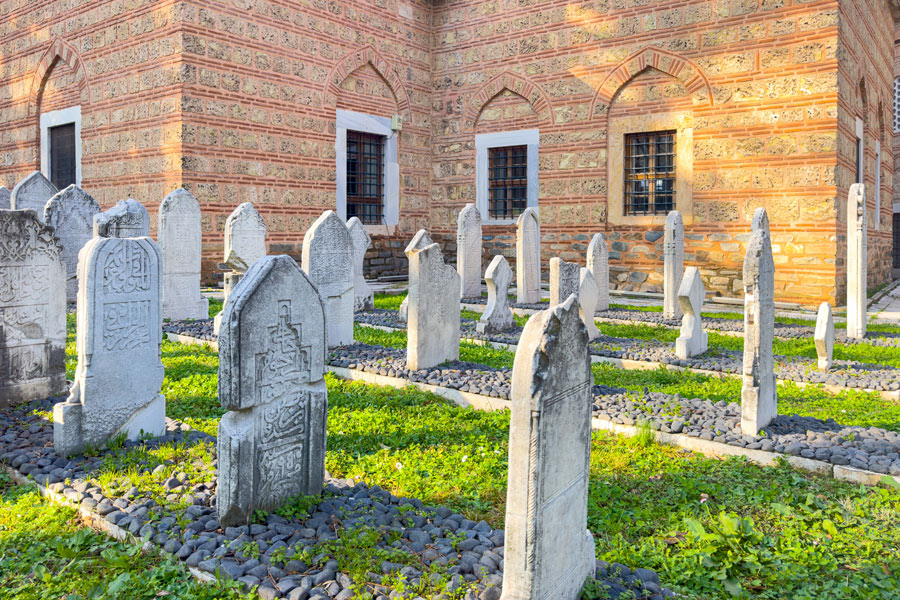
South of the mosque, old gravestones stand upright in the open air. They were gathered from cemeteries all over Bursa. The oldest date from the early 1400s, the latest from the late 1800s. Many of the men’s stones are topped with carved turbans.
The Madrasa, the Bath, and the Manuscripts Museum
West of the mosque, the madrasa keeps its sixteen cells around an arcaded courtyard. Each cell still has a hearth, a single window and three niches. Restored in 1951, the building served for decades as a tuberculosis clinic, and since 2019 it has housed the Muradiye Qur’an and Manuscripts Museum. Its ten rooms trace the written Qur’an from revelation to Ottoman calligraphy, with short films explaining the arts of binding, illumination and marbling. The main hall displays an eighteenth-century cover from the sarcophagus of Murad I.
Further west, at the crossroads, stands the complex’s bath, built in 1426 for the madrasa’s students. After serving as an iron foundry until the 1980s, it has since been restored, but it lies outside the garden walls and is not part of the museum visit.
Practical Information
Opening hours: The garden and tombs are open daily from 08:00 to 18:00 in winter and until 20:00 in summer. The Qur’an and Manuscripts Museum opens Tuesday to Sunday, 09:00–17:30, and is closed on Mondays, 1 January and the first days of religious holidays. Once the mosque reopens, visits will be paused during the five daily prayers.
Admission to the garden and tombs is free. The manuscripts museum was also free at the time of writing.
Guided tours: Group visits to the manuscripts museum must be booked in advance.
Facilities: The complex’s former soup kitchen, a few steps from the mosque, now operates as the restaurant, serving Ottoman dishes.
How to Get to the Muradiye Complex
Tickets for local transport: A rechargeable BursaKart covers the metro, trams and city buses. It is sold at station kiosks and at outlets displaying its logo.
By tram: The red T1 line stops at Altıparmak, at the start of Çekirge Caddesi, which runs west towards the old spa quarter. A short way along, a left turn leads into 2. Murat Caddesi. The mosque lies at the far end, about 8 minutes from the tram stop. The same line links Altıparmak with the Ulucami and Heykel stops.
By metro: The nearest Bursaray station is Merinos, about 20 minutes away on foot or five minutes by taxi.
By bus: Many city buses use Çekirge Caddesi, a few minutes north of the complex. The nearest stop, 2. Murat Hamamı, stands beside the old bath. Route numbers change, so it is worth checking the Moovit app.
On foot: From the Ulu Cami, the walk west takes about 30 minutes, much of it along Sakarya Caddesi on the northern slope of the citadel. Bozkurt Caddesi and then 2. Murat Caddesi lead on to the mosque.
By taxi: Metered taxis wait across the centre and drop passengers right at the mosque. The ride from Heykel takes about 10 minutes, longer at rush hour.
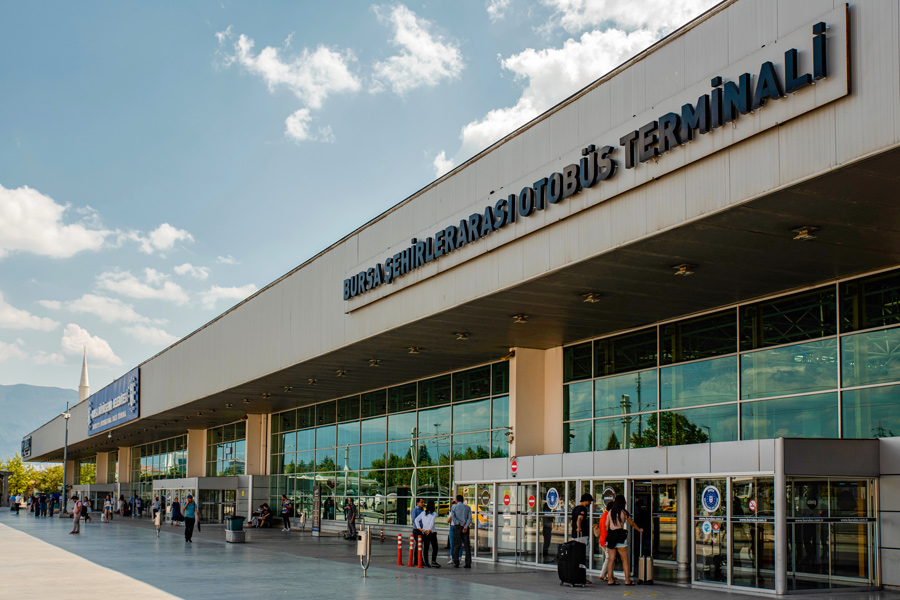
From the intercity bus terminal: Bursa Otogar sits about 10 km north of the centre. The T2 tram reaches Kent Meydanı from the terminal in about 25 minutes. From there the T1 continues round the centre to Altıparmak. A taxi takes about 30 minutes, or up to 45 in heavy traffic.
From Istanbul by ferry: Fast boats cross the Sea of Marmara to Mudanya or Güzelyalı in about 2 hours. From Güzelyalı a connecting bus runs to the Bursaray terminus at Emek. The metro then continues to Merinos, the nearest station to the complex. From Mudanya, bus 1/M covers the same route.
From Istanbul by road: The drive over the Osmangazi Bridge takes about 2.5 hours, and coaches to the Otogar run throughout the day.
Tips for an Optimal Visit
Recommended duration. Allow about an hour and a half to see the garden properly. The manuscripts museum needs another 30 to 45 minutes.
Best time of day. Weekday mornings are usually the quietest time in the garden. Once the mosque reopens, expect it to fill for Friday midday prayers.
Dress and conduct. Shoulders and knees should be covered inside every building here. Women should also cover their hair inside the mosque. Shoes come off at the tomb doors, where wooden racks stand ready. This is a place of prayer, so keep voices low.
Photography. Photography is generally permitted, but flash is best kept off.
Accessibility. The main paths are paved and largely level. Most of the mausoleums are entered up one or more steps.
Combine with. The tombs of Osman and Orhan at Tophane are 15 minutes east. Further on, the Ulu Cami and Koza Han complete a day’s walk. Kültürpark, the city’s large public park, lies a few minutes to the north.
The finest rooms here belong to princes who never ruled the empire, and two of them were commissioned by the very brothers who took the throne in their place. Their walls are dressed in tile and painted up to the domes. The only sultan here lies between almost bare white walls. And when a shower passes over Bursa, his is the one roof the rain comes through.