

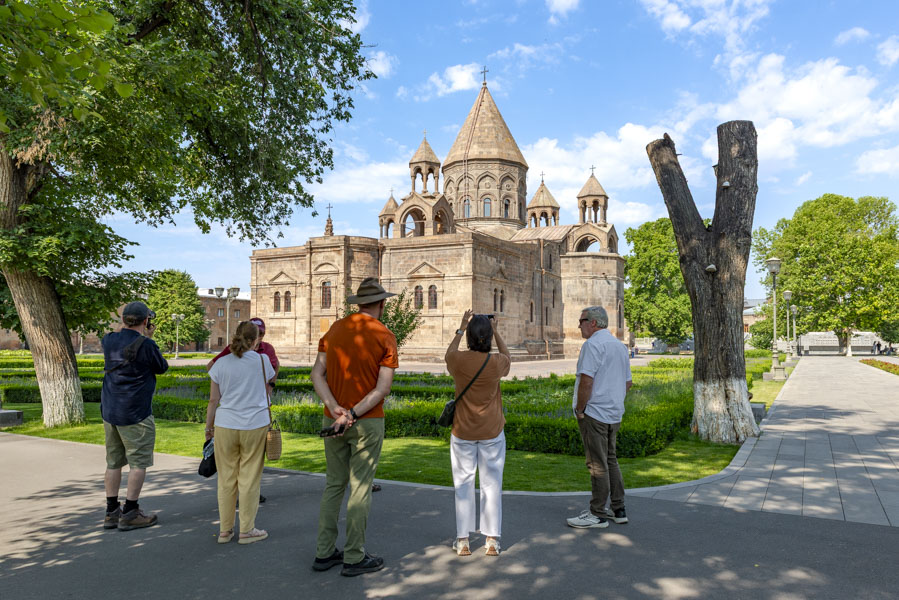
Etchmiadzin Cathedral stands at the heart of the Mother See of Holy Etchmiadzin in Vagharshapat, around 20 kilometres west of Yerevan. It is the mother church of the Armenian Apostolic Church and the seat of the Catholicos of All Armenians. Since 2000, the cathedral has formed part of a UNESCO World Heritage Site. For Armenians in the country and throughout the diaspora, this ancient cathedral remains the spiritual centre of a church that has shaped national life for more than seventeen centuries.
Traditionally dated to AD 301–303, Etchmiadzin is commonly described as the world’s oldest cathedral. The structure seen today, however, is not an untouched fourth-century church. Its central core, dome, bell towers, frescoes and adjoining buildings belong to different periods, making the cathedral a record of repeated damage, rebuilding and continued worship.
Etchmiadzin Cathedral is one of the principal places to visit on a day trip from Yerevan.
Etchmiadzin Cathedral Today
The cathedral’s reopening is the most important recent development for visitors. Work began in 2012 after investigations identified serious problems in the cathedral’s foundations, roof and dome. What was initially expected to be a more limited repair developed into one of the most extensive conservation projects in the building’s modern history.
The project reinforced the structure, restored stonework and frescoes, repaired the dome and roof, and introduced heating, ventilation and drainage systems. Sections of the murals were removed for laboratory treatment before being returned to their original positions. The cathedral reopened after its reconsecration in September 2024 and is once again used for regular services, major feast days and pilgrimages.
History and Religious Significance
The Vision of St Gregory the Illuminator
The cathedral’s foundation is connected with Armenia’s adoption of Christianity as a state religion under King Trdat III. According to the account attributed to the early Armenian historian Agathangelos, St Gregory the Illuminator saw Christ descend in a vision and strike the ground with a golden hammer, indicating where the new church should stand. The name Etchmiadzin is usually translated as ‘the Descent of the Only-Begotten’ and refers to this tradition.
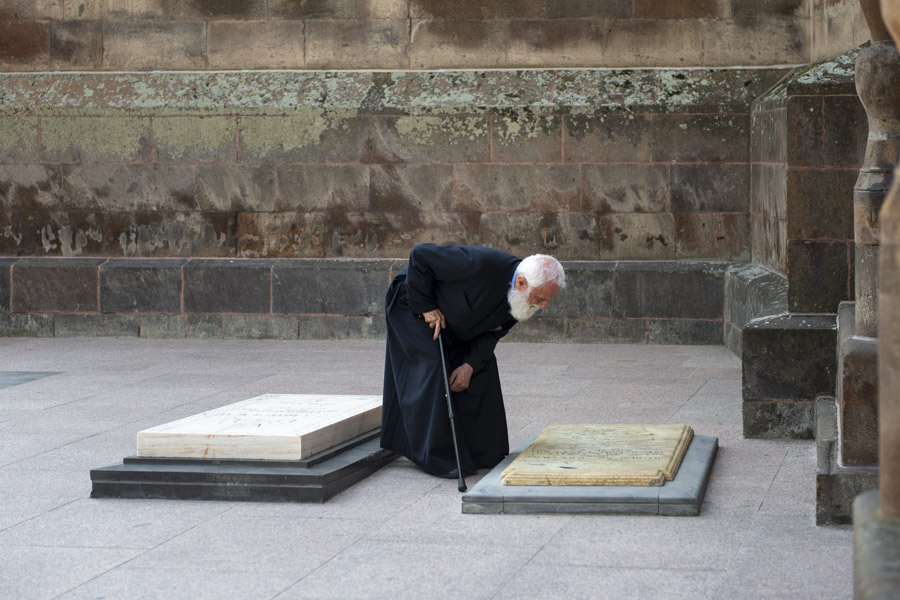
The first cathedral was built close to the royal palace in Vagharshapat. Although its exact appearance remains a subject of study, excavations beneath the present church have revealed elements associated with the fourth-century structure, as well as an Urartian stele and the remains of a fire altar. Some scholars have suggested that the cathedral may have replaced an earlier pagan sanctuary, although the archaeological evidence is open to interpretation.
Rebuilding the Cathedral
The original building suffered heavily during periods of invasion and political upheaval. In 483–484, Vahan Mamikonian rebuilt the cathedral with a central dome and four projecting apses, establishing the essential form preserved today. During the seventh century, wooden parts of the roof were replaced with stone.
The seat of the Armenian catholicos moved between several locations during the medieval period, but Etchmiadzin retained its religious importance. In 1441, the catholicosate returned permanently to the cathedral. This restored Vagharshapat’s position as the administrative and spiritual centre of the Armenian Church, a role the Mother See continues to hold.
The cathedral also remained in use during the Soviet period despite the state’s officially atheist policies and severe restrictions on religious life. In 1938, the Soviet Armenian authorities considered closing it and converting it into a museum, but the plan was not carried out. The cathedral continued to function, although for a time with only a small clergy and limited public activity.
Further rebuilding followed in the seventeenth century. The western bell tower was begun during the tenure of Catholicos Philip I and completed in 1658 under Catholicos Hakob IV. Three smaller bell-domes were added above the other apses later in the century, while the present main dome also dates from this period. These additions produced the distinctive five-domed silhouette now associated with Etchmiadzin.
Architecture and Frescoes
The Central-Domed Plan
Etchmiadzin is comparatively compact, but its architectural importance lies in its plan. Four apses open from a central space, and the dome is carried on four substantial piers. UNESCO identifies this central-domed, cross-shaped form as one of the major achievements of Armenian ecclesiastical architecture and notes its wider influence on church design in the region.
The exterior reveals the cathedral’s long construction history. The ancient core is joined by the richly carved western bell tower, smaller bell-domes, chapels and later additions. On the main drum, medallions depict the apostles. Seen together, these different volumes show how the cathedral was repaired, expanded and adapted over the centuries.
The Restored Interior
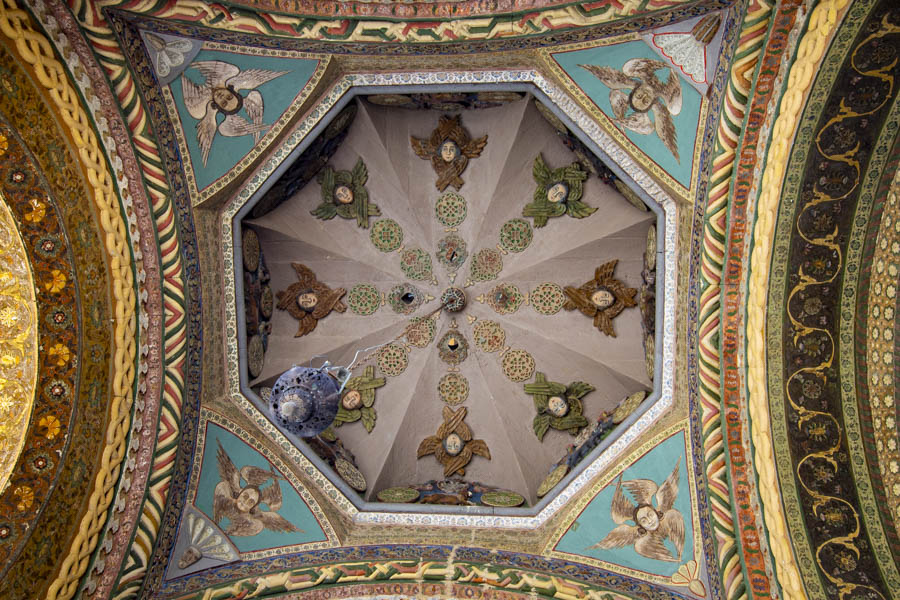
Inside, the painted decoration sets Etchmiadzin apart from the restrained stone interiors of many Armenian churches. Naghash Hovnatan began decorating the cathedral in the early eighteenth century, and later members of the Hovnatanian family continued his work. Surviving compositions include paintings in the upper dome and an image of the Mother of God in the main apse, as well as rows of saints and biblical figures framed by flowers, birds and scrolling foliage. These natural motifs recall the imagery of a heavenly garden.
During the latest conservation, sections of the murals were removed for treatment and later returned to their original positions in the dome, apse and upper walls. Their deep reds, blues and warm golden tones soften the massive stone piers and bring colour and movement to the otherwise austere interior.
Cathedral Depository-Museum
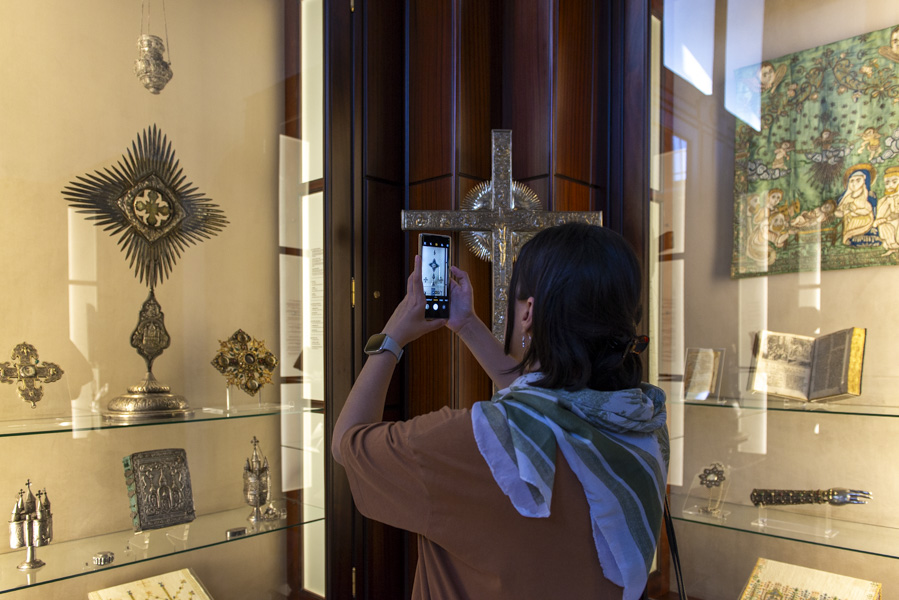
The Cathedral Depository-Museum is located in the eastern part of the cathedral and is accessed from inside the church near the main apse. Created in the nineteenth century, it preserves the cathedral’s principal sacred treasures.
Among its most venerated objects are the Holy Lance, known as Geghard; relics associated with Noah’s Ark and the True Cross; and reliquaries containing relics of apostles and saints, including St Nicholas and St John the Baptist. Displays may change when sacred objects are moved for services or feast days.
Etchmiadzin Cathedral Visitor Information
Location and Time Needed
Etchmiadzin Cathedral is in Vagharshapat, Armavir Province. Allow around 45 minutes for the cathedral and Cathedral Depository-Museum, or longer if you plan to attend part of a service.
Getting There from Yerevan
Vagharshapat is approximately 20 kilometres west of central Yerevan on the road towards Armavir. A taxi, private car or organised excursion provides the easiest access to the cathedral. Public transport also runs between Yerevan and Vagharshapat, but routes and departure points can change; confirm them locally rather than relying on an older route number.
When to Visit and Church Etiquette
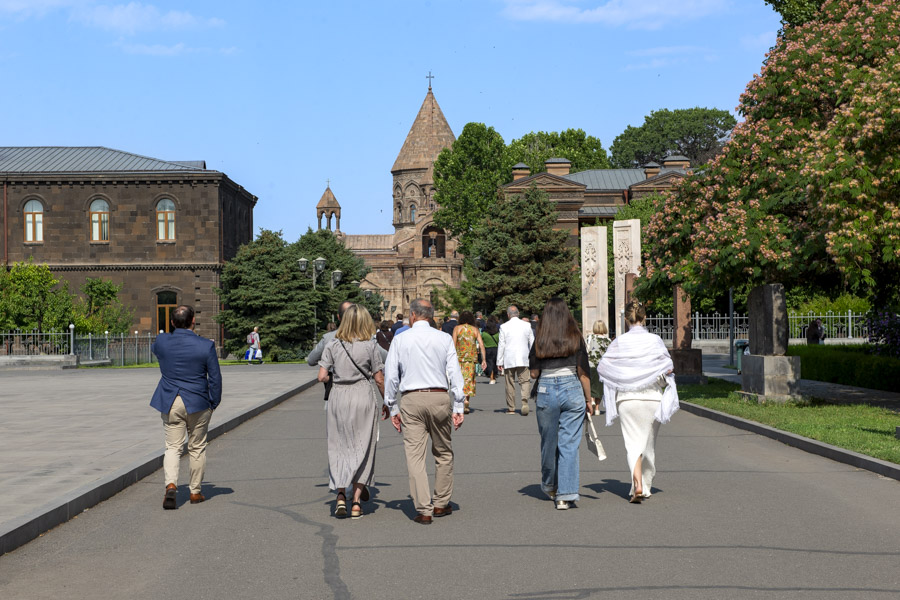
Weekday mornings are generally better suited to travellers who want time to study the architecture. Sundays and major feasts provide an opportunity to experience the cathedral as a living centre of Armenian worship, but the congregation must be allowed to use the space without disruption. During services, remain towards the side or rear, keep conversations quiet and avoid moving around unnecessarily.
Wear clothing appropriate for an active church and follow any instructions given at the entrance. Photography arrangements can vary between the cathedral, museums and special services, so check before taking pictures and do not photograph worshippers without permission. Flash should not be used around frescoes, manuscripts or museum objects unless staff explicitly allow it.