

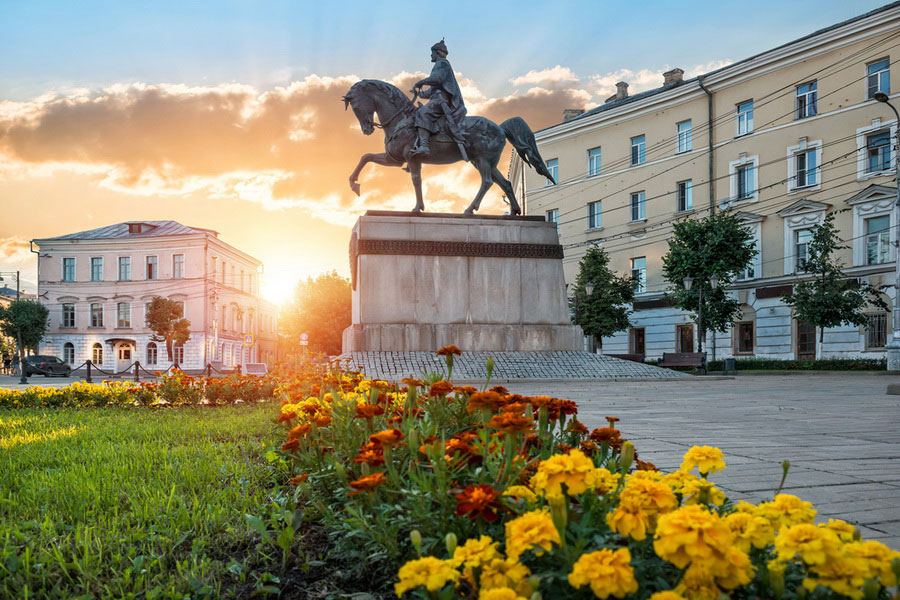
Tver stands on the Volga, with broad embankments, an imperial palace, historic churches, and merchants' mansions. One of Russia's oldest cities, it is widely regarded as the historic heart of the Upper Volga. Today, more than 400,000 people live here, and the city serves as the administrative centre of Tver Region.
About 180 km northwest of Moscow, Tver lies on the main route to Saint Petersburg. This convenient position supported trade and cultural exchange for centuries and now makes the city an easy destination for a one- or two-day trip. Its compact centre is well suited to walking, with museums, riverside paths and cafés all within easy reach.
On 19 July 2026, Tver officially joined the national Golden Ring of Russia tourist route. Its long history and extensive collection of 18th and 19th–century architecture make Tver a distinctive addition to the Golden Ring of Russia.
History of Tver
The official date of Tver's foundation is 1135, although historians believe that a settlement may have existed here even earlier.
The exact origin of the city's name remains uncertain. One theory links it with the Tvertsa River and an ancient Finnic place name, Tikhvera or Tkhver. Medieval Russian sources record forms such as Tfer and Tver. A more romantic, though unproven, folk explanation connects the name with the Russian word tverd, meaning a fortress or fortified place.
In the 13th century, Tver became the capital of an independent principality and one of Moscow's most serious political rivals in north–eastern Rus.
A major fire destroyed much of the wooden city in 1763. On the orders of Catherine II, Tver was rebuilt according to a unified architectural plan. Wide streets, squares and stone mansions appeared in the centre, together with a distinctive three-rayed street layout sometimes called the «Tver Trident». The reconstruction made Tver one of the most notable examples of 18th–century Russian urban planning.
In 1931, the city was renamed Kalinin in honour of the Soviet statesman Mikhail Ivanovich Kalinin. Its historic name, Tver, was restored in 1990.
Why Visit Tver
Tver combines centuries-old architecture with the cultural life and amenities of a modern regional capital. Weekend travellers from Moscow often come here for a change of pace. A typical visit can include landscaped parks, a former imperial residence, historic churches, and distinctive examples of Soviet architecture.
The Volga shapes much of the experience. Broad embankments and riverside squares create a relaxed atmosphere and offer open views across the water. In summer, the waterfront also includes a city beach. Another pleasant place for a walk is the Botanic Garden of Tver State University.
The cultural programme extends beyond historic monuments. Tver has a regional art gallery, the Tver Academic Drama Theatre, contemporary exhibition spaces, and numerous museums. Concerts, theatrical performances and festivals take place throughout the year, while restaurants, bars, and clubs provide plenty of evening options.
Street art has also become a recognisable part of the urban landscape. Colourful graffiti and large–scale murals cover the blank side walls of numerous buildings and bring a contemporary element to streets beyond the historic centre.
Top Attractions in Tver
Tver's landmarks span several periods, from the medieval principality to the imperial, merchant, and Soviet eras. Highlights include the Imperial Travel Palace, the Transfiguration Cathedral, historic squares, and mansions.
The Imperial Travel Palace was built between 1764 and 1766 in the Neoclassical style with Baroque elements. It served as a stopping place for members of the imperial family travelling between St Petersburg and Moscow. Empress Catherine II, better known as Catherine the Great, first visited the residence in 1767, when she held a dinner for the local nobility.
An especially important period in the palace's history is connected with Grand Duchess Catherine Pavlovna, Catherine II's granddaughter and the younger sister of Emperor Alexander I. She lived in Tver with her first husband, Duke George of Oldenburg, and turned the residence into a prominent centre of social and cultural life.
Today, the palace houses the Tver Regional Art Gallery, one of Russia's oldest art museums. Its restored ceremonial rooms display Russian and Western European paintings, historic icons, sculpture, porcelain and period furniture.
Highlights of the collection include Ilya Repin's Portrait of Leonid Andreyev, Isaac Levitan's Wooded Bank. Twilight, Valentin Serov's Mermaid. Study for the Painting of the Same Name and Konstantin Korovin's Evening. Portraits of Catherine II and Grand Duchess Catherine Pavlovna also recall the building's imperial past.
The Transfiguration Cathedral stands beside the Imperial Travel Palace. The first white-stone cathedral on this site was founded in 1285 and remained Tver's principal cathedral for centuries. It was destroyed in 1935, and the present building was reconstructed on the historic site in the 21st century.
The Monument to Afanasy Nikitin, unveiled in 1955, stands on the left bank of the Volga on the embankment named after him. A 15th–century merchant and traveller from Tver, Nikitin was one of the first Europeans to visit India and leave a detailed written account of the country. His observations of its people, customs, trade and political life became A Journey Beyond the Three Seas, written more than two decades before Vasco da Gama reached India.
The Starovolzhsky Bridge is recognised for its high steel towers and gently curving trusses. Built between 1897 and 1900, it was the first permanent bridge across the Volga in Tver.
White Trinity Church is the oldest surviving church in Tver. Consecrated in 1564, it has endured fires, wars and repeated periods of urban reconstruction. According to a long–standing local legend, the word «white» refers not to the building's colour but to its former exemption from certain taxes and duties.
Morozovsky Gorodok is a large complex of late–19th and early–20th–century industrial architecture. Developed around the Morozov family's textile works, it included workers' housing, public buildings, shops, and a hospital.
The Museum of the Goat is among the city's most unusual small museums. The goat has long been regarded as an unofficial symbol of Tver and the surrounding region, possibly because of the area's former leatherworking industry and the processing of goatskins. Opened in 2008, the museum now holds more than 7,000 goat–related exhibits from around the world.
The Tver River Terminal was built between 1935 and 1938 near the confluence of the Volga and Tvertsa rivers and remained one of the city's best–known Soviet–era landmarks for many years. After a long period of structural decline, the building was fully dismantled in November 2025. The Rechnoy Cultural and Exhibition Centre is now under construction on the site, with a design intended to echo the historic terminal's recognisable silhouette.