

Address: Cumalıkızık Mahallesi, 16300 Yıldırım, Bursa.
Contact information: Cumalıkızık Village Museum (Bursa Metropolitan Municipality Museums): +90 224 716 37 37.
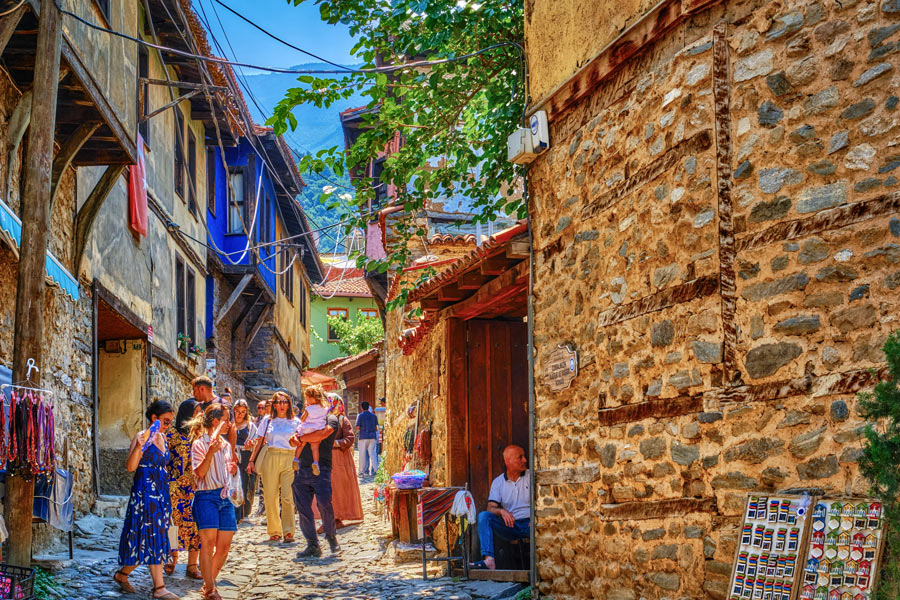
Cumalıkızık is an Ottoman village on the lower slopes of Uludağ. It sits about ten kilometres east of central Bursa, above the plain. At the last bend, tarmac gives way to cobbles. Houses crowd in on both sides, painted ochre, white and violet. Their upper storeys lean out over the lane on wooden brackets. Chestnut trees close the view above the roofs. A radio plays behind a shutter, and a cockerel calls.
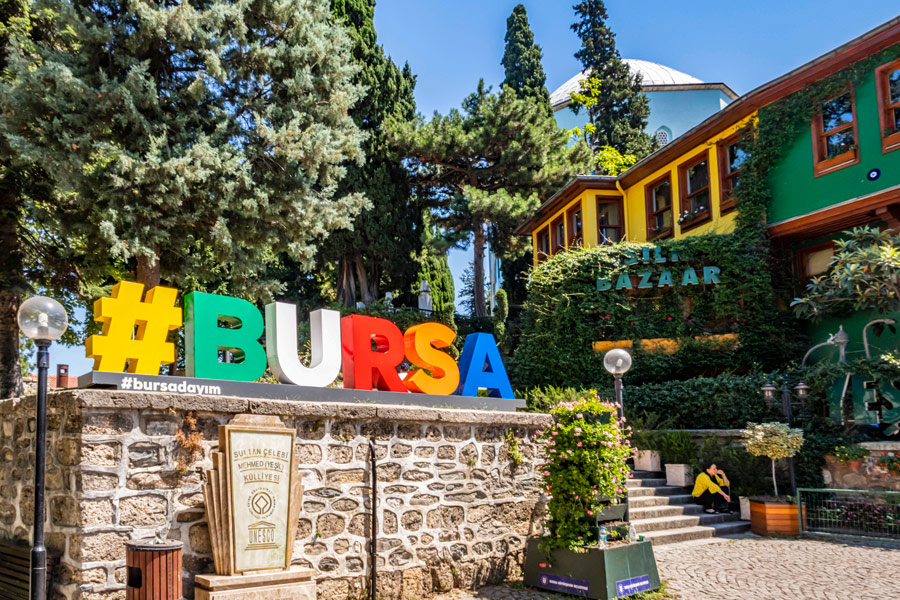
Around 700 people live here, on a hillside settled seven centuries ago. The village was founded to serve the new Ottoman capital below. It is the only village in Bursa’s UNESCO World Heritage listing, inscribed in 2014 as Bursa and Cumalıkızık: the Birth of the Ottoman Empire.
History of Cumalıkızık
The story of Cumalıkızık starts with a marriage settlement. Tradition says the Kızık, an Oghuz Turkic clan, came west from around Tokat. They asked Ertuğrul Gazi, father of Osman, for land. His own tribe, the Karakeçili, objected to the request. Ertuğrul sent the newcomers to the foot of Monk’s Mountain, today’s Uludağ. To keep the peace, the Kızık chief’s seven sons took Karakeçili brides. Seven villages grew up along the mountainside, each carrying the Kızık name, from Hamamlıkızık and Fidyekızık to Değirmenlikızık and Derekızık.
Bursa fell to the Ottomans in 1326, and Orhan made it his capital. In 1339 he built a mosque complex just outside the Byzantine walls. A mosque, a college, a kitchen and a bath needed steady income. Cumalıkızık was endowed to that foundation as a vakıf village. A vakıf was a charitable endowment: income from land, shops or entire villages was pledged in perpetuity to a mosque, school or other public institution. Its harvests and dues helped keep the whole complex running. On Fridays, people from the other Kızık villages gathered here to pray. The name is usually traced to cuma, the Turkish word for Friday.
Five of the seven historic villages still exist, while Bayındırkızık and Dallıkızık survive only in Ottoman tax registers. Modern construction has transformed four. Only Cumalıkızık kept its old lanes and houses. The village was placed under state protection in 1980. From then on, every change to a house needed official approval. In 2002, the television drama Kınalı Kar was filmed here. It followed a young teacher sent to a village ruled by an agha, a wealthy landowner and influential community figure. The series ran on Kanal D until 2004. Visitors soon followed, curious to see the real place. Film crews still treat the lanes as a ready-made set.
UNESCO’s heritage advisers were not easily won over. Their 2014 report questioned whether a rural settlement belonged in a nomination centred on the early Ottoman capital. Yet the same report found it more authentic than the city sites. Only about sixty per cent of its houses were lived in then. The inspectors warned against it becoming an empty museum village. The World Heritage Committee inscribed it that June regardless.
Highlights
There is no set route, and the lanes branch without warning. Most visits begin at the square and drift uphill from there.
The Square and the Plane Trees
The square lies at the foot of the settlement, where the road ends. Two registered monument plane trees stand over it. The larger trunk measures six metres round, the smaller four. Mosque, coffee house and plane tree formed the heart of many Ottoman villages. Cumalıkızık still keeps all three within a few steps. Stalls run uphill from the square into the first lanes. Well over a hundred line the way, most run by local women. Bags of tarhana soup mix and hand-cut noodles hang from the awnings. Dried fruit, pickles and handicrafts fill the counters below.
The Mosque, the Fountain and the Bath
The mosque carries no inscription, so its builder is unknown. Local accounts give it about three hundred years. Because the ground falls away, its north wall stands on a raised base. Twin stone stairs climb from left and right to a glazed porch. Above the door, a wooden sunburst fans out in thin rays. The motif entered Ottoman decoration only in the mid-nineteenth century. It points to a later refit, not the original build. The building was heavily repaired in 1916 and enlarged in the 1950s. Beneath the double stair, a white marble fountain sits in a vaulted niche. Its one-line Ottoman inscription names the donor, Zekiye Hatun. The bath stands close by, built of rough rubble stone. Its warm room, hot room and water tank are original. The changing area and furnace were added later. No surviving record dates it.
The Houses
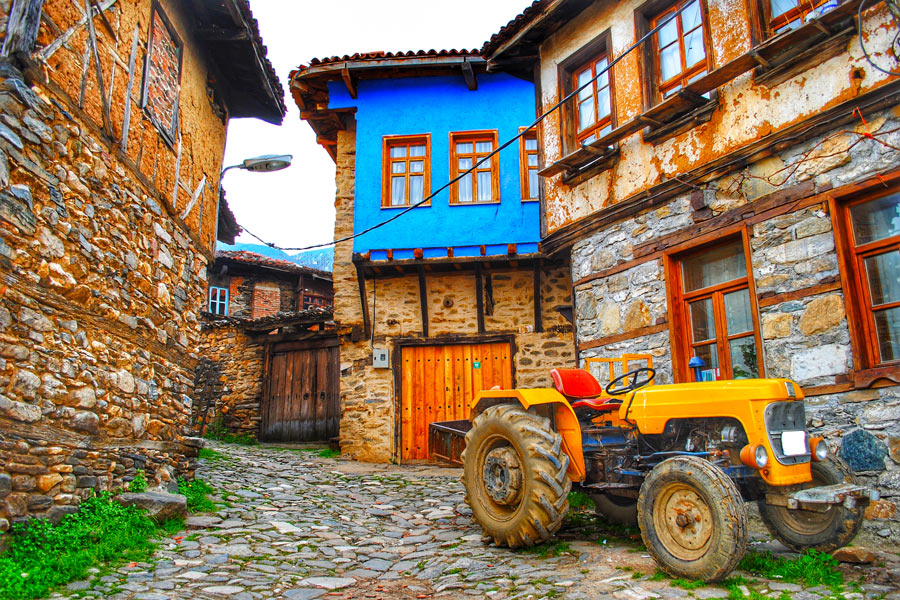
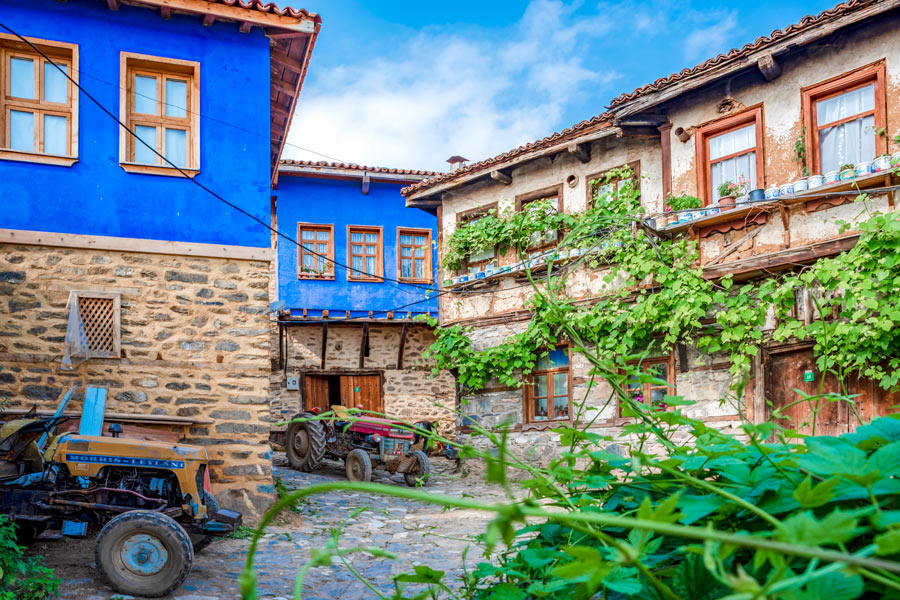
Around 270 historic houses stand in Cumalıkızık, most of them registered as examples of Ottoman civil architecture. Most feature three storeys, built in layers. The ground floor is rubble stone, laced with horizontal timber beams. Above it rises a timber frame filled with mud brick. Upper rooms project over the lane in bay windows called cumba. Most still keep wooden lattices behind the glass. The design put privacy first. From inside, a family could watch the street without being seen. Some entrances open into a walled yard, others straight into the hayat. The name means “life” in Turkish, and this stone-floored hall leads to the stable, the storerooms and the stairs. Related families often lived side by side and shared the work. Much of the fabric was rebuilt in the nineteenth century. Each house follows its own plot and gradient, so no two match.
Doors and Knockers
Street doors here are usually double-leaved and made of walnut. Iron straps and large-headed nails hold the planks together. Hand-forged iron rings or knockers survive on many of them. Tradition says a heavy knocker was for men, a light one for women. The deep or thin note told the household who was waiting. The right person could then come down to answer. A recent study examined the doors of 135 houses. It found 66 rings and 40 knockers still in place. Most date from the nineteenth century, when a fashion imported from Europe took on local forms. On the commonest type, the backplate may read ‘Allah’ twice, or ‘Maşallah’ (‘what God has willed’), a phrase believed to ward off the evil eye.
The Lanes and the Jinn’s Gap
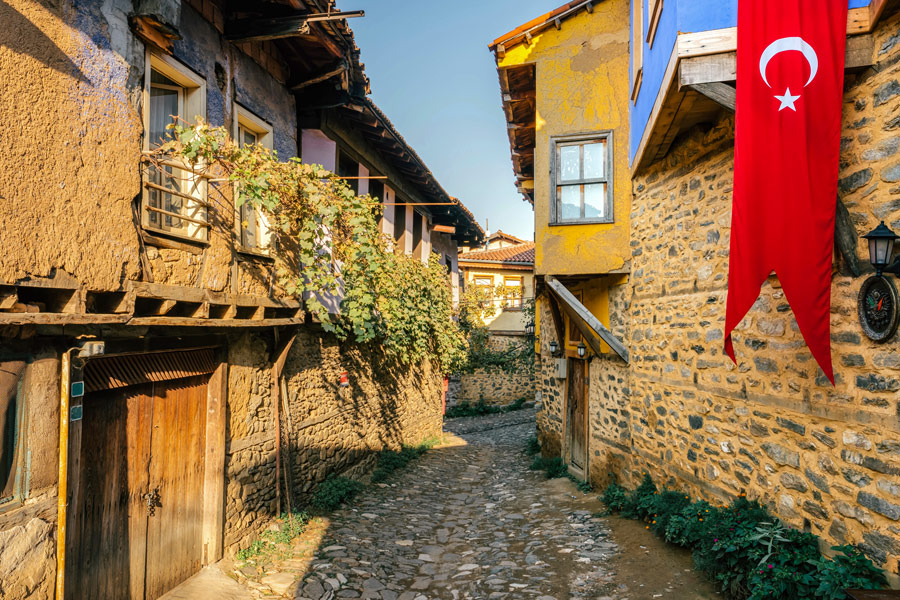
The lanes follow the ground rather than any plan. Some are too narrow for two people to walk side by side. Others stop without warning against a garden wall. Flat stones pave them, dipping to a shallow channel in the middle. Rainwater from the eaves runs down it, away from the house walls. The channel also carries water from a spring above the houses. Residents divert it into their gardens, and it cools the lanes in summer. The narrowest passage has a name, Cin Aralığı, or the Jinn’s Gap. It is about eighty centimetres wide and looks like a dead end. Legend ties the name to the Greek occupation of 1920–22. Soldiers, the story goes, herded villagers into the mosque to burn it. Some escaped and slipped through the gap. Their pursuers lost them and blamed the jinn.
Küpeli Ev
Küpeli Ev is often called the oldest house in Cumalıkızık. It has stood for around 350 years. The name comes from fuchsias, known in Turkish as earring flowers. The Bursa UNESCO Association adopted it as a project house. It now opens as a small, privately run house museum. It is the easiest way to see inside a Cumalıkızık house. Villagers donated the furnishings, some 1,500 objects in all. Objects from elsewhere are turned away, however valuable. Bedrooms and sitting rooms are laid out as a household once was. Plastic covers go over shoes at the door.
The Village Museum
The Village Museum occupies the former headman’s building on the square. Villagers first opened it in 1992, with their farming cooperative. Bursa’s metropolitan council redesigned it and reopened it on 22 June 2015. The date marked one year since the UNESCO listing. The display opens with the Kızık tribes and their arrival. Some 240 objects follow, from clay water jugs to lanterns and candlesticks. Sickles, scythes and pack saddles show the farm work behind the painted fronts. One corner explains why UNESCO listed the village with Bursa’s monuments.
Breakfast in the Courtyards
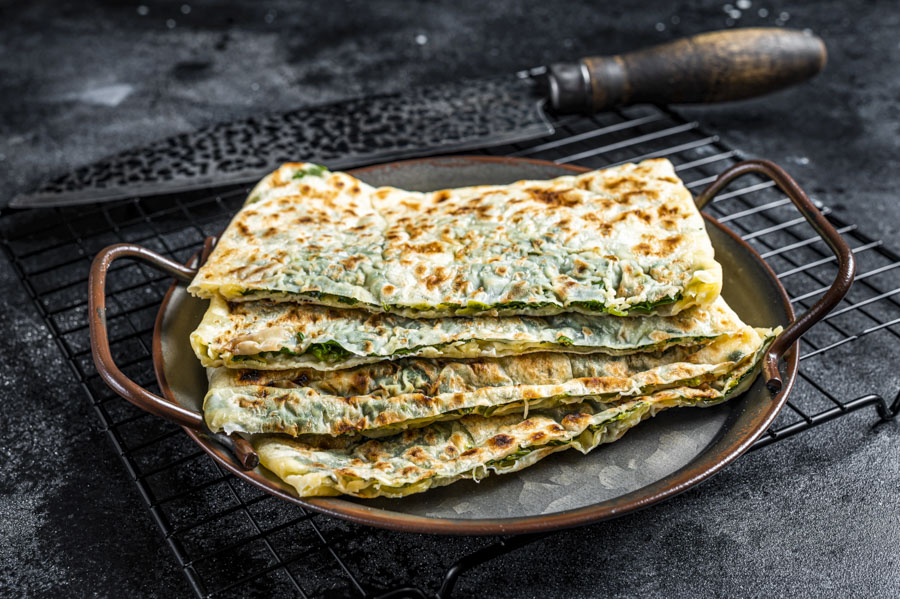
Breakfast draws visitors almost as much as the houses do. Tables fill courtyards and terraces from early morning. A village breakfast arrives as many small plates at once. Local cheese, olives, eggs and honey share the table. Raspberry and blackberry jams come from fruit grown on the slopes above. Gözleme follows, rolled thin and cooked on a domed iron griddle. The raspberry harvest is usually celebrated in June with a festival. The best-known address is the Bulanlar Konağı, on Hamam Sokak. Television viewers know it as the Kınalı Kar mansion.
Practical Information
Opening hours: The lanes are open at all times. The Village Museum opens Tuesday to Sunday, 08:30–17:00. Küpeli Ev is privately run, so its hours vary. The mosque is often locked outside prayer times.
Entry: There is no charge to enter Cumalıkızık. The Village Museum is also free. Küpeli Ev charges a small fee, payable in cash.
Facilities: Around sixty cafés, restaurants and breakfast houses line the lanes. Most occupy restored houses, and several double as small boutique guesthouses with rooms for an overnight stay.
Parking: Spaces at the entrance are limited and fill early. The lanes are too narrow for easy driving.
How to Get to Cumalıkızık
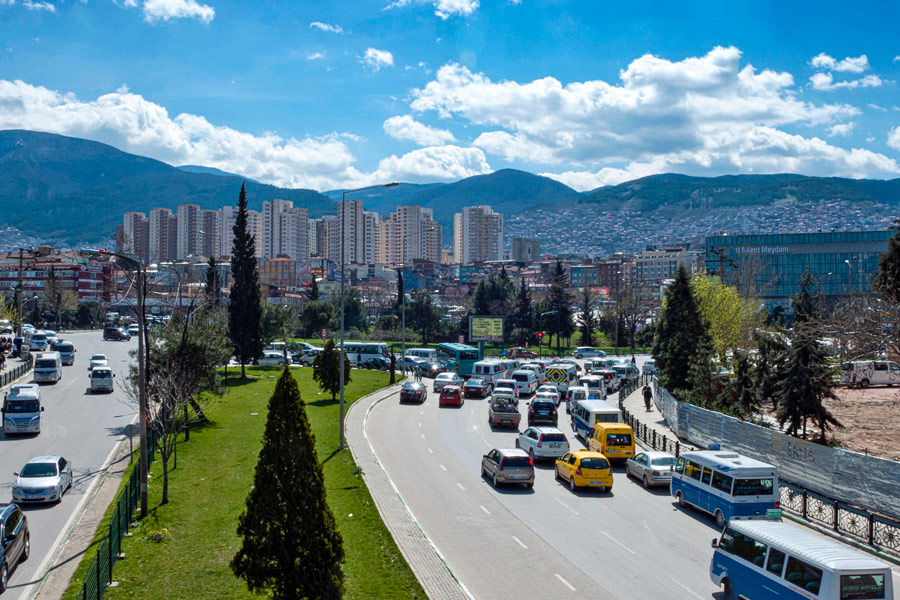
Public transport tickets: A rechargeable BursaKart covers the metro, trams and city buses. It is sold at station kiosks and newsagents. Bursa’s minibuses do not accept it and take cash instead.
By metro and minibus: The Bursaray metro runs east from Şehreküstü towards Kestel. The stop is Cumalıkızık station, also known as Değirmenönü. Minibuses wait beside the station and drive up to the square. The ride up takes 10 to 15 minutes.
By minibus from the centre: Direct minibuses leave from near Kent Meydanı in central Bursa. The journey takes around half an hour.
By bus: City bus routes also stop at the village square. Route numbers change, so it is worth checking the Moovit app.
By taxi: Metered taxis take about 20 minutes from the city centre.
By car: The turning leaves the Ankara road about 10 km east of Bursa. Cumalıkızık lies around 3 km further up the hill.
From the Otogar: The T2 tram reaches Kent Meydanı in about 25 minutes. Cumalıkızık minibuses leave a short walk away. A taxi straight from the terminal is simplest.
From Istanbul: Fast ferries cross to Mudanya or Güzelyalı in about 2 hours. By road over the Osmangazi Bridge, the drive takes about 2.5 hours.
Tips for an Optimal Visit
Recommended duration: Two to three hours covers the lanes and a slow breakfast. Allow another half hour for the museum and Küpeli Ev.
Best time of day: Weekday mornings are quietest, before the coaches arrive. Avoid summer weekends, when most of the week’s visitors come.
Best time of year: Spring and autumn suit the walk best. In October, chestnuts ripen in the woods behind the village. High summer afternoons can be hot on the cobbles. In winter, snow sometimes settles and the village falls quiet.
Footwear: Wear flat shoes with a firm grip. The cobbles are steep, uneven and slippery after rain.
Dress and conduct: Cover shoulders and knees in the mosque; women should also cover their hair. Remove shoes at the door. The houses are private homes, so keep voices low in the upper lanes. Courtyards are open only to invited guests.
Photography: The lanes and façades can be photographed freely. Ask before taking pictures of residents, especially the women at the stalls. Avoid close-up shots through open doors and windows.
Buying local: Jams, noodles and tarhana are made in village kitchens. Buying from the stalls keeps the money in Cumalıkızık.
Accessibility: Step-free access ends at the square, as many lanes rise in steps.
Combine with: The Green Mosque and Green Tomb lie on the way back into town. Both stand in Yıldırım, the same district as Cumalıkızık. Further west, Koza Han and the Ulu Cami belong to the same UNESCO listing.
For centuries, Cumalıkızık sent its harvest down the hill to Bursa. Now the city comes up the slope instead, by metro and minibus. The traffic has simply turned round. The spring above the last stalls never did. It slides down the central channel, past doorsteps and iron knockers. Visitors climb against it all afternoon, and it keeps going the other way.