

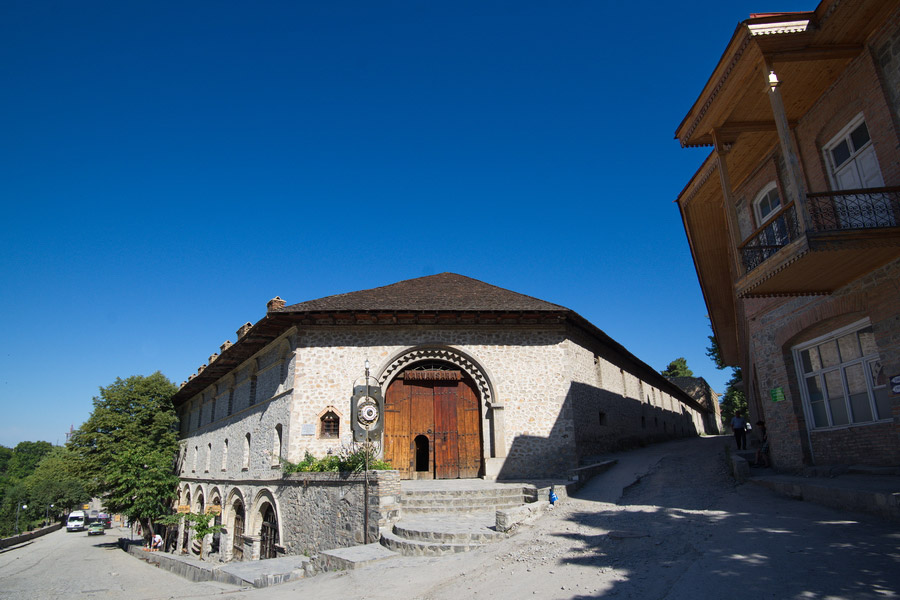
Set at the foot of the Greater Caucasus in north-western Azerbaijan, Sheki is known for its historic architecture, traditional crafts and distinctive regional food. Its UNESCO-listed centre brings together caravanserais, merchants’ houses, workshops and the richly decorated Palace of the Sheki Khans (Şəki Xan Sarayı).
Sheki’s appeal, however, is not limited to its best-known monument. Artisans still practise shebeke craftsmanship, confectioners make the city’s famous Sheki halva, and restaurants serve Sheki piti in individual clay pots. Nearby, Kish (Kiş), forested hills and historic sites make it easy to combine sightseeing with short trips beyond the city.
One reason to visit Sheki is its compact, easy-to-explore historic centre, anchored by the UNESCO-listed Khan’s Palace. The Historic Centre of Sheki with the Khan’s Palace has been on the UNESCO World Heritage List since 2019. The protected area includes far more than the palace itself, preserving an urban landscape shaped by residential architecture, gardens and public buildings.
Traditional craftsmanship and regional food are another reason to spend more time in Sheki beyond the main monuments.
Sheki Tours
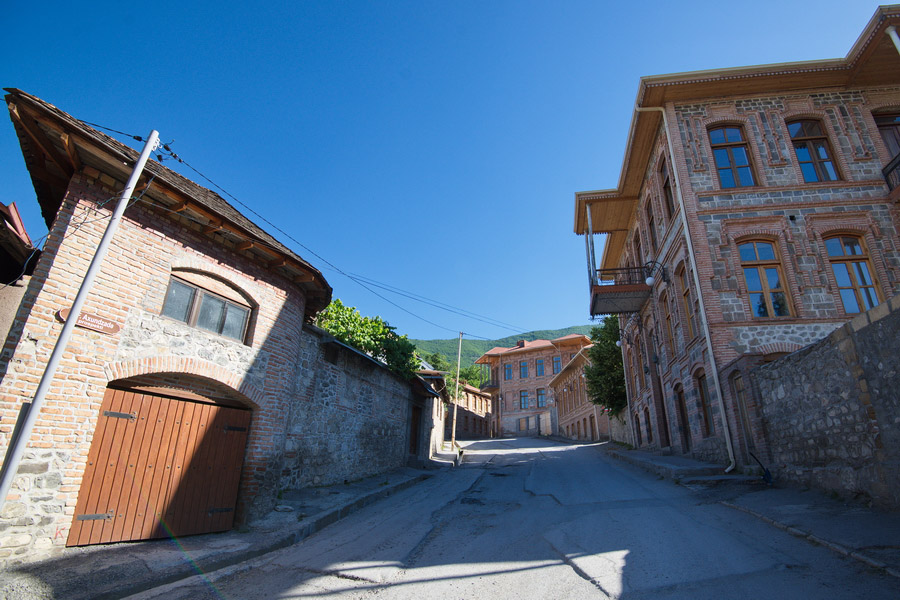
A full day is enough for the core landmarks, while a second day allows more time in the city and an excursion to nearby villages. Travellers planning to explore the wider mountain region should allow more time. Guided Sheki tours usually focus on the historic centre, Palace of the Sheki Khans (Şəki Xan Sarayı), caravanserais and local crafts. An experienced guide can add useful context to the city’s khanate history, architecture and decorative traditions, particularly inside the palace and fortress complex.
Tours from Baku often pass through Shamakhi (Şamaxı) and Lahij (Lahıc) before continuing west, while other itineraries combine the city with Gabala (Qəbələ) or destinations farther into the north-west. Advantour’s 2-day Tour to Sheki and Lagich follows this route through Shamakhi, Lahij, Sheki and Kish.
Day Trips from Sheki
Kish (Kiş), around 5–6 km from Sheki, is the easiest excursion. The village is best known for the Church of Kish (Kiş Alban məbədi), associated with the Christian heritage of Caucasian Albania, an ancient state that once covered parts of present-day Azerbaijan and the eastern South Caucasus. Archaeological finds point to much earlier activity at the site, while the church now functions primarily as a museum.
Beyond Kish, Gelersen-Gerersen Fortress (Gələrsən-Görərsən qalası) lies in the forested hills. The ruins are connected with the historic defence of Sheki and require a bit of walking, making the fortress a good option for travellers who want to combine history with an active outing.
Farther north-west, Ilisu (İlisu) lies among steep mountain slopes and preserves historical structures, including Sumug Tower. Its greater distance makes it better suited to a full-day trip or part of a wider journey through the Gakh (Qax) region.
Best Time to Visit Sheki
Spring and early autumn are the most pleasant times to visit Sheki. From April to May, temperatures become mild, and the surrounding hills and valleys turn green. Rain is still possible, so a light waterproof layer is useful.
June to August brings the warmest weather and longest days. Midsummer daytime temperatures usually reach the mid-to-upper 20s °C. The foothill setting can feel cooler than hotter lowland areas, although sun protection is still advisable in summer.
September and October are well suited for sightseeing. September remains warm, while October brings cooler conditions and autumn colour to the surrounding hills.
From November to March, Sheki is quieter and colder. Frost and snow are possible, especially in the nearby mountains.
History of Sheki
Sheki has ancient origins dating back to at least the 6th century BCE, when the area formed part of Caucasian Albania. Its position on routes through the South Caucasus exposed it to successive political and cultural influences.
The 18th century reshaped Sheki’s political and urban development. In 1743, Sheki became the centre of the Sheki Khanate. Under Haji Chalabi Khan (Hacı Çələbi xan) and his successors, it developed into a political and trading hub. A major mudflow in 1772 destroyed the earlier settlement, and the town was subsequently rebuilt on higher ground. The layout of today’s historic centre dates largely from this period.
Silk production became central to Sheki’s prosperity. Mulberry trees were grown for silkworm breeding, while silk and other goods supported the local community. The industry remained important under Russian rule in the 19th century and continued into the Soviet period.
In 2019, the Historic Centre of Sheki with the Khan’s Palace was inscribed on the UNESCO World Heritage List, recognising the distinctive urban landscape shaped by trade, silk production and cultural exchange.
Things to Do in Sheki
Most of Sheki’s main attractions are concentrated within a relatively compact area, making the city easy to explore on foot. Palaces, caravanserais and religious buildings survive within the same neighbourhoods, giving a relatively complete impression of the city’s former administrative and commercial life.
Historic Centre of Sheki
The Historic Centre of Sheki forms the wider UNESCO World Heritage site that includes the Khan’s Palace, historic houses and streets that remain part of the modern city.
Traditional homes are easily recognised by their high roofs, verandas and garden courtyards. The historic layout reflects Sheki’s mountain setting, with the settlement rising along the valley and adapting to streams and natural slopes.
Walking through the old neighbourhoods is therefore worthwhile even between the main sights.
Palace of the Sheki Khans
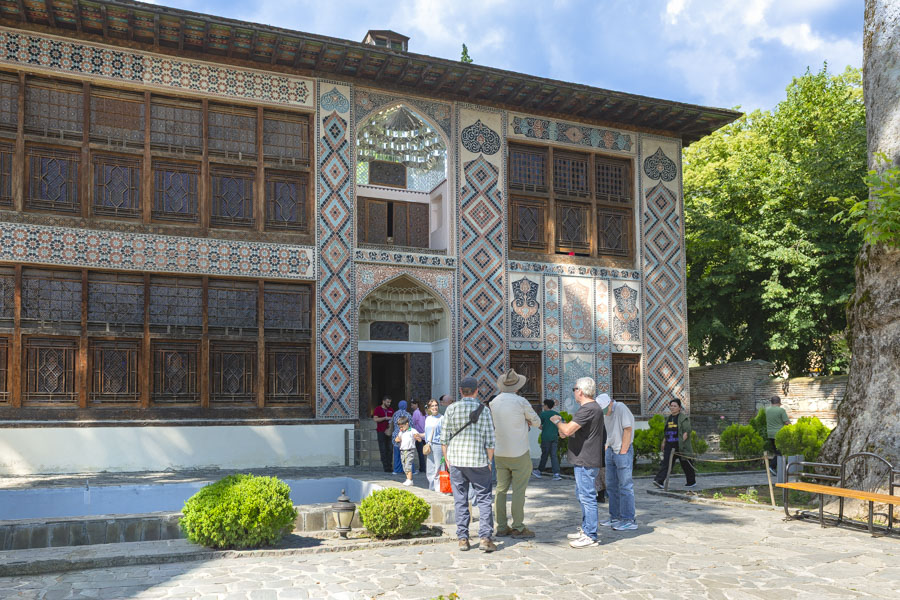
The Palace of the Sheki Khans (Şəki Xan Sarayı) is Sheki’s most famous monument and an outstanding example of 18th-century decorative architecture in Azerbaijan. The two-storey building is located within the fortress and is modest in size but exceptionally rich in detail. Its façade combines painted ornament, geometric designs and large stained glass windows. Inside, the walls are covered with floral patterns, animals and battle scenes, creating a highly decorated series of rooms.
The palace displays the use of shebeke (şəbəkə), a traditional technique in which pieces of coloured glass are fitted into intricately cut wooden lattices. The components are assembled without nails or glue. This craftsmanship, rather than the entire palace, is behind the common claim that the building was constructed without nails.
Allow time to explore the surrounding fortress area as well, where several museums and craft spaces are located.
Sheki Fortress
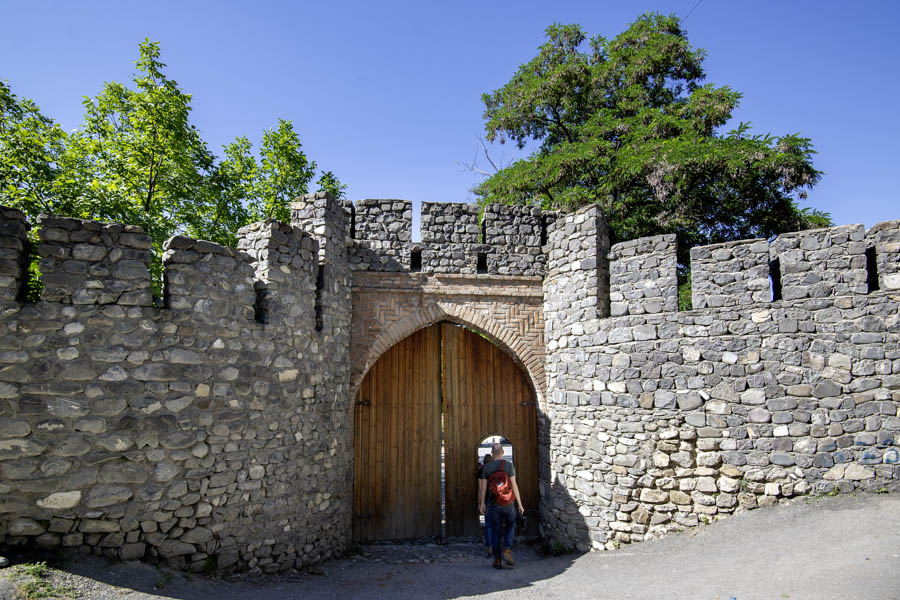
Built during the period of the Sheki Khanate, Sheki Fortress (Şəki qalası) once enclosed the rulers’ administrative complex. Its walls and gates remain a prominent feature of the upper historic centre.
Today, the enclosed area functions as a cultural complex rather than solely as a military monument. Alongside the Khan’s Palace, visitors can find spaces dedicated to applied arts and traditional crafts. The fortress is therefore best explored as a whole, with the palace as its highlight.
Sheki Caravanserais
Caravanserais are among the clearest surviving traces of Sheki’s trading past. These fortified inns provided merchants with accommodation, storage and space for trade along the Silk Road.
The Upper Caravanserai (Yuxarı Karvansaray) and Lower Caravanserai (Aşağı Karvansaray) are two surviving examples of a longstanding culture of roadside inns. Both were organised around large internal courtyards, with rooms and utility areas arranged around the perimeter.
The 18th-century Upper Caravanserai is the better-known of the two and continues to be used for accommodation. Its courtyard gives visitors an immediate sense of the scale and practical design of a traditional caravanserai.
Shekikhanovs’ House
Shekikhanovs’ House (Şəkixanovların evi) is a more domestic counterpart to the Khan’s Palace. The historic residence is known for its decorative wall paintings, ornamental interiors and shebeke-style windows.
The scale is smaller, but that gives a different perspective on Sheki’s elite architecture.
Khan’s Mosque and Historic Religious Architecture
The Khan’s Mosque and Cemetery Complex (Xan Məscidi və Xan qəbiristanlığı kompleksi) reflects the history of the Sheki Khanate and includes a cemetery where members of the ruling dynasty were buried.
Elsewhere in the city, the Gilehli Minaret (Gileyli məscidinin minarəsi) survives from a mosque that no longer stands. It is one of several smaller monuments that add interest to walks through Sheki’s old neighbourhoods.
Together, these sites show how religious, residential and commercial buildings formed part of the same historic urban landscape.
Traditional Hammams
Historic hammams once served both practical and social functions in Sheki. Several 18th- and 19th-century bathhouses survive, and among them, Abdulkhalig Hammam still operates as a public bath.
Sheki Museums
The Sheki Museum of History and Local Lore (Şəki Tarix-Diyarşünaslıq Muzeyi), inside the fortress, covers archaeology, regional history, domestic life and traditional industries. Exhibits related to silk, textiles, jewellery and embroidery help explain the crafts and industries once central to the regional economy.
The Museum of Folk and Applied Arts focuses more closely on decorative and practical traditions.
Two prominent Azerbaijani literary figures are also represented by house museums in Sheki. Mirza Fatali Akhundzadeh House Museum (Mirzə Fətəli Axundzadənin ev-muzeyi) is dedicated to the playwright, writer and intellectual born in the city in 1812, who played an important role in the development of modern Azerbaijani literature and theatre. The Bakhtiyar Vahabzadeh House Museum (Bəxtiyar Vahabzadənin ev-muzeyi) presents manuscripts, books, photographs and personal belongings connected with the 20th-century poet.
For a more unusual stop, the small Yurd Yaddashi Miniature Museum (“Vətən Yaddaşı” Miniatür Muzeyi) displays scale models of popular landmarks and scenes from Sheki’s past.
Sheki Theatres
The Sabit Rahman Sheki State Drama Theatre (Şəki Dövlət Dram Teatrı) is the centre of the city’s contemporary theatrical life. Named after Azerbaijani dramatist Sabit Rahman, it stages plays and other performances primarily for local audiences.
Performances are generally in Azerbaijani, and schedules vary, so check the programme in advance.
Entertainment, Parks and Shopping in Sheki
Sheki’s leisure scene is quieter than Baku’s, centred more on crafts, food and the surrounding landscape than on nightlife or large cultural venues.
Entertainment in Sheki
Traditional craft workshops are among the more unusual ways to experience Sheki. At shebeke workshops, visitors can watch artisans fit coloured glass into finely cut wooden frames using techniques seen in the Khan’s Palace.
Halva-making demonstrations and masterclasses reveal how one of Sheki’s traditional sweets is made and teach a technique visitors can later try at home. In the evening, tea houses and cafés provide a relaxed alternative to the nightlife found in larger cities.
Parks and Nature in Sheki
Gardens, trees and wooded slopes surround the historic neighbourhoods of Sheki, while the mountains begin only a short distance away.
The wooded foothills are suited for short walks and longer hikes beyond the historic centre. Routes vary in difficulty, from short walks to more demanding hikes. Check transport, trail conditions and the weather before setting out.
Shopping in Sheki
For traditional crafts and souvenirs, the best place to start is Mirza Fatali Akhundzadeh Street (Mirzə Fətəli Axundzadə küçəsi) in the historic centre. Small shops and artisan workshops along this former trading street sell shebeke pieces, ceramics, woodwork, textiles and other handmade goods. Buying directly from workshops also lets travellers see how some items are produced.
Sheki is particularly known for silk products, including kelaghayi (kəlağayı), traditional silk headscarves, as well as tekelduz (təkəlduz) embroidery. Craft shops around the fortress and historic centre are generally of more interest to travellers than the city’s modern shopping centres, although Yenilik Shopping Mall and other modern retail outlets are available for everyday shopping.
Food in Sheki
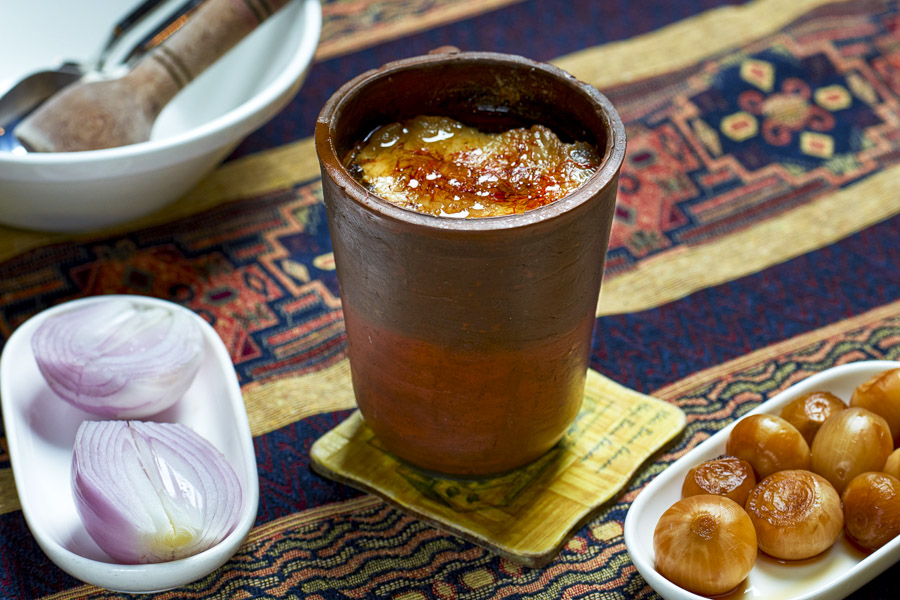
A visit to Sheki is a great opportunity to give local cuisine a try. The city is most commonly associated with two specialities – Sheki piti and Sheki halva.
Azerbaijani Cuisine
Sheki piti is a slow-cooked lamb dish traditionally prepared in individual clay pots. Recipes vary, but chickpeas are a standard component.
The dish is traditionally eaten in two stages. Bread is first broken into a bowl, and the broth is poured over it. The remaining meat and chickpeas are then mashed together and eaten separately.
The city’s other signature speciality, Sheki halva, differs from many sweets known internationally by the same name. Thin lattice-like layers made from rice dough are combined with nuts, sugar and spices, soaked in syrup and finished with a decorative surface pattern.
Vegetarian Restaurants and Vegan Options
Dedicated vegetarian restaurants are limited in Sheki, but most Azerbaijani restaurants offer several meat-free dishes. Vegetarian travellers can usually choose from salads, aubergine and other vegetable dishes, cheese, bread, rice, soups and qutab filled with greens or other meat-free ingredients.
Vegan options require a little more care, as butter, yoghurt, cheese, eggs or meat stock may be used even in dishes that appear plant-based. It is worth confirming ingredients when ordering, particularly in smaller traditional restaurants. Hotels and visitor-oriented establishments may also be able to adapt simple dishes on request.
Tea Houses, Bakeries and Patisseries
Traditional confectioneries are characteristic of Sheki. Many sell halva alongside other pastries and sweets, and some family-run businesses offer demonstrations of the preparation process.
Tea houses are common and make an easy stop between sights. Azerbaijani tea is usually served in pear-shaped armudu glasses and may be accompanied by preserves, sweets or lemon. Bakeries and simple cafés are useful for breakfast, snacks and lighter meals when time is limited.
City Transport in Sheki
Walking is usually the easiest way to move between the fortress, caravanserais, museums and surrounding historic streets. Walking becomes less practical for sights outside the centre, and places such as Kish require transport.
Public Transport
Buses and minibuses connect different parts of Sheki and some nearby settlements. They are inexpensive, although routes and timetables may not always be immediately clear to visitors. Kish can be reached by a minibus, making it one of the easiest nearby destinations to visit without a private car.
Public transport departure times are best confirmed in advance. For intercity services, you can check schedules on Azerbaijan’s official bus-station website or use Biletim.az to search routes and buy tickets.
Other Modes of Transport
Taxis are convenient for journeys beyond the centre, including Kish, transport terminals and other nearby attractions. Bolt operates in Sheki and allows users to see an estimated fare before requesting a car through the app. If using a street taxi, agree on the fare before departure.
Bicycles and electric scooters are another good option for shorter journeys, while travellers planning several stops outside Sheki may also find a private driver more practical.
How to Get to Sheki
Sheki lies around 300 km west of Baku by road. The journey usually takes about four and a half to five hours by car, depending on traffic, route and stops.
Private transfers are convenient for those who want to visit places such as Shamakhi (Şamaxı) or Lahij (Lahıc) along the way. Intercity buses connect Baku and Sheki as well, and are a more affordable choice for independent travel.
The Baku-Balakan passenger train stops at Sheki, providing an alternative to travelling by road. Sheki railway station lies outside the centre, so visitors need onward transport after arrival.
Road connections also link Sheki with Gabala (Qəbələ), Ganja (Gəncə) and other destinations in western Azerbaijan.
If you plan to continue towards Georgia, it is best to check the latest land-border and rail-entry rules before departure, as these arrangements remain subject to change.
Languages Spoken in Sheki
Azerbaijani is the main language spoken in Sheki, and Russian is understood by some residents, particularly older people and those working in tourism.
English is used in some hotels, museums and other businesses, but is less widely spoken in small shops, restaurants and surrounding villages. A translation app can be useful outside the main tourist areas. Learning a few basic Azerbaijani greetings can make everyday interactions easier, such as salam (sah-LAHM, hello) and çox sağ olun (chokh sah oh-LOON, thank you very much).
Security in Sheki
Sheki is generally straightforward to explore, and normal travel precautions are usually sufficient. Keep valuables secure, use reputable transport and take care on uneven or poorly lit streets after dark.
Visitors heading into the surrounding forests or mountains should prepare more carefully. Check the weather, choose routes suited to your experience and carry suitable footwear, water and navigation.
When travelling to remote mountain or border areas, follow local advice and always carry identification.