

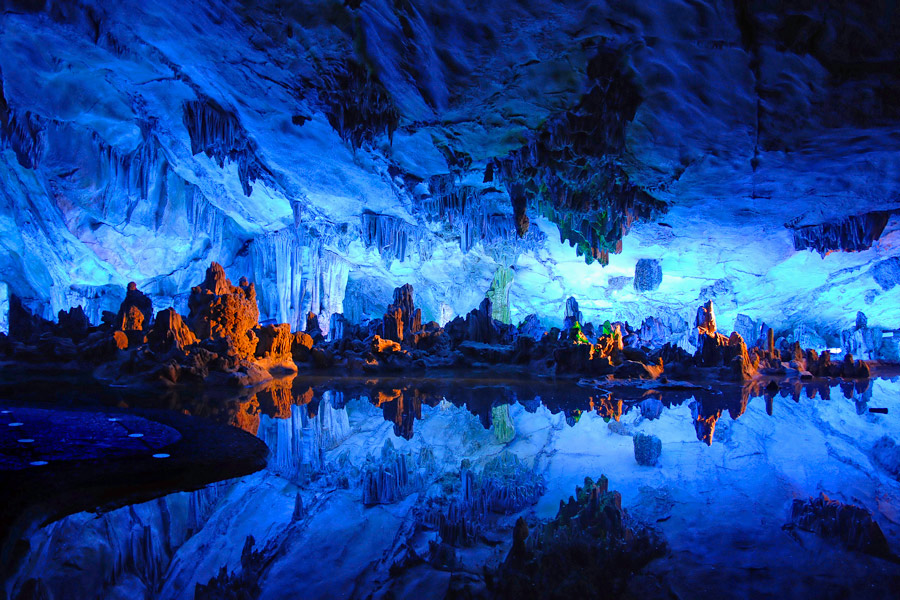
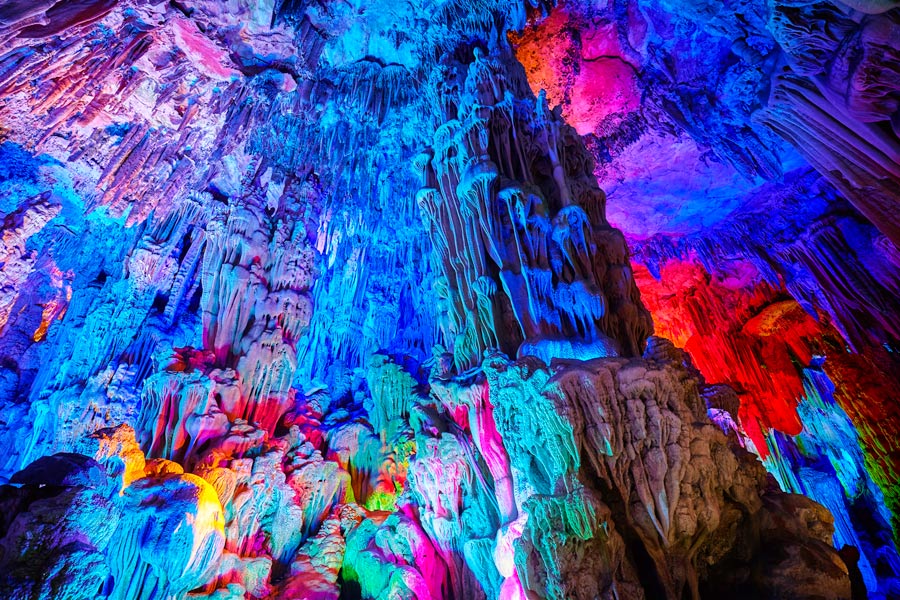
The Reed Flute Cave (芦笛岩, Lúdí Yán) in Guilin reveals a striking underground world, where unusual rock formations glow softly under carefully placed lighting. The walking route winds through a series of spacious halls connected by natural corridors. Above, stalactites hang in dense clusters, while stalagmites rise from the ground, creating a layered relief that conveys a clear sense of rhythm and depth.
Subtle coloured lighting brings out the curves of the arches and the texture of the stone, allowing intricate details to emerge. The cave is approximately 600,000 years old, and its walls bear dozens of ancient inscriptions, adding a historical dimension to this natural space. The Reed Flute Cave is part of the Guilin Karst, which is included in the wider UNESCO World Heritage Site of the South China Karst. Here, you step into an underground world shaped by time, stone, and water, encountering one of China’s most renowned karst formations.
The Reed Flute Cave Tours
Visiting the Reed Flute Cave is an excellent way to kick off your exploration of Guilin. Strolling through its vast chambers sets the stage for the stunning landscapes that characterise the region. One cherished choice is the 4-Day Guilin Highlights Tour, which combines the cave with a Li River cruise, a trip to the Longji rice terraces, and time in Yangshuo.
The cave visit can also be included in longer itineraries across China. For example, tours like the 12-day Central China Classic Tour, which begins in Beijing and concludes in Shanghai, or the 15-day China Natural Wonders Group Tour, which features destinations such as Xi’an and Zhujiajiao Water Town. They allow to experience the Reed Flute Cave as part of a broader journey through the country’s diverse landscapes. In every format, the visit offers both visual splendour and cultural insight.
Best Time to Visit the Reed Flute Cave
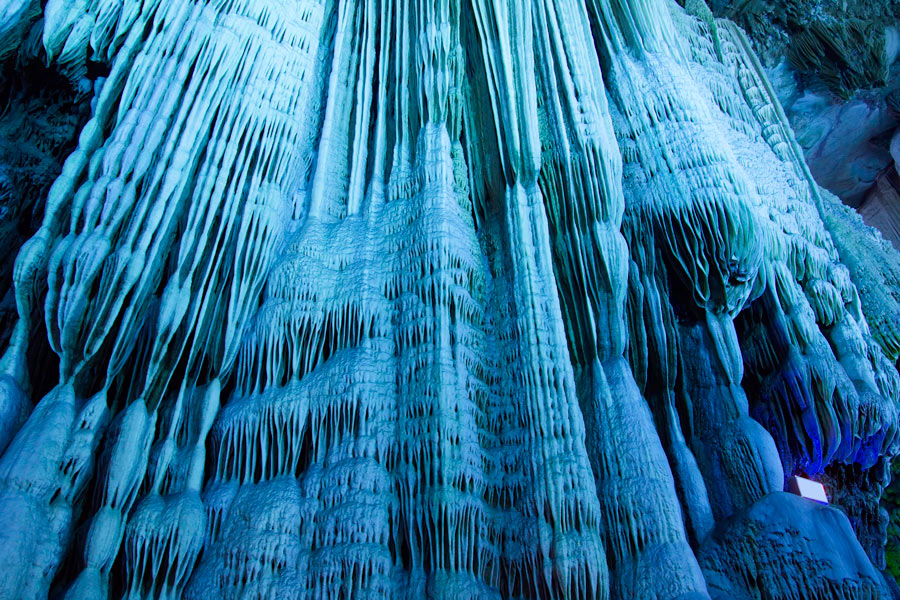
Spring and autumn are generally the most comfortable seasons to visit the Reed Flute Cave. During these months, Guilin’s mild weather provides pleasant conditions for sightseeing and photography. While daytime temperatures outside can be warm, the cave itself remains cool throughout the year, at around 20°C (68°F).
Opening Hours and Ticket Booking
The Reed Flute Cave is open daily, with opening hours varying slightly by season:
- April 1 – October 31: 7:30 – 18:00
- November 1 – March 31: 8:00 – 17:30
The last admission is 30 minutes before closing.
Tickets can be purchased at the entrance; however, queues are common during peak seasons and major holidays (such as Spring Festival or Golden Week). For a smoother visit, tickets can be reserved online in advance. Online bookings open five days before the intended visit date and are available via the official WeChat or Alipay mini-programmes by searching for 芦笛岩景区 (Reed Flute Cave Scenic Area). After booking, a QR code is issued and can be scanned directly at the entrance.
As of February 2026, admission is free for children under 1.20 metres tall and those aged under 6. The regular ticket price is CNY/RMB 90 (approximately $13, €11, or £9.60 ). Minors between the ages of 6 and 18, as well as seniors over 70, pay half the regular price.
Note: Prices are indicative and may change without prior notice.
History of the Reed Flute Cave
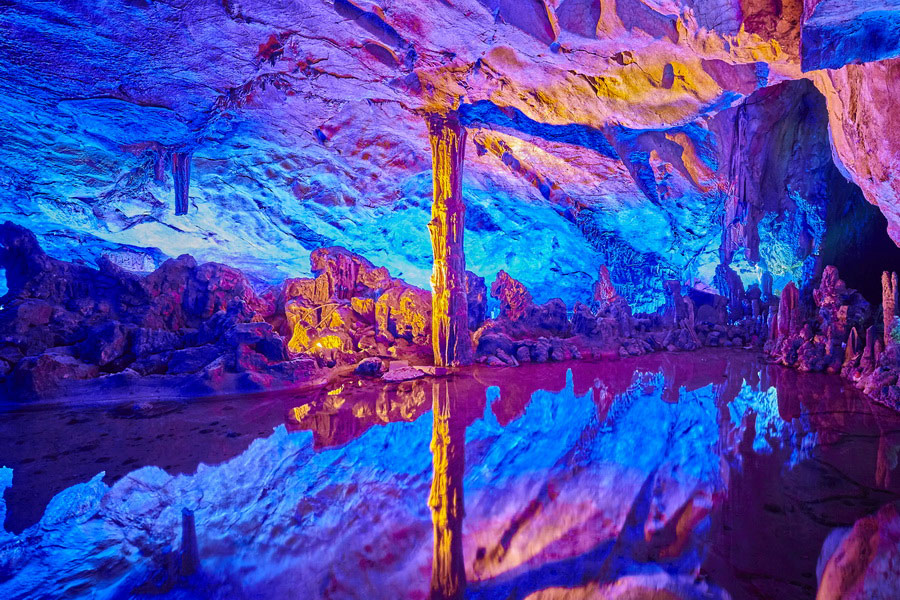
The Reed Flute Cave was formed over hundreds of thousands of years through the slow interaction of limestone and water. Underground streams gradually dissolved the rock, widening cracks and forming chambers. Subsequent geological changes transformed these cavities into the extensive network of karst halls we see today, complete with stalactites and stalagmites.
The cave takes its name from the reeds growing near the entrance, which were traditionally used to make flutes. Human interest in the site dates back over a thousand years. Over seventy inscriptions, mainly from the Tang dynasty (618–907), remain on the cave walls, including poems and travel notes left by scholars and pilgrims.
In the 20th century, the cave was rediscovered during the 1940s, when local residents used it as shelter during wartime air raids. Since the 1960s, it has been open to the public as one of Guilin’s best-known natural attractions.
What to See in the Reed Flute Cave
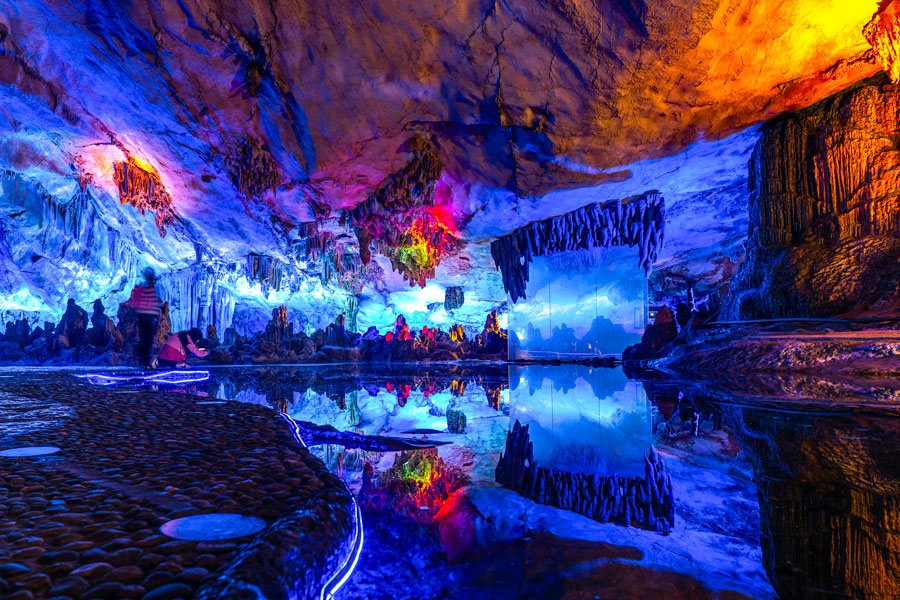
The interior of the Reed Flute Cave is more than just a collection of stalactites and stalagmites; it is a meticulously crafted gallery of karst formations, many of which bear poetic names inspired by the imagery they evoke. The cave stretches for about 240 metres (787 feet) along a U-shaped route, where a series of stone “scenes” unfolds under coloured lighting, creating a visual rhythm and a sense of movement.
Ancient Inscriptions
Between seventy and seventy-seven ancient inscriptions have been preserved on the cave walls, written in ink and primarily dating from the Tang dynasty and later periods. Poets, monks, and scholars left behind verses, brief reflections, and travel notes, many of which record the names of pilgrims who travelled together. These calligraphic remnants provide insights into the cultural and religious life of the region and reflect the flourishing of Buddhism in Guangxi between the 7th and 9th centuries.
The Crystal Palace Hall (水晶宫)
The Crystal Palace is one of the most spacious and impressive halls within the cave. Its flat floor and soaring arches, which rise to around 18 metres (59 feet), create an open, almost theatrical atmosphere. The space recalls a fairy-tale hall, with carefully selected music softly echoing against the rock surfaces, enhancing the sense of immersion.
The Lion Rock and Sunrise Hall (狮岭朝霞)
In this section, clusters of unusual rock formations resemble a family of lions greeting the first light of dawn. Among them, the outline of a large lion appears to watch over smaller cubs, an image that becomes more distinct as the lighting shifts across the stone surface.
The Pines in the Snow Hall (塔松傲雪)
This group of stalagmites evokes the image of snow-covered pine trees, accompanied by a figure that many visitors liken to a snowman. This impression is enhanced by the interplay of light and shadow, which accentuates the delicate contours of the formations.
The Sky-Scraping Twin (双柱擎天)
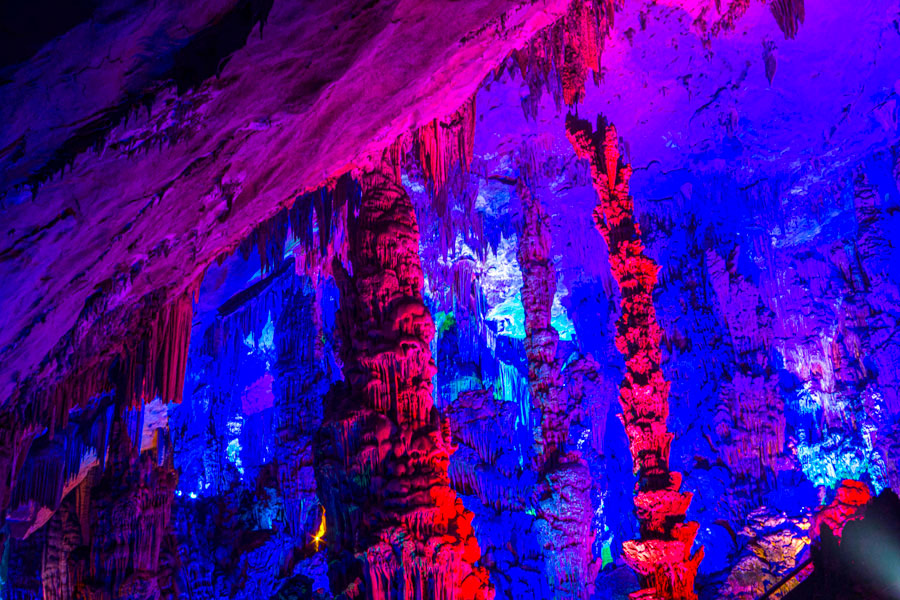
Two monumental stone columns rise toward the cave ceiling, setting the rhythm of the surrounding area and making the passage beneath them particularly striking.
The High Canyon Waterfall (高峽谷瀑布)
Here, towering rock formations resemble a vast waterfall suspended in mid-air, its cascading form captured and held in stone.
Other notable formations include the Flower and Fruit Mountain (花果山), the Mushroom Hill (蘑菇山传奇), the Dragon Pagoda (盘龙宝塔), the Virgin Forest (原始森林), and the Red Curtain (红罗宝帐). Together, they illustrate the remarkable diversity of shapes found within the cave and the imaginative responses they have inspired over centuries.
All major features are clearly marked with labels, allowing visitors to explore at their own pace, compare names with shapes, and form their own interpretations within the cave’s ever-changing stone landscape.
Attractions Near the Reed Flute Cave
After your visit, it is worthwhile to explore the surrounding area. Nearby sights include the Peach Blossom River (桃花江), the Flying Phoenix Bridge (飞鸾桥), the Back Mountain (後山) with its karst viewpoints, and the Fanglian Pond (芳莲池), which is especially attractive in spring.
How to Get to the Red Flute Cave in Guilin?

Buses
Reaching the Reed Flute Cave is straightforward thanks to Guilin’s well-developed public transport network. Several city bus routes — including buses No. 3, 13, and 58, as well as sightseeing buses — stop at the Reed Flute Cave Station, making the site easily accessible for visitors staying in various parts of the city.
- From Guilin South Railway Station, approximately 6 kilometres (3.7 miles) from the cave, bus No. 3 provides a direct connection. The service runs frequently, about every ten minutes, from 6:30 to 21:50, and the fare is just 1 yuan. From Guilin Railway Station, around 8 kilometres (5 miles) away, taking a taxi is generally the most convenient option.
- If you are staying in the city centre, roughly 5 kilometres (3.1 miles) from the Reed Flute Cave, you can also take bus No. 3 from Jiefang West Road, which goes directly to the cave without any transfers. Even first-time visitors will find the route easy to follow, with clear signage and well-marked stops along the way.
Taxis
From Guilin Liangjiang International Airport (KWL), located about 25 kilometres (15.5 miles) away, the most practical choice is to take a taxi via Zhongyin Road. The journey usually takes around 40 minutes, depending on traffic.
Tips for an Optimal Visit to the Reed Flute Cave
To make your visit to the Reed Flute Cave as comfortable and rewarding as possible, it helps to be aware of a few practical details. Familiarising yourself with the route’s organisation will allow you to explore at a relaxed pace and fully enjoy the cave’s highlights.
Visitor facilities
The area near the entrance is well organised. You will find parking, restrooms, vending machines, gift shops, and clear signage. The routes are easy to follow, even during busy periods.
Duration of visit
A standard visit takes about one hour, including time to walk through the cave and stop for photographs.
Accessibility and safety
Near the entrance of the site, you can rent a sedan chair, a traditional portable seat, which can be helpful for visitors with limited mobility to climb the steps to reach the cave entrance.
Inside the cave, the paths follow solid walkways, but some sections can be damp and slippery due to the high humidity levels. Preparing for this wonderful experience by wearing comfortable shoes with good grip will significantly reduce the risk of slipping. Visitors will need to climb steps, and some parts of the walkways are narrow, making them inaccessible to wheelchair users. It is advisable to assess your own comfort level in advance.
The air inside the cave is cool and humid, offering a noticeable contrast to the heat outside. A light jacket or shawl may be useful during the visit.
Photography
Photography is permitted throughout the cave but with the flash turned off. As lighting levels are low, a high ISO setting is recommended. It is best to move slowly and avoid sudden camera movements for clearer shots. In several areas, a thin layer of water on the cave floor creates mirror-like reflections, offering the opportunity to photograph stalactites and stalagmites from unexpected and visually striking angles.
A walk through the Reed Flute Cave reveals an underground world shaped entirely by nature. Take your time at the most striking formations and pause to capture photographs of this remarkable place. The impressions linger long after you leave, becoming a memorable part of your experience in Guilin.