

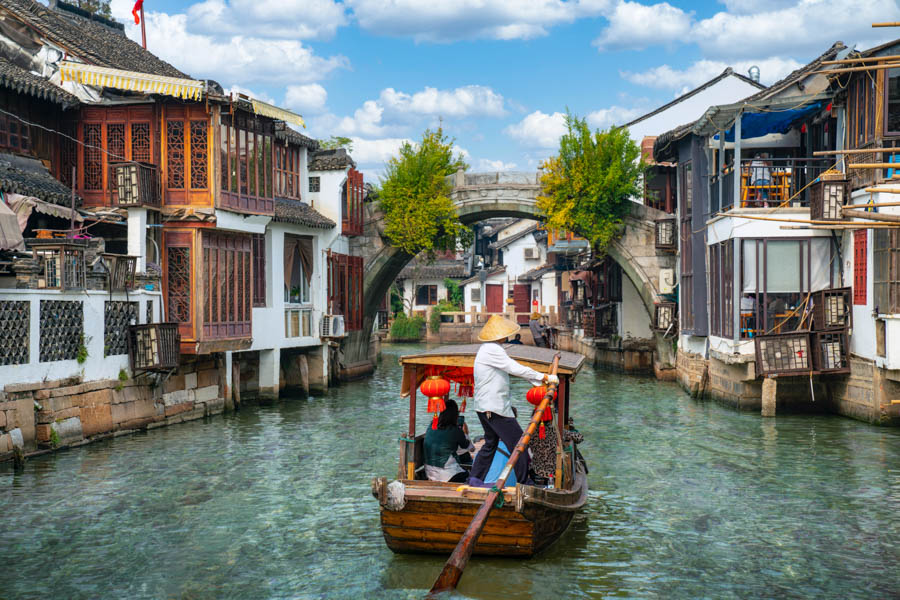
Zhujiajiao is often referred to as a town of bridges – not just as a metaphor, but as a defining characteristic of its layout. Thirty-six bridges span the canals, made from wood, brick and stone. They connect streets and courtyards, shaping a townscape defined by reflections in the water and the gentle curves of the banks.
Each bridge possesses its own unique proportions and character. Some are modest and functional; others rise gracefully with more elegant arches, their lines carefully crafted. When viewed together, they create a coherent whole – a place where architecture and waterways exist in serene balance and where the rhythm of daily life flows with the canals.
Historic Bridges of Zhujiajiao Tours
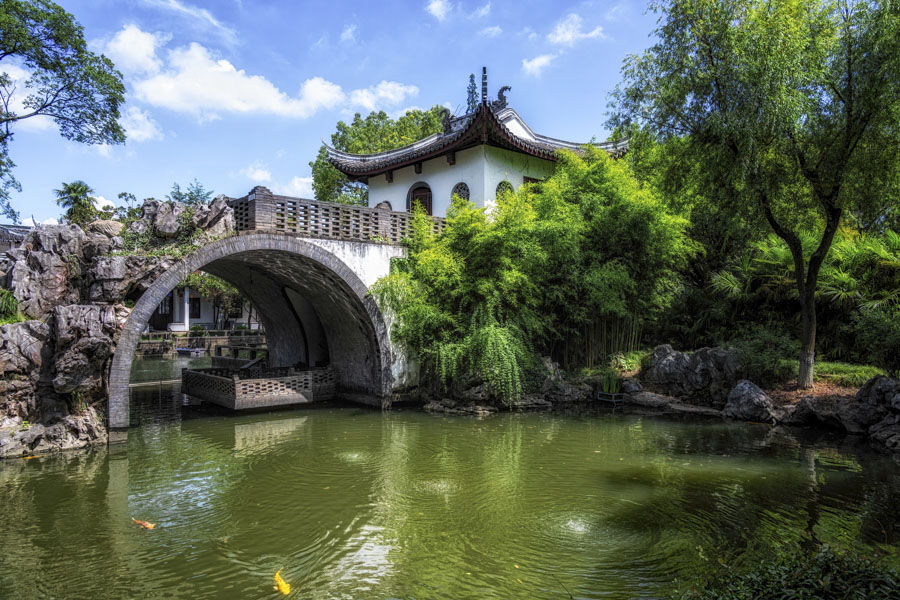
One of the most engaging ways to explore Zhujiajiao is to follow a route shaped by its bridges. Walking along the canals or drifting beneath the arches in a traditional wooden boat allows you to observe their construction up close and understand how they facilitate the town’s daily activities.
Travellers wishing to include this experience may choose from several formats. The one-day tour to Zhujiajiao from Shanghai offers a focused introduction, combining time spent among the bridges with a stroll through the old shopping streets, a visit to Kezhi Garden, and the opportunity to sample local cuisine. Zhujiajiao Water Town and its historic crossings can also be incorporated into longer itineraries, such as the 10-day Central China Discovery Tour or the 12-day Central China Classic Tour. Within these broader journeys, the town provides a refreshing contrast to larger urban centres, enriching one’s introduction to Chinese culture.
Best Time to Visit Zhujiajiao Bridges
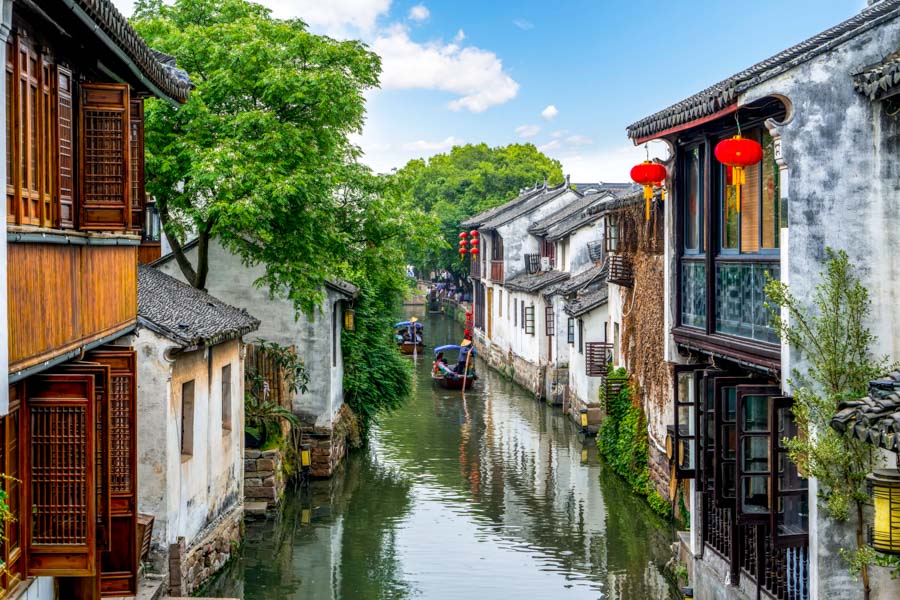
Spring (March–May) and autumn (September–November) are generally the best seasons for walking across Zhujiajiao’s historic bridges. The air is mild, and the canals reflect light and architecture with remarkable clarity.
Visiting Zhujiajiao in summer (June–August) offers a lively atmosphere. The air can be quite humid during this season, but it generally feels refreshing by the water, making it a delightful time to enjoy local delicacies and the bustling energy of the town.
In winter (December–February), tourist activity tends to slow down, and the town feels more intimate. Wrapped in warm clothing, you can take a boat trip, go shopping, and enjoy a meal in a peaceful setting. In this calm season, Zhujiajiao reveals its true character, sometimes covered in a delicate layer of snow that enhances its ethereal beauty.
Best time of the day to visit
Arriving before 10:00 allows you to cross the bridges ahead of the main flow of visitors, when the town feels quieter.
Later in the day, after around 16:00, softer light brings out the texture of stonework and the surface of the water.
Nighttime in Zhujiajiao is a magical experience, with each season bringing its unique charm as the lights reflect beautifully on the water.
Visit Zhujiajiao during the festivities
Seasonal festivals offer a different perspective on the canals. During the Dragon Boat Festival (端午节), which takes place in late May or June, the waterways host traditional races and celebrations. The Mid-Autumn Festival (中秋节), typically observed in September, is characterised by evening strolls and the sharing of mooncakes. In February or early March, the Lantern Festival (元宵节) brings illuminated decorations to the bridges and narrow streets, adding an enchanting layer of light to the historic setting.
Exploring Zhujiajiao: Routes by Foot and Boat
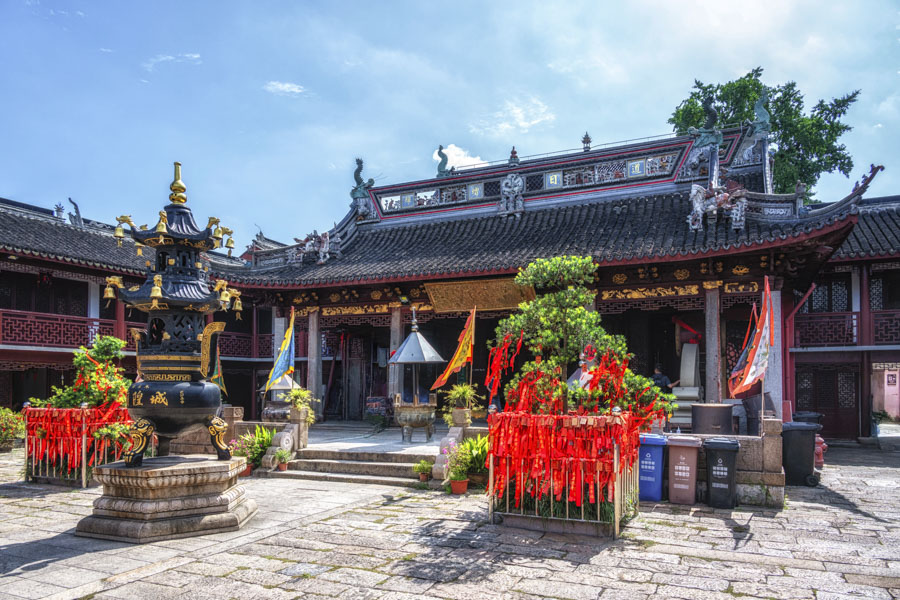
Zhujiajiao can be explored either on foot or from the water, each perspective revealing a different rhythm of the town. The routes outlined below showcase many of its historic bridges and nearby landmarks in a clear and manageable sequence.
On foot
Start your walk through the water town near the Zhujiajiao Ancient Town Tourist Centre, the main entry point to the historic area. Follow Xijing Street towards Jingting Port Canal (井亭港) to experience its distinctive mythological significance. Three bridges cross this narrow waterway:
- Yongquan Bridge (涌泉桥), the first on the route, is associated with the dragon’s tail – a symbol of hidden power.
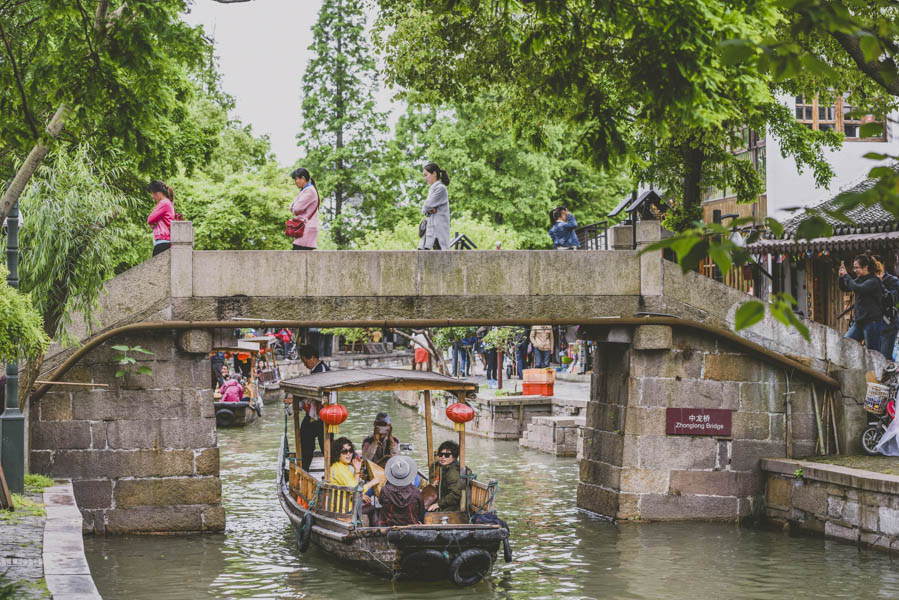
- Next comes Zhonglong Bridge (中龙桥), which occupies the central position and is linked with the dragon’s body.
- The sequence is completed by Yong’an Bridge (永安桥), perceived as the dragon’s head, facing forward towards the Caogang River (漕港河).
The “Three Bridges on Dragon River”, Yongquan Bridge (North Bridge), Zhonglong Bridge (Middle Bridge) and Yongan Bridge (South Bridge) play a significant role in festivals and customs. According to legend, the river that flows beneath the three bridges earned the name “Dragon River” as an emperor of the Qing dynasty once crossed its span, bestowing an enduring tale upon its waters. Yongquan Bridge represents the dragon’s tail, while Zhonglong Bridge embodies its belly, and Yong’an Bridge crowns its head – together, with the river, they sculpt the form of a dragon, a symbol of good fortune and prosperity.
After crossing Yong’an Bridge to the opposite side of the canal, turn right and continue towards the bank of the Caogang River. Follow the riverside path until you reach the town’s most famous landmark – Fangsheng Bridge (放生桥), a monumental structure featuring five elegant arches. As you cross, take note of the tea houses and restaurants along the embankments, where you may wish to pause for a moment.
After crossing Fangsheng Bridge, turn right and follow Great North Street / Bei Dajie (大北街). You will soon arrive at Tai’an Bridge (泰安桥), which is situated on your left, nestled among waterside houses. After crossing it, take Caohe Street on your left and continue deeper into the historic quarter, stopping along the way at Lang Bridge (廊桥), City God Temple Bridge (城隍庙桥) and Qijia Bridge (戚家桥). Continue until you reach Yongfeng Bridge (永丰桥), from where you can admire the historic building of the Qing Dynasty Post Office (大清邮局).
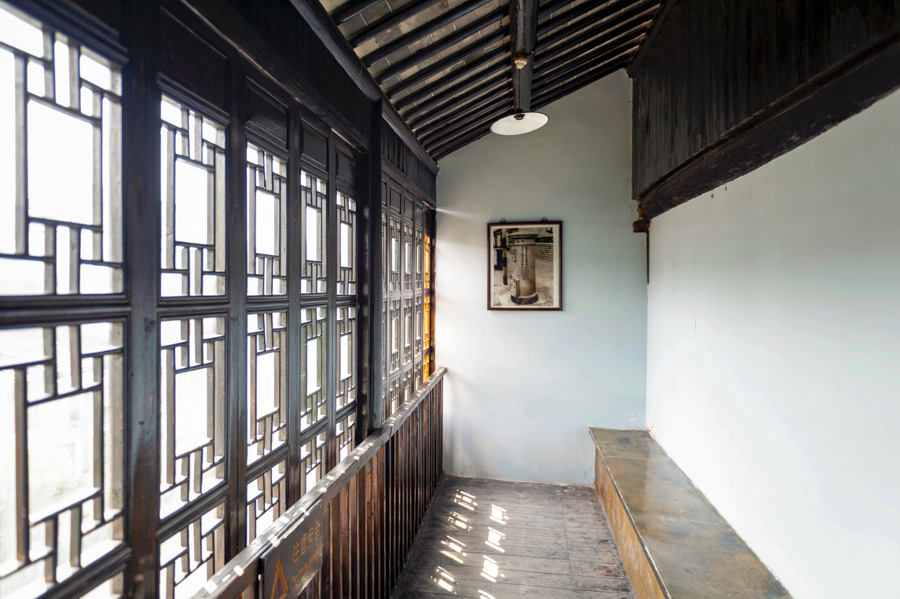
To complete the route, head to the right on Caoping Road, located just past the Post Office, which leads back to the Tourist Centre via Caoping Road Bridge. If you would like to continue exploring, Kezhi Garden and the Garden of Inseparable Hearts are nearby, providing a pleasant place to rest after your walk.
The walking route is approximately 2.5 km (about 1.6 miles), so allow 1.5–2 hours for a leisurely pace.
By Boat
Embarking on a boat trip through the enchanting canals of Zhujiajiao, the Venice of Shanghai, is an experience not to be missed. Upon entering this picturesque haven, make your way to Yongquan Bridge, home to Kezhi Garden Pier (课植园码头).
Here, you can set sail on an adventure that takes you past the magnificent Fangsheng Bridge before gracefully turning back to dock at Great North Street Pier, near the stunning Tai’an Bridge. Just five minutes later, the boat stops at City God Temple Bridge Pier, located next to the iconic bridge of the same name.
At night, the city takes on a completely different character; the waters radiate with lights projected from the traditional houses, the bridges are illuminated, and if you have the opportunity to sail on the rivers, you will discover a world so fascinating that words cannot describe it. Passing under a bridge is like passing from one realm to another.
If you prefer to explore on foot first, you can board at either of the last two piers. The boat passes many of the main bridges in the historic centre, allowing you to admire the townscape from water level.
The boat trip lasts 15–20 minutes.
Notable Historic Bridges of Zhujiajiao Water Town
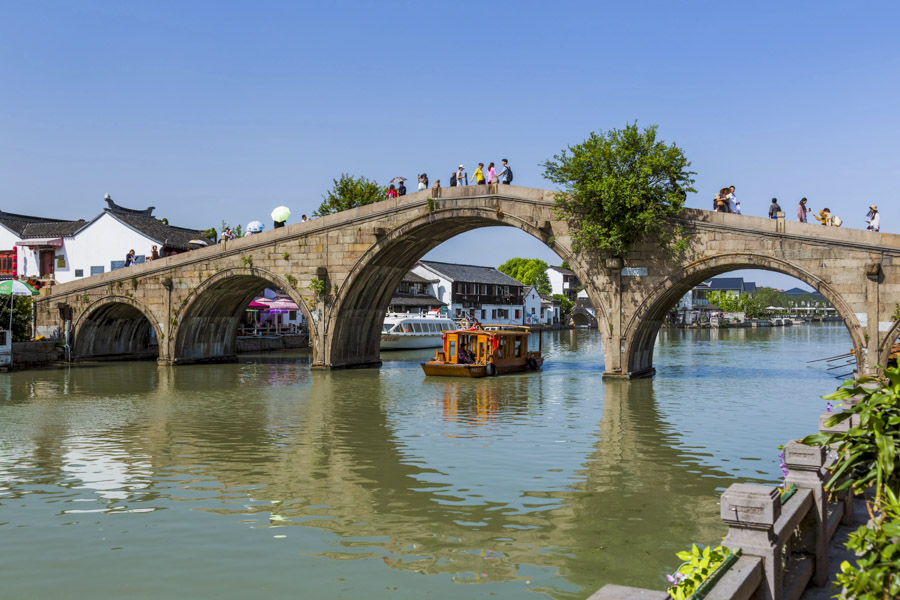
Each bridge in the historic quarter of Zhujiajiao occupies a precise place within the network of streets and canals, preserving stories, beliefs and traces of earlier centuries.
In the Zhujiajiao Water Town, a cherished tradition unfolds on Lunar New Year’s morning, as young and old traverse each bridge in joyous unison. These sturdy structures, which connect the streets, transform into vessels of protection and blessings for the year ahead.
Each bridge embodies its own hopes: Fangsheng Bridge bestows longevity; Ping’an Bridge ensures harmony; Taian Bridge prays for national prosperity; Yongan Bridge promises peace and health; Yongfeng Bridge represents bountiful harvests; Yongquan Bridge heralds wisdom and wealth; and Zhonglong Bridge signifies dragon-like vitality.
Embracing the elders, hearing their tales, and crossing the stone bridges while sharing blessings is a delightful way to usher in the New Year in China!
Below is an overview of the most emblematic crossings that have come to define the character of the water town.
Fangsheng Bridge (放生桥)
One of the largest, most recognisable, and remarkable historic bridges in Zhujiajiao and Shanghai area is Fangsheng Bridge. Built in 1571 during the Ming dynasty (1368–1644) at the initiative of the Buddhist monk Xingchao, it spans the Caogang River. Constructed from stone, its scale makes it one of the town’s most prominent crossings.
Referred to as “A rainbow across the wellport” in a historic poem, the bridge measures approximately 72 metres (236 feet) in length. Five stone arches, gradually decreasing in height towards the sides, form a broad curve above the water. Slender piers distribute the load while allowing the river to flow freely beneath. Carvings of eight coiling dragons pursuing a pearl among the clouds decorate the arch at the end of the bridge, while four stone lion figures stand along the balustrades.
The name “Fangsheng” refers to the Buddhist ritual of releasing living creatures – most often fish or turtles – back into the water as an act of compassion.
From the bridge, there are clear views across the historic quarter, with its tiled roofs and intersecting canals. Nearby stands the Zhujiajiao Ascension of Jesus Church (朱家角耶稣升天堂), identifiable by its tall bell tower. Fangsheng Bridge can also be reached directly by boat from the Kezhi Garden Pier.
Lang Bridge (朗桥)
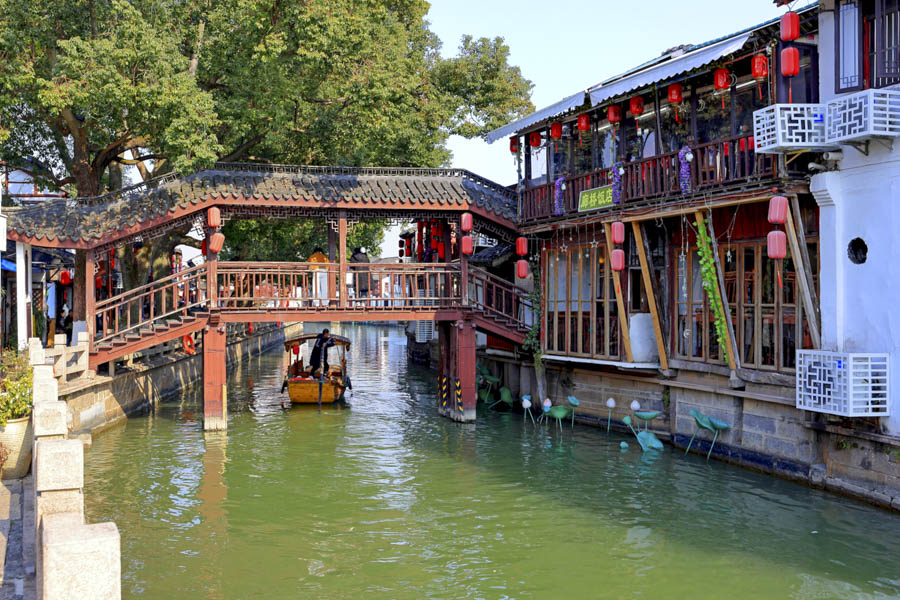
Also known as Huimin Bridge (惠民桥), which means “benefiting the people”, Lang Bridge connects Caohe Street (漕河街) with Great North Street (北大街) and serves as an ideal resting spot. It forms an important link within the pedestrian routes of the old town, historically connecting residential and commercial areas.
Originally built during the Qing dynasty (1644–1912), the bridge was dismantled in the 1960s due to deterioration and later reconstructed in 1996 in keeping with traditional styles.
Unlike many of the stone crossings, Lang Bridge is the only wooden bridge in Zhujiajiao, featuring a plank deck and tiled eaves that create the effect of a covered passageway above the water. The design offers shelter from sun and rain while maintaining an intimate scale. It lies just a short walk from Fangsheng Bridge along Great North Street. Nearby is the City God Temple (城隍庙), traditionally associated with the protection and prosperity of the town.
This bridge offers an extraordinary vantage point from which to observe the inhabitants going about their daily lives. It allows one to soak up the atmosphere of the city.
Ping’an Bridge (平安桥)
Located south of the City God Temple (城隍庙), Ping’an Bridge is also known locally as Qijia Bridge (戚家桥), in memory of the Ming-era general Qi Jiguang, who is said to have commissioned its construction during campaigns against Japanese pirates.
The bridge has a relatively flat profile, typical of older urban crossings, and combines granite, blue brick and timber in its structure. The uneven surface of its stone slabs produces a distinctive “clacking” sound underfoot – a detail that local tradition associates with the idea of well-being. The name “Ping’an” itself conveys the meaning of peace and tranquillity.
The poem “Anchoring at Ping’an Bridge under the Moonlight”, penned by the esteemed instructor Wang Xiyi during the Qing dynasty, is truly delightful. The “red-railed ancient bridge” he beautifully described appears to have withstood the test of time, preserving its charm and awaiting your visit.
Close to the bridge stands the Wangchang Memorial Hall (王昶纪念馆), the former residence of Wang Chang (王昶), a Qing dynasty scholar and official native to Zhujiajiao.
Tai'an Bridge (泰安桥)
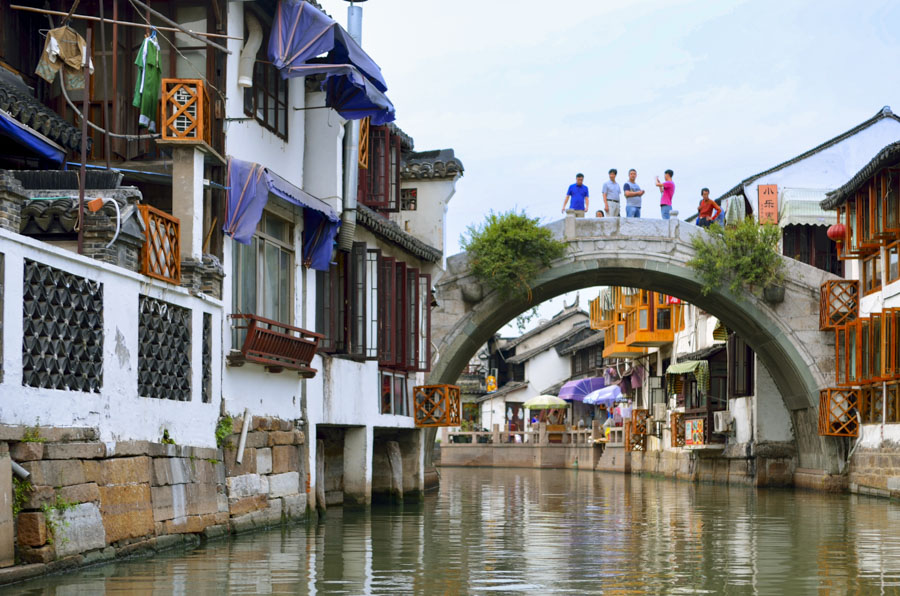
A poem entitled “Tai’an Bridge in Evening View”, by the Qing scholar Chen Jianglin, resonates profoundly, as if it were crafted in the present day.
Tai’an Bridge, also known as Hejia Bridge (何家桥), was built in 1584 during the Ming dynasty and restored in 1685. Positioned directly in front of the entrance to Yuanjin Temple (圆津禅院), it has long played a central role in the town’s spatial organisation.
This single-span stone arch bridge measures around 26 metres (85 feet) in length. Its high arch and steep flights of steps on both sides make it one of the most elevated crossings in Zhujiajiao. The railings are decorated with carved cloud motifs, and traces of earlier iron chains and fittings remain visible along the deck. When reflected in the water, the arch forms a near-complete circle – a shape traditionally associated with harmony and prosperity.
What captivates the eye most are the ancient pomegranate trees, four centuries old, thriving in the crevices of the bridge’s weathered stones. The mortar of this enduring structure, crafted from glutinous rice paste enriched with pomegranate seeds, has nurtured life that now flourishes in its joints. It is truly a spectacular sight.
To the east stands Handalong Jiangyuan (涵大隆酱园), a historic sauce workshop more than 140 years old. Nearby, surrounded by water on three sides, is the well-known Grandmother’s Tea House (阿婆茶楼), housed in a building dating to the Ming and Qing periods.
Yong’an Bridge (永安桥)
Spanning Xijing Street (西井街), Yong’an Bridge, also called South Bridge (南桥), is a modest yet solid stone structure. Characterised by granite slab paving and substantial supports, its design emphasises durability rather than ornament.
The four corners are reinforced with traditional bao gu (抱鼓) drum-shaped stone elements, and nine stone steps descend on both sides, a number that holds significant meaning. The number nine is associated with the Emperor of China, as well as concepts of longevity, permanence, and spirituality. Yong’an Bridge lies on the route towards Kezhi Garden (课植园) and is surrounded by small restaurants, shops and guesthouses.
Yongfeng Bridge (永丰桥)
The Bridge of Eternal Abundance, Yongfeng Bridge located in the southern part of Zhujiajiao between Donghu Street (东湖街) and Xihu Street (西湖街). Built in 1627 during the Ming dynasty, it was originally named “Bridge of Singing Winds”, this romantic bridge was immortalised in a poem by Shao Tang.
In November 1937, during the Second Sino-Japanese War, an incendiary bomb struck the bridge but failed to explode. The damaged stone was later preserved and inscribed with the date of the event as a memorial to the town’s survival.
The 20-metre (66-foot) bridge consists of a single span with wooden beams and stone supports. Lotus carvings decorate the balustrade ends, and at the base stands a stone column carved with motifs of the An Baxian (暗八仙), symbolic attributes of the Eight Immortals in Taoist tradition. Decorative details associated with auspicious imagery, including elements shaped in the form of yuanbao (元宝) ingots – traditional symbols of wealth – further reflect the symbolic language characteristic of historic bridges in Zhujiajiao.
Nearby is the Qing Dynasty Post Office (大清邮局), offering insight into the organisation of communications in the late imperial period. Yongfeng Bridge can be reached on foot from the southern quarter, using Ping’an/Qijia Bridge as a reference point.
Yongquan Bridge (涌泉桥)
As one of the first bridges encountered along the main tourist route, Yongquan Bridge establishes the architectural tone of this part of the historic district.
Yongquan Bridge spans the Jingting Port canal in the northern section of the old town. Built in the late Qing dynasty, it is a single-span granite beam bridge measuring approximately 15 metres (about 49 feet) in length and around 2 metres (approximately 6.5 feet) in width.
Each corner is decorated with pillars shaped like yuanbao (元宝) ingots, which are traditionally associated with wealth and stability. Fourteen stone steps with anti-slip patterns lead up on either side. Nearby is Kezhi Garden Pier, the departure point for canal boat rides.
Zhonglong Bridge (中龙桥)
Continuing along the Jingting Port canal, Zhonglong Bridge connects the eastern and western sections of Xijing Street. Its name translates as “Middle Bridge”, reflecting its position between Yong’an Bridge (永安桥) and Yongquan Bridge (涌泉桥), as previously mentioned in the legend of the three bridges. Together, the three form a unified ensemble along this stretch of water.
Constructed in the mid-to-late Qing dynasty, Zhonglong Bridge reflects the practical engineering approach of its period. Built of granite, it features broad supports and stone beams designed for stability. The absence of elaborate decoration underscores its functional purpose, while convenient steps to the water provide access for mooring boats.
Practical Tips for Visiting Bridges in Zhujiajiao
A few practical considerations can help make your walk across Zhujiajiao’s bridges both comfortable and well planned.
- Timing and photography. Morning and late afternoon offer the most favourable light, when the stone surfaces and their reflections in the canals appear more defined. Good vantage points can be found along the embankments and near the steps leading down to the water, where the arches can be photographed from a lower angle. After dusk, when lights are switched on, the bridges are mirrored in the canals, creating a particularly striking and gorgeous view.
- Accessibility. Most historic bridges are reached by steps, which may present difficulties for visitors with limited mobility. However, flat embankments and paved paths run alongside the canals, allowing the bridges to be viewed comfortably without the need to climb.
- Visitor services. For practical assistance, the Zhujiajiao Ancient Town Tourist Centre and the Tourist Advisory Centre, both located within the historic district, provide route maps and general information. Drinking water, temporary luggage storage, guidance on foreign card payments and access to phone charging facilities are available there.
The significance of Zhujiajiao’s bridges goes beyond engineering. Poets such as Wang Xiyi, Chen Jianglin, and Shao Tang wrote about them, giving the bridges a second life in language. A place preserved in verse is understood differently. That layered quality — of stone, water, and word — may be what lingers longest in the imagination after Zhujiajiao itself.