
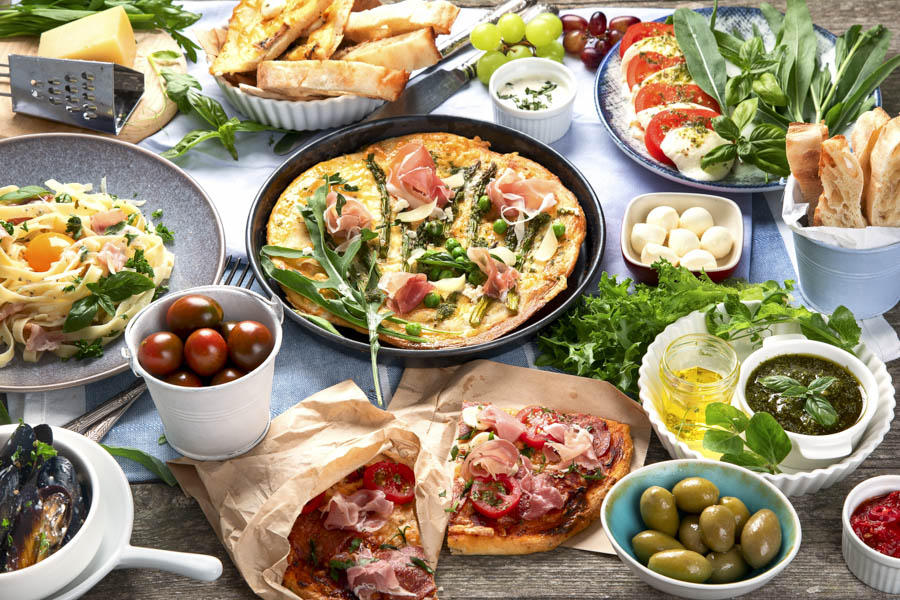
Italy is a country of regional cuisines rather than a single national repertoire. Butter, rice and mountain cheeses shape much of the cooking in the north. Central Italy is closely associated with handmade pasta, pulses, bread, olive oil and simply grilled meat, while the south and the islands draw heavily on tomatoes, aubergines, citrus fruit, seafood and durum-wheat pasta. As you travel, these differences become tangible at the table: a buttery risotto in Lombardy feels quite different from a tomato-bright pasta or seafood dish in Sicily.
In 2025, UNESCO inscribed Italian cooking, between sustainability and biocultural diversity, on the Representative List of the Intangible Cultural Heritage of Humanity. Italy is also represented through the Mediterranean diet, the art of Neapolitan pizzaiuolo and the traditions of truffle hunting and extraction. These recognitions concern knowledge, seasonality, social customs and ways of producing food as much as individual recipes.
You will encounter Italian food at many levels: in the smell of warm bread from a bakery, at market counters and family-run trattorias, over vineyard lunches and in contemporary restaurants that reinterpret regional dishes. The twenty specialities below are not intended as a definitive ranking. They provide a practical introduction to the ingredients, techniques and local identities that travellers are most likely to meet around the country.
20 Traditional Italian Dishes to Try
Pasta
Region: Throughout Italy
A pasta menu in Italy can read like a map of the country. There is the firm bite of dried durum-wheat spaghetti, the tenderness of fresh pasta that may be rolled and cut by hand, and regional shapes rarely encountered elsewhere. Fresh dough varies by region and pasta type: some recipes include eggs, while others use flour and water alone. Shape helps determine how the finished dish tastes. Spaghetti and flat linguine become coated in smooth tomato, seafood or olive-oil sauces, while hollow bucatini takes particularly well to a glossy amatriciana. Fresh ribbons have a softer texture. Tagliatelle catches slow-cooked ragù, and broad pappardelle carries hearty beef or wild-boar sauces. In Lombardy, buckwheat pizzoccheri has a rustic, nutty character, softened by butter, Valtellina Casera cheese, potatoes and cabbage or chard.
With short pasta, much of the pleasure comes from the sauce caught in its ridges, hollows and curves. Penne rigate is often paired with chilli-hot arrabbiata, while the generous tubes of rigatoni hold meat or tomato sauces both inside and out. Large paccheri may accompany seafood or tender, slow-braised pork. Farfalle works well with lighter, creamy sauces, while fusilli gathers herb-rich dressings in every twist. Smaller shapes such as ditalini and rice-shaped risoni, often sold as orzo in English-speaking countries, add warmth and substance to soups and similar dishes.
Stuffed pasta, or pasta ripiena, brings a different texture: tender parcels of dough enclosing meat, cheese, vegetables or herbs. Each region has its own shapes and accompaniments. Piedmont is known for agnolotti, while Ligurian pansotti are generally filled with herbs and greens and served with walnut sauce. Emilian tortellini traditionally contain meat and are often eaten in broth. Along the coast, look for pasta al nero di seppia. Cuttlefish ink gives the pasta its dramatic black colour and a subtle savoury, saline taste, often accompanied by cuttlefish or other seafood.
Wine pairings depend largely on the sauce: Chianti works well with tomato-based pasta, Vermentino with seafood, and Barbera with a hearty meat ragù.
Ribollita
Region: Tuscany
Ribollita is a thick Tuscan soup made with vegetables, beans and stale bread. If you order it in Tuscany, expect something closer to a spoonable bread stew than a light soup. Cavolo nero, or Tuscan black kale, is a characteristic ingredient, while the beans may include cannellini, toscanelli or borlotti. Its name means ‘reboiled’, reflecting the practice of reheating the soup so that the bread and vegetables settle into a dense, sustaining dish. Recipes vary between households and seasons, but good olive oil is usually added before serving, bringing a fresh, peppery finish to the earthy beans and greens. Ribollita belongs to the tradition of cucina povera — resourceful cooking based on modest, readily available ingredients. A glass of Chianti Classico is a natural Tuscan accompaniment, its acidity balancing the beans, vegetables and olive oil.
Cardi alla Bagna Càuda
Region: Piedmont
Bagna càuda is a warm Piedmontese sauce made with garlic, salted anchovies and extra-virgin olive oil. It is traditionally kept warm in a small terracotta pot known as a fujòt and placed at the centre of the table for dipping raw or cooked vegetables, including peppers, artichokes and cardoons. Cardoons — long, pale stalks related to the globe artichoke — are particularly associated with winter. If you order cardi alla bagna càuda, the cardoons themselves become the focus: they are cooked until tender and served with the warm sauce, while some versions are finished in the oven with grated cheese. The anchovy and garlic give depth to their mild bitterness. Barbera d’Asti, a fresh, lively red from Piedmont, is a good choice alongside the dish.
Fritto Misto
Region: Veneto and coastal Italy
Fritto misto simply means ‘mixed fry’, so its contents depend on the region and the day’s ingredients. In coastal areas, it usually combines prawns, squid and small fish, lightly coated in flour or a thin batter and fried until crisp. If you order it, eat it straight away, while the coating still crackles and the seafood beneath remains tender. Depending on the region, courgettes, aubergines, artichokes and even sage leaves may be included. In Venice and around the lagoon, it is a familiar way of serving a changing catch and seasonal vegetables rather than following a single fixed recipe. A crisp Soave or dry Prosecco makes a refreshing accompaniment.
Vitello Tonnato
Region: Piedmont
Served cold, vitello tonnato consists of thin slices of cooked veal covered with a silky sauce of tuna, capers and anchovies. In many modern versions, eggs and olive oil give the sauce a smooth, mayonnaise-like texture, while lemon adds freshness. The pairing may sound unusual, but it is unexpectedly harmonious: the veal is mild, the sauce cool and savoury, and a final scattering of capers provides a sharper, briny note. Generally served as an antipasto, vitello tonnato is particularly associated with Piedmontese summer meals and festive occasions. For a regional pairing, try Roero Arneis, a Piedmontese white with enough freshness to complement the tuna and caper sauce.
Fregola con le Arselle
Region: Sardinia
Sardinian fregola is made from small pellets of semolina that are dried and often toasted, giving them a gently nutty flavour and a rough surface that absorbs broth. In fregola con le arselle, the pasta is simmered rather than simply boiled with arselle — the small clams used in Sardinian cooking — together with tomato, garlic, parsley, white wine and sometimes saffron. As the pellets swell, they draw in the clam broth while retaining a pleasant bite, bringing together the sweetness of the shellfish and the toasted flavour of the semolina. Fregola may resemble North African couscous at first glance, but at the table it behaves as pasta and is served as a substantial Sardinian first course. A glass of Vermentino di Sardegna pairs particularly well with the clams and their broth.
Risotto alla Milanese
Region: Lombardy
Rice cultivation has shaped the food of the Po Valley for centuries, and risotto alla Milanese is its best-known urban expression. Short-grain rice is toasted in butter, then cooked gradually with stock until creamy, with saffron giving it a deep golden colour and a warm, distinctive aroma. Traditional recipes may include beef marrow and are finished with Parmigiano Reggiano or Grana Padano. In Milan, the risotto is often served with ossobuco, a slow-braised veal shank. A glass of Franciacorta Brut, a sparkling wine from Lombardy, provides a refreshing contrast to the richness of the dish.
A popular local legend traces the dish’s golden colour to a glassmaker’s apprentice working on the city’s cathedral, who is said to have added to the rice some of the saffron used to tint stained glass.
Polenta
Region: Northern and central Italy
Polenta is cornmeal cooked slowly until smooth and creamy. It may be served soft enough to spoon alongside a stew, left to set and cut into slices, or grilled until its edges turn crisp. Grain porridges made from millet, barley and spelt were eaten in Italy long before maize arrived from the Americas; cornmeal later became the usual base. Across northern Italy, polenta takes much of its character from what accompanies it: wild mushrooms, melted cheese, slow-cooked meat sauces, salt cod or lake fish. Around Lake Como, missoltini — salted and dried lake fish — are grilled and dressed with olive oil and vinegar before being served with polenta. In the Alpine north, polenta concia is enriched with generous quantities of butter and melted mountain cheese, giving it an especially soft, rich texture.
Wine choices depend on the accompaniments: Valpolicella works well with mushroom or meat-based versions, while a local Alpine white may be better suited to polenta enriched with mountain cheese.
Gattò di Patate
Region: Campania
Gattò di patate is a savoury Neapolitan potato cake whose French-sounding name reflects the influence of French-trained court cooks in southern Italy. Mashed potatoes are enriched with eggs, butter and grated Parmesan, then layered with mozzarella, provolone, cooked ham or salami. In the oven, the surface turns golden and lightly crisp, enclosing melted cheese and savoury pieces of meat. Soft, rich and comforting, gattò is generally served warm as a main dish or substantial side, although it can also be eaten at room temperature. Falanghina del Sannio, a fresh white from Campania, pairs well with its cheese and savoury filling.
Arancini and Arancine
Region: Sicily
Crisp and golden outside, with rice wrapped around a warm, savoury filling, Sicily’s fried rice balls are called arancini in much of eastern Sicily and arancine in Palermo and parts of the west. The classic filling combines meat ragù, peas and melting cheese, while versions with mozzarella, spinach, mushrooms, ham and other local ingredients are also widespread. Their shape changes across the island: round versions are common in western Sicily, while the cones associated with Catania and Messina are often said to evoke Mount Etna. You will find them in bakeries, bars and street-food shops, ready to eat by hand as a filling snack or quick lunch. They are at their best freshly fried, while the shell remains crisp and the rice, ragù and cheese inside are still warm. For meat-filled versions, try a glass of Cerasuolo di Vittoria, a Sicilian red with bright acidity and gentle tannins.
Bottarga
Region: Sardinia and Sicily
Bottarga is made from roe sacs, most often those of grey mullet or tuna, which are salted, pressed and dried. Mullet bottarga is strongly associated with Sardinia, while tuna bottarga is also produced in Sicily. Its concentrated marine flavour means that only a small quantity is needed to give a dish a deep, savoury lift. It may be grated over pasta, risotto or eggs. When cut into thin slices and served with olive oil and lemon, it becomes a simple antipasto to share at the start of a meal. Vermentino di Gallura, a dry Sardinian white, complements its concentrated, salty flavour.
Pizza Margherita
Region: Campania – Naples
Loved around the world, Pizza Margherita combines tomato, mozzarella and fresh basil on a Neapolitan base with a thin, soft centre and a puffed rim. The fierce heat of the oven leaves the edge blistered and lightly charred, while the mozzarella melts into the tomato. In Naples, eat it as soon as it arrives, when the rim is still airy and the centre soft. A cold Italian lager is a familiar accompaniment, while the lightly sparkling red Gragnano is a regional wine alternative.
According to the traditional account, it was named for Queen Margherita of Savoy, and its red, white and green ingredients were associated with the Italian flag. Its preparation draws on the Art of Neapolitan Pizzaiuolo – the craft and social tradition of pizza-making recognised by UNESCO as Intangible Cultural Heritage.
Parmigiana di Melanzane
Region: Southern Italy – Campania and Sicily
Parmigiana di melanzane layers fried aubergine with tomato sauce, basil and cheese, then bakes them until the top is golden and bubbling and the aubergine beneath is soft and silky. Its origins are disputed, with both Campania and Sicily closely associated with the dish, while recipes vary by place and household. Some Campanian versions dip the aubergine in beaten egg before frying, while others fry it uncoated. Mozzarella, caciocavallo and grated hard cheese are used in different combinations between the layers and over the top. Usually allowed to rest briefly after baking, the dish may be served warm as a main course or substantial side. It is also excellent at room temperature, when the layers have set and the flavours become more pronounced. Aglianico del Vulture, a red from neighbouring Basilicata, has enough structure to accompany the tomato, aubergine and cheese.
Bistecca alla Fiorentina
Region: Tuscany – Florence
Bistecca alla Fiorentina is a thick Tuscan T-bone steak grilled over fierce heat until deeply browned outside and rare within. Served with little more than salt and a drizzle of olive oil, it combines a lightly charred crust with a succulent, deep-red centre. If you order it in Florence, expect a steak that may weigh between 1.5 and 2 kg (3.3–4.4 lb), is usually priced by weight and is meant to be shared. Chianina is one of the breeds traditionally associated with the dish, although others are also used. For wine, consider Chianti Classico Riserva or Brunello di Montalcino, two structured Tuscan reds that complement grilled beef.
A popular Florentine story traces the word bistecca to English visitors calling for ‘beef steak’ during Medici-era festivities. Its precise etymology remains uncertain, but the story has become part of the dish’s local folklore.
Risotto al Nero di Seppia
Region: Veneto – Venice
In Venice, risotto al nero di seppia brings creamy rice together with tender cuttlefish, coloured an intense, glossy black by the ink. Wine, onion, garlic and a small amount of tomato may be used, depending on the recipe. If its appearance seems dramatic, the flavour is more balanced than the colour suggests – rich, savoury and briny rather than overwhelmingly fishy. A classic of Venetian lagoon cooking, it is usually served without cheese, leaving the cuttlefish and ink to define the dish. Soave Classico, a dry white from Veneto, is a good match for its savoury, marine flavours.
Saltimbocca alla Romana
Region: Lazio – Rome
A Roman favourite, saltimbocca alla Romana combines tender veal escalopes with salty prosciutto and fragrant sage, quickly sautéed in butter and finished with white wine. The prosciutto and aromatic sage give the mild veal much of its character, while the butter and wine create a light, savoury sauce. The name saltimbocca literally means ‘jumps in the mouth’ – a playful description of these small, flavourful pieces. Veal is traditional in the Roman version, while pork and chicken appear in adaptations elsewhere. In Rome, it is usually listed among the secondi, or main meat courses, rather than served alongside pasta. A local Frascati Superiore makes a good pairing, particularly with the sage and buttery wine sauce.
Gnudi
Region: Tuscany
If you enjoy delicate dumplings, try gnudi, a Tuscan speciality that resembles gnocchi but is made from ricotta and spinach rather than potato. Egg, Parmesan and a small amount of flour bind the mixture, giving the dumplings their soft, ricotta-rich texture. Their name means ‘naked’ because they are essentially the filling of ravioli served without its pasta covering. After gentle poaching, they are usually served with nutty brown butter and fragrant sage, sometimes with more grated Parmesan; a simple tomato sauce is another traditional option. With the butter-and-sage version, try Vernaccia di San Gimignano, a dry Tuscan white.
Abbacchio alla Romana
Region: Lazio
During your stay in Rome, try abbacchio alla romana, a Lazio speciality made with tender milk-fed lamb. Traditionally roasted with rosemary, garlic and white wine, the lamb remains succulent while the pan juices take on the warm aroma of the herbs. It is usually served as a secondo, or main meat course, with golden roast potatoes or seasonal vegetables. Although found throughout the year, abbacchio is particularly associated with Easter tables in Rome and across Lazio. Cesanese del Piglio, a red wine from the region, is well suited to the roast lamb and rosemary.
Coniglio alla Ligure
Region: Liguria
Coniglio alla ligure is rabbit slowly braised with wine, garlic, aromatic herbs, pine nuts and small Taggiasca olives. The gentle cooking leaves the meat tender and creates a rich, fragrant sauce in which the olives’ slight bitterness balances the rabbit’s delicate flavour, while the pine nuts bring a buttery note. If you order it in Liguria, keep some crusty bread for the herb-scented cooking juices. A glass of Rossese di Dolceacqua, a relatively light local red, makes a good accompaniment.
Bombette Pugliesi
Region: Puglia
Bombette pugliesi are small rolls made from thin slices of pork wrapped around cheese, usually caciocavallo, and seasoned with herbs and pepper; some versions also include pancetta. They are a speciality of the Valle d’Itria, particularly Cisternino and Martina Franca. In Cisternino, order them at a fornello pronto, where you choose the meat at a butcher’s counter and it is grilled for you to eat on site. Cooked over charcoal or roasted on skewers, bombette are at their best with lightly charred edges, juicy pork and the cheese inside still melting. They may be eaten as street food or as part of a mixed grill. For a local wine pairing, try Primitivo di Manduria, a full-bodied Puglian red that works well with grilled pork and melted cheese.
Cheeses in Italy
Italy’s cheese counters offer a compact map of the country’s landscapes and farming traditions. Many of the cheeses named here carry PDO (Protected Designation of Origin) or PGI (Protected Geographical Indication) status, linking them to a defined place and production tradition. In Piedmont, Roccaverano is made from raw goat’s milk and is creamy and gently acidic when fresh, becoming more intense as it matures. Bra ranges from soft and buttery to firm and savoury, while Castelmagno is crumbly and full-flavoured. Lombardy brings another set of contrasts, from creamy Gorgonzola and soft Taleggio to the granular texture of Grana Padano. From the high summer pastures of Valtellina comes Bitto, one of the region’s distinctive mountain cheeses.
The Asiago plateau gives its name to Asiago. The young cheese is soft and milky, with a gentle acidity, while longer ageing produces a firmer texture and deeper savoury flavour. Emilia-Romagna is closely identified with Parmigiano Reggiano, whose crumbly, crystalline texture develops during long maturation. Although both cheeses are familiar as cooking ingredients, they are also worth tasting on their own, particularly when different ages are offered side by side.
Central Italy has a strong sheep’s-milk tradition. Fresh Pecorino Toscano is tender and relatively sweet, while the aged cheese becomes firmer and more intense. Pecorino Romano is harder and saltier, which explains its familiar role grated over pasta. Despite its name, most is now produced in Sardinia, although the protected area also includes Lazio and part of Tuscany. Markets and small dairies sell creamy fresh ricotta alongside local caciotta, a general name for relatively young, often mild cheeses rather than a single protected variety.
Campania is the principal home of Mozzarella di Bufala Campana, made exclusively with buffalo milk within its designated production area. When cut fresh, its supple white surface releases drops of milky whey, followed by a soft centre and delicate tang. It is best eaten on the day it is bought. Puglia is known for stretched-curd cheeses such as caciocavallo and scamorza, including smoked varieties. When cut, Burrata di Andria opens to reveal a creamy filling of stracciatella. The region also produces ricotta forte, a pungent fermented ricotta speciality usually spread sparingly on bread or used to deepen sauces.
Sardinia’s pastoral traditions are expressed through sheep’s-milk cheeses such as Pecorino Sardo and Fiore Sardo. Mild Pecorino Sardo is soft, sweet and aromatic; the mature version is firmer and more piquant. Fiore Sardo, made from raw sheep’s milk and lightly smoked, also becomes sharper and more savoury with age. A Sardinian cheese plate can therefore move from mild and yielding to firm, smoky and peppery without leaving the island’s sheep’s milk tradition.
Desserts in Italy
Northern Italy’s desserts make generous use of butter, nuts, chocolate and enriched dough. Piedmont’s bonèt is a silky cocoa-and-amaretti pudding scented with rum, while Turin’s gianduja blends chocolate with Piedmontese hazelnuts in pralines, spreads and gelato. Milanese panettone rises into a tall dome with a soft, airy crumb, raisins and candied fruit, and now appears on tables across Italy at Christmas. Mantua’s sbrisolona offers a completely different texture: a coarse, crumbly almond cake traditionally broken by hand rather than cut into neat slices. It began as a rustic cake before the cooks of the Gonzaga court enriched it with almonds, sugar and butter.
Tiramisù, widely associated with Treviso and the Veneto, balances coffee-soaked savoiardi with cool mascarpone cream and a dusting of bitter cocoa. Emilia-Romagna’s zuppa inglese layers sponge or biscuits with custard and ruby-red Alchermes liqueur. In Tuscany, crisp almond cantucci are traditionally dipped in Vin Santo, while Siena’s panforte packs nuts, honey, candied fruit and spices into a dense, chewy festive cake.
In central and southern Italy, pastries slip easily between breakfast and dessert. Rome’s maritozzo is a soft sweet bun split open and generously filled with whipped cream. In Lecce and across Salento, pasticciotto arrives warm from the oven, its crisp shortcrust shell holding soft custard; order it with coffee for a typical local breakfast. Campania’s sfogliatella comes in crisp layered and softer shortcrust versions, both commonly filled with ricotta and semolina scented with cinnamon or vanilla and candied citrus peel.
The Amalfi Coast turns its celebrated lemons into delizia al limone: small sponge domes filled and coated with smooth, tangy lemon cream, sometimes scented with limoncello. Sicily’s desserts draw on ricotta, almonds, pistachios and candied fruit. The first bite of a cannolo contrasts a crisp fried shell with cool, sweetened ricotta, sometimes finished with chopped pistachios or candied fruit. The more elaborate cassata layers sponge and ricotta beneath marzipan and colourful candied fruit. On a warm Sicilian morning, granita served with a soft brioche bun can be breakfast rather than an after-dinner dessert.
Gelato may be Italy’s most democratic sweet pleasure, eaten from a cup or cone while walking through the streets or pausing in a piazza. Recipes and textures vary from one maker to another, and regional flavours are part of the appeal: look for gianduja in Piedmont and Bronte pistachio in Sicily. Gelato can round off a meal, but it also provides an easy reason to pause during an afternoon or evening walk.
Wines of Italy
The wines suggested alongside the regional dishes above provide a starting point for exploring Italy’s wine traditions. From Piedmont and Tuscany to Sicily and Sardinia, each region has its own grape varieties, winemaking practices and local specialities.
Wine in Italy is closely connected with food. Restaurant wine lists often give prominence to local producers, and a regional wine by the glass can be more interesting than a famous bottle from elsewhere. Lambrusco brings freshness to the cured meats and filled pasta of Emilia-Romagna; a crisp coastal white pairs naturally with seafood; and a Tuscan red complements bistecca alla Fiorentina. Trying these combinations is a good way to understand how local food and wine traditions have developed together.
Italian wine labels provide information about geographical origin and the rules governing production. DOC (Denominazione di Origine Controllata) and DOCG (Denominazione di Origine Controllata e Garantita) apply to wines from defined areas, with DOCG subject to additional controls. IGT (Indicazione Geografica Tipica) generally covers a broader geographical origin and allows producers greater flexibility over grapes and methods. These categories provide useful context, but they do not form a simple ranking of taste or quality.
To compare different styles without committing to a bottle, try wines offered by the glass in an enoteca – a specialist wine bar – or restaurant. Those interested in visiting wineries can follow Italy’s designated wine roads, which connect producers with hill towns, vineyards and regional food traditions. Many winery visits require advance booking, and transport should be arranged before a tasting. Individual routes, grape varieties and wine denominations are covered in our separate guide to Italian wines and wine routes.