

Address: Piremir Mahallesi, Teleferik Caddesi No: 88, 16340 Yıldırım, Bursa
Location: Google Maps
Opened in 1963 as Turkey’s first passenger cable car, the Bursa Teleferik links the south-eastern edge of Bursa with the high pastures of Uludağ, the Great Mountain. Ancient writers called the mountain Mysian Olympus, and the Ottomans knew it as Keşiş Dağı, the Monk’s Mountain. The ride begins at Teferrüç, under a curved roof of steel ribs and glass. A cabin slides in, slows almost to walking pace and takes on eight passengers. Then the doors close, the floor lifts, and the rooftops fall away. Within minutes there is only forest below, and on grey days the cables run on into the cloud.
For more than six decades, this has been the way Bursa goes up to its own snow in winter and its cool air in summer. Among the things to do in Bursa, none leaves the city behind so quickly: the cabins reach the mountain in about 22 minutes. The first line took five years to build, and a military coup stalled the work halfway.
History of the Uludağ Cable Car
The idea belonged to a governor in a hurry. İhsan Sabri Çağlayangil, who later served three times as Turkey’s foreign minister, took over the province in December 1954. He soon opened talks with Von Roll, a Swiss engineering firm. The mountain was then a long drive away, up a road of more than 300 bends. In October 1957 the city council borrowed 1.5 million lira for the project, and work began the following year. The first plan ran all the way to the hotels, but money ran short, and the line stopped at the meadows of Sarıalan.
On site the work was led by Hubert Sondermann, a German-born engineer and partner in Von Roll. He brought in Swiss fitters for each stage and taught young men from Bursa the trade as they went. Temporary cables, strung from local timber poles, carried materials and crews up the slope. Sondermann rented a house near Teferrüç, with a view across to Emirsultan and the Green Mosque. Neighbourhood children called him Alman amca, the German uncle, and he turned up at their weddings and funerals.
Then politics intervened. The army seized power on 27 May 1960, and four days later the governor was replaced. Work slowed, and the opening slipped by years. The line finally opened on 29 October 1963, the fortieth anniversary of the Republic. It ran in two stages, with large cabins shuttling back and forth between Teferrüç, Kadıyayla and Sarıalan. A return ticket cost 9 lira, and 3,820 people rode in the first two days.
Those cabins carried some 17 million passengers over the next fifty years, most of them visitors from elsewhere. In October 2013 the mayor, Recep Altepe, rode them one last time with his officials and the city’s reporters. The old cables came down that autumn, and a new gondola opened to Sarıalan in June 2014. İlker Cumbul, who headed the operating company, said the project meant a great deal to him as a man of Bursa.
Highlights
A visit follows the ride upward, from the city’s edge through the forest to the snowline.
Teferrüç Station
The lower terminal is a broad hall of steel and glass, with the operator’s name in large blue letters by the door. Behind the building, the cables climb straight into the trees. On cloudy days the cabins vanish into the mist within a few hundred metres. One leaves about every 20 seconds, so even a long queue keeps moving.
The cabins themselves are small and glass-sided, with doors that open and shut automatically. Staff fill each one before departure, so small parties often share. Some 140 are in service, spaced about 115 metres apart along the cable. Together they can carry 1,500 passengers an hour, where the old line managed about 120.
The Climb Through the Forest
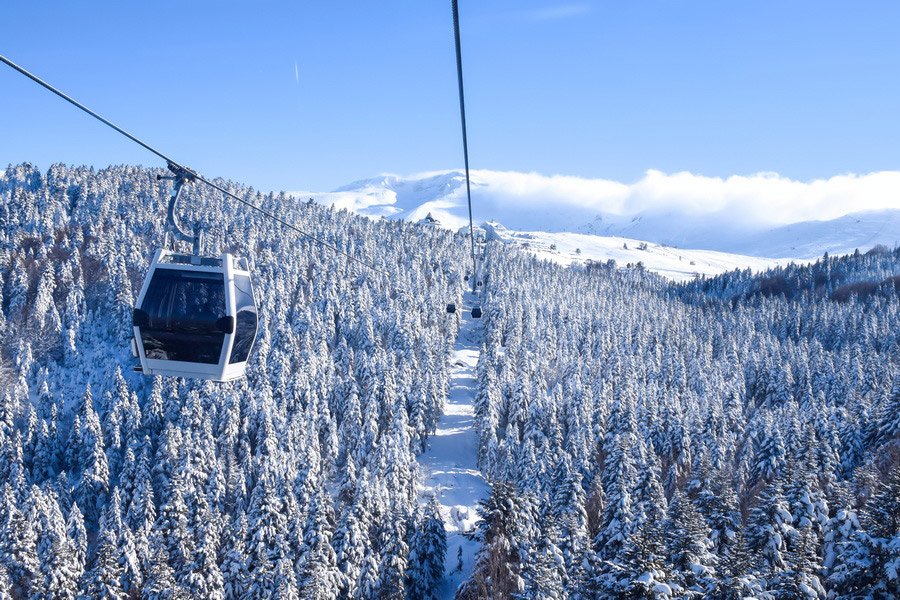
The full line runs for almost nine kilometres, and on completion its builder, the Italian firm Leitner, called it the longest single-cable gondola in the world. Between Teferrüç, at 395 metres, and the top, the cabins gain about 1,400 metres in height. Above the city the line crosses dense forest, and the trees shaped the whole project. During the rebuilding in 2013, a helicopter flew up towers in loads of up to 4.5 tonnes, so no road had to be cut through the woods. Higher up, a court halted the extension to the hotels for the same reason. The builders raised the towers about five metres in the thickest stands, and the cabins now pass above the treetops. Halfway up, at 1,230 metres (4,040 feet), the cabins pass through the intermediate station at Kadıyayla and swing towards Sarıalan. Leafy lower slopes turn to dark conifers, and in winter to snow.
Sarıalan
Sarıalan, at 1,635 metres, was the end of the line for fifty years, and it is still where most summer visitors step out. Around the station, a high meadow opens among the firs, with picnic grounds, camping areas and an adventure park. On holidays its clearings fill with families and barbecue smoke, and after snowfall with snowball fights.
The Hotels Zone
The last section climbs to 1,810 metres and the hotels zone of Uludağ, the country’s longest-established ski resort. For decades, skiers finished the journey from Sarıalan by bus or taxi, or on an old chairlift of two-seat chairs towards Çobankaya. Now the cabins cover that final stretch as well. The top station, Kurbağakaya, holds a small shopping centre, cafés and restaurants, with hotels and ski lifts a short walk away. In busy winter weeks traffic can stretch the road journey to two and a half hours, so the cabins are by far the quicker way up.
Practical Information
Opening hours: The cabins usually run daily from 10:00 to 18:00. They stop in high winds, and the line closes for maintenance each autumn, in 2026 from 5 October to 1 November. Outside the ski season, the top section to the hotels may not run.
Admission: A return ticket for Turkish citizens costs 500 TL in 2026. Foreign visitors pay a higher fare, about 1,100 TL return in mid-2026, and must buy tickets at the box office. Children born in 2020 or later travel free. Tickets are valid only on the day of purchase, and fares are refunded if wind cancels the service.
Facilities: Teferrüç has shops, a small mosque and lavatories. Sarıalan has a restaurant, Sarıalan Sofrası, and a souvenir shop, and the top station has cafés.
Parking: The car park at Teferrüç holds 240 vehicles.
How to Get to the Uludağ Cable Car
Tickets for local transport: A rechargeable BursaKart covers the metro, trams and city buses. It is sold at station kiosks and at outlets displaying its logo.
By tram: The heritage T3 tram runs from Zafer Plaza to Çınarönü, its eastern terminus. From Çınarönü, it is a walk of about 22 minutes, steep in places, up Musababa Caddesi and Teleferik Caddesi to Teferrüç.
By metro: No Bursaray station is within easy reach of the line. Gökdere, the nearest, is about 34 minutes away on foot, so a bus or taxi makes a better link.
By bus: Routes S/1 and S/2 run from Heykel to the cable car. Shared minibuses, or dolmuş, marked Teleferik also leave from Heykel. Route numbers change, so it is worth checking the Moovit app.
On foot: From Heykel the walk takes about 32 minutes. It crosses the Irgandı Bridge, then climbs through residential lanes to Teleferik Caddesi.
By taxi: Metered taxis wait across the centre and stop at the entrance. From Heykel the ride takes about 15 minutes, longer at rush hour.
From the intercity bus terminal: Bursa Otogar sits about 10 km north of the centre. Bus 94 runs from there to Teferrüç. A taxi takes about 25 minutes, longer in heavy traffic.
From Istanbul by ferry: Fast boats cross the Sea of Marmara to Mudanya or Güzelyalı in about 2 hours. From the Mudanya pier, bus F/3 runs to the cable car. From Güzelyalı, bus F/1 reaches the city, and Teleferik minibuses continue from Heykel.
From Istanbul by road: The drive over the Osmangazi Bridge takes about 2.5 hours, and coaches to the Otogar run throughout the day.
Tips for an Optimal Visit
Recommended duration. Allow half a day for the ride and some time at the top. A round trip without stopping takes about 45 minutes.
Best time of day. Weekday mornings bring the shortest queues. After fresh snow, weekend queues at Teferrüç can stretch for an hour or more.
Dress. Sarıalan sits more than 1,200 metres above the city, so a warm layer is wise even in summer.
Photography. On the way down, the plain lies ahead of the cabin rather than behind it. The descent therefore gives the clearest pictures of Bursa.
Accessibility. Escalators and a lift lead up to the boarding platform at Teferrüç. Wheelchair users should check with staff before travelling.
Combine with. The Emir Sultan Mosque is about 20 minutes’ walk downhill. The Green Mosque and Green Tomb are about 23 minutes away, and the Irgandı Bridge about 26. Beyond the bridge, the old bazaar leads on to Koza Han and the Ulu Cami.
Hubert Sondermann stayed on in Bursa for years after the opening. When he died in 1976, he asked to lie at Emirsultan, the quarter he had watched from his window. He was buried there under a cypress, a twenty-minute walk below the cable car. And up the hill, one after another, the cabins still leave Teferrüç for the mountain.