

Address: Kurtoğlu Mahallesi, Gökdere Bulvarı No: 14, 16360 Yıldırım, Bursa
Location: Google Maps
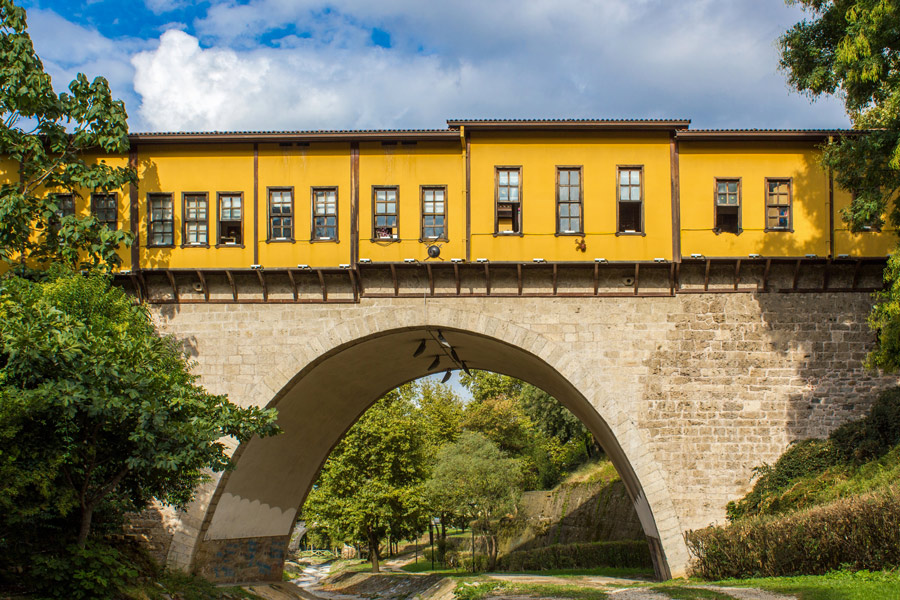
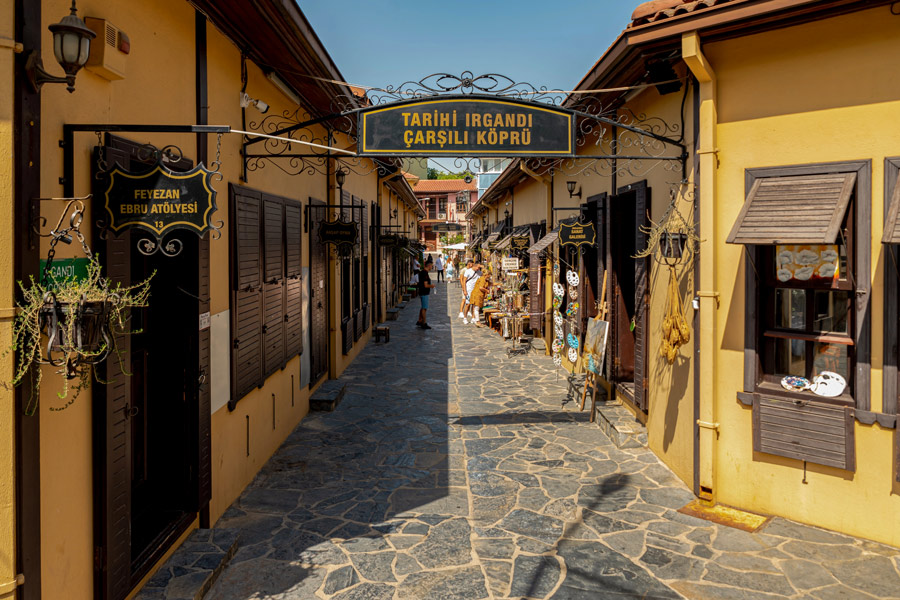
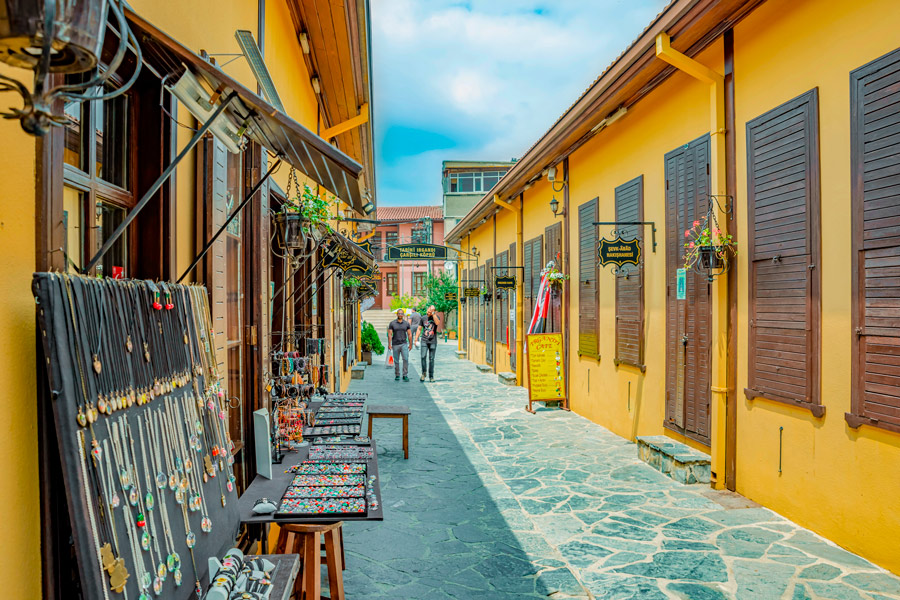
Built by a merchant in the fifteenth century, the Irgandı Bridge carries a lane of shops across the Gökdere stream in the old centre of Bursa. An iron archway over the entrance reads Tarihi Irgandı Çarşılı Köprü, the historic bazaar bridge. Beyond it, a narrow flagstone passage runs between two rows of timber-fronted workshops, their dark wooden shutters closed each evening. By day, the open doorways give glimpses of calligraphy, painted tiles and inlaid wood. Westwards lies the bazaar quarter; eastwards, lanes climb towards the Green Mosque.
The stream below marks the boundary between the Osmangazi and Yıldırım districts. Among the historical sites in Bursa, this one is also an everyday thoroughfare. Very little of it, however, is as old as it looks: the shops are a modern reconstruction.
History of the Irgandı Bridge
Court records name the builder as Hoca Muslihuddin, son of Ali the Irgandi. In his day the title hoca was often given to merchants, and Irgandi most likely refers to a place called Irgand, perhaps his father’s home town. According to Bursa’s city guide, Muslihuddin dealt in silk, buying it in Azerbaijan and selling it on to Italian merchants. It was the same trade that made Bursa the silk market of the empire and filled the galleries of Koza Han. The records date the bridge to 1442, but Muslihuddin was still alive for another fifty years, so some historians favour the 1490s.
In 1559 a grandson of the same name drew up a vakfiye, or foundation deed, which lists thirty-one shops and sets out rules for their use. Rent from several of them went to the foundation’s trustees, and one unit at the northern end served as a small prayer room. The first shops were probably timber; around this time they seem to have been vaulted units resting on corbels. A roof covered the passage between the two rows. Bursa’s court registers record repairs again and again, and in 1848 a flood on the Gökdere damaged one of the piers.
In 1640 the Ottoman travel writer Evliya Çelebi counted some two hundred shops on the bridge, a figure scholars now doubt. All of them, he said, belonged to cotton carders, who fluffed raw fibre for quilts by striking a taut bowstring. Iron gates with loopholes, like those of a castle, closed each end and in the bridge’s name he heard a Turkish word for shaking. He credited it to Orhan Gazi, the ruler who captured Bursa in 1326 and made it his capital. Later writers proposed different builders, and a city legend preferred a warrior who found treasure among the rocks and, on Orhan’s advice, spent it on a bridge.
The earthquake of 1855, which brought down most of the domes of the Ulu Cami, left the Irgandı standing but badly damaged. Over the following decades it became an open-air market of wooden stalls. Greek troops occupied Bursa in July 1920, during the Greco-Turkish War that followed the First World War. When they withdrew in September 1922, they blew up the bridge, and everything on it was lost.
In 1949 the municipality rebuilt it as a plain crossing with nothing on it. The art historian Semavi Eyice later complained that it had been treated as a mere link between two banks. Venice and Florence, he pointed out, had never stripped the Rialto or the Ponte Vecchio. Another scholar, Yılmaz Önge, published a study of the bridge’s original architecture in 1981, and plans to restore the shops took shape from 1988. Osmangazi Municipality completed the work in 2004, ending eighty-two years without trade on the span.
Highlights
A visit usually begins among the studios on the span and finishes down by the water, beneath the arch.
The Workshops
Artists and craftspeople, rather than traders, now hold most of the units, and much of their work goes on in full view of passers-by. Calligraphers and marblers sit beside illuminators, who frame a page of script in gold leaf and colour. All three belong to the tradition of the Ottoman manuscript. Tile painters, miniaturists and wood carvers have studios here too, as do specialists in mother-of-pearl inlay, who set slivers of shell into timber. One workshop makes and teaches the ney, the reed flute of Sufi music. Another belongs to a designer who holds Turkey’s official title of State Artist and recreates headdresses in old Anatolian styles. Signboards hang from iron brackets above the doors, and lanterns light the passage after dark. Several studios run classes, a few of them free of charge, and finished pieces, from painted tiles to carved wood, are sold on the spot. A board chaired by one of the artists runs the bazaar, which now has more than a dozen workshops.
The Overhanging Shops
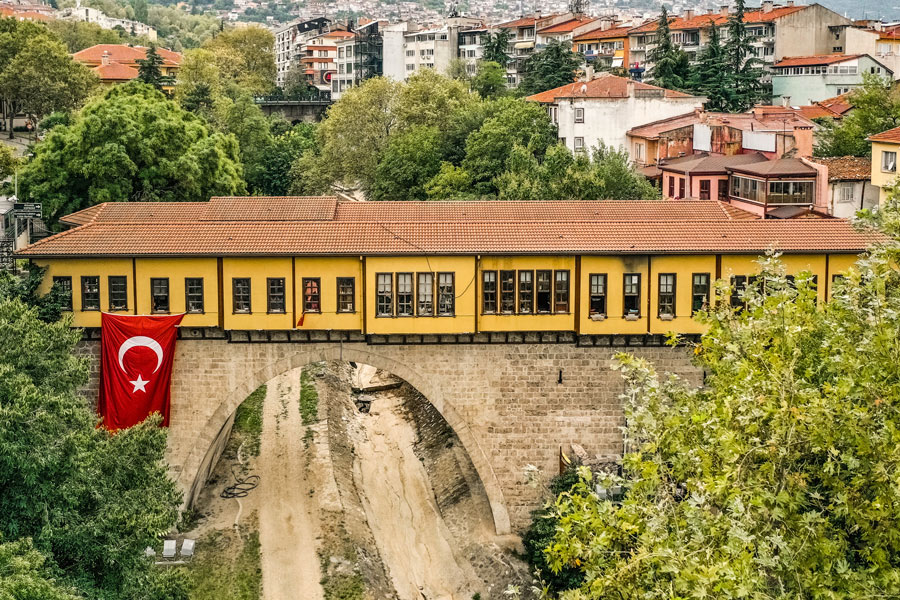
Seen from the banks, the shops look like a terrace of small houses, with ochre walls, white-framed windows and a tiled roof running the whole length. Built of Scots pine, the row juts out over the drop on dark timber brackets. Bursa’s old Ottoman homes use the same device, the cumba, to push an upper room out over the lane; here the extra space hangs above the stream instead. For British visitors the nearest comparison may be Pulteney Bridge in Bath, which also carries shops on both sides, though behind a Palladian stone façade.
The Arch and the Vaulted Rooms
The whole span rests on a single pointed arch, about 16 metres wide and almost as high above the stream bed. This is where the reconstruction is easiest to see. The arch itself is plain concrete, poured in 1949, and only the walls rising from it are limestone, laid in lime mortar. On either side, vaulted rooms open into the flanks of the bridge. They once served as stables and as storerooms for the shops overhead, and Evliya mentions a lodging here where travellers tied up their horses. Some now hold workshops, nearer the water than the street.
The Gökdere and Irgandı Park
The Gökdere comes down from Uludağ, the mountain that rises behind Bursa, and runs north across the plain to join the Nilüfer. The name translates roughly as the “sky-blue stream”. In 2023 the city landscaped both banks here as Irgandı Park. Under the arch, a red-paved path of almost 250 metres follows the walled channel between lawns.
The View Upstream
A short distance upstream, the Setbaşı Bridge carries the main road across on two pointed arches, one large and one small. Nobody knows who built it or exactly when, but repairs are recorded as early as 1565. Its wooden deck gave way to concrete after 1920, and restoration began in 2025. The city library stands beside it, at the head of the park. On clear days, the slopes of Uludağ close the view beyond.
Practical Information
Opening hours: The bridge is a public crossing and never closes. Workshop hours vary, but most open from about 10:00 until 18:00. Many close on Sundays, and hours may shift in summer.
Admission: There is no charge to walk across the bridge or browse the studios.
Facilities: Irgandı Cafe, at the western end, usually stays open until 22:00.
Parking: Street parking nearby is scarce, so public transport is easier.
How to Get to the Irgandı Bridge
Tickets for local transport: A rechargeable BursaKart covers the metro, trams and city buses. It is sold at station kiosks and at outlets displaying its logo.
By tram: The heritage T3 tram runs from Çınarönü to Zafer Plaza and stops at Gökdere/Panorama, a six-minute walk north of the bridge. Kayhan Boğazı Sokak and Selçuk Hatun Sokak lead to the western end. The red T1 line calls at Heykel, about seven minutes away on foot.
By metro: The nearest Bursaray station is Demirtaşpaşa, north-west of the bridge. The walk, partly along Cumhuriyet Caddesi, takes about 11 minutes.
By bus: Many city routes terminate at Heykel, beside the T1 stop. Route numbers change, so it is worth checking the Moovit app.
On foot: From the Ulu Cami, the walk east takes about 12 minutes. Atatürk Caddesi leads to Heykel, and Ünlü Caddesi and Keresteciler Caddesi continue to the western end of the bridge.
By taxi: Metered taxis wait across the centre and can drop passengers on Gökdere Bulvarı, at the eastern end. The ride from Heykel takes about five minutes, longer at rush hour.
From the intercity bus terminal: Bursa Otogar sits about 10 km north of the centre. The T2 tram reaches Kent Meydanı from the terminal in about 25 minutes. From there the T1 continues round the centre to Heykel. A taxi takes about 30 minutes, or up to 45 in heavy traffic.
From Istanbul by ferry: Fast boats cross the Sea of Marmara to Mudanya or Güzelyalı in about 2 hours. From Güzelyalı a connecting bus runs to the Bursaray terminus at Emek, and the metro then continues to Demirtaşpaşa. From Mudanya, bus 1/M covers the same route.
From Istanbul by road: The drive over the Osmangazi Bridge takes about 2.5 hours, and coaches to the Otogar run throughout the day.
Tips for an Optimal Visit
Recommended duration. Allow about 45 minutes for the studios, the arch and the park below. A class or a long tea can easily double that.
Best time to visit. From late morning on any day but Sunday, most workshops are open. In spring snowmelt from Uludağ swells the stream, which by the end of summer can shrink to a trickle. After dark, new lighting picks out the bridge and the riverside paths.
Photography. The best view of the arch and the overhang is from the park below, while the Setbaşı Bridge upstream gives a profile of the whole span. It is courteous to ask before photographing an artist at work.
Accessibility. Google Maps lists a wheelchair-accessible entrance to the bridge, but the passage is paved with uneven flagstones, so care is needed. The park paths lie well below street level, close to the water.
Combine with. Koza Han and the Ulu Cami are each 12 minutes west on foot. The Green Mosque and Green Tomb are about seven minutes uphill to the east, with the Emir Sultan Mosque a short walk beyond. Cumhuriyet Caddesi, a pedestrian street of curtain, glassware and carpet shops shared with the heritage tram, leads back towards the bazaar. The Osman Gazi and Orhan Gazi Tombs lie 22 minutes west, on the citadel hill at Tophane.
Evliya heard a word for shaking in the bridge’s name, and flood, earthquake and war have shaken it often enough since. One craft practised on the bridge today works with water itself. In ebru, or marbling, paint floats on a shallow bath thickened with gum; a fine stylus drags the colours into swirls, and a sheet of paper lifts them off. Mutlu Çatalkaya, the artist who chairs the board, has taught it here for more than a decade. And while the Gökdere runs on beneath the arch, the marbler’s tray holds the only water still enough to keep a picture.