

Address: Osmangazi Mahallesi, Yiğitler Caddesi No: 4, 16040 Osmangazi, Bursa
Location: Google Maps
Telephone: +90 (224) 716 37 37 (Bursa Museums, Bursa Metropolitan Municipality)
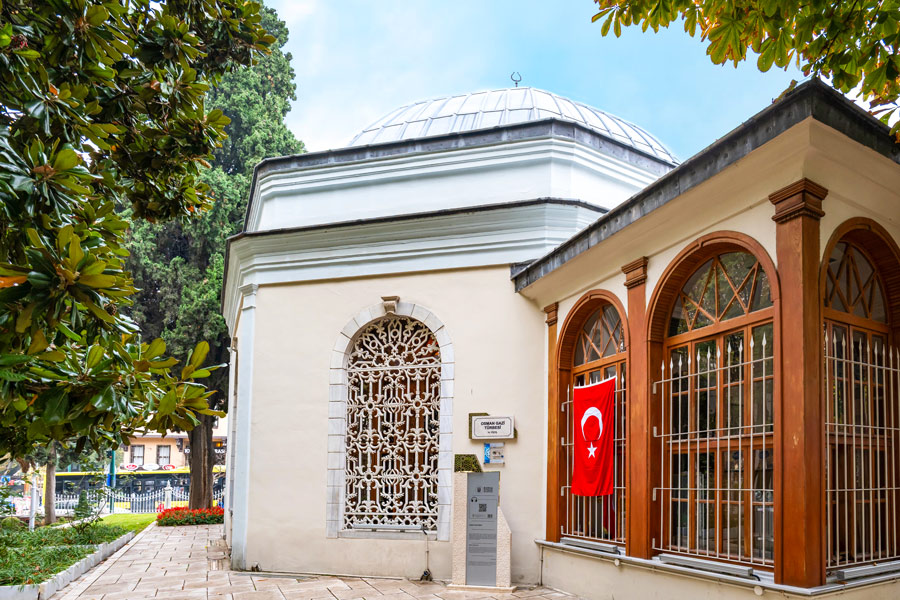
The tombs of Osman Gazi, founder of the Ottoman dynasty, and his son Orhan Gazi occupy the site of a Byzantine monastery at the top of the citadel hill, a complex that Ottoman locals knew as the Davullu (Drum Monastery). Rebuilt after the earthquake of 1855, the two domed buildings share a leafy park in Tophane, the Osmangazi district at the heart of Bursa. A path climbs past the ramparts to a wooden porch. Two guards stand motionless on either side of it, and through the open door comes the low voice of a Qur’an reciter. A stone clock tower rises among the trees nearby. Beyond the railings, red roofs fall away towards the plain.
This is where Ottoman Bursa began, and few historical sites in Bursa mean as much to Turks today. Father and son lie a few steps apart, among the wives and sons of the dynasty’s first generations. Yet the rooms that hold them are far younger than the graves: both buildings date from the 1860s, and their Baroque garlands and floral motifs belong to the age of Sultan Abdülaziz (1861-1876).
History of the Osman Gazi and Orhan Gazi Tombs
In the early 1300s, Byzantine Prusa sat behind strong walls on the lower slopes of Uludağ, and Osman’s warriors could not break in. They raised two towers outside the city, Aktimur and Balabancık, and settled into a long blockade. Tradition says Osman often looked up at the citadel during those years. On the hill stood a monastery chapel with a round dome that gleamed like silver in the sun. People called it the Gümüşlü Kümbet, the silvery dome. “When I die,” Osman told Orhan, “lay me under that silver dome.”
He did not live to see the city fall. Most historians place his death in 1324, while the siege was still dragging on. In April 1326 the Byzantine governor finally surrendered to Orhan. The terms were generous. No one inside was to be harmed, those who left could take their goods under Ottoman protection, and the city paid 30,000 pieces of gold. Orhan then brought his father’s body up the hill and laid it beneath the shining roof.
Bursa became the first Ottoman capital, and Orhan ruled from it for more than three decades. He built a mosque, a college and a soup kitchen on the flat ground below the citadel, and the city’s markets grew up around them. In the early 1330s the Moroccan traveller Ibn Battuta found fine bazaars and wide streets, ringed by gardens and running springs. He also met Orhan himself, whom he called the greatest of the Turkmen kings in wealth, lands and troops. When Orhan died of plague in March 1362, he was laid to rest in another part of the same monastery, probably beside the hall that had already been converted into a mosque.
Sultan Abdülaziz had both tombs rebuilt in 1863. On the father’s tomb, a ten-line inscription in the hand of the Mevlevi calligrapher Zeki Dede closes with a verse by the poet Osman Nevre that encodes the year of construction. Orhan’s tomb carries no inscription at all. In 2014 the tombs became part of the UNESCO World Heritage Site “Bursa and Cumalıkızık: The Birth of the Ottoman Empire”.
Highlights
Most visits begin with the walk up past the walls and end by the clock tower.
The Citadel Walls
The route up to the park passes the Saltanat Kapısi (the Sultanate Gate), once the main entrance to the walled city. The Bithynians, the city founders, set the original walls directly on the rock. After Timur’s army sacked Bursa in 1402, and again after a Karamanid siege in 1413, the defences were repaired and strengthened by Hacı İvaz Pasha, the vizier who went on to design the Green Mosque.
The Honour Guard
Since September 2020, two gendarmes have kept watch at Osman’s door, dressed as alps, the warriors who rode with the first Ottomans. Each carries a sword and an axe. The guards are volunteers, chosen partly for their build and drilled for thirty days in the warrior’s march, posture and oath before taking up the post. The watch was introduced in September 2020 to mark the 98th anniversary of Bursa’s liberation in 1922, and for many Turkish visitors it is a gesture of loyalty to the founder. The day opens with a short ceremony at the park entrance, after which the guards take turns standing for an hour at a time, every day of the year, whatever the weather.
The Tomb of Osman Gazi
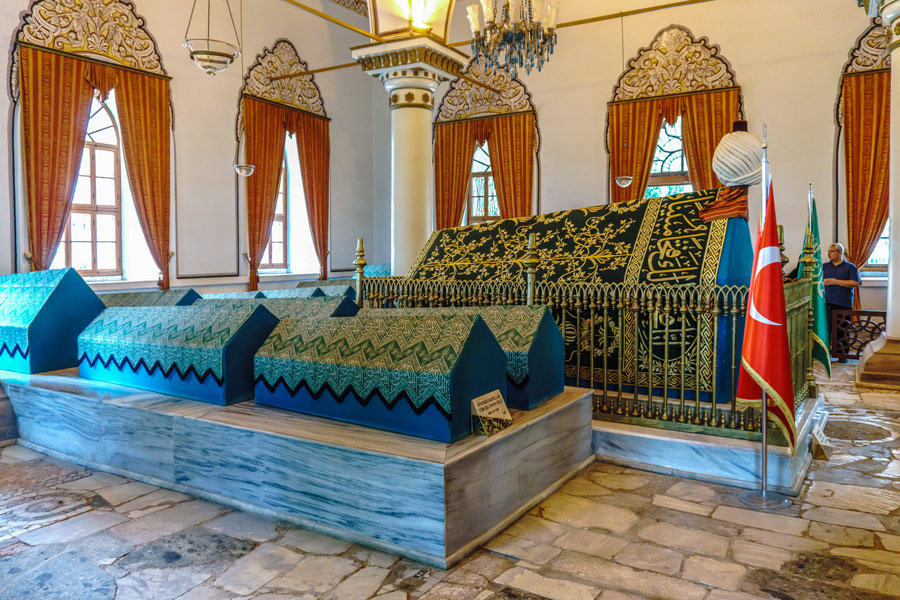
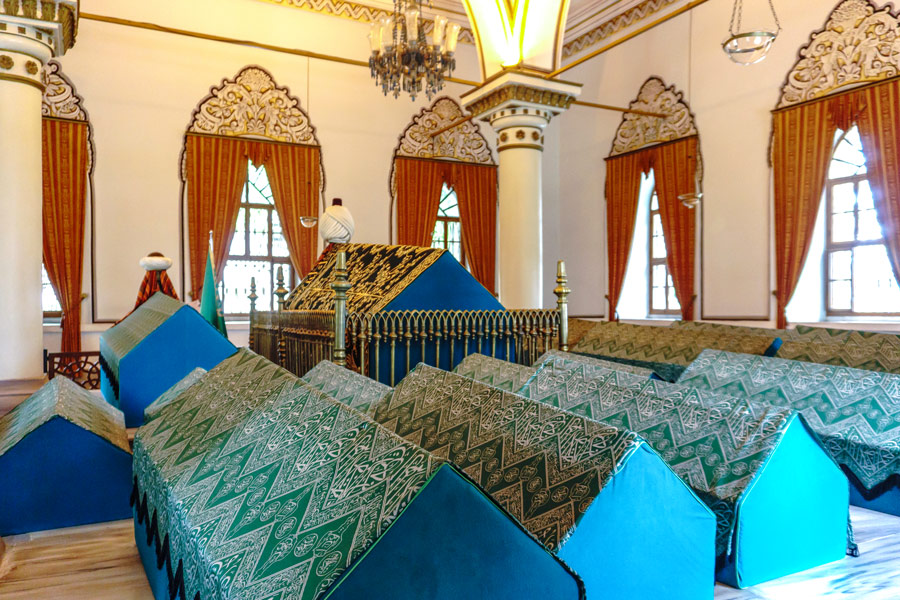
The porch rests on two slender columns and carries the tuğra of Abdülaziz, the calligraphic monogram that served the sultans as a signature. Beyond a short hall and a few steps lies an eight-sided room, slightly larger than the chapel it replaced. Arched windows alternate with pilasters that look like green marble, and a crystal chandelier hangs above the founder’s sarcophagus. It wears a velvet cover patterned with Baroque flowers and embroidered in silver thread at the head end, inside a lattice inlaid with mother-of-pearl.
Two framed pieces on the walls quote the Qur’an’s verse of conquest. One, lettered in gold on black by the calligrapher Hakkı, was presented by a society of Istanbul primary-school teachers. The other is stitched in gilt thread on red satin. Both make a curious tribute to a man who never took the city himself. Seventeen sarcophagi share the room, though only five can be named. Besides Osman himself, they are his son Alaeddin Bey, Orhan’s wife Asporça Hatun and their son Ibrahim, and Savcı Bey, the son of Murad I who rebelled against his father.
The Tomb of Orhan Gazi
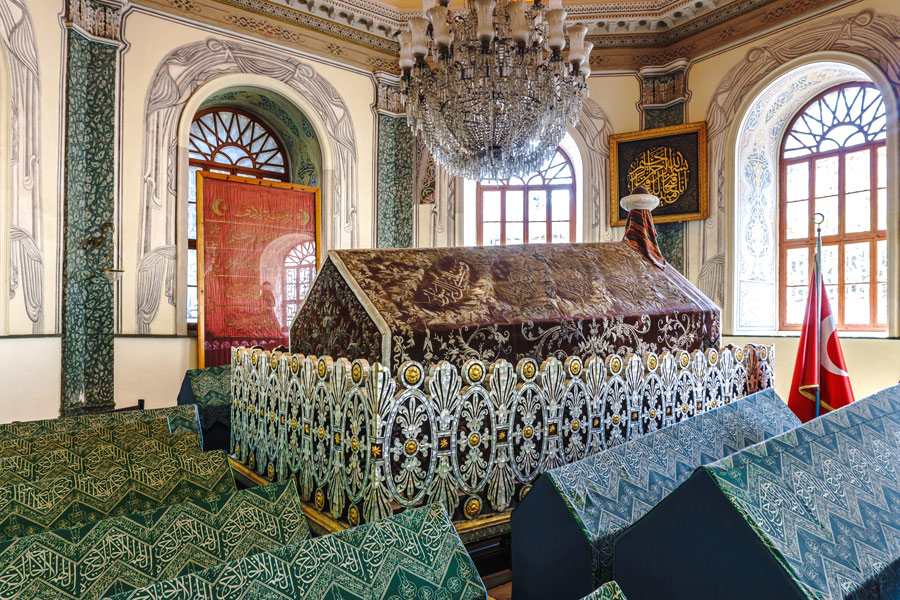
Next door, Orhan’s tomb is square and more restrained. Inside, four columns linked by arches carry a small central dome, and a vaulted walkway runs around them. Orhan lies at the centre under a green cover, inside a brass grille, with twenty other sarcophagi around him. Only a handful can be identified, among them his son, Şehzade Kasım and Fatma Sultan, the daughter of Bayezid I. The best known is Nilüfer Hatun, the mother of Murad I. Early chroniclers made her the daughter of a Byzantine lord from nearby Yarhisar, a story modern historians treat with caution. She is credited with a bridge over a stream on the Bursa plain, and the stream still carries her name.
The Byzantine Floor
Inside the two tombs, only one part of the old monastery remains in place: the floor beneath Orhan. It is laid in opus sectile, a technique in which cut pieces of coloured marble are fitted together into patterns. Bands of tiny squares in red, black and white run between plain slabs. Elsewhere, interlaced circles curl around larger discs of stone. A low rope now keeps feet off the main panels, which have suffered from weather and daily use. European travellers, who linked its round buildings with the Prophet Elijah, knew the monastery as the Church of St Elias.
The Clock Tower and the Cannons
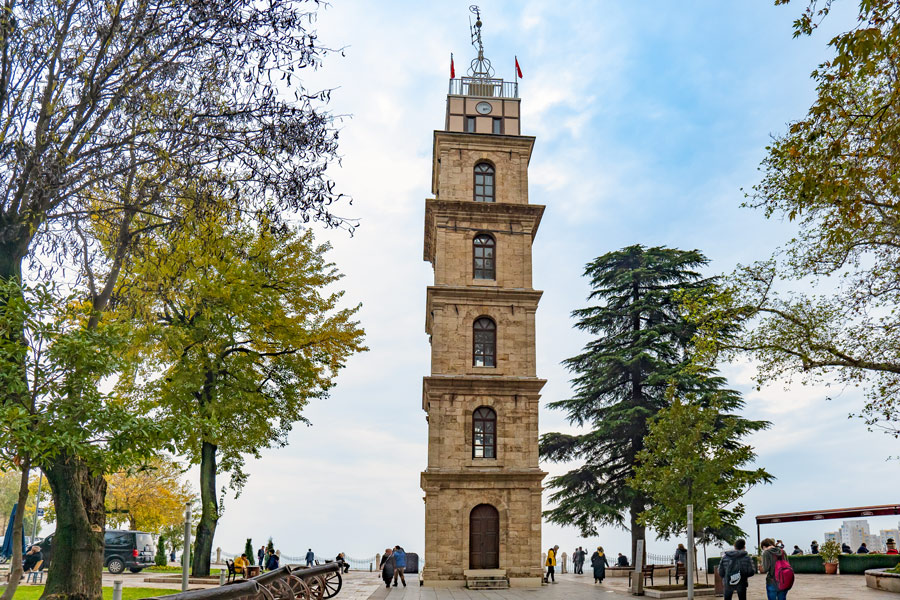
North of the tombs, the Tophane clock tower rises 33 metres, its six storeys divided by moulded cornices. It opened on 31 August 1905, the anniversary of Abdülhamid II’s accession. For decades its balcony served as a lookout for fires in the city below. Since its restoration in 2022, the original clockwork has run inside a glass case in front of the tower, and its chiming mechanism is still wound by hand every 24 hours.
Old cannons on wooden wheels line the ramparts nearby. For generations, guns fired from here to mark the pre-dawn meal and the breaking of the fast during Ramadan. Today the city’s fire brigade sets off a sound charge instead. From the railings, the view runs north over the rooftops to the plain, and the domes of the Ulu Cami are easy to pick out to the south-east.
Practical Information
Opening hours: The tombs are open daily from 08:00 to 18:00 in winter and until 20:00 in summer. The honour guard stands from 09:00 to 17:00 and changes on the hour.
Admission: There is no charge for either tomb.
Facilities: Cafés and tea gardens surround the park and its central fountain.
Parking: The nearest large car park is at Zafer Plaza, a few minutes east.
How to Get to the Osman Gazi and Orhan Gazi Tombs
Tickets for local transport: A rechargeable BursaKart covers the metro, trams and city buses. It is sold at station kiosks and at outlets displaying its logo.
By tram: The red T1 line stops at Timurtaşpaşa, below the citadel hill. From there, Osman Gazi Caddesi climbs to the park in about six minutes, most of it uphill. The heritage T3 tram runs from Çınarönü to Zafer Plaza, seven minutes’ walk away.
By metro: The nearest Bursaray station is Şehreküstü, a quarter of an hour on foot. The walk crosses Cemal Nadir Caddesi near Zafer Plaza, then rises towards the citadel.
By bus: The nearest stop, Tophane, is on Osman Gazi Caddesi beside the park. Route numbers change, so it is worth checking the Moovit app.
On foot: From the Ulu Cami, the walk takes about ten minutes. It follows Kazım Baykal Caddesi briefly, then turns uphill on Osman Gazi Caddesi.
By taxi: Metered taxis wait across the centre and can drop passengers at the park gate. From Heykel the ride takes about five minutes, longer at rush hour.
From the intercity bus terminal: Bursa Otogar sits about 10 km north of the centre. The T2 tram reaches Kent Meydanı from the terminal in about 25 minutes. From there the T1 continues round the centre to Timurtaşpaşa. A taxi takes about 30 minutes, or up to 45 in heavy traffic.
From Istanbul by ferry: Fast boats cross the Sea of Marmara to Mudanya or Güzelyalı in about 2 hours. From Güzelyalı a connecting bus runs to the Bursaray terminus at Emek, and the metro then continues to Şehreküstü. From Mudanya, bus 1/M covers the same route.
From Istanbul by road: The drive over the Osmangazi Bridge takes about 2.5 hours, and coaches to the Otogar run throughout the day.
Tips for an Optimal Visit
Recommended duration. Allow about an hour for the walls, the two tombs and the clock tower.
Best time of day. Weekday mornings are usually the calmest time on the hill.
Dress and conduct. Shoulders and knees should be covered inside the tombs, and women may wish to carry a scarf for their hair. Many people come here to pray, so voices are kept low. The guards stand to attention and should not be touched or distracted.
Photography. Photographs are generally allowed, though flash is best kept off inside. People at prayer should not be photographed close up.
Accessibility. The park is paved and largely level near the tombs. Osman’s tomb is reached up a few steps beyond the porch. The approach from the bazaar is steep, so visitors with limited mobility may prefer a taxi to the gate.
Combine with. The Ulu Cami and Koza Han lie ten minutes downhill to the south-east, and Orhan’s own mosque stands beside the Koza Han. The Muradiye Complex is about 15 minutes west on foot. The Green Mosque and Green Tomb are a short taxi ride further east.
For years Osman watched this hill from beyond the walls, waiting for its gates to open. Seven centuries later the watching runs the other way. People climb up from the city to see two men in the dress of his warriors stand guard at his door.